What is revenue attribution: A Practical Guide for Shopify Founders
Discover what is revenue attribution and how to measure marketing ROI, optimize spend, and scale your Shopify store with AI-powered insights.

You're running a growing Shopify brand, and the data is coming from everywhere. Meta Ads, Google Shopping, your Klaviyo flows—each platform is proudly reporting sales. The problem? When you check your Shopify dashboard, the numbers just don't add up. It feels like you're paying three different channels for the same conversion, leaving you to guess which marketing efforts are actually bringing in the cash.
This is the classic headache for DTC brands: fragmented data and unreliable reports. You're left wrestling with critical questions that directly impact your profitability:
- Which campaigns are truly profitable, and which are just burning cash?
- Should I pour more money into TikTok ads or double down on our email marketing?
- Is that influencer collaboration actually driving sales, or is it just generating likes?
This is where revenue attribution becomes your most powerful tool. It’s the process of connecting the dots between your marketing efforts and your sales, letting you move past guesswork and start making decisions backed by real, unified data. For Shopify brands, this isn't just a "nice-to-have"—it's the key to scaling profitably.
Why Your Shopify Sales Data Is Misleading You
If you're running a Shopify store, this probably sounds familiar. You’ve got Meta ads running, a Google Shopping feed churning out traffic, and your Klaviyo flows are working hard. Every single one of those platforms is showing you impressive numbers, each taking credit for the sales that hit your bank account.
But when you log into your Shopify dashboard, the math just doesn't add up. It feels like you’re paying three different platforms for the same conversion.
This is the classic headache for DTC brands: fragmented data. Each marketing platform lives in its own world, serving up reports that make them look good but leave you with a muddled view of your actual return on ad spend (ROAS). You're left wrestling with critical questions:
- Which campaigns are truly profitable?
- Should I pour more money into TikTok ads or double down on email marketing?
- Is that influencer collab actually driving sales, or is it just generating likes?

The Problem with Siloed Reporting
Without a single, unified view, you’re flying blind, making big budget decisions based on information that's incomplete at best and conflicting at worst. Meta might tell you an ad drove a sale, while Klaviyo insists its email flow deserves the credit, and Google Analytics reports something else entirely. This data chaos leads directly to wasted ad spend and missed opportunities for growth.
This is where revenue attribution becomes the most important tool in your arsenal. It’s not just a buzzword; it’s the solution to this mess.
Revenue attribution is simply the framework you use to give credit to the different marketing touchpoints that guided a customer toward a purchase. It’s the difference between just seeing a list of sales and truly understanding the story behind each one.
Instead of staring at each channel’s isolated report, a proper attribution model connects every single interaction—from the first ad a customer ever saw to the final email they clicked. It maps out the entire journey from awareness to purchase, showing you which touchpoints actually made an impact.
You can see the fundamental difference clearly here:
Last-Click vs Multi-Touch Attribution Quick Comparison
| Aspect | Last-Click Attribution (The Old Way) | Multi-Touch Attribution (The Smart Way) |
|---|---|---|
| Credit Given | 100% of the credit goes to the final touchpoint before conversion. | Credit is distributed across multiple touchpoints in the customer journey. |
| Visibility | You only see the end of the story, ignoring everything that came before. | You get a complete picture of how different channels work together. |
| Accuracy | Often misleading and oversimplifies complex customer behavior. | Provides a more accurate and nuanced view of marketing performance. |
| Decision-Making | Leads to undervaluing top-of-funnel channels and poor budget allocation. | Empowers smarter, data-driven decisions on where to invest your budget. |
This clarity is non-negotiable for any DTC brand looking to scale profitably. By understanding these complete journeys, you can finally build a Shopify analytics dashboard that tells you the whole story, not just the final chapter.
Next-generation, AI-powered analytics platforms are built to solve this exact problem. They automatically pull together data from all your Shopify tools, swapping out endless manual spreadsheet crunching for a clear, single source of truth. This transforms confusing, siloed reports into insights you can actually use to improve ROAS, lower CAC, and boost profitability.
Understanding Revenue Attribution in Plain English
Let’s be honest, revenue attribution sounds like something you’d need a data science degree to understand. But the core idea is actually pretty simple, especially for a Shopify founder.
Think of your marketing channels as a soccer team working together to score a goal.
A customer might first discover your brand from a Facebook ad (that’s the scout who spots the talent). A few days later, they click a Google Shopping link (the midfielder who moves the ball down the field). Finally, they buy after getting a reminder email from Klaviyo (the striker who kicks the ball into the net).
If you only give credit to the last touchpoint—a model called last-click attribution—the email gets 100% of the credit. This old-school approach totally misses the critical teamwork from Facebook and Google that set up the shot. You're left thinking email is your only star player, blind to the assists that made the sale happen.
Moving Beyond the Final Touchpoint
This is where true revenue attribution comes in. It’s like being the team’s coach, analyzing the game tape to see how every player contributed to the win. It’s the process of fairly distributing credit to every marketing touchpoint a customer interacts with on their way to making a purchase.
Instead of just staring at the final click, you get to see the entire customer journey unfold. This lets you finally answer the questions that really matter for a growing Shopify brand:
- Did that TikTok ad we ran last week actually plant the seed for this sale?
- How much did our blog content really contribute to warming up a lead before they converted?
- Are our Google Ads just breaking even, or are they consistently setting up sales that our email flows close?
Revenue attribution turns a messy, tangled web of data into a clear story. It’s the difference between guessing which channels are working and knowing with data-backed confidence where to put your next marketing dollar.
This shift from guesswork to clarity is why the marketing attribution software market is exploding. It was valued at USD 4.74 billion and is projected to climb to USD 10.10 billion by 2030 as more DTC brands move beyond simplistic models. You can see the full report on this market surge to understand how fast businesses are adapting.
This is exactly what AI-powered platforms like MetricMosaic are built to do. We automatically stitch together the data from all your channels, giving you a single, unified view of the entire customer journey. You can finally see how your marketing efforts work together to drive sales, allowing you to build a smarter, more profitable strategy on a solid foundation of first-party data. It turns all that confusion into your biggest competitive edge.
Decoding Common Revenue attribution models
So, if giving all the credit to the final click is the old way, what’s the new way? Think of the different revenue attribution models like plays in a playbook. Each one gives you a different angle on how your marketing is actually performing, and picking the right one comes down to your strategy.
Let’s walk through the most common models you’ll run into as a Shopify brand, starting with the basics and working our way up.
The Single-Touch Models (A Limited View)
These are the simplest models out there. They’re a piece of cake to understand but often paint a dangerously incomplete picture because they assign all the credit to a single touchpoint.
- Last-Click Attribution: We’ve already touched on this one. It gives 100% of the credit to the final interaction right before a sale. For a Shopify store, that might be a customer clicking a "10% off" email link just before they check out. It's clean, but it totally ignores all the brand-building you did beforehand—like the Meta ads or influencer posts that got them interested in the first place.
- First-Click Attribution: This model is the exact opposite. It gives 100% of the credit to the very first time a customer interacted with your brand. Say a customer first found you through a blog post on Google, then bought something two weeks later. That blog post gets all the glory. This model is pretty useful for figuring out which channels are driving initial awareness.
While they’re easy to set up, relying only on these models is like trying to understand a movie by watching just the first or last scene. You’re missing the entire plot.
The Multi-Touch Models (A Much Clearer Picture)
This is where things get really interesting for DTC brands. Multi-touch models accept that the customer journey is rarely a straight line and instead distribute credit across multiple touchpoints.
The visual below really drives home this fundamental shift in thinking, from a single action to the full journey.
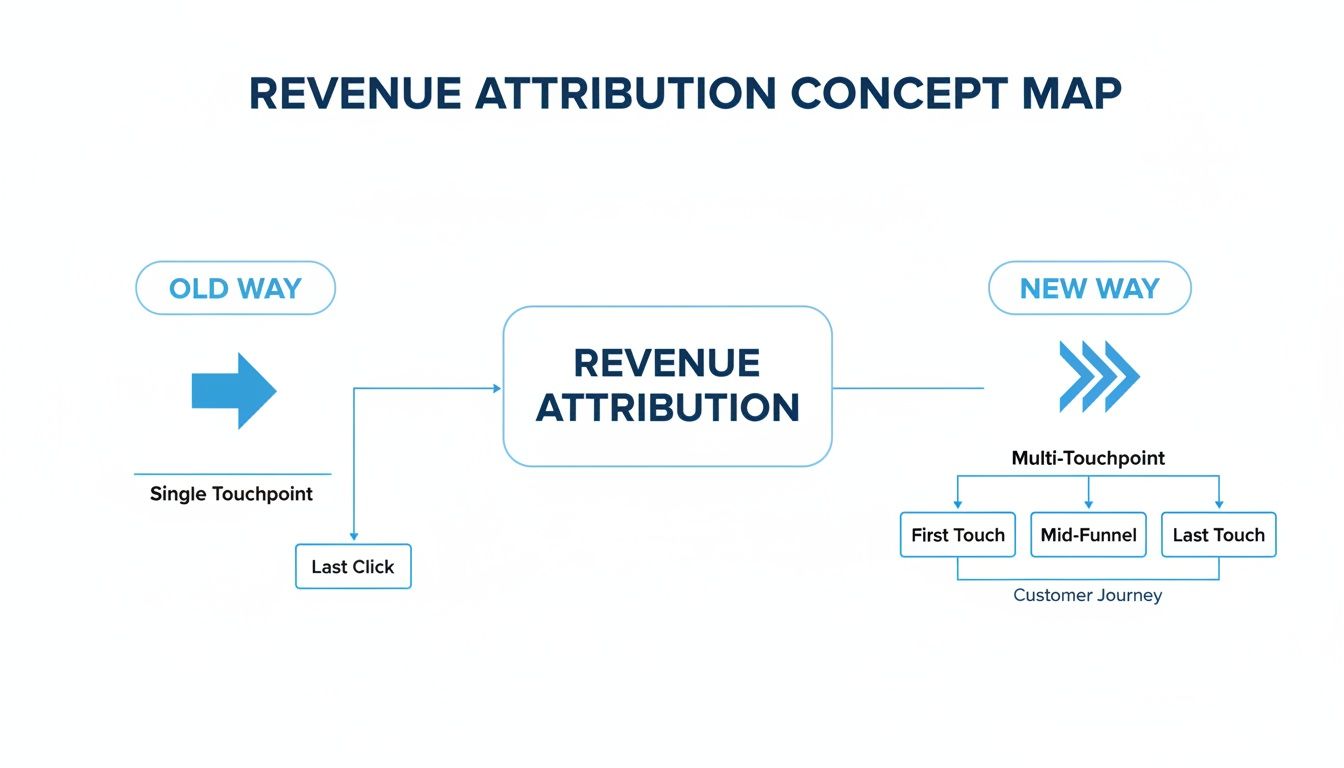
It’s clear that while the old way fixates on one final click, the new way gives you a complete, holistic view of how a customer actually became a customer.
Here are the most common multi-touch approaches:
- Linear Attribution: This model is the ultimate diplomat—it splits credit evenly across every single touchpoint. If a customer saw a TikTok ad, clicked a Google ad, and then converted from an email, each channel gets 33.3% of the credit. It’s fair, but it also assumes every interaction is equally important, which is almost never the case.
- Time-Decay Attribution: This model gives more weight to the touchpoints that happened closer to the sale. The thinking here is that the final interactions were the most persuasive. In our example, the email click would get the most credit, the Google ad would get less, and that initial TikTok ad would get the least.
- Position-Based (U-Shaped) Attribution: This model champions the beginning and the end of the journey. It typically gives 40% of the credit to the first touchpoint and 40% to the last one, then divides the remaining 20% among all the interactions in the middle. It’s a great way to value both the channel that introduced the customer and the one that sealed the deal.
These models give you a far more nuanced read on your marketing mix. To track all these moving parts, especially for performance marketing like affiliates or influencers, having solid Affiliate Tracking Software is non-negotiable for getting the data right.
The Gold Standard: Algorithmic Attribution
So, which one of these models is perfect? Trick question—none of them are. Rules-based models like Linear or U-Shaped still lean on assumptions. That’s where the most advanced approach, algorithmic attribution (also called data-driven attribution), comes in.
Algorithmic attribution doesn't follow a fixed rule. Instead, it uses machine learning to analyze every single customer path—both the ones that convert and the ones that don't—to figure out the actual impact of each touchpoint. It assigns credit dynamically based on what the data proves is most effective.
This AI-powered approach is the future for DTC growth. In fact, the adoption of multi-touch revenue attribution is accelerating, with algorithmic models growing at a 14.05% CAGR. This boom is fueled by AI's ability to weigh touchpoints dynamically, uncovering why a retention email might contribute 40% more to LTV than a paid search ad. While single-touch models once ruled, the shift is clear, with multi-source models now dominating at a 58.2% share.
For a busy Shopify founder, this means you can stop debating whether linear or time-decay is "right." An AI-powered analytics platform like MetricMosaic does the heavy lifting for you. It automatically analyzes your data from Shopify, Meta, and Klaviyo to build the most accurate model for your specific business.
It turns a complicated analytical headache into a clear, actionable insight, telling you exactly where your next marketing dollar will make the biggest splash. Our guide on multi-touch attribution modeling dives even deeper into these strategies.
How AI Transforms Attribution for Shopify Stores
Understanding the different attribution models is a huge step forward. But let's be real—as a Shopify founder, you don’t have time to become a full-time data scientist.
The old way was a nightmare. You'd manually export reports from Shopify, GA4, Meta Ads, and Klaviyo, then spend hours trying to jam it all together in a spreadsheet. It was slow, frustrating, and incredibly easy to mess up.
This is where the game completely changes. Modern analytics isn't about giving you yet another dashboard to stare at; it's about giving you an AI co-pilot that does the heavy lifting for you.

Imagine a system that automatically pulls all your data into one reliable source of truth. That’s the real power of AI in revenue attribution. It kills the manual data crunching and siloed reports, giving you a clear, unified view of your entire business.
From Manual Spreadsheets to Automated Insights
The biggest leap forward AI delivers is the shift from reactive analysis to proactive intelligence. Instead of you hunting for insights, the insights come to you. A few next-gen features are driving this change, turning complex data into a simple, actionable advantage.
AI-powered platforms can analyze thousands of customer journeys in real-time, catching patterns a human could never spot. This automated process means your attribution model is always learning and adapting to how your customers actually behave, giving you the most accurate picture of what’s driving revenue.
The goal of AI in analytics is not to replace you, but to empower you. It handles the complex data work so you can focus on what you do best—making smart, strategic decisions to grow your Shopify brand.
This new approach brings a level of clarity and speed that used to be out of reach for most DTC brands. It’s like having an entire data team working for you, 24/7.
Conversational Analytics: Your Data Co-Pilot
One of the most powerful advancements is conversational analytics. Forget wrestling with clunky report builders or trying to remember specific metric names. With a tool like MetricMosaic's MosaicLive, you can just ask your data questions in plain English, like you would with a colleague.
For example, you could ask:
- "Which channels drove the most sales for our new product last month?"
- "What's the ROAS for our latest TikTok campaign compared to Meta?"
- "Show me the customer journey for our top 10% of customers."
Your AI co-pilot instantly translates your question, analyzes the unified data, and gives you a clear answer in seconds. This makes deep analysis accessible to everyone on your team, not just the data experts. You can see how this philosophy helps build a more intuitive and useful eCommerce analytics dashboard that supports this kind of quick-fire analysis.
Proactive Stories: Uncovering Hidden Opportunities
While asking questions is powerful, the next level is an analytics platform that tells you things you didn't even know to ask. This is where proactive insights, or "Stories," come into play.
An AI engine constantly monitors your data, looking for significant trends, anomalies, and opportunities. When it finds something important, it automatically generates a short, easy-to-understand insight.
You might get a Story that says:
- "Heads Up: Your new TikTok campaign is outperforming Meta for top-of-funnel engagement, driving 30% more first-touch interactions this week."
- "Opportunity: Customers who buy Product A are 4x more likely to purchase Product B within 30 days. Consider creating a post-purchase email flow to boost AOV."
- "Warning: The conversion rate from your Google Ads has dropped by 15% in the last 48 hours. You should check your landing page."
These AI-generated Stories cut through the noise, flagging what actually matters and suggesting a clear course of action. They turn your data from a passive resource into an active growth partner, constantly working to make your business more profitable. This is what AI-driven revenue attribution is all about: turning complexity into a clear, actionable competitive advantage, fast.
Putting Attribution into Action to Boost Profit
Knowing the theory behind attribution models is one thing. Seeing how AI can untangle the data is another. But the real magic happens when you start turning those insights into decisions that actually grow your Shopify store’s bottom line.
Think of accurate revenue attribution as less of a reporting tool and more of a strategic lever for driving real, tangible profit.
For too long, DTC brands have been forced to make high-stakes budget decisions using platform-reported metrics that are, let's be honest, often inflated and unreliable. When you finally get a clear, unified view of what's actually working, you can stop guessing and start knowing. You can turn data into dollars.

This shift is why the global marketing attribution software market, currently valued at USD 4.06 billion, is expected to explode to USD 12.38 billion by 2032. It’s not just hype. Brands that nail multi-touch attribution often see a 15-20% boost in budget efficiency, finally giving credit where it's due—like to all that under-the-radar organic traffic. It's quickly becoming non-negotiable for any serious performance marketer.
Optimize Ad Spend and Supercharge ROAS
The quickest win you’ll get from accurate attribution is smarter ad spend. Full stop. Instead of blindly trusting the numbers Meta or Google feeds you, you can see which campaigns and channels are genuinely driving profitable sales.
Imagine this scenario: your data shows a Google Ads campaign crushing it with last-click conversions. At the same time, your TikTok ads seem... okay. But an AI-driven model reveals that those TikTok ads are consistently introducing high-value customers who buy weeks later.
A last-click model would tell you to slash the TikTok budget. A smarter model shows you it's your most powerful top-of-funnel engine.
Armed with that kind of insight, you can:
- Reallocate Budget Confidently: Move money from campaigns that just look good on paper to the ones proven to deliver the highest return on ad spend (ROAS).
- Refine Your Ad Creative: Double down on the messaging and visuals that resonate in your true high-performing channels.
- Stop Wasting Money: Cut the campaigns that are only generating vanity metrics—clicks and likes—without contributing to actual revenue.
Lower Your Customer Acquisition Cost (CAC)
When you can see the entire customer journey, you can spot your most efficient acquisition paths. You might discover that customers who come from an influencer collaboration cost 30% less to acquire than those from paid search, even if their path to purchase is a bit longer.
This kind of knowledge is a game-changer. It empowers you to focus your resources on the channels that bring in profitable customers for less. As you put attribution to work, a key metric for judging your overall marketing health is the Marketing Efficiency Ratio (MER). A lower CAC directly pumps up your MER and, in turn, your profitability.
Increase Customer Lifetime Value (LTV) and Average Order Value (AOV)
Not all customers are created equal, and not all channels attract the same kind of buyer. Revenue attribution is how you finally connect specific marketing activities to long-term customer value.
By analyzing the journeys of your most valuable customer cohorts, you can reverse-engineer their path to purchase. This reveals which channels and campaigns attract high-LTV customers, not just one-time buyers.
For instance, you might find that customers who first read your blog and then convert through a Klaviyo email campaign have a 25% higher LTV than customers acquired straight from a paid social ad. That insight is pure gold.
You can also use attribution to pump up your Average Order Value (AOV). By spotting which touchpoints bring in customers who consistently spend more, you can optimize those channels to attract more of them. Maybe your YouTube tutorials are leading customers to buy product bundles, driving up their initial cart size.
This level of granular insight is what separates the DTC brands that are scaling fast from everyone else. With an AI-powered platform like MetricMosaic, these actionable takeaways are surfaced for you automatically as "Stories," so you don't have to spend hours hunting for them. It transforms your data into a clear, strategic roadmap for profitable growth, showing you exactly what to do next to improve every core metric that matters to your Shopify brand.
Ready to Go from Data Chaos to Actionable Clarity?
We've spent this guide pulling back the curtain on revenue attribution. It’s not some complex, unattainable luxury reserved for Fortune 500s anymore. For any ambitious Shopify brand serious about scaling, it's now a fundamental part of the playbook.
The journey for a modern DTC brand is about making a shift—from reacting to last month's numbers to proactively shaping next month's growth. It’s time to stop squinting at conflicting reports from Meta and Google and start using sharp, AI-driven insights to make confident bets on your future.
The good news? You don't need a data science degree or a team of analysts to pull this off. The goal is to find a smart tool that does the heavy lifting, translating the tangled mess of your marketing data into simple, actionable clarity. That's what lets you make faster, more profitable decisions that show up on the bottom line.
Your Next Step: From Awareness to Confident Action
Understanding what revenue attribution is? That's step one. The real magic happens when you put that knowledge into practice. It’s about taking command of your data and turning it into your most powerful competitive edge.
This means committing to a single source of truth that pulls everything together—your Shopify store, ad platforms, and email marketing tools. With that foundation in place, you can finally trust the numbers you're seeing and make strategic moves based on the whole picture, not just a sliver of it.
The big takeaway is simple: Accurate, AI-powered attribution lets you spend smarter, not just more. It’s the key to unlocking sustainable growth, making sure every marketing dollar you invest is working as hard as it possibly can.
Instead of drowning in spreadsheets, you can get back to focusing on strategy. You can use real insights to sharpen your ad creative, smooth out your customer journeys, and build a marketing engine that just works. The path forward is clear: move beyond the fuzzy picture of last-click attribution and the chaos of fragmented reporting. By bringing an AI-powered analytics platform into your stack, you can automate the soul-crushing work of data collection and analysis, freeing you up to focus on what actually moves the needle.
A Few Common Questions About Revenue Attribution
We've covered a ton of ground, but a few questions always seem to pop up when Shopify founders start digging into attribution. Let's tackle them head-on.
What’s the Best Attribution Model for a New Shopify Store?
When you’re just starting out, the Position-Based (or U-Shaped) model is usually the smartest place to begin. It gives you a balanced view by crediting two of the most important moments: how a customer first found you (the first touch) and what finally sealed the deal (the last touch).
This approach is great because it stops you from ignoring those crucial top-of-funnel efforts that build your brand, while still giving proper credit to the channels that push customers over the finish line. It offers a much more complete picture than simple first or last-click models, giving you a solid foundation before you have enough data to power a more advanced AI model.
How Do You Handle Offline or Hard-to-Track Marketing?
This is a classic problem. Tracking a podcast ad or a word-of-mouth referral isn't as straightforward as tracking a click, but you can absolutely connect the dots. Modern analytics platforms are built to pull in data from all over the place.
For instance, you can use:
- Discount Codes: Create unique codes for specific channels (like "PODCAST15").
- Surveys: Add a simple "How did you hear about us?" question to your post-purchase flow.
- Manual Uploads: Bring in data from offline events or sales calls.
An AI-powered tool can then weave this information into its model, giving you a much fuller, more honest picture of what’s truly driving sales, both online and off.
Why Don't My Ad Platform Sales Match My Attribution Sales?
Seeing different sales numbers in Meta Ads or Google Analytics versus your attribution platform is actually a good sign. It’s totally normal, and it means your attribution tool is doing its job. Ad platforms often take credit for the same sale using a simple last-click model, which leads to inflated, overlapping numbers.
A dedicated attribution tool acts as your single source of truth. It de-duplicates every conversion, making sure each sale is only counted once and credit is assigned based on the model you choose. This is exactly why brands rely on platforms like MetricMosaic—to get an accurate read on their true ROAS and make budget decisions that actually drive growth.
Ready to swap confusing spreadsheets for clear, actionable insights? MetricMosaic brings all your Shopify data together and uses AI to surface the story behind the numbers, so you can grow faster. Start your free trial today and turn your data into your biggest competitive advantage.