What Is First Party Data and How Can Shopify Brands Use It?
Learn what is first party data and discover how Shopify brands are using it to build powerful, personalized marketing campaigns that boost LTV and ROAS.
If you're running a Shopify brand, you know the daily scramble. You’re hopping between Shopify analytics for sales, Meta Ads Manager for ROAS, Google Analytics 4 for traffic, and Klaviyo for email opens. Each platform gives you a single, isolated piece of the puzzle, but never the full picture.
This constant tab-switching creates a fog of uncertainty. Is that ad campaign really profitable, or just driving clicks? Which channels are actually bringing in your best, highest-LTV customers? Why did AOV tank last month? Too often, the answers come from messy spreadsheets and gut feelings—hardly a strategy for sustainable growth.
The solution isn't yet another dashboard. The key to unlocking real clarity and scaling your brand profitably is already inside your business. It's your first-party data.
The Growth Data Hiding in Your Shopify Store
Let’s get straight to it: first-party data is the information you collect directly from your audience. It's every digital handshake, every conversation your brand has with a real person—all gathered straight from your own turf, like your Shopify store, your website, and your email list.
Think of it as the most honest, reliable data you'll ever get your hands on. Why? Because it comes with consent, straight from the source.
Uncovering Your Data Goldmine
Every time a customer visits your site, buys a product, signs up for your newsletter, or leaves an abandoned cart, they’re handing you invaluable insights. These aren't just random data points; they're breadcrumbs that map out the entire customer journey.
This is your brand’s goldmine. It’s a direct line to understanding:
- Customer Behavior: What products are they looking at? How often do they come back? What finally convinces them to hit "buy"?
- Marketing Attribution: Which campaigns and channels are actually driving sales, not just vanity metrics.
- Personalization Opportunities: What specific offers or messages will click with different customer segments.
The whole marketing world is shifting in this direction. A recent Salesforce report found that a massive 84% of marketers now see first-party and transactional data as their top sources. Meanwhile, only about 20% still lean on third-party data for customer experience. The writing is on the wall: owned data is the future. Explore more statistics on first-party data adoption.
The real challenge isn't just collecting this data—it’s about pulling it all together and making sense of it. That’s where an AI-powered analytics co-pilot like MetricMosaic comes in. By automatically connecting those scattered sources, it stitches together your metrics into a clear, actionable roadmap, replacing hours of manual data crunching.
Suddenly, that hidden data isn't so hidden anymore. It becomes your greatest competitive advantage.
What Is First-Party Data, Really?
Let’s cut through the jargon. Think of first-party data as the digital equivalent of getting to know your customers in a brick-and-mortar shop. It's every piece of information they willingly share with you—their email for a discount, the products they browse, what they add to their cart, and their final purchase.
More formally, first-party data is all the information your Shopify brand collects directly from your audience. This happens across every touchpoint you own: your website, your email and SMS lists (Klaviyo, Attentive, etc.), your social media profiles, and even your customer service chats.
It's your data. You own it, you control it, and it comes straight from the source. This direct connection is what makes it so incredibly valuable. You’re not buying a list or guessing what people want; you're listening to what they actually do and say.
How It Stacks Up Against Other Data Types
To really get why this matters, you need to see how first-party data compares to its less-reliable cousins: second and third-party data. Understanding the difference is mission-critical for building a marketing strategy that actually works in 2024 and beyond.
Second-Party Data: This is just someone else's first-party data. Imagine partnering with a complementary brand to share audience insights. It can be useful and fairly reliable, but it’s hard to come by and you’ll never have the full picture.
Third-Party Data: This is the sketchy stuff. It's data bought from massive aggregators who scrape information from thousands of websites to build generic user profiles. For years, brands bought this data to target ads, but its days are numbered.
Why? The whole ecosystem is falling apart. With browsers like Chrome phasing out third-party cookies and privacy laws like GDPR getting stricter, third-party data is becoming a wildly inaccurate and risky bet.
For a long time, marketers had to rely on third-party data to guess what shoppers wanted. As a DTC brand, you have a massive advantage: first-party data lets you know what they want based on their real actions in your store.
First-Party vs. Third-Party Data At a Glance
The move away from third-party data isn't just a passing trend—it's a fundamental reset for how modern eCommerce brands have to operate. The future belongs to those who own their customer relationships.
For a Shopify founder, this is everything. Third-party data might offer a bit of scale, but it’s a house of cards built on shaky accuracy and eroding customer trust. First-party data is the bedrock. It’s the direct, consent-based insight you need to actually improve ROAS, boost LTV, and earn repeat customers.
Here's a quick breakdown to make the difference crystal clear.
| Attribute | First-Party Data | Third-Party Data |
|---|---|---|
| Source | Collected directly from your audience (your Shopify site, email list, etc.) | Purchased from data aggregators with no direct user relationship |
| Accuracy | High. It reflects actual, direct interactions with your brand. | Variable to low. Often outdated, inaccurate, or based on assumptions. |
| Cost | Free to collect, but requires investment in tools and strategy. | Must be purchased, with costs that can scale significantly. |
| Privacy | High. Collected with user consent, making it compliant with regulations. | Low. Faces major challenges with privacy laws and browser restrictions. |
| Competitive Edge | Unique to your business, providing a distinct advantage. | Available to anyone who buys it, including your competitors. |
When you look at it this way, the choice is obvious. Building a robust first-party data strategy isn't just a "nice to have" anymore; it's the only sustainable way to grow an online brand.
How First-Party Data Drives Key Growth Metrics

Knowing what first-party data is is one thing. Actually using it to grow your Shopify store is where the real magic happens.
This isn’t just about collecting information. It’s about turning those direct customer signals into real movement on the metrics that matter: Return on Ad Spend (ROAS), Customer Acquisition Cost (CAC), Average Order Value (AOV), and Lifetime Value (LTV).
When you master your own data, you stop guessing and start engineering profitable growth. You can finally shift from spending money to acquire any customer to investing in the right ones—the people who buy more, stay longer, and become your biggest fans.
The financial upside is huge. DTC brands building their strategy around first-party data are seeing incredible results, like an 8x return on investment, over 25% lower acquisition costs, and revenue growth up to 2.9x higher than their peers. Just look at Pandora—they used sales data to boost offline revenue by 220%. Or Interflora, which grew revenue by 30% while slashing CAC by 32%. To see more on these benchmarks, you can explore the findings on first-party data ROI.
And this isn't just for enterprise giants. As a Shopify founder, these are the kinds of results you can get by putting the data you already own to work.
Slash Your Customer Acquisition Cost (CAC)
High CAC can absolutely cripple an otherwise healthy DTC brand. Spraying your ad budget across broad, generic audiences is like casting a massive net hoping to catch a few specific fish—it's inefficient and expensive.
First-party data lets you trade that net for a spear.
By analyzing what people do on your site, you can create hyper-specific audiences for your ad campaigns on platforms like Meta.
Here’s a practical takeaway:
- The Data: A visitor hits your Shopify store and views the "Men's Performance Hoodies" collection three separate times but never buys.
- The Action: Instead of just another generic brand ad, you serve them a dynamic ad showcasing the exact hoodies they were looking at, maybe with a small nudge like free shipping.
- The Result: Your ad is instantly more relevant. The click-through rate climbs, the conversion rate improves, and your CAC for that customer plummets because you didn't waste a single impression on someone who wasn't interested.
This kind of targeted approach means every ad dollar works harder, directly lowering what it costs to bring in each new customer.
Supercharge Your Return on Ad Spend (ROAS)
Improving ROAS isn’t just about cutting costs; it’s about squeezing more revenue out of every dollar you spend. And first-party data is your best tool for finding the people who are most likely to buy from you.
Let's look at how you can combine data from your Shopify and Klaviyo accounts to build unstoppable lookalike audiences on Meta.
Instead of asking Meta to find people who look like everyone who has ever visited your site, you can ask it to find people who look like your absolute best customers—those who have purchased multiple times and have a high AOV.
This is a complete game-changer. By feeding Meta a highly curated list of your VIP customers (identified through their Shopify purchase history and Klaviyo engagement), you give its algorithm a much clearer, higher-quality signal.
The resulting lookalike audience is packed with potential buyers who share the traits of your most profitable customers. This leads to way higher conversion rates and a ROAS that blows broad targeting out of the water.
Maximize Customer Lifetime Value (LTV)
Getting a customer is just the start. The most profitable Shopify brands are masters of retention, turning one-time buyers into loyal, repeat purchasers. First-party data is the engine that powers a world-class retention strategy.
By tracking purchase history, frequency, and product preferences in your Shopify data, you can create deeply personal post-purchase experiences.
Think about these actionable scenarios:
- Personalized Cross-sells: A customer just bought a specific type of coffee bean. Your data shows that people who buy that bean often come back for a particular coffee grinder. You can trigger an automated email flow through Klaviyo offering a 15% discount on that exact grinder.
- Replenishment Reminders: You sell skincare products with a 60-day lifecycle. Based on their purchase date, you can send an automated SMS reminder a week before they're due to run out, making it effortless to reorder.
These personalized touchpoints make customers feel seen and understood, which drastically increases the odds of a second, third, and fourth purchase. That directly boosts your LTV. You can go deeper on this by exploring these essential user retention metrics every Shopify brand should track.
Platforms like MetricMosaic use AI to automate this entire process. It can instantly analyze your unified data and surface your highest-LTV customer segments, telling you exactly where to focus your marketing budget for maximum long-term profit.
Building Your First Party Data Collection Strategy
Knowing what first-party data is and actually collecting it are two different things. For Shopify brands, the trick is to build a smart, practical playbook that creates opportunities for customers to share their information willingly across your entire ecosystem.
The core principle here is simple: value exchange. You can't just ask for data; you have to offer something real in return. When a customer feels like they’re getting a genuine benefit—a discount, personalized advice, exclusive access—they’re much more likely to share their details. This builds trust from the very first click.
This transparent approach isn't just good ethics; it's great business. It turns a simple transaction into a moment that builds a real relationship.
Key Collection Points for Your Shopify Store
A solid strategy uses multiple touchpoints to gather different kinds of valuable data. Each method serves its own purpose, from grabbing a quick email to understanding a customer's deepest buying motivations.
Here are some of the most effective tactics we see DTC brands using right now:
- Website Pop-ups: These are your front-line soldiers for list growth. Using a tool like Klaviyo, you can set up an exit-intent pop-up offering a 10% discount for an email or phone number. It's a classic for a reason—it works, capturing those top-of-funnel leads before they bounce.
- Interactive Quizzes: Go deeper than just a sign-up. A tool like Octane AI lets you create engaging quizzes. Imagine a skincare brand with a "Find Your Perfect Skincare Routine" quiz. The customer gets a personalized recommendation, and you get powerful data on their needs to fuel your marketing.
- Post-Purchase Surveys: The moment after a customer buys is a golden opportunity. You can embed a simple, one-question survey right on the Shopify thank-you page asking, "What was the main reason you purchased today?" This kind of qualitative data is priceless for understanding what really makes your customers tick.
- Loyalty Programs: Rewarding your best customers is a fantastic way to collect data on your most valuable audience. A loyalty program lets you track purchase frequency, product preferences, and engagement over time, giving you a crystal-clear picture of what drives high LTV.
The Power of a Multi-Channel Approach
Relying on just one collection method gives you a blurry, incomplete picture. The real magic happens when you combine data from all your channels—your Shopify store, website analytics, your CRM, and customer surveys. Smart businesses collect data from their website, e-commerce shop, and mobile apps to capture a whole range of behavioral signals, not just demographics. We're talking order history, subscription data, and loyalty activity.
This is a big deal. In fact, 91% of top marketers believe using this kind of data to constantly understand customer preferences is a key driver for growth.
The goal isn't just to collect more data, but to collect the right data that tells a story about your customer. Each touchpoint adds another chapter to that story, helping you understand their journey from discovery to loyalty.
Of course, trying to stitch together data from Shopify, Klaviyo, and Meta by hand can get overwhelming fast. That’s why having a system to automatically unify this information is so critical. You can explore a variety of data connectors for Shopify brands that help centralize everything without the manual headache.
A crucial part of this process is learning how to improve data quality from the get-go, so your insights are actually reliable. By connecting your tools, you create a single source of truth that powers smarter, more profitable decisions across your entire business.
Activating Your Data with AI-Powered Analytics
Collecting data is only half the battle. If you're a Shopify founder, you know the real challenge isn't getting information—it's turning that mountain of data into clear, profitable actions. This is where growth often stalls, stuck in a maze of messy spreadsheets, conflicting reports, and decisions made on gut feel.
This is precisely the problem AI-powered analytics was built to solve. Modern platforms like MetricMosaic act as a growth co-pilot for your brand. They automatically pull together your first-party data from Shopify, GA4, Klaviyo, and Meta into a single, reliable source of truth. No more manual data crunching. No more conflicting numbers.
Suddenly, all that time you spent wrestling with reports is freed up for what you do best: building your brand. To get the most out of these tools, a solid foundation in understanding website analytics is a great starting point, as it frames how to interpret customer behavior.
Making Sense of Your Data Instantly
The biggest shift with AI analytics is how accessible it makes everything. Deep data analysis is no longer reserved for data scientists. These next-gen tools translate complex concepts into something any founder can use to get answers, not just more data points.
Let's break down what this actually looks like for your DTC brand:
Conversational Analytics: Imagine asking your data questions in plain English, just like you'd ask a team member. Instead of building clunky reports, you can just ask, "What's the 90-day LTV of customers from our latest TikTok campaign?" and get an instant, clear answer. This makes deep analysis fast, intuitive, and available to anyone on your team.
Predictive Insights: Your analytics platform becomes proactive. It doesn’t just report on what happened last month; it flags what's likely to happen next. AI can spot which customer segments are showing signs of churn or predict which products are about to trend, giving you a chance to get ahead of the curve.
Story-Driven Data: Raw numbers are hard to make sense of. AI excels at turning them into clear, actionable narratives. MetricMosaic’s "Stories" feature, for example, transforms complex data into simple, powerful insights like: "This Meta campaign is acquiring high-LTV customers, but they aren't making a second purchase. Target them with a personalized win-back offer to boost retention."
This flow chart shows a few of the simple but effective ways you can gather the initial data that fuels these AI insights.
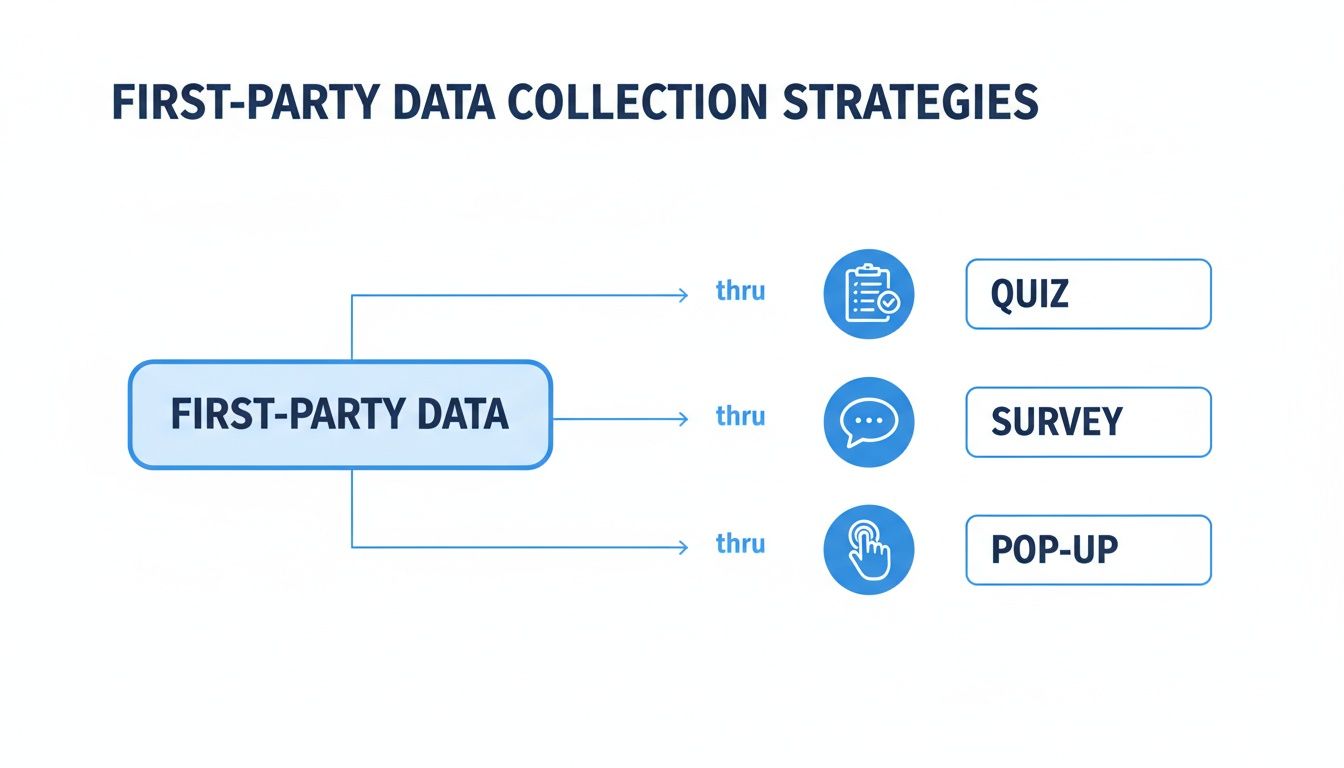
Each of these collection points—quizzes, surveys, and pop-ups—feeds your analytics engine with the raw material it needs to generate these powerful, story-driven recommendations.
From Insights to Actionable Growth Levers
Putting your first-party data to work with AI isn't about getting fancy reports; it's about making smarter decisions that directly grow your bottom line. An AI co-pilot connects the dots between different data sources to reveal growth opportunities you might have otherwise missed.
The real power of AI analytics is its ability to move you from awareness to action. It doesn't just show you a problem; it suggests the solution. This transforms your data from a passive resource into an active strategic asset.
For instance, by unifying your Shopify sales data with your Klaviyo engagement data, an AI platform can automatically segment your customers. It can instantly identify your "brand loyalists," "at-risk customers," and "one-time buyers."
From there, it can recommend specific actions for each group:
- For Brand Loyalists: "Create a VIP segment in Klaviyo for these high-LTV customers and give them early access to your next product drop."
- For At-Risk Customers: "Launch a re-engagement campaign offering a special discount to customers who haven't purchased in 90 days."
- For One-Time Buyers: "Serve targeted Meta ads showcasing complementary products to encourage a second purchase and increase AOV."
This level of automated analysis turns your first-party data into a true competitive advantage. Instead of being overwhelmed by information, you're empowered by it. If you're looking to build out your command center, our guide on creating a powerful ecommerce analytics dashboard provides a practical roadmap for visualizing these key insights.
Ultimately, AI makes sophisticated, data-driven growth accessible to every Shopify brand, no matter your size or technical expertise.
Your Action Plan for Data-Driven Growth
Everything we’ve covered so far boils down to one simple, powerful truth: your first-party data is the single greatest asset you have for unlocking profitable, sustainable growth. It's your ticket to moving beyond shaky ad performance and building a resilient brand that actually knows its customers.
The era of renting audiences with third-party data is closing fast. The future belongs to brands that own their customer relationships, and that ownership is built on a foundation of trust and a direct exchange of data. It's time to stop wrestling with fragmented reports and start treating your data like the strategic asset it is.
Your Four-Step Roadmap to Get Started
You don't need a data science degree to make this happen. With the right focus and a smart AI co-pilot, you can start turning the data you already have into a growth engine this quarter.
Here’s a simple, actionable checklist to get you moving:
- Audit Your Collection Points: Start by mapping out every single place you currently ask for or receive customer information. Think Shopify checkout, website pop-ups, Klaviyo sign-up forms, quizzes, and even customer support chats. Get a crystal-clear picture of what you're working with right now.
- Implement One New Method: Don't try to boil the ocean. Just pick one high-impact collection method to add this quarter. A post-purchase survey on your Shopify thank-you page is a fantastic, low-effort starting point for gathering priceless qualitative insights.
- Centralize Your Data: Your goal is a unified customer view. Connect your core platforms—Shopify, GA4, Meta, and Klaviyo—to a central analytics hub. This move alone crushes data silos and creates the single source of truth you need for clear, reliable analysis.
- Activate with an AI Co-Pilot: This is the fun part. Use an AI-powered tool like MetricMosaic to translate your newly unified data into clear, actionable growth strategies. Let the platform do the heavy lifting of surfacing insights, identifying your high-LTV segments, and recommending specific actions to improve ROAS and retention.
Your next big growth breakthrough isn't hiding in some new marketing hack. It's already sitting in your Shopify and Klaviyo accounts, just waiting to be unlocked. The real challenge isn't collecting more data—it's activating the data you already have with clarity and confidence.
Following this plan flips the switch from being reactive to proactive. You’re no longer just looking at what happened; you’re building a system to shape what happens next.
If you're ready to go deeper, our guide to effective ecommerce growth strategies offers even more tactical advice.
MetricMosaic was built to be your partner on this journey, turning complexity into clarity and making data-driven growth a reality for every Shopify brand.
Got Questions? We've Got Answers.
Even with the best strategy, hitting the ground running with first-party data brings up some practical questions. We hear these a lot from Shopify founders, so let's clear them up.
Is GA4 Data Actually First-Party Data?
Yep, most of it is. The data you get from Google Analytics 4 about what people do on your Shopify store—page views, clicks, how long they stick around—is 100% your first-party data. You own the site, you're the one collecting it directly from your visitors.
It gets a little fuzzy if you turn on features like Google Signals, which pulls in aggregated data from people logged into their Google accounts across different sites. But the core, foundational behavior data from your domain? That's yours, and it's gold.
How Can I Collect Data Without Annoying My Customers?
This is all about the value exchange. Don't interrupt, enhance. When a customer feels like they're getting something good in return, sharing their data feels less like an intrusion and more like a smart move.
Think of it this way:
- Instead of a pop-up the second they land, try an exit-intent pop-up offering 10% off if they share their email. You're not blocking their shopping, you're catching them on the way out with a deal.
- Run an interactive quiz. Help them find their perfect skincare routine or the right coffee blend. They get a personalized recommendation, and you get valuable preference data. It's a win-win.
- Create a sense of community. Offer early access to new drops or exclusive content to your loyalty members or SMS subscribers. Exclusivity is a powerful motivator.
Do I Really Need a Data Scientist for This?
Absolutely not. That’s probably the biggest change in eCommerce over the last couple of years. Not long ago, you might have needed someone technical to make sense of all the spreadsheets and build complicated models. Those days are over.
Modern AI analytics platforms like MetricMosaic were built specifically for founders and marketers. They do the heavy lifting for you, automatically pulling together your data from Shopify, Klaviyo, Meta, and GA4. Even better, the AI tells you what it all means in plain English, pointing out which campaigns are actually making you money and where your next big opportunity is. You get to make sharp, data-backed decisions without ever needing a Ph.D. in statistics.
Ready to stop wrestling with spreadsheets and turn your Shopify data into your biggest competitive advantage? MetricMosaic is the AI-powered analytics co-pilot that unifies your data and delivers the clear, actionable insights you need to grow faster and more profitably. Start your free trial today.