Multi-Touch Attribution Modeling: Your Shopify Brand's Guide to Smarter Growth
Discover how multi touch attribution modeling reveals the full customer journey and unlock true marketing ROI with data-driven ad spend decisions.

As a Shopify founder, you're pouring time, energy, and a serious budget into a mix of marketing channels. You’re running campaigns on Meta, testing creatives on TikTok, and buying Google Ads to grab high-intent searchers. The sales are rolling in, but when you look at your analytics, the story is a mess. Your data is fragmented, the reports feel unreliable, and you're not 100% sure what's actually driving your ROI.
This is where multi-touch attribution modeling gives you a complete, honest view of all the marketing touchpoints that nudge a customer toward a purchase. Instead of dumping 100% of the credit on the final click, it smartly distributes value across the entire journey—from the very first ad they saw to the last email they opened.
The Hidden Costs of Last-Click Attribution on Shopify

Does this sound familiar? You log into your ad accounts and see your branded search and retargeting campaigns crushing it with a phenomenal return on ad spend (ROAS). Meanwhile, your top-of-funnel TikTok videos or influencer collabs look like they're barely breaking even. This happens because most ad platforms default to a last-click attribution model, which hands all the glory for a sale to the very last thing a customer clicked.
This dangerously simple view creates a massive blind spot for DTC brands. It completely ignores all the crucial steps that made that final click possible in the first place, leading you to make bad decisions with your marketing budget.
How Last-Click Steers You Wrong
Relying on last-click data is like giving credit only to the player who scores the goal, completely ignoring the assists from the rest of the team. It’s a flawed perspective that leads to poor strategic decisions that can slowly eat away at your profitability and bring your growth to a screeching halt.
Here’s where it hurts the most:
- Misallocated Budgets: You end up over-investing in bottom-of-the-funnel channels (like retargeting) while slashing the budgets for the awareness campaigns that actually feed them.
- Undervalued Channels: That TikTok video that first introduced a customer to your brand gets zero credit. In your reports, it looks worthless, but it was actually the crucial first domino to fall.
- Stalled Growth: By starving your discovery channels, you shrink the pool of potential new customers, eventually hitting a growth ceiling you just can't seem to break through.
This flawed measurement model creates a cycle of bad decisions. You cut what you think isn't working, which in turn makes the channels that seem to be your winners less effective, leading to a frustrating decline in overall performance.
Moving Beyond the Final Click
To scale your Shopify brand profitably, you have to see the entire customer journey. You need a way to understand how all your marketing efforts work together—how a visit to a blog post influences a later social ad click, which then leads to an email signup and, finally, a purchase.
This is where multi-touch attribution modeling comes in. It helps you move beyond the misleading simplicity of last-click to give you the clarity needed for smart, data-driven growth. It’s the key to turning your fragmented data into a clear roadmap for scaling your business.
If last-click attribution is just giving credit to the player who scored the final goal, multi-touch attribution modeling (MTA) is like watching the entire season's highlight reel. It’s a way of looking at your marketing that gives a nod to every single player—and every single play—that led to the win.
Instead of dumping 100% of the credit on that last click, MTA smartly spreads that credit across every touchpoint a customer had on their way to your Shopify store.
Think about a real customer journey. Someone might see your brand for the first time in a TikTok ad, search for you on Google a week later and read your blog, sign up for your newsletter, click a promo email three days after that, and finally buy through a retargeting ad on Instagram. Last-click gives all the glory to that final Instagram ad and ignores everything else. Multi-touch attribution, on the other hand, gives each of those steps its fair share of the credit.
This is the only way to get an honest, complete picture of what's actually working. It gets you past the simplistic metrics and shows you what’s truly driving growth for your DTC brand.
Beyond a Single Point of View
The whole idea behind multi-touch attribution modeling is to assign a piece of the credit to every ad, email, and social post that played a part in a sale. This is a massive shift from the old single-touch models that made sense back when digital marketing was a lot simpler.
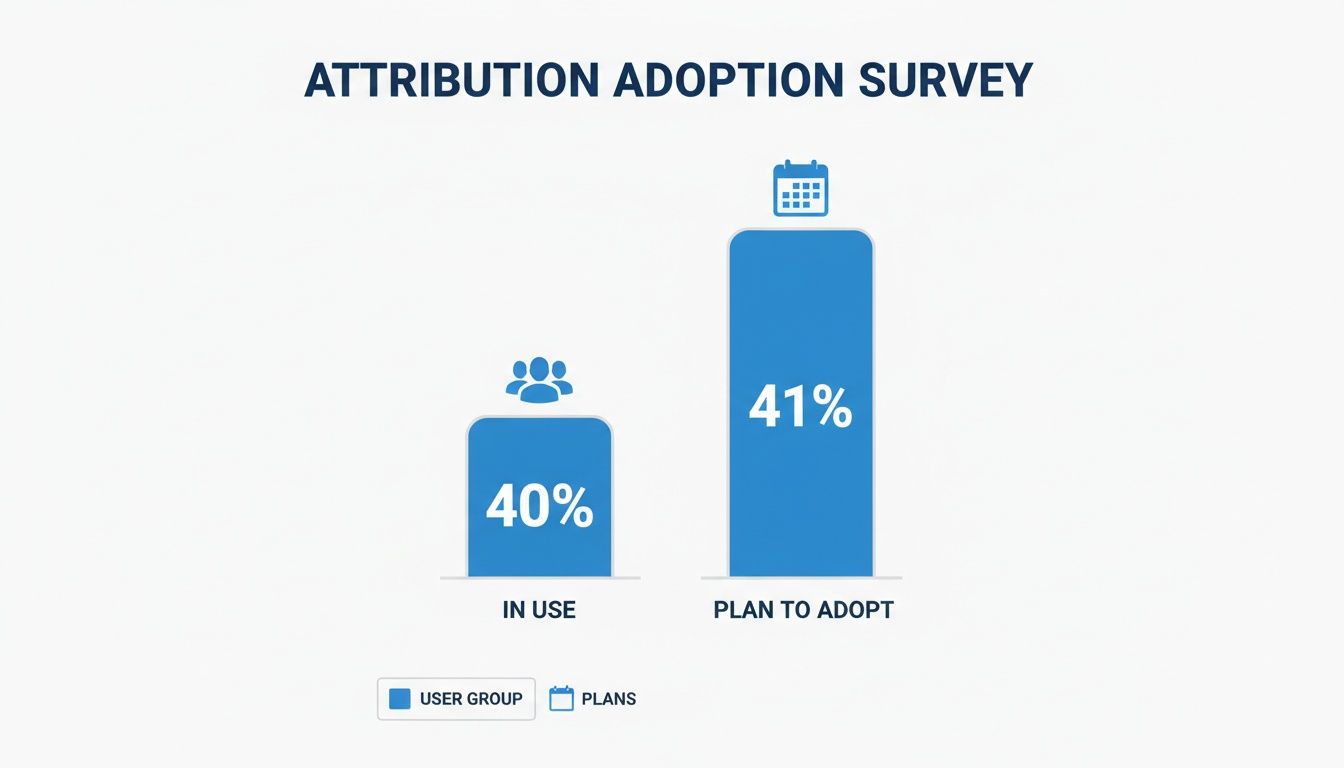
As the number of online channels exploded, it became glaringly obvious that single-touch models just weren't cutting it anymore. They failed to capture the messy reality of how people actually buy things. MTA was the answer, and brands are catching on fast. A 2021 industry study found that 40% of North American marketing organizations were already using an MTA solution, with another 41% planning to jump on board in the next 18 months.
That's a huge shift, and it points to a simple truth: you can't manage what you can't accurately measure. You can find more great insights on attribution frameworks from the IAB.
Multi-touch attribution isn't just a different report; it's a different philosophy. It accepts that customer journeys are complex and that multiple marketing efforts have to work together to build trust, create desire, and finally drive someone to click "buy."
The Power of the Full Story
For a Shopify founder, seeing the full story is a total game-changer. When you understand which channels and campaigns are the "assists" versus the "scorers," you can make much smarter, more profitable decisions without getting lost in spreadsheets.
With multi-touch attribution modeling, you can finally get real answers to the big questions:
- Which top-of-funnel channels are actually good at bringing in new customers who eventually buy?
- How are my email campaigns from Klaviyo actually helping my Meta ads perform better?
- What is my true, blended customer acquisition cost (CAC) when I factor in every single touchpoint?
Answering these questions is the first step toward building a marketing engine that can actually scale. Instead of blindly cutting budgets based on bad data, you can confidently double down on the channels that are quietly filling your pipeline. This is exactly what AI-powered tools like MetricMosaic are built for—automating the entire process and turning all that complex data into a clear story of what’s working, what’s not, and where your next big win is hiding.
Comparing Common Attribution Models for Shopify Brands
Picking an attribution model isn't just some technical box-checking exercise. It fundamentally shapes how you see your marketing channels, which ones you decide to fund, and which ones you cut. For any Shopify brand trying to grow, getting this right is everything.
Each model tells a completely different story about your customer's journey. And if you’re listening to the wrong story, you’ll end up with some seriously flawed ideas about what’s actually working.
Let’s walk through the most common models you'll run into, starting with the simple (and dangerous) ones and moving toward more sophisticated multi-touch approaches.
Single-Touch Models: The All-or-Nothing Approach
Single-touch models are clean and simple, but that’s also their biggest weakness. They give 100% of the credit for a sale to just one marketing touchpoint, completely ignoring everything else that happened along the way.
- Last-Click Attribution: This is the old standby, the default setting for tons of platforms. It gives all the glory to the very last thing a customer clicked before buying. While it’s helpful for knowing what closes a deal, it dangerously overvalues your bottom-funnel channels—think branded search and retargeting ads—while ignoring what brought the customer to you in the first place.
- First-Click Attribution: This one is the exact opposite. It hands all the credit to the very first touchpoint that introduced a customer to your brand. It's a great way to see which channels are best for discovery, but it tells you nothing about the hard work your other channels did to nurture that person toward a purchase.
While easy to understand, these models paint a wildly incomplete picture, often leading brands to pour money into the wrong places. It's no surprise that the industry is moving on. Recent data shows that while 40% of marketers are now using multi-touch attribution, another 41% plan to adopt it soon. That's a massive shift away from the limitations of single-touch thinking.
This trend makes one thing crystal clear: to really get what’s driving your growth, you have to look beyond a single interaction.
Multi-Touch Models: A More Balanced View
This is where things get interesting. Multi-touch attribution models spread the credit across multiple touchpoints, giving you a much more holistic and, frankly, more honest view of your marketing ecosystem.
Here are the most common rules-based models you'll see:
Linear Model
The Linear model is the most straightforward of the multi-touch family. It just splits the credit equally across every single touchpoint in the journey. If a customer saw a Facebook ad, clicked a Google search result, opened an email, and then clicked a retargeting ad, each channel gets exactly 25% of the credit. It’s fair, but its fatal flaw is assuming every touchpoint is equally influential—which, let's be honest, is almost never the case.
Time-Decay Model
The Time-Decay model gets a bit smarter. It gives more credit to the touchpoints that happened closer to the sale. The logic here is that the final interactions were probably more persuasive in getting the customer to pull out their credit card. This model is particularly useful for DTC brands with longer consideration periods, as it properly values the marketing that re-engages a potential customer and finally pushes them over the line.
U-Shaped (Position-Based) Model
The U-Shaped model is a really popular choice because it focuses on what many marketers see as the two most important moments: the first touch (discovery) and the last touch (the close). A typical setup gives 40% of the credit to that first interaction, 40% to the last one, and then sprinkles the remaining 20% evenly across all the touchpoints in between.
This model is perfect for Shopify brands that care deeply about both finding new customers and converting them efficiently. It gives a nod to both brand awareness and direct-response marketing.
To see just how dramatically these choices can alter your perception of what's working, let's look at a simple customer journey and see how each model would score it.
How Different Attribution Models Credit a Sample Shopify Customer Journey
| Touchpoint (Channel) | Linear Model (25% each) | Time-Decay Model (Example %) | U-Shaped Model (40-20-40 Rule) | Last-Click Model (100%) |
|---|---|---|---|---|
| 1. Facebook Ad (First Touch) | 25% | 10% | 40% | 0% |
| 2. Google Search (Organic) | 25% | 20% | 10% | 0% |
| 3. Email Newsletter | 25% | 30% | 10% | 0% |
| 4. Branded Search Ad (Last Touch) | 25% | 40% | 40% | 100% |
Look at that. The same four touchpoints, but four completely different stories about which channel is the hero. Your choice of model can absolutely change channel optimization decisions and media budgets by double-digit percentages. You can learn more about how these different MTA rules impact reporting.
Ultimately, the goal is to find a model that actually reflects how your customers shop. And while these rules-based models are a massive step up from last-click, the next evolution is letting AI determine the right credit for your unique business—which is exactly what platforms like MetricMosaic are now bringing to Shopify brands.
How AI Is Changing the Attribution Game for DTC Brands

Let's be honest. For a busy Shopify founder, manually pulling data from Shopify, Google Analytics, Meta, and Klaviyo to build an attribution model is a complete non-starter. That’s a full-time analyst's job, and it’s an absolute grind of data cleaning and spreadsheet gymnastics.
This is precisely where AI-powered analytics platforms come in and completely change the game for DTC brands. AI simplifies the entire process, replacing hours of manual data crunching with automated, story-driven insights.
Modern tools automate the entire workflow. They do the messy work of collecting, cleaning, and stitching together your Shopify data with all your marketing channels. Instead of you losing days crunching numbers, an AI-driven system can run incredibly sophisticated models and surface clear, actionable insights in minutes.
Moving Beyond Pre-Set Rules
Traditional multi-touch attribution modeling makes you pick one set of rules and apply it to every single customer, no matter how they behave. But what if your high-value customers buying luxury skincare follow a totally different path than first-time buyers grabbing a sale item? AI gets these nuances.
By using machine learning, an AI-powered analytics platform like MetricMosaic can run dynamic attribution models that adapt to how people actually behave. It analyzes thousands of customer paths to understand which touchpoints truly move the needle, assigning credit based on data, not assumptions.
This approach gives DTC brands some serious advantages:
- Automated Data Unification: AI tools plug directly into your Shopify store and marketing platforms, creating a single source of truth without any manual exporting and importing.
- Algorithmic Modeling: Instead of picking a one-size-fits-all model, the system finds the most accurate credit distribution for your specific business and customer segments.
- Predictive Insights: Modern platforms don't just report on the past. They can spot patterns that predict future outcomes, helping you see emerging trends before your competitors do.
The real shift is moving from static reports to a dynamic, learning system. Your attribution model gets smarter over time as it processes more data, continuously refining its understanding of what drives growth for your brand.
The Rise of Conversational Analytics
The next big step for AI in analytics is making data accessible to everyone on your team, no technical skills needed. This is where conversational analytics comes in, a next-gen trend that turns complex data queries into a simple conversation.
Imagine just asking your data questions in plain English, like you would a seasoned analyst. No more digging through dashboards or wrestling with report builders.
You could simply type:
- “What was the true ROAS of my latest influencer campaign?”
- “Show me the customer journey for people who bought our new product.”
- “Which channels are best at acquiring customers with a high LTV?”
An AI co-pilot, like MetricMosaic’s MosaicLive, can understand your question, run the right analysis using its advanced attribution models, and give you an instant, reliable answer. This isn't science fiction; it's the new reality for data-driven Shopify brands. AI becomes your strategic partner, effortlessly turning the chaos of fragmented data into your most valuable growth lever.
Your Practical Roadmap to Multi-Touch Attribution
Alright, let's get our hands dirty. Moving from theory to action with multi-touch attribution doesn't have to be a nightmare of spreadsheets and custom code.
The old myth that MTA is only for enterprise giants with huge analytics teams? Officially busted. Thanks to modern, AI-powered platforms, getting a sophisticated attribution system up and running for your Shopify store is more straightforward than ever.
The whole game boils down to two things: clean, organized data and the right tech to make sense of it. Nail these, and you create a powerful feedback loop where better data gives you clearer insights, which then drive smarter, more profitable decisions.
This is your practical roadmap to get it done.
Step 1: Get All Your Data in One Place
Right now, your customer data is probably scattered all over the place. Your orders are in Shopify, web behavior is in Google Analytics, email engagement is in Klaviyo, and your ad platforms—Meta, Google, TikTok—all have their own siloed metrics.
Job number one for any real multi-touch attribution modeling project is to pull all of this together.
Trying to manually export CSVs and stitch them together is a fast track to frustration and costly mistakes. This is where a modern analytics platform like MetricMosaic becomes your best friend. It uses pre-built connectors to automatically pull data from all your key sources into one place, creating a single source of truth for the entire customer journey.
Think of it this way: you can't understand the full story if you're only reading random pages from different books. Consolidating your data brings the entire narrative together, making it possible to see how every chapter—every single touchpoint—connects.
Step 2: Build a Rock-Solid UTM Strategy
Once your data is flowing into one spot, you need to make sure it's all speaking the same language. This is where Urchin Tracking Modules (UTMs) come in. They’re just simple tags you add to your URLs that tell your analytics tools exactly where a visitor came from.
A consistent UTM strategy is the absolute backbone of accurate attribution.
Without one, your data becomes a tangled mess. You might see clicks from "Facebook," "facebook.com," and "FB" all showing up as different line items in your reports, even though they’re the same source. A simple UTM governance plan ensures every link is tagged correctly, giving your attribution model the clean, reliable data it needs to work its magic.
Here’s a quick checklist to build a robust UTM plan today:
- Create a Naming Convention: Define a consistent, lowercase format for your sources (e.g.,
google,meta,klaviyo,tiktok). No exceptions. - Standardize Your Mediums: Use clear, obvious mediums like
cpcfor paid ads,emailfor newsletters, orsocialfor organic posts. - Get Descriptive with Campaigns: Name your campaigns logically so you can easily identify them months from now (e.g.,
spring-sale-2024ornew-product-launch-skincare). - Use a Shared Template: A simple Google Sheet or a dedicated tool where your team can build and log UTM links is a lifesaver. It kills inconsistency before it starts.
- Do a Monthly Audit: Once a month, take 15 minutes to scan your analytics for messy sources or mediums and clean them up. This tiny bit of data hygiene pays off big time.
Step 3: Choose a Platform That Does the Heavy Lifting
With your data centralized and your tracking locked down, the final step is to pick a tool that can turn all that information into insights you can actually use. This is where you graduate from basic reports and step into true multi-touch attribution modeling.
Modern platforms built for Shopify brands handle the complicated math for you. They don't just slap a rigid, one-size-fits-all model like Linear or U-shaped onto your data. Instead, they use AI to analyze your unique customer journeys and figure out the most accurate way to assign credit.
This AI-driven approach tears down the technical walls that once made MTA feel out of reach. You don't need a data science degree to understand what’s working. The platform does the hard analysis and then tells you the story behind the numbers—showing you which channels are your best assists, which ones score the goals, and how you can shift your budget for maximum impact.
Turning Attribution Insights Into Profitable Actions
Alright, you’ve got a complete picture of your marketing performance. Now the real work begins.
True multi-touch attribution modeling was never about generating pretty reports. It’s about making smarter, more profitable decisions with absolute confidence. This is where all that initial setup starts to pay off, turning a tangled mess of data into a clear roadmap for growth.
You can finally stop guessing where your next dollar should go. The insights from a solid attribution model translate directly into tangible actions that can give your Shopify store an immediate boost across ROAS, CAC, and LTV.
Confidently Reallocate Your Budget
The most immediate win you'll see from multi-touch attribution is the power to shift your marketing budget with surgical precision. You can finally see the true ROAS of every single channel—not just the last-click heroes that have been stealing all the credit.
Think about it. Your old reports might have screamed at you to cut spending on your top-of-funnel TikTok campaigns because they weren't driving direct sales.
But a multi-touch view could pull back the curtain and show you that those exact same campaigns are consistently the first touchpoint for your highest-value customers. Suddenly, you have a totally different story.
This insight lets you:
- Scale High-Assisting Channels: You can now confidently pour more money into the awareness channels that are proven to feed your conversion-focused campaigns down the line.
- Optimize Underperformers: Spot the channels that contribute little to no value at any stage of the journey and test moving that budget over to your proven winners.
- Balance Your Funnel: Make sure you're properly funding both brand discovery and conversion drivers. This is how you build a sustainable marketing engine for the long haul.
This strategic budget shifting, guided by AI-powered analytics, moves you from a reactive, "spray and pray" spending model to a proactive investment strategy.
Your marketing budget is no longer a gamble. It becomes a precision tool, with every dollar allocated to the channels that demonstrably contribute to your bottom line—whether they score the goal or provide the crucial assist.
Fine-Tune Your Creative and Messaging
Attribution insights go way beyond just channel performance. When you analyze the entire customer journey, you can start to understand which types of creative and messaging are hitting the mark at different stages. This is a game-changer for campaign optimization.
Imagine discovering that your video ads on Meta are incredible at introducing new customers to your brand, while your static image ads with discount codes are the undisputed champs at closing the deal. That knowledge is pure gold.
- Optimize by Funnel Stage: Tailor your ad creative to match its job in the customer journey. You can run inspirational content at the top, educational in the middle, and direct-response offers at the bottom.
- Refine Audience Targeting: Pinpoint which customer segments respond best to certain touchpoint sequences and double down on those proven paths to purchase.
- Improve Customer Lifetime Value (LTV): Once you understand the journey that leads to your best customers, you can build campaigns specifically designed to replicate that success and acquire more high-LTV buyers.
Your Competitive Advantage Is Clarity
Stop making critical budget decisions based on flawed, incomplete data.
Embracing an AI-driven approach to multi-touch attribution modeling with a platform like MetricMosaic doesn’t just clean up your reports—it unlocks a complete, story-driven view of your customer journey.
This clarity is your ultimate competitive advantage. It turns your everyday store data into your most powerful engine for profitable growth.
A Few Common Questions About Multi-Touch Attribution
Jumping into a more sophisticated way of measuring your marketing always brings up a few questions. For busy Shopify founders, the biggest one is usually: "Is this going to be worth the effort?" I get it. You need to know that this will lead to real results without bogging you and your team down.
Here’s the straight talk on the most common questions we hear.
How Much Technical Skill Do I Actually Need to Set This Up?
This is the biggest hang-up for most people, and the answer has changed a lot over the last few years. It used to be that you needed a data analyst or a developer on speed dial. Not anymore.
Today, AI-powered analytics platforms like MetricMosaic are built for DTC founders, not data scientists. They use pre-built connectors that securely link to Shopify, Meta, Google, and Klaviyo in just a few clicks. The whole data collection and modeling process runs on its own, so you can focus on the insights, not the setup.
How Do I Know Which Attribution Model is Right for My Brand?
You don't have to guess. While older, rules-based models like U-Shaped or Time-Decay can be a decent starting point, this is where modern AI analytics really shines.
A good platform won't force you into picking one rigid model. Instead, it uses an algorithm to analyze your unique customer journeys and figure out the most accurate way to distribute credit. The system finds the model that actually mirrors how your customers shop, giving you a much more reliable picture of what’s working.
How Quickly Can I Start Making Better Decisions?
Surprisingly fast. Once you connect your data sources, a platform like MetricMosaic can start surfacing real insights within hours.
You could immediately spot channels where you're overspending or find campaigns that are quietly driving huge value. For example, you might discover that a top-of-funnel influencer campaign you were about to cut is actually bringing in your highest LTV customers. That kind of clarity lets you make smarter budget decisions from day one.
Ready to stop guessing and start growing with a complete view of your marketing performance? MetricMosaic turns your fragmented store data into clear, actionable stories that drive profit. Start your free trial today.