What Is Marketing Attribution? Your Guide to Smarter Shopify Growth
Understand what is marketing attribution and how it turns your Shopify data into actionable insights for higher ROAS, better LTV, and real profit growth.
Marketing attribution is the process of connecting the dots—of understanding which marketing touchpoints a customer interacted with on their path to making a purchase. For a Shopify brand, it’s how you discover exactly which efforts are actually making you money, so you can pour fuel on what’s working and stop wasting cash on what's not.
It’s about turning fragmented data into a clear roadmap for profitable growth.
The Million-Dollar Question: Where Did That Sale Really Come From?
You’re staring at your Shopify dashboard. Sales are up, which is great. But that nagging question is always there: where did these customers actually come from? Was it that new Meta ad you launched last week? The Klaviyo welcome series you spent all weekend optimizing? Or maybe that TikTok influencer post is finally kicking in?
For most DTC founders, this is the daily grind. You’re trying to piece together data from a dozen different platforms, and each one is telling you a different story.
- Meta Ads claims credit for 50 sales.
- Google Analytics shows 40 sales from that same campaign.
- And your Shopify report? It tells another story entirely.
This mess of conflicting data leads to a cycle of uncertainty. You’re left guessing where your budget should go, unable to confidently calculate your true Return on Ad Spend (ROAS) or Customer Acquisition Cost (CAC). It feels less like a data-driven strategy and more like throwing spaghetti at the wall and hoping something sticks.
From Siloed Spreadsheets to a Single Source of Truth
The old way of doing this involved exporting CSVs into clunky spreadsheets—a nightmare that was not just painfully slow but also riddled with errors. You'd end up with a blurry, outdated snapshot of your business that relied on simplistic models giving all the credit to the very last click before a sale. It completely ignored all the other crucial interactions that warmed the customer up.
The practice of tying marketing to sales has come a long way. The late 1990s and early 2000s saw the rise of multi-touch attribution (MTA), a huge leap forward from last-click thinking. Yet, as recently as 2016, a shocking 12% of marketers were still clinging to last-touch models, flying blind and misallocating huge chunks of their budget. You can dig into the history of marketing measurement to see just how far we've come.
Marketing Attribution is like a sports team’s post-game analysis. Instead of just celebrating the player who scored the final goal, you look at the entire play—the initial pass, the defensive block, and the crucial assist. Every touchpoint played a role in getting that win.
Today, AI-powered analytics platforms like MetricMosaic cut through that complexity. We act as your central data hub, pulling everything from Shopify, your ad platforms, and email tools into one clean, reliable view. Instead of wrestling with conflicting reports, you get a single source of truth. This AI-driven approach gives you the full picture of the customer journey, so you can see precisely how each channel contributes to your bottom line and turn fragmented data into a clear roadmap for growth.
Decoding Common Attribution Models for Your Store
Once you know you need to connect the dots, the next question is how. This is where attribution models come in. Think of them as different lenses you can use to view your customer journey data. Each one tells a slightly different story about which touchpoints deserve credit for a sale, and choosing the right one can make or break your marketing budget.
Let's break down the most common models with a real-world example. Imagine a customer, Sarah, buys a new pair of sneakers from your Shopify store. Her path to purchase wasn't a straight line. It looked more like this:
- First: She discovered your brand after seeing a TikTok influencer’s video.
- Middle: A few days later, she got hit with a retargeting ad on Instagram and clicked through to browse your site.
- Last: A week later, she typed your brand name into Google, clicked a search ad, and finally made the purchase.
So, who gets the credit? The TikTok creator? The Instagram ad? Google? The answer depends entirely on the model you use.
Single-Touch Models: The All-or-Nothing Approach
The simplest models give 100% of the credit to a single touchpoint. They're easy to understand, but they often paint a dangerously incomplete picture for a growing DTC brand.
First-Touch Attribution: This model gives all the credit to the very first interaction. For Sarah, that's the TikTok influencer. This is a great way to see which channels are filling the top of your funnel and generating initial awareness. The massive downside? It completely ignores every single interaction that happened afterward, making all your hard work on conversion-focused ads look useless.
Last-Touch (or Last-Click) Attribution: This is the default setting for many ad platforms like Google Ads and Meta. It hands all the credit to the final touchpoint before the sale—in this case, Sarah’s click on the branded search ad. This model is good for pinpointing what closes the deal, but it seriously overvalues bottom-of-funnel channels while making your crucial brand-building campaigns on TikTok or Instagram seem like a total waste of money.
This is the classic dilemma. Older, simpler methods just can't keep up with how customers actually shop today.
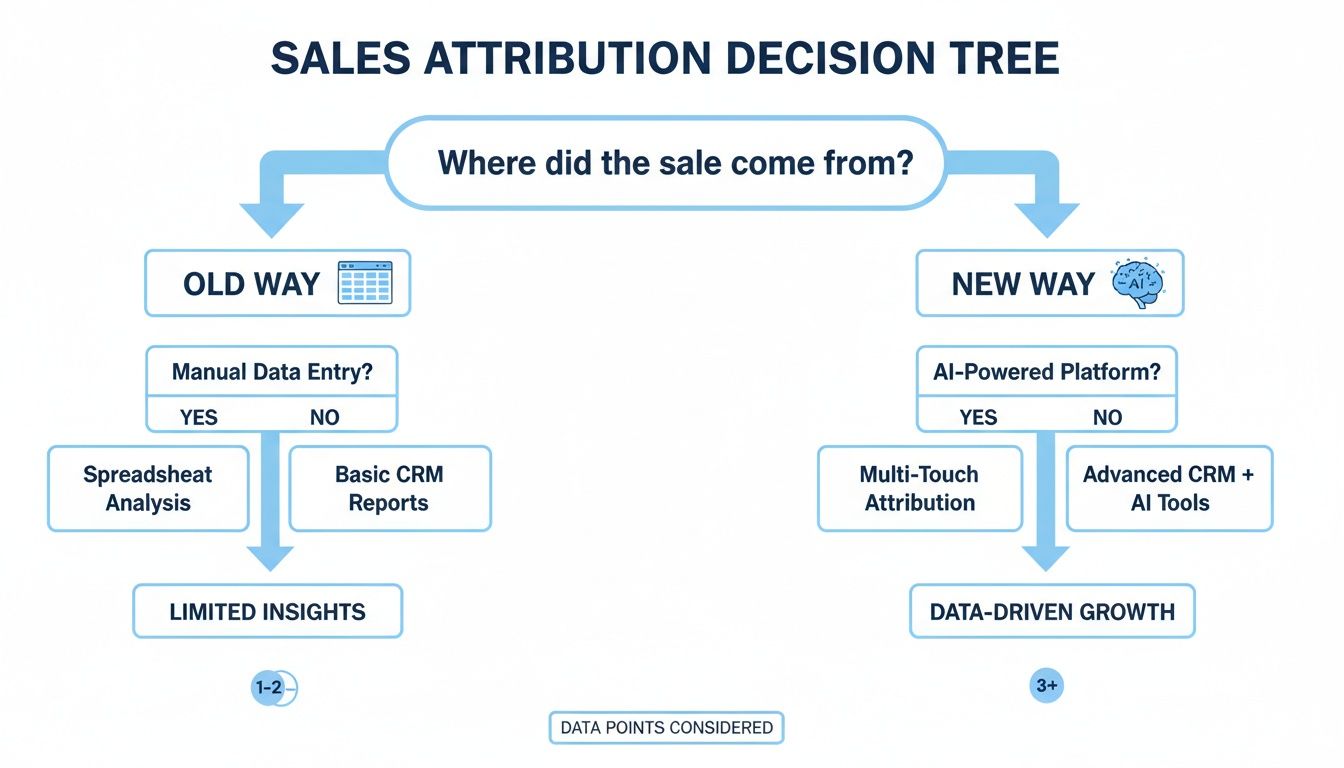
As the visual shows, modern attribution isn't about guesswork or isolated data points. It's about using a smarter, unified approach to see the complete and accurate picture of the customer journey.
Multi-Touch Models: Spreading the Credit
Let's be real—for most Shopify stores, the customer journey involves a whole series of interactions. To get a true sense of what’s working, you need to explore different methods of attribution modeling. Multi-touch models are built for this reality, distributing credit across several touchpoints.
Relying solely on a last-click model is like giving all the credit for a championship win to the person who scored the final point. You're completely ignoring the assists, defense, and teamwork that made the win possible in the first place.
If you want to go deeper on these more advanced approaches, check out our full guide on multi-touch attribution modeling for eCommerce.
For now, here are a few popular multi-touch models that DTC brands use:
Linear Attribution: This is the most straightforward of the bunch. It splits the credit equally among every single touchpoint. In Sarah’s journey, the TikTok video, Instagram ad, and Google search ad would each get 33.3% of the credit. It’s fair, but its biggest flaw is assuming every touchpoint is equally important—which is almost never the case.
Time-Decay Attribution: This model gives more credit to the touchpoints that happened closer to the purchase. Sarah’s Google Search ad would get the most credit, the Instagram ad would get less, and the initial TikTok video would get the least. This model is pretty useful for brands with shorter sales cycles where the most recent interactions have the biggest impact.
U-Shaped (or Position-Based) Attribution: This model gives the most weight to the first and last touches, then distributes the rest among the interactions in the middle. Typically, it assigns 40% of the credit to the first touch (for sparking awareness) and 40% to the last touch (for closing the deal), leaving the remaining 20% to be split among the middle touchpoints. It's a popular choice because it values both how a customer found you and what finally pushed them to buy.
Choosing a model can feel overwhelming, so we put together a quick comparison to help you figure out what might work best for your brand.
A Quick Guide to Attribution Models for Shopify Brands
| Attribution Model | How It Works | Best For... | Biggest DTC Pitfall |
|---|---|---|---|
| First-Touch | Gives 100% credit to the first marketing touchpoint a customer interacts with. | Understanding which channels are best at driving initial brand awareness. | Completely ignores all middle and bottom-of-funnel efforts that lead to a sale. |
| Last-Touch | Gives 100% credit to the final marketing touchpoint before a conversion. | Identifying which channels are most effective at closing deals. | Overvalues branded search and retargeting, making top-of-funnel channels look ineffective. |
| Linear | Spreads credit evenly across every touchpoint in the customer's journey. | Getting a simple, balanced view without prioritizing any specific stage. | Falsely assumes every touchpoint has equal impact, which is rarely true. |
| Time-Decay | Gives more credit to touchpoints that occur closer to the time of conversion. | Brands with short sales cycles where recent interactions matter most. | Can undervalue early-stage awareness campaigns that plant the seed for a future purchase. |
| U-Shaped | Gives 40% credit to the first touch, 40% to the last touch, and splits 20% among the middle. | Valuing both the channel that introduced the customer and the one that sealed the deal. | Can undervalue the "consideration" phase, where customers are nurtured by middle-funnel content. |
Each model offers a unique perspective, but none of them are perfect on their own. The key is understanding their biases and using them to ask better questions about your marketing performance.
How Better Attribution Directly Boosts Your Bottom Line
Getting a handle on attribution models is one thing, but turning that theory into actual profit? That’s the real game. For any growing Shopify brand, better attribution isn't just some academic exercise—it’s the engine that powers smarter, more profitable growth.
When you finally get a clear, reliable picture of what’s actually working, you stop guessing and start knowing. That clarity gives you the confidence to move your budget around, scale the campaigns that are crushing it, and cut the losers without a second thought. It’s the difference between flying blind and having a precise GPS guiding you straight to your revenue goals.
Optimize ROAS and Slash Wasted Spend
The most immediate win from a solid attribution system is a serious boost to your Return on Ad Spend (ROAS). Without it, you’re almost certainly giving credit to the wrong channels and making some expensive mistakes.
Imagine this common scenario: your last-click model tells you that branded search ads are your superstars, while those TikTok awareness campaigns look like a total money pit. But with a more sophisticated, AI-powered attribution view, you might uncover that TikTok is actually introducing 70% of your highest-value customers to your brand for the very first time.
Armed with that kind of insight, you can:
- Double down on top-of-funnel channels that you now know are driving discovery and long-term value.
- Stop over-investing in bottom-funnel ads that are just catching demand created somewhere else.
- Tweak your ad creative and messaging based on the specific role each touchpoint plays in the journey.
This is a strategic shift. Every dollar you spend starts working harder, pushing your overall ROAS up and making your entire operation more profitable.
Lower Your Customer Acquisition Cost
Right on the heels of ROAS is your Customer Acquisition Cost (CAC). When you stop wasting money on channels that aren't really contributing to sales, your average cost to bring in a new customer naturally drops.
Good attribution helps you map out the most efficient paths to purchase. You might find that customers who see a Meta ad and then get a follow-up email from Klaviyo convert at a 25% lower CAC than those who only saw the ad. That's not just interesting data; it’s a strategic lever you can pull to get more customers without increasing your budget.
Boost AOV and Lifetime Value
True attribution looks way beyond that first purchase. It helps you understand the complete story of your best customers—the ones with the highest Average Order Value (AOV) and Lifetime Value (LTV).
By analyzing their paths, you can basically reverse-engineer success. What channels brought them in? Which campaigns nurtured them along the way? What content did they interact with before they became loyal, repeat buyers? This lets you build lookalike audiences and campaigns laser-focused on attracting more people just like them.
By connecting marketing efforts to long-term customer value, you stop chasing cheap, one-off sales and start building a sustainable business fueled by loyal, profitable customers.
This focus on customer quality over quantity is where modern DTC brands find their edge. The landscape has changed fast, especially after privacy shifts from Apple and GDPR gutted old tracking signals. These changes forced the industry to get smarter about measurement, with brands seeing CPA drops of 20% and ROAS gains of 1.5x within a year of implementing unified attribution. You can learn more about the evolution of marketing attribution and its impact.
Instead of spending hours buried in spreadsheets trying to stitch all these dots together yourself, AI-powered platforms like MetricMosaic automate this entire process. They turn your raw Shopify and ad platform data into a clear strategy for profitable growth, giving you the confidence to make the right calls, faster.
Building Your Modern Shopify Attribution Stack

Knowing what marketing attribution is gets you to the starting line. Actually building a system to do it is the race.
For a Shopify brand, this doesn't have to be some massive, intimidating project. A modern attribution "stack" isn't about duct-taping dozens of tools together. It’s about building a few core pillars that make sure your data is clean, connected, and telling you the truth.
Forget the days of wrestling with endless spreadsheets. The goal today is to create a seamless flow of information—from first click to final sale, and even beyond to customer lifetime value. This is the foundation that lets you make confident, data-backed decisions that actually grow your bottom line.
The good news? AI-powered analytics platforms are built to do the heavy lifting. But getting the fundamentals right on your end is still absolutely essential.
Pillar 1: Consistent UTM Tagging
First up, and completely non-negotiable, is consistent UTM tagging. Urchin Tracking Modules (UTMs) are just simple snippets of text you add to the end of your URLs. Think of them as digital name tags telling your analytics tools exactly where each visitor came from.
They're like breadcrumbs. Without them, every visitor who isn't from organic search looks like they just materialized out of thin air. With them, you can clearly see the difference between traffic from:
- A specific Meta ad creative versus another one in the same campaign.
- Your Klaviyo welcome flow versus a one-off promotional email blast.
- A particular TikTok influencer versus your own organic posts.
Key Takeaway: A messy UTM strategy is like having a warehouse full of boxes with no labels. You know there’s valuable stuff inside, but you have no earthly idea where to find anything. Consistency is everything.
Every single link you put out there—in ads, emails, social posts, or influencer bios—needs clean, standardized UTMs. This simple discipline is what makes sure the raw data flowing into your system is reliable from the very beginning.
Pillar 2: Robust Event Tracking
Next, you need to see what people are actually doing on your Shopify store. This is where robust event tracking comes into play. Page views are fine, but they don't tell you the whole story. You need to track the meaningful actions that signal someone is ready to buy.
The old way of doing this was with client-side tracking (think pixels running in the browser), which is now notoriously flaky thanks to ad blockers and privacy updates like iOS 14. The modern gold standard is server-side tracking, which sends data straight from your store’s server to your analytics platform. It’s far more accurate, secure, and doesn’t get tripped up by browser issues.
Essential events to track on your Shopify site include:
- Viewed Product: See which products are catching shoppers' eyes.
- Added to Cart: A huge indicator of real interest.
- Initiated Checkout: The final hurdle before a conversion.
- Purchased: The ultimate goal.
Tracking these events accurately creates a detailed map of the customer journey on your site, showing you exactly where people drop off and what actions really lead to a sale.
Pillar 3: A Unified Data Platform
Finally, all this clean, well-tagged data needs a home where it can be connected, crunched, and understood. This is the role of a unified data platform. It’s the brain of your attribution stack, pulling all your scattered data sources into one cohesive view.
A platform like MetricMosaic connects directly to:
- Your Shopify store for sales, product, and customer data.
- Your ad platforms (Meta, Google, TikTok) for spend and campaign data.
- Your email/SMS tool (like Klaviyo) for your lifecycle marketing data.
- Google Analytics 4 for website behavior data.
By centralizing everything, an AI-powered platform automates what used to take a team of analysts weeks to do by hand. It cleans the data, stitches together customer journeys across different devices, and runs sophisticated models to give you a single source of truth. If you want to see how this comes together, you can explore how a well-designed eCommerce analytics dashboard brings this unified data to life.
This unified approach is what turns raw numbers into real, actionable insights. It lets you focus on strategy, not spreadsheets.
Navigating Attribution in a Privacy-First World
The ground is shifting under every marketer's feet. For years, we leaned on cookies and tracking pixels to follow customers across the web, but that era is officially coming to a close. Between Apple’s iOS 14 updates, Google’s plan to phase out third-party cookies, and a growing wave of privacy laws, the old ways of attribution are simply breaking down.
If you’ve noticed your Meta Ads reports don’t quite line up with your Shopify sales, or that Google Analytics 4 is suddenly full of "direct" traffic, you're not imagining things. Ad platforms and traditional analytics tools no longer have the full picture. They’re operating with huge data gaps, making it nearly impossible to see what's actually working.
This isn’t just a minor headache; it’s a full-blown strategic crisis for DTC brands that live and die by their ROAS. The tracking signals we all took for granted are vanishing, leaving founders guessing where their sales are truly coming from.
The Rise of AI and More Resilient Measurement
This new reality demands a much smarter approach. Instead of trying to patch up a leaky, outdated system, the most forward-thinking brands are turning to next-generation techniques that don’t rely on perfect one-to-one tracking. This is where AI-powered analytics platforms completely change the game for Shopify brands.
Two key concepts are leading the charge here:
Marketing Mix Modeling (MMM): This isn't a new idea, but AI has given it a massive upgrade. MMM looks at your marketing from a bird's-eye view, using statistical analysis to see how changes in ad spend across channels correlate with changes in your sales. It helps answer the big-picture questions, like, "If I bump my TikTok budget by $10,000, what’s the likely impact on my overall revenue?"
Incrementality Testing: This is all about proving cause and effect. Instead of just tracking clicks, you run controlled experiments—like temporarily pausing an ad campaign in one region—to measure the true lift your marketing is providing. It gets to the heart of the most critical question: "Did this campaign actually cause new sales, or would those customers have bought from us anyway?"
These methods used to be walled off, reserved for enterprise giants with entire teams of data scientists. Today, AI automates the heavy lifting, putting these powerful tools directly into the hands of Shopify founders.
How AI Fills in the Data Gaps
Think of AI as a brilliant detective piecing together a complex puzzle. It takes the fragmented data you do have—from Shopify, your ad platforms, and your own first-party data—and uses sophisticated models to paint a complete and probable picture of your customer journeys.
Instead of just counting clicks, AI-driven attribution understands the relationships between your marketing efforts and your sales outcomes. It builds a resilient model that gets smarter over time, even as privacy restrictions tighten.
Marketing attribution actually got its start back in the 1950s with the creation of marketing mix models (MMMs), a groundbreaking statistical approach that revolutionized how businesses measured marketing impact. Back then, MMMs helped large consumer goods firms reallocate up to 20-30% of their marketing spend more effectively, driving huge revenue lifts. To see how this foundational concept has evolved, you can discover more insights on the history of attribution. Today, platforms like MetricMosaic are bringing this powerful legacy into the digital age for modern DTC brands.
By embracing these AI-powered methods, you can finally move from a fragile system dependent on user-level tracking to a durable one built on statistical truth. This lets you navigate the privacy-first world with confidence, making smarter budget decisions based on a far more accurate and resilient understanding of what’s really driving your growth.
Turning Attribution Data into Smarter Growth Decisions

Getting a handle on marketing attribution and setting up a solid data foundation is a huge step forward. But let's be real—the end goal isn't to create perfect reports. It’s about making faster, smarter decisions that actually grow your Shopify business. This is where you move from data chaos to strategic clarity.
The real magic of modern attribution is how it closes the gap between seeing an insight and acting on it. It’s no longer about staring at a complex dashboard, trying to decipher what the numbers are even telling you. The next wave of analytics is built to tell you a story.
From Dashboards to Conversations
Imagine being able to just ask your business data a question—in plain English—and get an instant, clear answer. This is the new reality of conversational analytics, a core part of AI-powered platforms like MetricMosaic.
Instead of hunting through endless reports, you can simply ask things like:
- "Which campaigns are driving my highest LTV customers this quarter?"
- "What's the average payback period for our Google Ads spend?"
- "Show me the most common customer journey for orders over $150."
This completely removes the technical barrier between you and your data. You don't need to be a data scientist to find profound insights; you just need to be curious. The AI does all the heavy lifting, translating your questions into queries and serving up the answers in a way you can immediately understand. For a deeper look at this, you can learn more about turning data into actionable insights on our blog.
Your Data Becomes a Competitive Advantage
When you get this right, mastering attribution gives your Shopify brand a serious competitive edge. While your competitors are still guessing which ads are working or wrestling with unreliable last-click reports, you’ll have a clear, unified view of your entire business.
This clarity allows you to move with speed and confidence. You can scale winning campaigns, cut wasted spend, and optimize customer journeys based on what the data proves is profitable—not just what a platform’s default report tells you.
Your store’s data transforms from a confusing mess into your most valuable strategic asset. It becomes a roadmap, guiding every decision you make toward more efficient customer acquisition, higher retention, and a healthier bottom line. The journey from learning about attribution to actually implementing it is the first step toward building a more resilient, data-driven brand.
Common Questions About Marketing Attribution
Diving into better marketing attribution always sparks a few questions. Here are the most common ones we hear from Shopify founders and marketing teams trying to get a real handle on their data.
What's the Real Difference Between GA4 and a Platform Like This?
Look, Google Analytics 4 is great for what it does: telling you what happens on your website. It shows you clicks, page views, and the path someone takes through your store. But that's where its vision ends. It has no idea what you spent on ads, what your products actually cost, or who's opening your emails in Klaviyo.
An AI-powered analytics platform like MetricMosaic connects all the dots. It pulls in your Shopify sales, your ad spend from Meta and Google, your email data, and your cost of goods. Suddenly, you’re not just seeing conversions—you’re seeing profitability per channel, per campaign, even down to the specific SKU. It’s a completely different ballgame.
How Quickly Will I Actually See Results?
You’ll get some "aha!" moments almost right away. Within the first couple of weeks, once all your data is connected, you’ll start seeing customer journeys you never knew existed. You'll likely spot quick wins, like a Facebook campaign that’s driving way more value than the ad platform gives it credit for.
But the real, strategic impact—the kind that measurably lifts your ROAS or brings down your blended customer acquisition cost—usually takes about a full quarter to materialize. That gives you enough time to collect solid data, confidently shift budgets based on what you’ve learned, and see those decisions translate into more profitable growth.
Can't I Just Do This Myself in a Spreadsheet?
You could, technically. But you’ll hate it. The "manual" way means exporting giant CSVs from Shopify, Google Ads, Meta, and GA4, then trying to mash them all together in a monstrous spreadsheet.
It’s not just a massive time-suck; it's also incredibly prone to errors. And by the time you've wrangled all that data into something usable, it's already old news. AI platforms automate this entire painful process, letting you focus on making smart decisions instead of fighting with VLOOKUPs.
Ready to stop guessing and start knowing exactly what drives your growth? MetricMosaic unifies your Shopify data and turns it into clear, actionable insights. Start your free trial today and see the full story behind every sale.