How AI-Powered Analytics Turns Churn Reduction into Your #1 Growth Strategy for Shopify
Learn practical steps for reducing churn rate on your Shopify store with AI insights and data-driven tactics to boost LTV and profits.

You live for the Shopify "cha-ching." But while you’re celebrating new customers walking in the front door, are you watching the ones quietly slipping out the back? It’s a classic DTC trap: a relentless focus on acquisition while a leaky bucket silently drains your profits. The secret to plugging that leak is buried in your data—it tells you why customers are leaving, and more importantly, how to step in before they do.
Why Churn Rate Is Your Shopify Store's Silent Killer

As a founder, you're wired for growth. Every new sale feels like a win, a sign that your product and marketing are hitting the mark. But the constant pressure to acquire new customers can create a massive blind spot: the slow, silent bleed of customer churn.
This isn't just another metric on a cluttered dashboard. It’s a direct tax on your profitability and the biggest roadblock to sustainable growth. High churn means your Customer Acquisition Cost (CAC) is constantly working against you. You’re forced to run faster on the acquisition treadmill just to stay in the same place, torching your ad spend to replace customers who should have become advocates.
The True Cost of a Leaky Bucket
Let's break this down. Imagine your Shopify store has 10,000 customers and what seems like a small monthly churn rate of just 5%. Doesn't sound too alarming, right?
But that small leak compounds. Fast.
Here’s a quick look at how even a modest monthly churn rate snowballs into massive annual customer loss.
| How Monthly Churn Compounds into Annual Customer Loss | ||
|---|---|---|
| Monthly Churn Rate | Annual Customer Loss | Customers Lost from a 10,000 Base |
| 1% | 11.4% | 1,140 |
| 3% | 30.6% | 3,060 |
| 5% | 46.0% | 4,600 |
| 8% | 63.3% | 6,330 |
| 10% | 71.8% | 7,180 |
After just one year, that 5% monthly churn doesn't mean you've lost 60% of your customers (5% x 12). Because of the compounding effect, you've actually lost nearly half (46%) of your entire customer base. You’d be starting the next year with only 5,400 of your original 10,000 customers.
Now, imagine trying to scale your DTC brand when you have to replace almost 5,000 customers every single year just to break even. It's an impossible uphill battle.
If you want to run the numbers for your own brand, check out our guide on how to calculate customer churn rate.
For most DTC brands, customer churn is the single biggest—and most fixable—drag on profitability and LTV. It’s always more expensive to acquire a new customer than to keep an existing one, making churn reduction the highest-leverage activity you can possibly focus on.
From Passive Metric to Active Growth Lever
The first step is a mental shift. Stop seeing churn as a passive, historical metric and start treating it as a leading indicator of your store's health. High churn is just a symptom; your data holds the cure.
This is where next-gen AI analytics completely changes the game for Shopify operators. Manually piecing together spreadsheets to figure out why people are leaving is slow, painful, and rarely gives you a clear answer. AI-powered tools replace that manual data crunching.
They automatically surface the story behind the numbers, showing you things like:
- Which marketing campaigns bring in customers with the lowest LTV.
- The exact point in the customer journey where specific segments tend to drop off.
- Which products are frequently part of a customer's final purchase before they disappear.
By turning your data into clear, actionable insights, you can finally move from reacting to churn to proactively preventing it. This guide is your playbook for doing exactly that.
Pinpointing Why Your Customers Are Leaving

You can't fix a problem you don't understand. For most Shopify founders, the real story behind customer churn is buried deep inside a dozen different platforms—fragmented data that creates an unreliable picture of your business.
You’ve got orders in Shopify, traffic in GA4, email engagement in Klaviyo, and ad performance in Meta. This fractured view makes it next to impossible to figure out who is leaving and—more importantly—why.
Trying to stitch this all together manually in a spreadsheet is a special kind of hell for a busy founder. It’s a slow, error-prone process that usually creates more questions than answers. Is it a specific product that’s letting people down? A confusing post-purchase flow? Or are the customers you’re acquiring from that new TikTok campaign simply not the right fit?
This is exactly where AI-powered analytics platforms come in. They act as a central nervous system for your DTC brand, connecting all that scattered data into a single, cohesive story. Instead of spending hours wrestling with VLOOKUPs, AI simplifies the complexity, giving you immediate clarity on the moments that actually matter in your customer lifecycle.
Uncovering the Story with Cohort Analysis
One of the most powerful tools in your arsenal for understanding churn is cohort analysis. It sounds technical, but the concept is dead simple: you group customers who made their first purchase in the same time frame (like a "January Buyers" cohort) and then track their behavior over the following months. This approach cuts through the noise of daily sales figures to reveal the real patterns in your retention.
With a cohort analysis, you can finally answer critical questions about your Shopify store's health:
- How long do customers from our Black Friday sale actually stick around compared to our summer launch?
- Do customers who buy Product X come back for a second purchase faster than those who buy Product Y?
- What percentage of new customers are we really retaining after 30, 60, or 90 days?
By visualizing how each group behaves, you can pinpoint the exact drop-off points in the customer journey. You move from making generic guesses to a precise diagnosis—the only real foundation for an effective churn reduction strategy.
This kind of visual makes it painfully obvious that while the January cohort had strong initial retention, something went wrong by Month 3, signaling a potential fire in the early customer experience you need to put out.
From Data Overload to Actionable Answers
Modern analytics tools are taking this a huge step further with next-gen trends like conversational analytics. Imagine being able to ask your data questions in plain English, just like you’d ask a team member.
Instead of getting bogged down building complex reports, you can just ask:
- "Which products have the highest churn rate after the first purchase?"
- "Show me the LTV of customers from our latest Google Ads campaign."
- "What was the repeat purchase rate for customers who used a discount code?"
This AI-driven approach makes data accessible to everyone on your team—not just the one person who knows how to build reports. It transforms your analytics from a static, rear-view mirror into a dynamic growth co-pilot.
The proof is in the numbers. Advanced analytics and data-driven personalization are directly tied to lower churn. Companies that nail the customer experience grow revenue up to 2x faster than their competitors. And when you remember that the probability of selling to an existing customer is 60–70% (versus a measly 5–20% for a new prospect), every single customer you keep delivers a far better ROI. Dig into these customer retention statistics to see the full impact.
The goal isn't just to gather data; it's to turn that data into a story that tells you exactly where the leaks are in your customer journey. Only then can you start patching them effectively.
Using Predictive AI to Identify At-Risk Customers

The best way to slash your churn rate is to stop churn before it even starts. While looking back at past churn is useful for learning from mistakes, the real growth happens when you get ahead of the problem. You need to know which customers are about to leave, long before they actually stop buying.
This is where traditional analytics can be a huge time-sink for busy DTC founders. Manually digging through mountains of customer data to spot the subtle warning signs of disengagement is like searching for a needle in a haystack. It’s tedious and often fruitless.
Luckily, AI-powered platforms do the heavy lifting for you. They’re designed to automatically flag at-risk accounts by analyzing hundreds of different behavioral signals. These predictive insights look way beyond simple things like "last purchase date" and instead analyze purchase frequency, shifts in AOV, declining email engagement, and even the specific types of products a customer buys. From all this, they build a comprehensive "health score" for every single person in your database, freeing you up to focus on strategy, not spreadsheets.
From Data Points to At-Risk Segments
This is where things get powerful. Predictive AI lets you create dynamic customer segments based on what people are actually doing in real-time, not just on static attributes like when they signed up. Instead of blasting out a generic, one-size-fits-all win-back campaign, you can build hyper-targeted playbooks designed for specific at-risk personas.
To get really effective here, it's worth understanding the world of Predictive Marketing Analytics, which can provide some incredible foresight into customer behavior patterns.
Here’s a quick look at some of the most common at-risk segments we see and how you can spot them with the right tools.
Common At-Risk Customer Segments for DTC Brands
The table below breaks down some classic at-risk customer personas for e-commerce brands, including the data signals that give them away and the likely reasons they're about to churn.
| At-Risk Segment | Key Data Identifiers | Primary Reason for Churn |
|---|---|---|
| One-Time Discount Hunters | First purchase used a deep discount; no repeat purchase after 60-90 days; low email engagement. | They bought the deal, not the brand. There’s a lack of perceived value at full price. |
| High-Value First-Time Buyers | High AOV on their first order; no engagement or second purchase within the expected buying cycle. | The initial high-value experience wasn’t matched by an equally compelling post-purchase journey. |
| Disengaging Subscribers | For subscription brands, this includes skipping multiple orders, low product usage, or visiting the cancellation page. | The product is no longer a core part of their routine, or its value has diminished over time. |
| Product-Specific Churn Risk | Customers who bought a specific, problematic product (e.g., one with high return rates) and have not returned. | A poor product experience soured their perception of the entire brand. |
Once you can automatically identify these groups, you can build automated workflows to step in with the perfect message at just the right moment. The goal is to move away from guesswork and toward a precise, data-backed retention engine.
Turning Predictive Insights Into Action
Just identifying these segments is only half the battle, though. The real magic of AI-driven analytics is turning those insights into immediate, concrete actions. Modern platforms don’t just dump a list of at-risk customers on you; they deliver story-driven data that tells you what to do next.
For example, a tool might surface an insight like: "Customers who bought the 'Winter Collection' are churning 40% faster than your average customer. Consider a targeted feedback survey and a special offer on a complementary product."
That single sentence gives you a clear problem, a potential cause, and a specific action to take. It’s incredibly powerful. This kind of automated segmentation uncovers those high-value but disengaged customers, letting you build a targeted win-back campaign before it's too late.
It’s this leap from passive dashboards to proactive, story-driven guidance that allows smaller teams to execute the kind of retention strategies that were once only possible for massive, enterprise-level companies.
The most effective retention strategy isn't a single massive campaign; it's a series of small, proactive, and personalized interventions triggered by predictive data. Stop waiting for customers to leave and start meeting them where they are.
By learning to read the subtle cues of disengagement, you can transform your churn reduction efforts from a reactive chore into a proactive growth strategy. If you want to dig deeper into the mechanics of how this all works, check out our guide on how churn prediction models can safeguard your revenue.
Building Your High-Impact Retention Playbook
Having predictive insights that tell you who is at risk of churning is a massive leap forward. But as a founder, you know insights are useless if you don't act on them.
Now comes the fun part: translating that data into targeted, automated campaigns designed to keep your customers engaged and buying. This is where you build your retention playbook.
Forget the generic, one-size-fits-all email blasts. For modern Shopify brands, a winning playbook is a set of precise, data-driven actions that meet customers exactly where they are. It’s about building relationships, not just blasting out promotions.
Here are three practical, actionable plays every DTC brand should have running 24/7 to improve LTV and reduce churn.
Play 1: The Proactive Post-Purchase Flow
The most fragile moment in the entire customer lifecycle? That window right after their first purchase.
Think about it. A new customer just took a chance on you. Now, the clock is ticking to prove they made the right call. Your goal here isn't just to say "thanks for the order"—it's to lock in that crucial second purchase and start building a habit.
A powerful post-purchase flow is way more than just shipping notifications. It’s your best shot at truly onboarding a new customer into your brand's world.
- Timing is everything. Trigger this flow the moment they buy. A mix of email and SMS is perfect for this.
- Educate, don't just sell. Your first message should make them feel smart for choosing you. Share user-generated content, a quick how-to guide, or the story behind the product they just bought. Reinforce their decision.
- Pave the way to purchase #2. After a couple of value-driven touchpoints, introduce a compelling, time-sensitive reason to come back. This could be a small store credit, early access to a new drop, or a curated recommendation based on their first order. AI tools are great for this, automatically suggesting complementary products with a high purchase correlation.
The KPI to watch here is your Repeat Purchase Rate within the first 60-90 days. If you see that number lift, you know you're successfully turning one-time buyers into loyal customers and boosting LTV.
Play 2: The Data-Driven Win-Back Campaign
When a customer goes dark, the typical move is to send a desperate "We miss you!" email with a generic 15% off coupon. They rarely work because they completely ignore the most important question: why did they leave in the first place?
A smarter, data-driven win-back campaign uses past purchase history and engagement data to create hyper-relevant offers that actually resonate. This is where connecting your Shopify data to your marketing platform becomes a superpower.
Instead of a single "please come back" blast, create segmented flows.
- For the One-Time Buyer: Remind them of the specific product they loved. Frame your offer around restocking that item or trying something new from the same category. Something like, "Still loving your Ascent Coffee? Try our new single-origin roast, perfect for fans of bold flavors."
- For the High-LTV Customer Gone Quiet: A simple discount can feel cheap and might even devalue your brand. Offer them something with high perceived value, like VIP support, a free gift with their next purchase, or exclusive access to an upcoming product.
- For the Product-Specific Churn: Let's say your data shows a customer bought a product with a high return rate. Address it head-on. Offer a genuine apology, a store credit, and a recommendation for a far superior alternative. This turns a negative experience into a massive trust-builder.
The goal is to show you remember who they are and what they cared about. That’s far more powerful than any generic discount code.
Play 3: The Surprise and Delight Program
Your best customers—that top 5-10% who drive a huge chunk of your revenue—are your most valuable asset. Any serious churn-reduction strategy needs a proactive plan to celebrate them. These are the people who become your most vocal brand advocates, but only if you give them a story to tell.
This isn't about a formal loyalty program with points and tiers. It’s about creating unexpected, memorable moments that build a real emotional connection.
- Identify Your VIPs. Use an AI-powered analytics tool to create a dynamic segment of your top customers based on LTV, purchase frequency, and AOV. This shouldn't be a static list.
- Automate the unexpected. Set up triggers. When a customer enters this VIP segment or makes their 5th purchase, send them something out of the blue. It could be a handwritten thank-you note from the founder, a free product you think they'll love based on their history, or some exclusive branded swag.
- Empower your support team. Give your customer service reps a small monthly budget to "make someone's day." If a loyal customer runs into an issue, empower your team to not only fix it but to send them a freebie as an apology and a thank you.
This kind of proactive appreciation creates an emotional moat around your brand that a competitor just can't cross with a discount. If you're looking for more ways to nurture these key relationships, our team has put together a detailed guide on how to improve customer retention with more advanced strategies.
Creating a Proactive Growth Engine for Your Brand
Slashing your churn rate isn't just about launching a few clever win-back campaigns. It's about building a fundamentally better, more resilient business. This is where you connect all those customer insights back into a continuous growth loop.
This loop should fuel everything from product development to your on-site experience, turning retention data into your brand’s most powerful competitive advantage. The goal is to get out of reactive mode and start proactively building a brand that customers simply don't want to leave.
Turning Churn Insights Into Product Wins
Your churn data is a goldmine for product innovation. When you see a pattern of customers leaving after buying a specific item, that’s not just a retention problem—it’s a bright, flashing signal that the product itself might be the issue.
AI-powered analytics can surface these insights instantly, saving you from hours of manual digging through spreadsheets. Imagine your platform flagging that customers who buy your "Performance Tee" have a 30% lower LTV than those who buy other shirts. That's not just a number; it’s a directive.
It tells you to investigate everything from the product description and on-site photos to the fabric quality and fit. You can then pinpoint a fix that improves both the product and customer loyalty.
Pinpointing UX Friction on Your Shopify Store
Sometimes, customers churn for reasons that have nothing to do with your products. Their frustration is with your Shopify store experience. A confusing navigation menu, a clunky checkout, or a hard-to-find return policy can create just enough friction to sour an otherwise good relationship.
And while you're tackling retention, don't forget that learning how to improve ecommerce conversion rates is the other side of the same coin. Your churn data can act as a heat map, showing you exactly where the on-site experience is breaking down.
For example, if you notice a cohort of customers dropping off right after a site redesign, you can correlate that with on-site behavior (like rage clicks or high bounce rates on certain pages) to identify the exact UX elements causing the problem.
This playbook lays out the core journey, from a customer's first purchase to them becoming a loyal advocate for your brand.
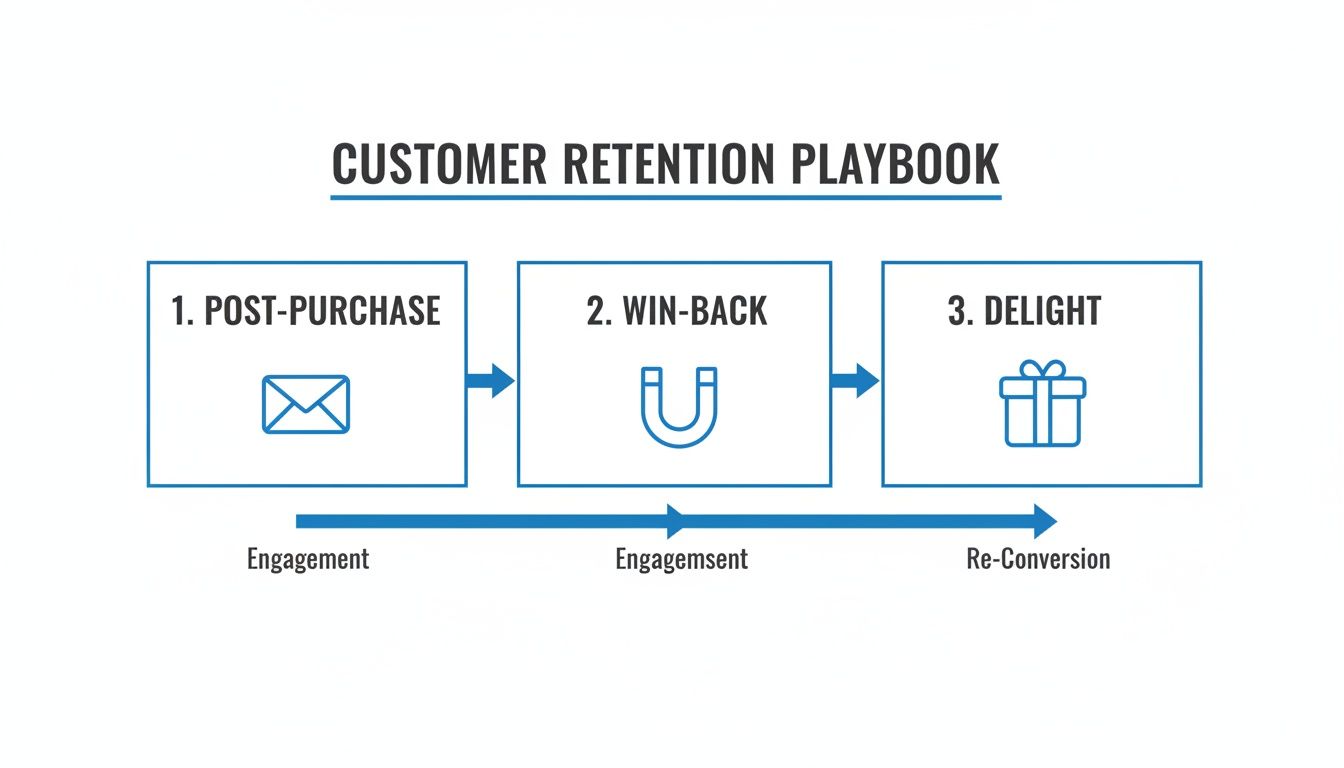
The flow is key: moving from post-purchase engagement to proactive win-back strategies and "surprise-and-delight" moments creates a system for building real, lasting relationships.
Prioritizing Your Retention Initiatives
With so many potential fixes, the biggest challenge is figuring out where to focus your limited time and resources. You need a simple framework for deciding what to tackle first.
The most effective way to prioritize is to weigh the potential impact of an initiative against the effort required to implement it. Always start with the high-impact, low-effort wins.
A simple prioritization matrix is perfect for mapping this out:
- High Impact, Low Effort: These are your quick wins. Think optimizing your post-purchase email flow or adding a simple exit survey to your cancellation page. Do these immediately.
- High Impact, High Effort: These are major strategic projects, like launching a new product line based on customer feedback or overhauling your entire returns process. Plan for these in your quarterly roadmap.
- Low Impact, Low Effort: These are small tweaks that you can get to when you have time, but they shouldn't distract from bigger goals.
- Low Impact, High Effort: Avoid these like the plague. They drain resources with almost no return.
When you connect churn insights directly to your product, UX, and customer service strategies, you stop playing defense. You start building a durable, profitable DTC brand that’s truly centered on the customers you’ve already worked so hard to win. To get a better handle on all this data in one place, see how a unified ecommerce analytics dashboard can bring these insights together.
Common Questions from the Trenches
As a Shopify founder, you're constantly pulled in a million directions, trying to grow the top line without letting the bottom line fall out. Churn is one of those leaky buckets that can silently sink your profitability. It's a huge lever for growth, but it's also where we see the most questions pop up.
Here are a few of the most common ones we hear from operators just like you.
What’s a “Good” Churn Rate, Really?
Honestly, there’s no single magic number. It all depends on your category, price point, and whether you're subscription-based or not.
But for a solid benchmark, a non-subscription DTC brand should aim to keep monthly customer churn under 5-7%. If you’re running a subscription model on Shopify, you need to be even tighter—ideally, well under 5%.
If you're consistently seeing churn rates creeping above 10%, that's a red flag. It’s a sign that something fundamental in your customer experience is off, and it needs your immediate attention. The first step is just to know your number, establish a baseline, and then work to chip away at it every single month.
How Can I Tackle Churn with a Small Team and No Budget?
You don’t need a data science team or a six-figure software budget to make a dent. The trick is to stop trying to do everything and focus your limited resources on the one or two things that will actually move the needle.
- Start with the data you already have. Jump into your Shopify analytics and run a basic cohort analysis. Where’s the biggest drop-off point? If a huge chunk of customers never come back after their first purchase, forget everything else. Pour all your energy into building a killer post-purchase email or SMS flow that hooks them for that second sale.
- Just ask. Seriously. It’s the most underrated, low-cost tactic out there. Send a dead-simple, one-question survey to customers who haven’t come back. "What's the main reason you haven't purchased from us again?" The replies you get will be pure gold.
- Work smarter, not harder. Modern AI-powered analytics tools do the heavy lifting for you, spotting patterns you'd never find in a spreadsheet. This lets a small team punch way above their weight, finding insights without needing a dedicated analyst.
How Does AI Actually Help Reduce Churn?
This is where things get interesting. AI takes churn reduction from a frustrating guessing game to a precise, data-backed strategy. For Shopify brands, it typically helps in three very specific ways:
- It ends the spreadsheet chaos. First, AI tools automatically pull together all your scattered data—Shopify, Klaviyo, Meta Ads, GA4—into one clean, unified view. That alone is a game-changer.
- It sees the future. Instead of just showing you who already churned (which is too late), predictive models analyze thousands of tiny behavioral signals to forecast who is at risk of leaving. This lets you step in and save the relationship before they walk away.
- It gives you the "so what." The best platforms don’t just throw dashboards at you. They deliver plain-English insights and recommend what to do next. You might get an alert like, "Your customers from the last holiday sale are churning 30% faster than average. Consider sending them a targeted win-back offer."
This is the big shift: moving from looking in the rearview mirror to having an AI co-pilot who can see what's coming around the corner. That's the edge modern DTC brands are using to win.
Ready to stop guessing and start growing? MetricMosaic unifies all your data into one story-driven analytics platform, giving you the predictive insights and actionable recommendations you need to reduce churn and maximize profitability.