How AI-Powered Churn Prediction Models Boost Shopify Retention
Learn how churn prediction models stop customer loss for Shopify stores. This guide explains how to use predictive analytics to increase retention and LTV.
Every Shopify founder knows that sinking feeling. You’re checking your reports and realize a once-loyal customer hasn't bought anything in months. You're pushing hard on acquisition, but your growth feels stuck. It’s like pouring water into a leaky bucket—a frustrating cycle that drains your marketing budget and your morale. This isn't just a feeling; it's a critical data problem that directly hits your bottom line.
With customer data scattered across Shopify, Klaviyo, and your ad platforms, seeing the early warning signs of churn is nearly impossible for a busy team. Trying to manually piece together a customer’s journey from a dozen different dashboards is a recipe for missed opportunities and reactive, last-ditch "win-back" campaigns that rarely work.

From Reactive Panic to Proactive Profit
This is where AI-driven churn prediction models change the game for DTC brands. Instead of just guessing who might be slipping away, these models analyze thousands of data points to calculate a precise churn risk score for every single customer. They act as your brand’s early-warning system, flagging subtle changes in behavior that signal a customer is losing interest long before they’re gone for good.
A smart model can spot trends like:
- A slight drop in how often they’ve purchased over the last 90 days.
- Lower-than-average email engagement, even if they still open a campaign now and then.
- A change in the types of products they buy or even just browse.
These signals are invisible to the naked eye but are clear red flags to an AI model. This shift from reactive to proactive is everything. The strategic importance is clear when you look at how other industries tackle retention. For instance, a 2022 analysis found the average annual churn rate in the hyper-competitive SaaS world was 5.6%, but companies using advanced predictive models cut their churn by an average of 15-20% over a year. You can dig into more insights on the impact of churn models on Perceptive-Analytics.com.
By identifying at-risk customers early, you can deploy targeted, automated strategies to save the relationship. This isn't about blasting a generic 10% off coupon; it's about delivering the right message at the perfect moment to protect your hard-earned revenue and boost customer lifetime value (LTV).
So, What Exactly Are Churn Prediction Models?
Let's cut through the jargon. Think of a churn prediction model as an AI-powered early-warning system for your Shopify store. It's like a weather forecast for your customer base—instead of predicting rain, it predicts which customers are about to stop buying from you. This gives you a precious window of opportunity to step in before they walk away for good.
As a DTC founder, you can't possibly keep tabs on every single customer's health manually. You might notice a top-tier customer has gone quiet after a few months, but by that point, it's usually too late. A churn prediction model automates this entire lookout process, and it does it at scale.
Your AI-Powered Customer Detective
Imagine hiring a brilliant detective who can analyze every single clue your customers leave behind. That’s what AI brings to the table. The model digs through thousands of data points from your entire tech stack—Shopify, Klaviyo, and more—to spot the subtle behavioral shifts that signal a customer is losing interest.
These aren't obvious red flags you’d find in a basic report. We’re talking about nuanced, predictive insights that only a machine could ever hope to spot, like:
- The time between a customer's second and third purchase is just a bit longer than your most loyal customers.
- Someone's email click-through rate has dipped by 15% in the last 60 days, even if their open rate hasn't changed.
- A customer who used to buy from three different product categories has only purchased from one in their last two orders.
A human could spend weeks buried in spreadsheets and still never connect these dots. An AI model does it instantly, for every customer, every single day.
Turning Complex Data into Simple Actions
The real magic of modern churn prediction models is that you don't need a data science degree to use them. The whole point of today’s AI analytics tools is to handle all the heavy lifting for you. The model crunches the numbers and runs the statistical analysis behind the scenes.
The output isn't some complex equation or a confusing dashboard. It's a simple, actionable story: "Here are the 250 customers with an 85% or higher chance of churning in the next 30 days."
This completely changes the game. Instead of guessing who might be unhappy, you get a clear, prioritized list of at-risk customers. Your job shifts from tedious data analysis to creative marketing strategy. You can now focus your energy on crafting the perfect win-back campaign, turning a predictive insight directly into protected revenue and higher customer LTV. It's about making proactive retention a core part of your growth engine, not just a reactive afterthought.
Using the Data You Already Have to Predict Churn
You might think building a powerful churn prediction model requires some massive, expensive data setup, something far beyond the reach of a growing Shopify brand. The good news? That’s an old-school myth.
The truth is, your existing tech stack—especially Shopify and your marketing platform like Klaviyo—is already a goldmine of predictive data. All the clues you need about a customer's future are scattered across their purchase history and how they engage with your brand.
The challenge was never a lack of data. It was the soul-crushing, manual effort of piecing it all together. This is exactly where modern AI analytics tools create a massive advantage, automating the work of connecting these different sources into one clear picture of customer risk.
Start with Your Shopify Store Data
Your Shopify admin holds the most fundamental clues about a customer's relationship with your brand. These transactional data points paint a vivid picture of their buying habits and how much they’re worth to you. Any good churn model starts here, looking for the signals that show whether a customer's loyalty is growing or starting to fade.
Some of the most telling Shopify data points include:
- Time Since Last Purchase: This is probably the strongest indicator of churn. When a customer deviates from their normal buying rhythm, they’re often a silent churn risk.
- Order Frequency: How often do they buy over a certain period, like the last 90 days? A sudden drop-off is a huge red flag.
- Average Order Value (AOV): Changes in how much they spend can signal a shift in interest. A customer who starts spending less per order might be losing their connection to your brand.
- Lifetime Value (LTV): High-LTV customers who suddenly start to disengage are your highest-priority saves. You can't afford to lose them.
- Product Categories Purchased: Did a customer who used to buy across multiple categories suddenly narrow their focus to just one? This could mean they're losing interest in your broader product line.
Layer on Your Klaviyo Engagement Data
Transactional data tells you what a customer bought, but engagement data from a tool like Klaviyo tells you how connected they feel to your brand between purchases. This is where you can spot the earliest signs of disinterest, long before a customer misses their next expected order date.
The essential Klaviyo data points are:
- Email Open and Click Rates: A steady decline in how often a customer engages with your campaigns is a classic precursor to churn.
- Time Since Last Engagement: When was the last time they actually clicked a link in one of your emails? A long spell of inactivity is a definite warning sign.
- Segment Membership: Are they part of your VIP segment? A VIP who stops engaging is a major revenue risk.
- SMS Engagement: If you use SMS marketing, tracking click-through rates here gives you another layer of behavioral insight.
Before you can build a reliable churn model, you need to bring all this information together. Below is a quick breakdown of the key data sources you can tap into from your existing DTC tech stack.
| Data Source | Key Data Points / Features | Why It Matters for Churn Prediction |
|---|---|---|
| Shopify | Order History, Time Since Last Purchase, AOV, LTV, Items per Order, Product Categories, Discount Code Usage | This is the bedrock of your model. It tells you what customers do and how valuable they are. Changes in these core behaviors are the most direct signs of churn. |
| Klaviyo | Email Opens/Clicks, SMS Clicks, Time Since Last Engagement, Segment Membership (e.g., VIPs), Campaign Interactions | This data reveals a customer's interest between purchases. A customer who stops opening your emails is often on their way out, even if they just bought last month. |
| GA4 / Web Analytics | Site Visit Frequency, Time on Site, Pages Viewed per Session, Abandoned Carts | This shows you how actively a customer is browsing. A loyal customer who suddenly stops visiting your site is a clear risk, even before their email engagement drops. |
| Customer Support (e.g., Gorgias) | Ticket Volume, Ticket Resolution Time, Support Ticket Sentiment | This uncovers friction points. A spike in support tickets or negative interactions can precede churn, as a poor experience drives customers away. |
By pulling these streams together, you move from isolated data points to a complete, actionable view of each customer. This unified data is what makes a churn model truly effective.
By automatically combining these two data streams, an AI-powered analytics platform like MetricMosaic builds a complete, 360-degree view of each customer. It transforms fragmented data points into a clear, story-driven prediction of future behavior.
The quality of this unified data is what separates a truly effective churn model from a generic one. Research has shown that average churn rates for DTC brands can be as high as 70%. Models trained on real-time, integrated data from sources like Shopify and Klaviyo are vastly more accurate than theoretical academic models.
For example, some academic approaches might predict a 40-70% churn probability for a large group of customers, when in reality, a staggering 88-97% of those customers actually churn. This highlights a critical insight for founders: using your own rich, historical data is the key to creating predictions you can actually trust and act on. You can learn more about Klaviyo's findings on predictive accuracy.
This is why next-generation analytics focus on unifying the data you already have, turning it into your most powerful retention asset.
Comparing Churn Prediction Methods for Shopify
Not all churn prediction methods are built the same, especially for a fast-moving Shopify brand. While some give you a basic starting point, the real power to protect your revenue comes from understanding the subtle, AI-driven signals your customers send every day.
Let's walk through the common methods, from the old-school manual baseline to modern, AI-powered models that do the heavy lifting for you.
The Old School Way: Manual RFM Scoring
For years, DTC brands have leaned on RFM (Recency, Frequency, Monetary) scoring. It’s a straightforward, manual way to segment customers based on three simple questions:
- How recently did they buy?
- How frequently do they buy?
- How much money have they spent?
The process usually involves exporting your Shopify data into a spreadsheet, assigning scores (say, 1-5) for each R, F, and M category, and then grouping customers. A "555" is your champion—they bought recently, buy often, and spend a lot. A "111" is likely gone for good.
But here’s the problem: RFM is like looking at a static snapshot. It tells you where your customers were, not where they’re headed. It completely misses the subtle behavioral shifts that happen long before a customer decides to stop buying.
The AI Advantage: Machine Learning Models
This is where AI-driven churn prediction models flip the script. Instead of a static snapshot, a machine learning model is like a full-motion video of each customer’s journey. It analyzes thousands of data points—not just three—to spot hidden patterns that simple scoring misses entirely.
This is what a modern, automated workflow looks like. Data flows from your core platforms like Shopify and Klaviyo into a central AI model that does the predictive work for you.
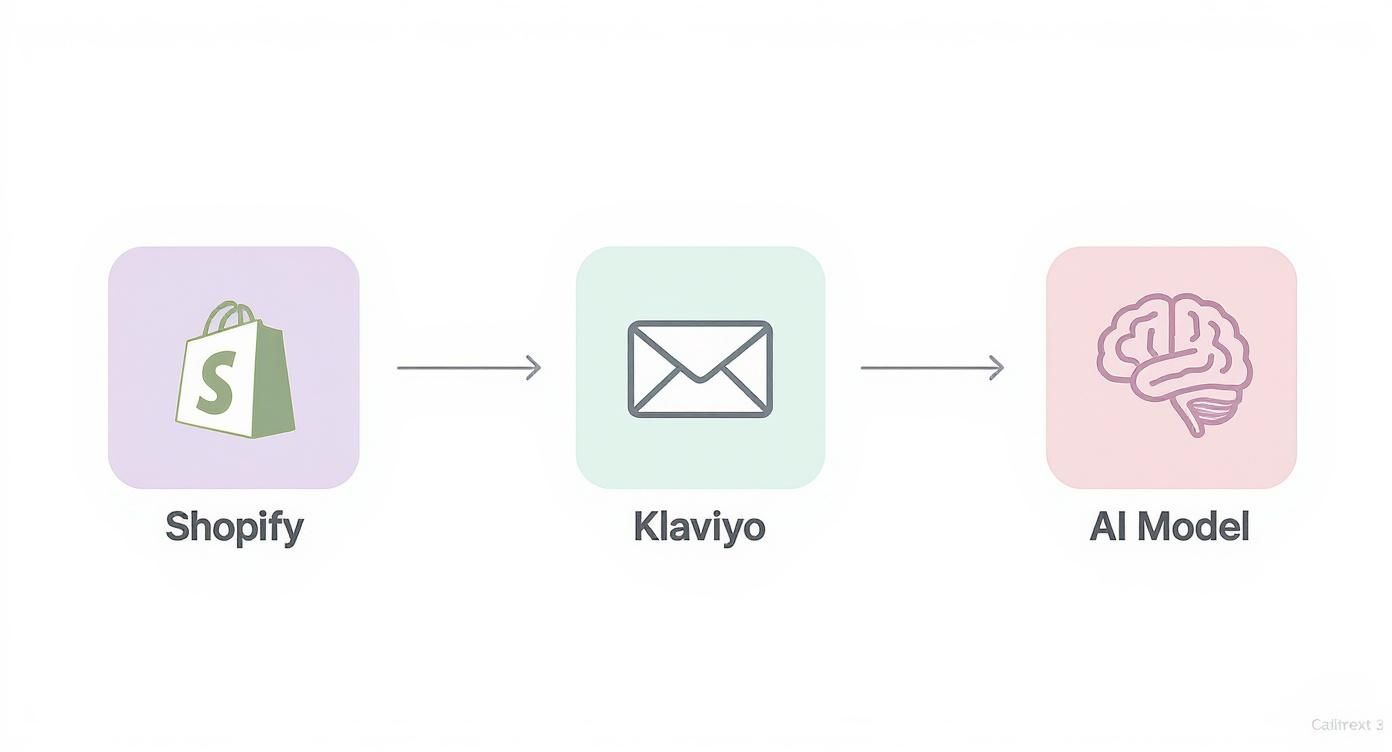
This seamless integration is crucial. It lets the AI see the whole story—from purchase behavior to email engagement—which leads to far more accurate and actionable predictions.
Churn Prediction Methods at a Glance
So, how does the classic RFM approach stack up against modern AI? Here’s a quick comparison for DTC and Shopify brands.
| Method | How It Works | Pros for DTC Brands | Cons for DTC Brands |
|---|---|---|---|
| RFM Scoring | Manually segments customers based on Recency, Frequency, and Monetary value. | Simple to understand and implement with basic spreadsheet skills. A good first step beyond no segmentation at all. | It's a rearview mirror—describes past behavior, doesn't predict future actions. Misses crucial non-transactional signals. |
| AI/Machine Learning | Automatically analyzes thousands of behavioral and transactional data points to predict future churn probability for each customer. | Highly accurate and predictive. Uncovers hidden patterns and identifies at-risk customers before they leave. Continuously learns and adapts. | Can seem complex or require specialized tools. Perceived as a "black box" without the right analytics platform. |
While RFM has its place, it’s a tool from a different era. To get ahead today, you need a system that anticipates the future instead of just summarizing the past.
Different Flavors of Machine Learning
Even within AI, models come in different shapes and sizes. Machine learning algorithms have become the gold standard for their raw accuracy. Depending on the richness of your Shopify data, it's common for models to achieve 80-90% accuracy in predicting churn.
More advanced algorithms can capture complex, non-linear relationships, with some studies showing accuracy hitting 92%—a level of precision manual analysis could never dream of. You can read more about the effectiveness of different machine learning models at Pecan.ai.
The best part? You don't need to be a data scientist to make this work for you.
AI-powered analytics platforms like MetricMosaic handle all the complex modeling behind the scenes. They automatically connect to your Shopify and Klaviyo data, run the predictions, and serve up a simple, actionable list of at-risk customers.
This turns what used to be a massive data science project into a straightforward marketing action. You can finally save customers you didn't even know were about to leave. By identifying these high-risk segments, you can trigger targeted Klaviyo flows or build exclusion audiences for ad campaigns, directly protecting your LTV and boosting profitability.
How to Turn Churn Predictions Into Profit
An accurate churn prediction model is like having a crystal ball—it gives you a glimpse into who’s about to leave. But that knowledge is completely useless if you don't do anything with it. This is where the magic happens, bridging the gap between a predictive insight and a campaign that protects your revenue and boosts LTV.
The goal is to shift from just watching the numbers to proactively automating your response. Your model’s predictions should kick off a sequence of events across your marketing stack, creating personalized re-engagement journeys for customers who are on their way out. This isn't about firing off a one-off campaign; it's about building a systematic, always-on retention engine for your Shopify store.

Step 1: Create Dynamic Customer Segments
First, turn those raw churn risk scores into actionable segments. Don't just lump everyone into a generic "At-Risk" bucket. Get specific. A modern analytics platform lets you create dynamic segments that are constantly updating in real-time as the predictions roll in.
A few powerful segments you’ll want to build are:
- High-Risk VIPs: These are your big spenders, the high-LTV customers who are suddenly showing an 80% or higher chance of churning. Losing them stings the most, so they immediately become your top priority.
- At-Risk First-Time Buyers: A new customer who hasn't come back for that crucial second purchase and gets flagged as high-risk needs immediate attention to build early loyalty.
- Wavering Regulars: Think of these as your regulars who've been consistent but are now showing a 50-70% churn probability. They're on the fence, and a gentle nudge might be all it takes to bring them back.
These segments aren't static lists; they're the living fuel for all your retention marketing, automatically syncing with the tools you use every day.
Step 2: Trigger Automated Klaviyo Flows
With your dynamic segments ready, it’s time to put them to work in Klaviyo. The idea is simple: create automated email and SMS flows that are triggered the very moment a customer lands in a high-risk segment.
This is what proactive retention looks like. You're not waiting for a customer to disappear for 90 days. You’re reaching out the instant the AI model spots the first signs of them drifting away.
Here are a few proven flows you can set up right away:
- The VIP Check-In: For your "High-Risk VIPs," trigger a simple, plain-text email that looks like it came directly from the founder. No flashy graphics, no discounts. Just a quick, "Hey [First Name], just wanted to personally check in and see how you're doing. Anything we can help with?" This personal touch works wonders.
- The Second-Purchase Nudge: Go after your "At-Risk First-Time Buyers" with a flow that shows off your bestsellers, features great user-generated content, and gives them a compelling reason to come back—maybe a small, exclusive discount or free shipping.
- The Gentle Reminder: For the "Wavering Regulars," a friendly campaign reminding them of their loyalty points, showing new arrivals in their favorite categories, or even a simple "We Miss You" message can be surprisingly effective.
Step 3: Refine Your Acquisition Strategy
Finally, the insights from your churn prediction models are a goldmine for smarter customer acquisition and a better ROAS. It's about creating a powerful feedback loop where your retention data makes every dollar of your ad spend work harder.
Here's how to connect the dots:
- Build High-Value Lookalike Audiences: Take that segment of your loyal, low-churn customers—your true brand fans—and use it to create lookalike audiences on platforms like Meta or Google. You're telling the ad platforms, "Go find me more people who look just like my best customers." This is a game-changer for improving targeting and bringing down your CAC.
- Create Exclusion Audiences: On the flip side, take the segments of customers who churned fast or are consistently flagged as high-risk. Add them to an exclusion list for your top-of-funnel acquisition campaigns. Why spend money trying to re-acquire people who've already shown they aren't the right fit for your brand?
When you put these steps into action, you turn a predictive model from a number on a dashboard into a powerful, automated system that not only saves customers but makes your entire growth engine more efficient.
Putting Your Churn Prediction Model to Work
Alright, we've walked through the what, why, and how of predicting customer churn. Now it’s time to move from theory to action. This whole discussion is really about driving home one critical point for every ambitious Shopify brand: fighting churn isn't a luxury reserved for giant companies with data science departments.
Modern AI analytics platforms were built for DTC founders and marketers—people who want to make data-driven decisions without getting lost in spreadsheets. The tools to transform your raw Shopify and Klaviyo data into a revenue-saving weapon are right at your fingertips. It’s about giving you a genuine competitive advantage.
Stop Reacting and Start Retaining
The old-school approach to churn is completely reactive. You wait for someone to go dark for 90 days, then you hit them with a generic "we miss you" email and a flimsy 10% discount. By then, it's almost always too late. They've moved on or forgotten why they liked your brand in the first place. That’s a losing game that torches your marketing budget.
This is where AI-driven churn prediction models flip the script. They let you get ahead of the problem by spotting the faint signals of disengagement weeks—sometimes even months—before you’d traditionally label a customer as "churned." That early warning gives you a golden opportunity to step in with smart, personalized campaigns that save the relationship and protect your LTV.
The goal isn't just to build a model; it's to build a proactive retention engine. Think of it as an automated system that uses predictive insights to send the right message to the right customer at the perfect moment. It turns your everyday store data into your most valuable asset.
Your Next Step Toward Smarter Growth
Every single day, your Shopify store is collecting thousands of data points. These are clues telling you what your customers love, what they’re ignoring, and who is quietly slipping away. The question isn't whether you have enough data to predict churn. It's whether you have the right tools to turn that data into real action.
Instead of spending another quarter trying to acquire your way out of a leaky bucket, you can start building a more stable, profitable foundation for your brand. This means shifting your focus from chasing new customers at any cost to maximizing the value of the ones you've already worked so hard to win over.
Platforms like MetricMosaic are designed to bridge this exact gap. They do the heavy lifting—all the complex data science—behind the scenes. What you get are clear, story-driven insights that tell you exactly which customers are at risk and why. Your job shifts from data analyst to growth strategist, armed with powerful predictive tools to secure your revenue and build lasting customer loyalty. The era of guesswork is over. Proactive, data-driven retention is here.
Common Questions About Churn Prediction
Getting started with predictive analytics always brings up good questions. Here are a few of the most common ones we hear from Shopify founders, answered in plain English.
Just How Accurate Are Churn Models for Ecommerce?
For DTC brands, a well-built model is surprisingly accurate—often hitting 80-90% precision or higher. The secret isn't some black-box magic. It's all about the quality and richness of the data you feed it.
The best churn prediction models don't just look at what someone bought; they connect the dots between your Shopify and Klaviyo data. By seeing both purchase history and how customers are engaging (or not engaging) with your marketing, the AI builds a much deeper understanding of loyalty. This is why it works so well—the model learns the unique rhythm of your customers, delivering predictions you can actually trust.
Do I Really Need to Hire a Data Scientist?
Not anymore. While building a churn model from scratch is a job for a specialist, modern AI analytics platforms handle all the complex data science for you.
These tools are built to automate the whole process, from cleaning and connecting your Shopify and Klaviyo data to training the model and outputting simple churn risk scores. This completely flips the script on your role. Instead of getting lost in the technical weeds, you get to be the strategist, using the insights to build smarter campaigns in the tools you already use every day.
How Fast Will I See Results?
You can start seeing a payoff almost immediately. As soon as the model flags your first group of at-risk customers, you can have a re-engagement flow ready to go in Klaviyo.
The first wins, like better open rates and a few saved sales from those specific campaigns, often show up within weeks. The bigger-picture impact—a real, measurable lift in customer lifetime value (LTV) and your overall retention rate—starts to become clear over the first few months as you consistently get ahead of churn.
Can This Actually Help with Customer Acquisition?
Absolutely. It might seem counterintuitive, but your churn prediction models are a secret weapon for smarter acquisition and better ROAS. Once you know the behavioral DNA of your most loyal, low-churn customers, you have the perfect blueprint for your ad targeting.
You can take those characteristics and build high-powered lookalike audiences on platforms like Meta. This means your ad dollars are aimed squarely at people who look just like your best customers. The result? Better ROAS, a lower customer acquisition cost (CAC), and a much more efficient growth engine.
Ready to stop reacting to churn and start proactively protecting your revenue? MetricMosaic unifies your Shopify data and uses AI to deliver clear, actionable churn predictions. Turn your data into your most powerful retention tool. Start your free trial today.