How to Improve Customer Retention for Shopify and DTC Brands
Discover how to improve customer retention with our data-driven guide. Learn actionable strategies to boost LTV and profitability for your Shopify or DTC brand.
Improving customer retention isn't just about loyalty programs or the occasional discount code. For a modern Shopify brand, it’s a full-blown system built on data: measuring what truly matters (like cohort retention and churn), figuring out why customers are leaving, and then building automated campaigns to keep them around. The real goal is to shift from putting out fires to proactively building a loyal customer base that maximizes Customer Lifetime Value (LTV).
Moving Past the Leaky Bucket in DTC Growth

If you're running a Shopify brand, this probably sounds familiar. You spend a ton on acquisition, pouring new customers into the top of your funnel, only to watch your hard-earned profits seep out as existing customers quietly disappear. You're bouncing between Shopify reports, GA4, and Meta Ads Manager, trying to stitch together a coherent story, but the data is fragmented, reports feel unreliable, and the true ROI is a constant question mark.
This guide is designed to plug that leak for good. We’re not talking about gimmicks; we're talking about turning retention into your most powerful engine for sustainable, profitable growth. It’s about creating a business where every dollar you spend bringing someone in generates compounding returns over their entire lifetime with your brand.
The Real Cost of Neglecting Retention
The day-to-day reality of running a DTC brand means your data is scattered everywhere. This fragmented view almost always hides the true cost of churn.
In the cutthroat eCommerce world, where the average customer retention rate is a dismal 38%, the brands winning are the ones who can spot churn risks early. The numbers don't lie: a tiny 2% increase in retention has the same bottom-line impact as slashing your costs by 10%.
For Shopify and DTC brands, this is where the money is. Returning customers aren't just loyal; they spend 67% more than new ones and drop 31% more per transaction. You can dig deeper into these eCommerce retention stats at focus-digital.co.
From Guesswork to a Growth Engine
It's time to move beyond guesswork. This guide will show you how AI-powered analytics can finally unify that data chaos, turning complex retention numbers into clear, actionable levers you can pull to grow your business. We’ll walk through a data-driven path to:
- Measure What Matters: Forget vanity metrics. We'll dive into true customer health with cohort analysis and LTV.
- Diagnose Churn Drivers: Use AI-powered analytics to understand why customers are leaving before they're actually gone.
- Build an Automated System: Create personalized lifecycle campaigns that engage customers at exactly the right moment.
- Optimize the Entire Journey: Fine-tune the post-purchase experience to build genuine, lasting loyalty.
We're going to stop chasing new customers at all costs and start building a resilient business powered by the people who already know and love what you do.
Building Your Foundation by Measuring What Matters

If you want to actually improve customer retention, you have to stop guessing. It's time to start measuring what’s really driving growth. So many Shopify brands get fixated on surface-level stats like repeat purchase rate, but that metric barely tells you anything.
The real story—the actual health of your customer base—is buried a layer deeper.
This means you have to graduate from basic Shopify reports. The goal isn't just to see if people come back; it's to understand when they come back, why they come back, and for how long they stick around. That’s where the gold is.
Unpacking Cohort Analysis: The Story of Your Customers
The single most powerful tool in your retention toolkit is cohort analysis. It sounds more complicated than it is. A cohort is just a group of customers who all made their first purchase in the same month. You then track that group's buying behavior over time. Simple.
Instead of one generic, blended repeat rate, you get a crystal-clear view of how different groups of customers behave. A cohort report can instantly show you that customers acquired during a big November sale have a much lower lifetime value than those who found you organically in October. This is the kind of story your data should be telling you—a clear signal of what’s working and what’s not.
Now, you could try to build these reports in a spreadsheet. I'll save you the trouble: it’s a nightmare. It means wrestling with massive CSV exports from Shopify, dealing with complex formulas, and practically guaranteeing some kind of human error along the way. It’s slow, mind-numbingly tedious, and by the time you finally get an answer, your data is already stale.
AI-powered analytics platforms like MetricMosaic automate this whole mess. Instead of manual data crunching, you get live, dynamic cohort reports with one click. You can instantly compare customer groups and spot retention problems without ever having to open a spreadsheet.
From Manual Calculations to Predictive Power
Beyond cohorts, two other metrics are absolutely critical for any DTC brand: Customer Lifetime Value (LTV) and churn rate. LTV tells you how much a customer is worth over their entire relationship with you, while churn tells you how fast you're losing them.
To get this right, knowing How To Calculate Customer Retention Rate is an essential starting point. But just like with cohorts, trying to do this manually is a deeply flawed approach. Traditional LTV formulas are stuck looking in the rearview mirror, using historical averages that fail to account for today's market trends or shifts in customer behavior.
This is where AI changes the game completely. Instead of just looking backward, AI models generate predictive LTV. They analyze hundreds of data points—purchase frequency, AOV, product categories, email engagement—to forecast the future value of your customers with stunning accuracy.
The table below breaks down just how different these two approaches are.
Essential Retention Metrics: Manual vs. AI-Powered Approach
| Metric | Manual Method (Spreadsheets) | AI-Powered Method (MetricMosaic) | Key Benefit of AI |
|---|---|---|---|
| Cohort Analysis | Exporting massive CSVs; complex VLOOKUPs and pivot tables. Time-consuming and error-prone. | One-click, automated report generation. Visually compares cohorts instantly. | Speed & Clarity: Get immediate insights instead of spending hours on data prep. |
| Customer Lifetime Value (LTV) | Calculating historical averages; a backward-looking metric that's often inaccurate for new customers. | Generates predictive LTV based on hundreds of behavioral signals. Forward-looking. | Proactive Strategy: Forecast future revenue to make smarter decisions on ad spend and budget. |
| Churn Rate | Manually calculating the percentage of customers lost over a specific period. It's reactive. | Monitors leading indicators of churn risk in real-time and identifies at-risk segments. | Early Intervention: Spot churn before it happens, giving you time to launch win-back campaigns. |
This shift from historical reporting to predictive forecasting is a massive advantage for Shopify brands. It empowers you to:
- Spot Your VIPs: Instantly see which customer segments have the highest predicted LTV so you can double down on acquiring more people just like them.
- Optimize Ad Spend: Make smarter calls on your customer acquisition cost (CAC) by knowing the true future value of the customers you're paying to acquire.
- Proactively Fight Churn: Get an early warning when a segment’s LTV starts to dip, giving you a chance to step in with a targeted offer before it’s too late.
Ultimately, the goal here is to get out of the data-crunching business and into the decision-making business. AI-powered analytics platforms that surface these insights for you provide the clarity you need to build a lasting, profitable brand. For a deeper look, you can explore more about these foundational client retention metrics and how they directly impact your bottom line.
Using Predictive Analytics to Figure Out Why Customers Leave
Knowing your retention and churn rates is a great start, but it really only tells you what is happening. It doesn't tell you why. Why are customers from that big summer sale leaving at twice the rate of your organic traffic? Why do customers who buy Product X never seem to come back for a second purchase?
To get to the bottom of it, you need to understand the why. This is where the diagnostic power of AI becomes a total game-changer for Shopify brands. It shifts you from reacting to stuff that already happened to proactively understanding what's about to happen. Instead of just seeing that a customer has already churned, you can now predict which ones are likely to churn and step in before they’re gone for good.
Predictive models are designed to sift through thousands of data points across your entire store—purchase history, product interactions, email engagement, you name it. They find the subtle, almost invisible behavioral patterns that signal a customer is losing interest. This isn't about guesswork; it's data science making complex connections that a human analyst could never spot staring at a spreadsheet all day.
From Hidden Signals to Actionable Alerts
For a busy DTC founder, this means you can finally stop spending hours crunching data and instead get automated, forward-looking insights. The whole point is to get a proactive alert that tells you something critical, letting you take immediate action.
Picture this: you just wrapped up a major Meta Ads campaign. A week later, you get an alert. Your AI-powered analytics platform has identified a specific group of customers—first-time buyers from that campaign who bought a particular clearance item—and slapped them with a 70% churn probability. The AI noticed their time-on-site was low and they never even opened your welcome email.
This is the new reality of retention marketing. Instead of waiting three months to realize that campaign was a bust in your cohort analysis, you get an early warning signal. You can finally shift from a reactive "win-back" strategy to a proactive "save" strategy.
This capability completely transforms how you think about your marketing and operations. You can finally connect the dots between acquisition channels, what people buy first, and how much they're worth to you over time.
Common Churn Triggers for DTC Brands
AI models are incredibly good at digging up these risk factors, which for most ecommerce brands, usually fall into a few key categories:
- Post-Purchase Dissonance: A customer’s first experience after clicking "buy" is everything. Long shipping times, a clunky returns process, or just plain bad communication can create instant buyer's remorse and kill any chance of a second purchase.
- Product-Market Misfit: The data might show that customers who buy a specific, heavily discounted "entry-level" product almost never move on to your core, full-price items. That's a huge red flag signaling a disconnect between that product and what your ideal customers actually want.
- Misaligned Marketing Messages: An aggressive sale might drive a spike in orders, but if the discount-chasers it attracts don't really care about your brand's actual value, their LTV will be low and their churn rate will be high.
- Lack of Engagement: Sometimes it's the simple things. A customer who hasn't opened an email in 60 days or visited your site since their first purchase is a clear churn risk. These behavioral cues are powerful predictors.
Without AI, spotting these connections requires hours of manual work. With it, these insights are surfaced automatically, often presented as clear, story-driven narratives. You can dive deeper into how these models work and learn more about predictive analytics for eCommerce to see how they apply to your own growth challenges.
Connecting Predictive Insights to Your Marketing Stack
Now, the real magic happens when you connect these predictive insights directly to your marketing tools. It’s one thing to know a group of customers is at risk; it’s another to automatically do something about it.
Modern analytics platforms can integrate directly with tools like Klaviyo or Attentive. When the AI flags a high-value customer as having a high churn probability, it can automatically add them to a specific "At-Risk VIPs" segment in your email platform.
This can then trigger a pre-built, targeted workflow designed to re-engage them. Maybe it's an exclusive offer, a survey asking for feedback (with an incentive), or a personal message from your support team. You’re no longer sending generic "we miss you" emails to people who are already long gone. Instead, you're delivering the right message to the right person at the exact moment it can make a difference. This is how you build a retention engine that actually runs itself.
Automating Your Retention Engine for Maximum Impact
Having clean data and a solid diagnosis of why customers are leaving is a huge win. But here's the thing—insights don't pay the bills. The real growth kicks in when you translate those insights into an intelligent, automated machine that works for you 24/7.
This isn't just about reacting to churn; it's about getting ahead of it. It’s time to close the gap between knowing what to do and actually getting it done, moving from building campaigns by hand to deploying a smart, trigger-based retention engine.
Building Proactive, Personalized Lifecycle Campaigns
The old playbook was all about generic "win-back" flows that blasted the same offer to every lapsed customer. That's just not good enough anymore. The modern approach is way more precise, connecting predictive analytics directly to your marketing stack—think tools like Klaviyo or Attentive—to create hyper-targeted campaigns.
These campaigns aren't based on guesswork. They're triggered by specific customer behaviors and AI-generated forecasts, turning your Shopify store data into something powerful.
The goal is to deliver the perfect message to the right customer at the exact moment it matters most. Instead of a generic discount, you can send a personalized offer based on a customer's unique history and predicted future value.
This proactive approach, visualized below, maps out a simple but powerful flow: collect data, use AI to predict what happens next, and then take automated action.
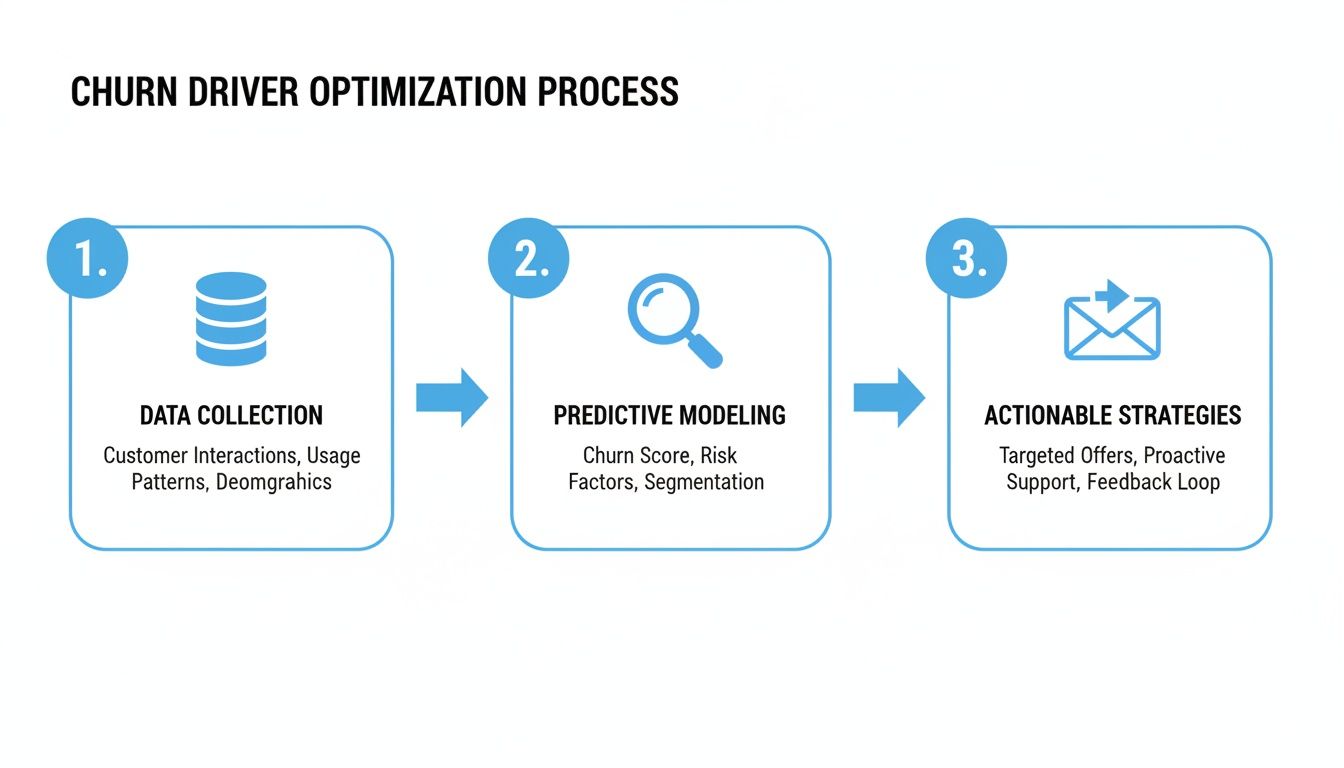
This process transforms retention from a reactive guessing game into a proactive strategy that directly boosts your bottom line.
Real-World Examples of Automated Retention Flows
Okay, let's get out of the clouds and into practical examples. Here’s how a modern DTC brand can put this into action:
The Predictive LTV Welcome Series: Forget the one-size-fits-all welcome email. Imagine a dynamic flow where a customer with a high predicted LTV gets an exclusive offer for a complementary product, while a lower-value customer gets the standard greeting. You're strategically investing your best offers where they'll have the biggest impact, directly improving ROAS.
The High-Value Churn-Risk SMS Flow: Your system flags a high-LTV customer who hasn't purchased in 45 days—but their typical buying cycle is 30. This instantly triggers an SMS campaign through Attentive with a personalized nudge, like early access to a new drop you know they'll love based on their purchase history.
The Post-Purchase Upsell Trigger: A customer just bought your hero product. Your data shows that 70% of customers who buy this item come back within 21 days for a specific accessory. On day 14, an automated email lands in their inbox showcasing that exact accessory. Boom. You just turned a one-off purchase into a predictable repeat order, boosting AOV.
These aren't futuristic ideas. They're actionable playbooks you can run today. This level of automation frees your team from the tedious work of manual segmentation so you can focus on strategy while the system executes flawlessly.
Using Conversational Analytics to Fuel Your Campaigns
One of the most exciting shifts in this space is the rise of conversational analytics. For Shopify founders who aren't data scientists, this is a total game-changer. Instead of wrestling with complex reports, you can just ask your data questions in plain English.
It’s like having an analyst on your team who gives you instant answers. Next-gen platforms like MetricMosaic bake this right in, where you can type things like:
- "Which products do my top customers buy on their second order?"
- "Show me the LTV of customers we got from our last Meta Ads campaign."
- "What's the average time between first and second purchases for customers in California?"
The answers are immediate and clear. You can take the answer to that first question—"Our top customers often buy Product Y on their second order"—and jump straight into Klaviyo to build a post-purchase flow that encourages exactly that.
This completely removes the friction between finding an insight and acting on it. It’s the fastest way to turn your store’s data into a competitive advantage and a core part of systematically improving customer retention.
Crafting an Unforgettable Post-Purchase Experience
Here's a hard truth: lasting loyalty isn't won in the marketing funnel. It's forged in the moments after a customer hits 'buy'. Your automated campaigns are vital, sure, but the real test of your brand happens when the package lands on their doorstep.
This is your single biggest chance to blow past their expectations. It’s where you turn a simple transaction into a memorable event and build a genuine connection that data alone can't create. For Shopify brands, this means engineering a journey that feels personal, delightful, and reassuring from checkout to unboxing and beyond.
Elevating the Unboxing Moment
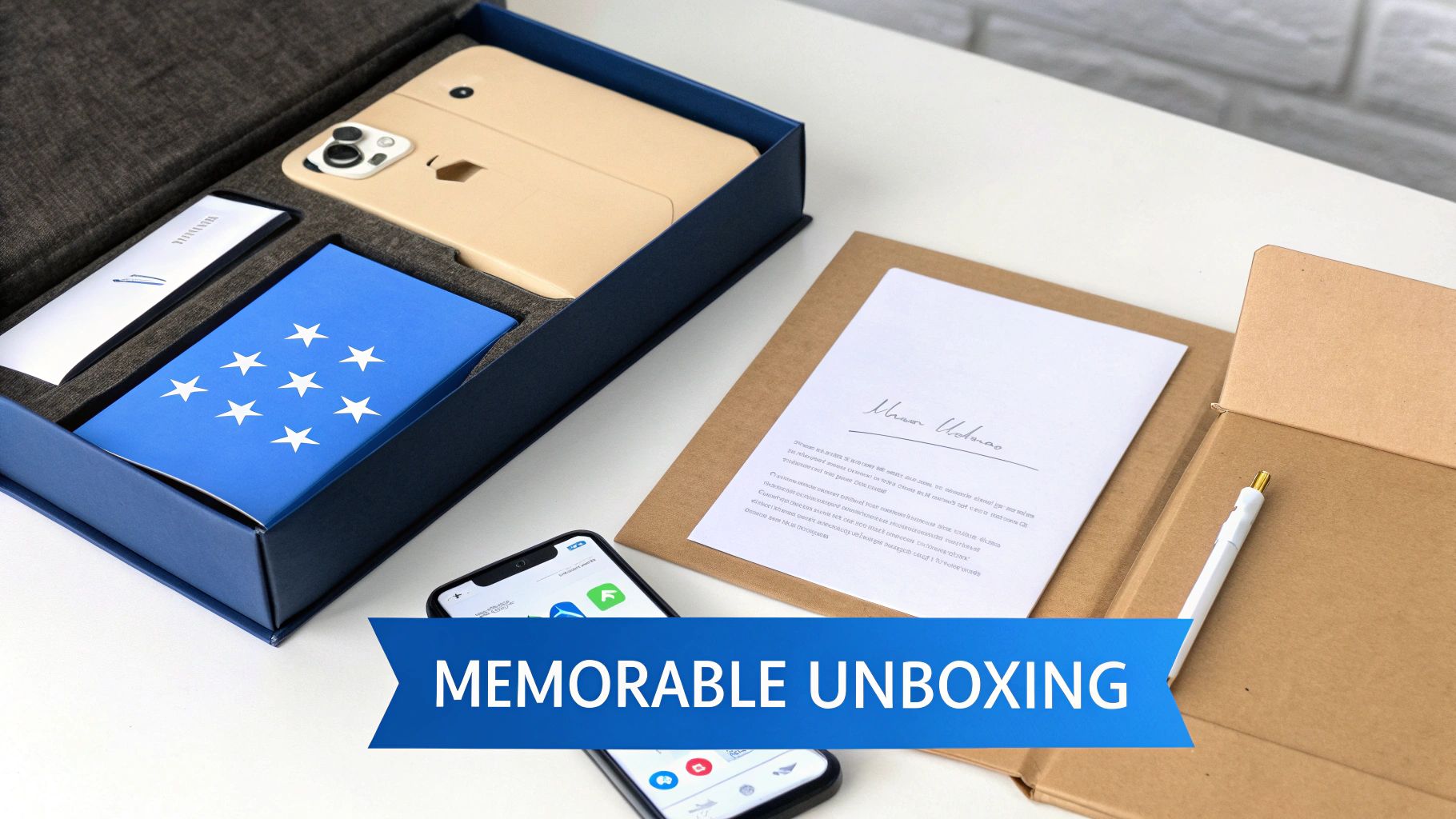
Think of the unboxing experience as the physical handshake from your brand. It’s a powerful, tangible touchpoint that can create an immediate emotional bond. A plain brown box with a product tossed inside says one thing; a beautifully packaged item with thoughtful details says something else entirely.
Making this moment count doesn't have to break the bank. It's about small, high-impact additions:
- A Personalized Note: A simple, handwritten-style thank you card that uses the customer's name makes them feel seen. It's shockingly effective.
- Branded Inserts: Include a small card with care instructions, a snippet of your brand story, or a QR code linking to a "how-to" video.
- A Surprise & Delight Element: A small, unexpected freebie—a sample of a complementary product or even a branded sticker—can create a moment of genuine joy.
The key here isn't expense; it's thoughtfulness. You're showing customers you care about their experience, not just their order number. It's a foundational step that far too many brands overlook.
From Proactive Support to Building a Community
Beyond the box, your communication and support are where you truly solidify trust. An incredible product can be instantly soured by a slow or unhelpful support interaction. To get this right, you have to be proactive.
A common mistake DTC founders make is treating customer service as a cost center. It's not. It's a retention engine. Every support ticket is a chance to reinforce a customer's decision to buy from you.
To really nail this, you should master e-commerce customer service that builds loyalty by guiding shoppers through their entire journey. This means using your data to anticipate what they need. If you know a product has a slight learning curve, why not proactively send an email with tips three days after it's delivered?
This is also the perfect time to invite them into your world. Encourage customers to join a VIP Facebook group, follow you on social for exclusive content, or sign up for a loyalty program. This transforms a one-time buyer into a brand advocate. By making them feel like an insider, you give them a powerful reason to stick around. You can dive deeper into how data drives this journey with customer experience analytics.
Leveraging Data to Build Loyalty Programs That Work
Speaking of loyalty programs, their power is undeniable. This market is projected to become a $41.2 billion industry by 2032, largely driven by the demand for smarter personalization. While 74% of consumers say they're loyal to at least one brand, eCommerce retention still struggles.
The real leverage is this: repeat customers can be worth up to 10x their initial purchase over their lifetime.
The key is building a program that feels valuable, not just transactional. Use your data to create meaningful tiers and rewards that actually resonate.
- Market Basket Analysis: AI-driven tools like MetricMosaic can analyze purchase data to reveal which products are frequently bought together. Use this insight to offer relevant product bundles as a "thank you" or a loyalty reward.
- Segmentation for VIP Tiers: Don't offer the same perks to everyone. Identify your highest LTV customer segments and create an exclusive VIP tier for them with real benefits like free shipping, early access to new products, or dedicated support.
This data-driven approach ensures your loyalty efforts aren't just a shot in the dark. They become targeted and effective, turning a customer’s first purchase into the beginning of a long, profitable relationship.
Turning Retention Insights into Your Competitive Edge
We’ve covered a lot of ground, walking through the modern playbook for customer retention—from getting your measurement right and using AI to diagnose churn, all the way to building smart automation. If there’s one thing to take away, it’s that the DTC brands that are winning are the ones using their data to build better, more meaningful relationships.
It’s time to stop guessing. Your Shopify store’s data is your most powerful growth asset. Let’s put it to work.
The Power of a Superior Customer Experience
Ultimately, all these data points lead back to one thing: delivering a superior customer experience (CX). It really is the ultimate lever for retention. In fact, 44.5% of organizations now point to it as their number one differentiator.
This isn’t just about making people feel good; it drives real results. Customers who have a positive experience are willing to spend 140% more. You can dig into the specifics in this Sprinklr report on customer retention statistics.
In a world where 89% of companies now compete primarily on the basis of customer experience, leveraging your data to create standout moments is no longer optional—it's essential for survival and growth.
This is exactly how you build a real, lasting competitive advantage. By turning raw numbers into a clearer picture of what your customers actually want and need, you can start making smarter decisions across the entire business. Think of AI-driven analytics as your trusted co-pilot, turning complexity into clarity and action.
For a deeper look into the mechanics of this, check out our guide on advanced lifetime value modeling.
Common Questions Answered
What’s a Good Customer Retention Rate for a Shopify Store?
Everyone wants that magic number, but the truth is, while the industry often floats 35% as a "good" benchmark for DTC, fixating on a single number misses the point.
The real goal isn't just to hit a static benchmark—it's to see your retention improving. Are this month's new customers sticking around longer than last month's? That's the question that matters. A smart analytics tool will let you compare retention across different customer cohorts. This shows you whether your strategies are actually working and what's really making people loyal to your specific brand.
How Soon Should I Start Focusing on Customer Retention?
From day one. Seriously. From your very first order.
Retention isn't some advanced tactic you switch on after you hit a certain revenue milestone. It's a mindset that needs to be baked into your business from the start.
Think about it: building a great post-purchase experience, asking for feedback, and keeping an eye on who comes back for a second purchase—all of this creates a powerful growth loop. Even with a small customer base, those early data points are gold. They tell you exactly why your best customers are choosing you again and again, giving you the blueprint for a profitable brand right from the ground up.
Can AI Really Predict Which Customers Will Churn?
Yes, and it's remarkably accurate. AI and machine learning models are built for this kind of work. They can sift through hundreds of signals—things like the time between purchases, average order value, the products someone buys, and whether they open your emails—to spot the subtle changes in behavior that signal a customer is about to leave.
This isn't just a vague guess, either. A modern platform can give you a specific churn probability score for every single customer. This is a game-changer. It means you can stop reacting and start being proactive. Reach out to those at-risk customers with a thoughtful offer or a bit of extra support before they're gone, and you can often turn a potential loss into one of your most loyal fans.
Ready to turn your Shopify store's data into your most powerful growth asset? MetricMosaic is the AI-powered analytics co-pilot built for DTC brands like yours. Unify your data, get predictive insights, and build a retention engine that drives real profit.
Start your free trial today and see the story your data is waiting to tell you.