Unlocking Shopify Growth with Lifetime Value Modeling
Discover how lifetime value modeling transforms your Shopify data into predictable revenue and smarter ad spend. Learn practical AI strategies for DTC growth.

Lifetime value modeling is all about predicting the total profit you can expect from a single customer over their entire relationship with your brand. For a Shopify store, this means looking past a single sale to forecast the entire future revenue a new customer will generate. It's how you turn historical data into a powerful tool for real, strategic growth.
Stop Guessing and Start Predicting Your Shopify Revenue

Running a Shopify store often feels like you're navigating a storm with a broken compass. You see revenue coming in, but the path to sustainable profitability is foggy. You’re pouring money into Meta and Google ads, but are you acquiring customers who will actually fuel long-term growth, or just one-and-done buyers who disappear after the first purchase?
This uncertainty is a massive hurdle for growing DTC brands. Relying on surface-level metrics like first-purchase Average Order Value (AOV) or daily Return on Ad Spend (ROAS) can be dangerously misleading. Your data is fragmented across a dozen different apps, making reports unreliable and leaving you with an unclear picture of your true ROI.
The Problem with Short-Term Metrics
Focusing only on immediate returns creates a risky cycle. You might celebrate a campaign with a low initial Customer Acquisition Cost (CAC), only to find out those "cheap" customers never come back.
Meanwhile, a different campaign with a higher initial CAC might be acquiring customers who make multiple purchases a year, becoming your most profitable segment over time.
Without a forward-looking view, you're essentially flying blind, making critical budget decisions based on an incomplete story. This is where lifetime value modeling changes the game.
Key Takeaway: Lifetime value (LTV) modeling shifts your focus from short-term transactions to long-term customer relationships. It's the difference between asking, "How much did we make today?" and "How much will this customer be worth to us over the next year?"
A Smarter Way to Measure Growth
Imagine knowing, with confidence, which marketing channels consistently deliver customers with the highest future spending potential. That's the clarity LTV modeling provides. Instead of just tracking sales, you start understanding the real, underlying value of your customer base.
This strategic shift allows you to answer the questions that truly matter for scaling your Shopify brand:
- Which marketing channels are my most profitable long-term investments? By comparing the LTV of customers from different sources (say, TikTok vs. email marketing), you can allocate your budget with confidence.
- How much can I really afford to spend to acquire a new customer? LTV provides the ceiling for a sustainable CAC, ensuring your ad spend is always profitable in the long run.
- Which customer segments should I focus my retention efforts on? Identifying high-LTV cohorts allows you to create targeted campaigns that keep your best customers engaged and happy.
This doesn't have to mean wrestling with complex spreadsheets or hiring a data science team. Modern AI-powered analytics platforms like MetricMosaic automate this entire process. They connect directly to your Shopify store, ad platforms, and email tools to unify your fragmented data.
From there, AI algorithms do the heavy lifting, replacing manual data crunching with predictive models that turn your raw numbers into a clear roadmap for growth. It transforms complexity into actionable clarity, showing you the story your numbers are trying to tell.
Getting the Right Data for Your LTV Model
Any solid LTV model starts with good data. But let's be real—for most DTC founders, this is the first big hurdle. Your customer data is all over the place. It's in your Shopify admin, your Google Analytics account, your Klaviyo flows, and scattered across ad platforms like Meta and Google.
Trying to glue all that fragmented information together in a spreadsheet isn't just a headache; it’s a surefire way to get unreliable reports and miss huge opportunities. You end up trying to manually connect the dots between an ad click, a first purchase, an email open, and a repeat sale. It’s a messy, error-prone process that just doesn't scale.
Pulling Your Data Sources Together
To build an LTV model you can actually trust, you need a single, unified view of the entire customer journey. That means bringing all those different data types together to see the full story behind every single transaction.
This is exactly what modern AI analytics platforms are built for. Instead of messing with manual exports and VLOOKUPs that break, these tools plug directly into your core e-commerce stack. A platform like MetricMosaic, for instance, automatically pulls and makes sense of data from:
- Shopify: All your core transaction data, customer profiles, and order histories.
- Ad Platforms (Meta, Google, TikTok): To finally connect your ad spend and campaign performance to the long-term value of the customers you acquire.
- Email & SMS (Klaviyo): For engagement metrics that give you clues about customer loyalty and help predict what they'll do next.
- Web Analytics (GA4): To understand what people are doing on your site—like how often they visit or what pages they look at before buying.
This process creates a single source of truth, giving you the clean, structured data you need for serious predictive analysis without having to do any of the manual data wrangling yourself.
Focusing on the Data Points That Matter
Once your data is in one place, the next step is to zero in on the specific metrics that actually power a predictive LTV model. It’s not about tracking everything; it’s about tracking the right things.
For lifetime value modeling, the most important inputs really fall into three buckets.
1. Transactional Data
This is the foundation of any LTV analysis, and it’s usually summarized by the RFM framework:
- Recency: How long has it been since a customer last bought something? This is a huge indicator of how engaged they are right now.
- Frequency: How often do they come back to buy? High frequency is a dead giveaway for a loyal, high-value customer.
- Monetary Value: How much have they spent with you in total? This helps quantify their historical value to your business.
2. Behavioral Data
This is the data that adds context to buying habits and helps you predict what might happen next:
- Site Visits: How often does a customer browse your store, even if they don't end up buying anything?
- Time Between Purchases: What’s the typical gap between orders for a certain customer or cohort? This helps you forecast when their next purchase might be.
- Product Categories Purchased: Are they a one-trick pony, or do they explore your whole catalog?
3. Marketing Engagement Data
How customers interact with your marketing says a lot about how they feel about your brand:
- Email Open/Click Rates: Are they actually opening and clicking your emails?
- SMS Interactions: Do they engage with your text offers?
- Ad Engagement: Which specific ads or campaigns brought them to you in the first place?
Founder-Friendly Tip: You don't need to be a data scientist to get this right. AI-powered analytics tools are designed to automatically structure this data for you. They pinpoint the key signals needed to predict which of your new customers are most likely to become your future VIPs.
By bringing these different data streams together, you can finally move beyond looking at historical reports. You start building a dynamic, multi-dimensional profile for each customer that lets you accurately forecast future revenue and make much smarter calls on where to put your marketing budget.
Choosing the Right LTV Modeling Approach
Okay, so you’ve wrangled your Shopify and marketing data into one place. Now what? The big question is how to turn that raw information into a predictive LTV model that actually helps you make money.
This part sounds intimidating, like you need a Ph.D. in statistics. But for a DTC founder, it’s really about picking the right tool for the job. You can start simple to get your bearings and then scale up to more sophisticated, AI-driven methods as your brand grows.
The goal is to match your lifetime value modeling approach to your store's complexity and the kinds of decisions you need to make. Let's walk through the most common methods, from the foundational stuff to the truly predictive models.
Foundational Methods: Cohort Analysis and RFM
Think of these as your starting point. They aren't crystal balls, but they give you a vital baseline for understanding what your customers have done in the past.
Cohort Analysis is the simplest way to look at LTV. You just group customers by the month they made their first purchase (like the "January 2024 Cohort") and watch how much they spend over time. It’s perfect for seeing how customer value changes and whether your latest retention efforts are actually working better than last month's.
RFM Segmentation is the next logical step. It groups customers based on three simple behaviors:
- Recency: How recently did they buy?
- Frequency: How often do they come back?
- Monetary: How much do they spend?
This helps you create practical segments like "Champions" (your best customers) or "At-Risk" (customers you're about to lose). While RFM is brilliant for targeting your marketing, it’s still looking in the rearview mirror.
Founder-Friendly Tip: Both cohort and RFM analysis are fantastic for a quick health check. They tell you who your best historical customers are. But they can't tell you the potential value of a brand new customer you acquired today. For that, we need to get predictive.
AI-Driven Predictive Models for Shopify Brands
This is where things get really interesting. Predictive models use statistics and machine learning to forecast what customers will do based on what they've already done. They answer the crucial questions, like, "How many times will this new customer buy in the next year, and what's their likely spend?"
Data from every touchpoint—transactions, on-site behavior, and marketing interactions—all feeds into these models to build a complete picture.
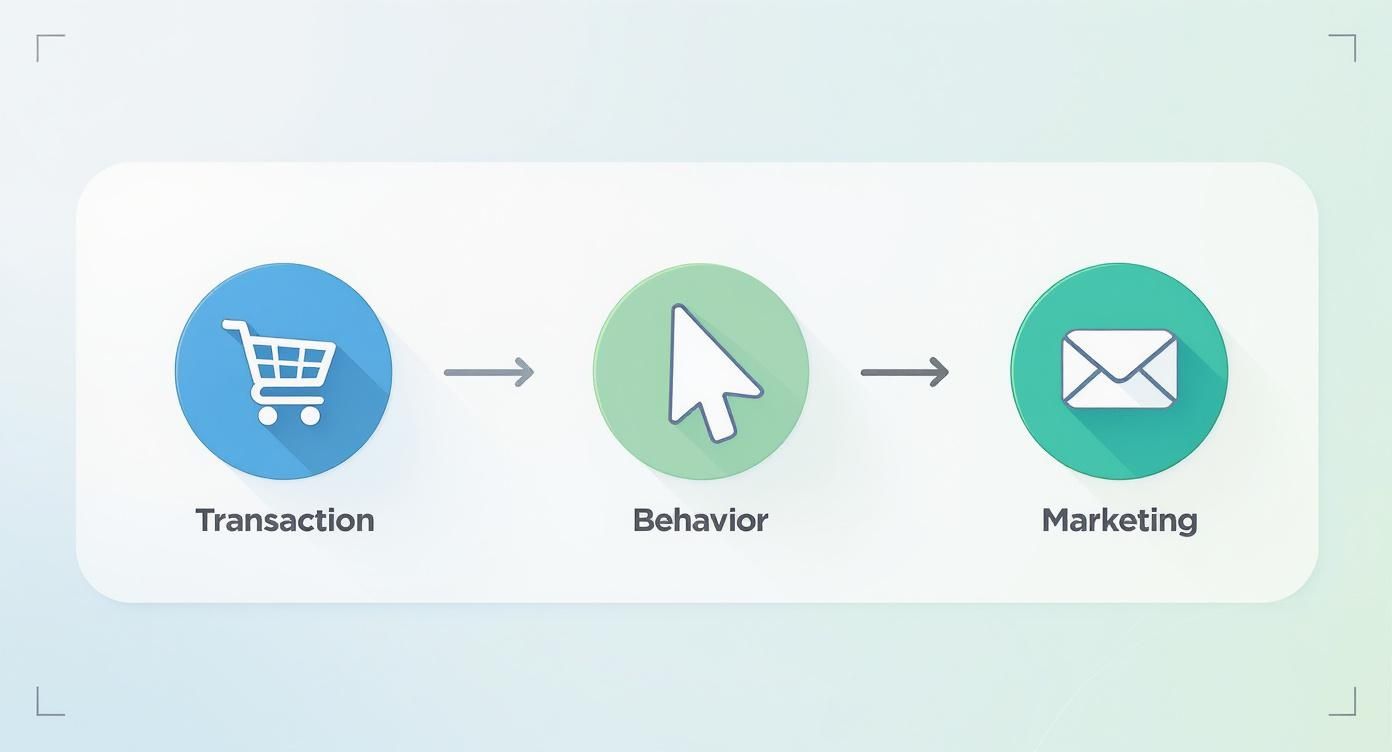
This flow shows how a modern analytics platform pulls everything together. It’s this holistic view that makes accurate forecasting possible.
For most non-subscription DTC brands, two models stand out as the workhorses of predictive LTV: the BG/NBD model and the Gamma-Gamma model.
Buy Till You Die (BG/NBD) Model: This model is all about predicting future transactions. It operates on the idea that customers can "churn" at any time and analyzes their past purchase cadence to estimate how long they'll stick around.
Gamma-Gamma Model: This one works hand-in-hand with BG/NBD. It focuses on predicting the monetary value of those future purchases by looking at a customer's historical average order value.
When you put them together, you get a powerful combo: BG/NBD predicts how often they’ll buy, and Gamma-Gamma predicts how much they’ll spend. It’s a one-two punch that delivers a surprisingly accurate LTV forecast for each individual customer.
The best part? You don't have to dust off a statistics textbook. Platforms like MetricMosaic have these models built right in, automating the heavy lifting and serving up the insights you need.
Comparing LTV Modeling Methods for DTC Brands
Choosing the right method can feel overwhelming, so here’s a quick breakdown of the common approaches and where they fit best for a growing Shopify brand.
| Modeling Method | Complexity | Key Data Inputs | Best For |
|---|---|---|---|
| Cohort Analysis | Low | Customer ID, First Purchase Date, Order Value, Order Date | Early-stage brands wanting to track historical LTV trends and retention over time. |
| RFM Segmentation | Low-Medium | Recency, Frequency, and Monetary value for each customer. | Segmenting the customer base for targeted marketing and identifying high-value groups. |
| BG/NBD + Gamma-Gamma | High | Customer ID, Recency, Frequency, Monetary value (T). Requires individual transaction history. | Mature brands needing accurate, individual-level LTV predictions to optimize ad spend. |
| Machine Learning (e.g., Regression, XGBoost) | Very High | Transaction data plus behavioral data (clicks, views), demographics, and marketing touchpoints. | Large-scale brands with data science resources looking for the highest possible accuracy. |
Each model serves a purpose. Start with cohorts to understand your baseline, use RFM to sharpen your marketing, and graduate to predictive models when you're ready to optimize acquisition spend with confidence.
Granular Forecasting for Smarter Decisions
Advanced LTV modeling isn't about finding a single, magical number for your whole store. The real power comes from getting granular.
For instance, some large tech companies calculate incremental LTV at Lucid on a monthly basis over a fixed period, like 48 months, instead of an indefinite "lifetime." This allows them to compare forecasted vs. actual ROI with much more precision.
For your Shopify store, this means getting LTV predictions broken down by acquisition channel, the first product a customer bought, or even the discount code they used. This is how you go from just knowing your LTV to using it to make smarter, more profitable decisions everywhere in your business.
Turning LTV Insights into Profitable Actions

A killer LTV model is only half the battle. Honestly, it’s just a number until you actually do something with it. The real magic happens when you translate that predictive insight into tangible growth for your Shopify store. This is where you graduate from just analyzing data to making smarter decisions everywhere, from ad spend to email flows.
Think of your LTV model as a strategic compass. It’s there to guide your most important marketing moves, making sure every dollar you spend is geared toward long-term profitability, not just a fleeting spike in sales. The goal is to build a more resilient, valuable business one data-backed choice at a time.
Setting Smarter Acquisition Budgets
One of the questions that keeps every DTC founder up at night is, "How much can I actually afford to spend to get a new customer?" Without a solid LTV model, you're basically guessing, probably tying your bids to immediate ROAS and leaving money on the table.
With a predictive LTV model, you finally get a clear, justifiable ceiling for your Customer Acquisition Cost (CAC).
For example, your model might show that customers from a Google Shopping campaign have an average 12-month LTV of $250, while those from a specific Meta campaign come in at just $150. This is a total game-changer. It tells you that you can confidently spend more to acquire that Google customer because their long-term value is so much higher.
This is how you start setting channel-specific CAC targets, pouring more fuel into high-LTV channels and pulling back on the ones that bring in low-value, one-and-done buyers—even if their initial cost looks cheap on the surface.
Optimizing Your LTV:CAC Ratio
The LTV:CAC ratio is one of the most vital health metrics for any growing DTC brand. It’s a straightforward measure of how profitable your acquisition strategy really is. A common benchmark for a healthy business is a 3:1 ratio—for every dollar you spend to bring someone in, you get three dollars back over their lifetime.
A ratio below 1:1 is a red flag. It means you're actively losing money on every single new customer you acquire. Tracking LTV:CAC by cohort lets you spot these problems early and make a change before they burn a hole in your budget.
This is where platforms like MetricMosaic come in. They do the heavy lifting by automatically calculating this ratio in real-time. You can see at a glance which campaigns are actually delivering profitable customers and which ones need a serious rethink, taking you from guesswork to genuine strategic optimization.
Personalizing Retention and Driving Repeat Purchases
Your LTV model isn’t just an acquisition tool; it’s a goldmine for your retention efforts. When you segment customers by their predicted LTV, you can stop blasting everyone with the same message and start tailoring your marketing to maximize value from each group.
Here are a few ways to put this into play:
- High-Value VIPs: For the customers your model flags as top-tier, roll out the red carpet. Think exclusive perks like early access to new drops, a dedicated support line, or even surprise gifts. The goal here is simple: nurture these relationships.
- At-Risk Customers: A good predictive model can spot customers showing signs of churn (like a sudden drop in purchase frequency). You can get ahead of it by targeting them with a personalized "we miss you" campaign in Klaviyo before they’re gone for good.
- New High-Potential Customers: When a new customer’s profile looks a lot like your best historical customers, don't wait. Send them a more engaging welcome series that tells your brand story and pushes them toward that all-important second purchase.
This kind of targeted action is where sophisticated models really prove their worth. Research shows that blending behavioral data (like RFM) with other insights can make a huge difference. In fact, companies using advanced CLV models that look at both purchase history and customer engagement have seen retention improvements averaging 27% over more basic methods. You can dive deeper into how predictive models improve customer retention to see the full impact.
The Classic LTV Modeling Blunders to Sidestep
Getting into lifetime value modeling feels like you've unlocked a secret level for your DTC brand. It gives you this sudden clarity on long-term profitability that changes how you see your business. But getting there means dodging a few common pitfalls that trip up even the sharpest Shopify founders.
Think of this as your field guide to keeping your LTV models honest and making sure the insights are actually useful. Getting this stuff right from the get-go is everything.
Relying on a Single, Store-Wide LTV
This is hands-down the most common mistake: calculating one LTV number for your whole store and calling it a day. This “blended” average is a smokescreen. It hides all the juicy details your data is trying to tell you by lumping your best customers in with your worst. What you’re left with is a mushy, middle-of-the-road number that’s useless for making sharp decisions.
Let's say a customer from a high-intent Google Search campaign has a 12-month LTV of $300. But a customer who found you through a viral TikTok only has an LTV of $75. Your blended average of $187.50 tells you nothing about this massive difference.
Founder-Friendly Tip: The real magic of lifetime value modeling is in the segmentation. An analytics platform like MetricMosaic can automatically slice up your LTV by acquisition channel, first product purchased, or even the discount code they used. That’s how you find out which levers actually move the needle on long-term value.
Forgetting It's All About Profit
Here’s another classic slip-up: building an LTV model using only revenue. Sure, top-line sales feel good, but they don’t pay the bills. If you’re not factoring in your Cost of Goods Sold (COGS), you're calculating Lifetime Revenue, not Lifetime Value.
A customer who keeps coming back for high-margin products is infinitely more valuable than someone spending the same amount on low-margin or heavily discounted items. Real LTV is all about profit. Once you pull in COGS and other variable costs, you get a much clearer picture of what each customer segment is actually putting in your pocket.
Using an Infinite Time Horizon
The "lifetime" in LTV can be a bit of a trap. For a growing DTC brand, trying to predict a customer’s value over the actual lifetime of your company is pretty much a guessing game. Your products, marketing, and entire customer base could look completely different in just a couple of years.
A much smarter way to go is to pick a fixed, actionable time horizon. For most Shopify stores, a 12-month or 24-month LTV forecast is way more practical. This timeline lines up with your annual planning, makes it easier to track CAC payback periods, and helps you set growth targets you can actually hit. It grounds your strategy in reality, turning LTV into a tool for today, not some fuzzy, far-off projection.
Treating Your LTV Model as a One-and-Done Project
Your Shopify store isn’t static, and neither are your customers. A model you built last year might be totally irrelevant today, especially if you’ve launched new products or started selling in new markets. As your business changes, so does customer behavior.
That’s why great LTV modeling isn’t a task you check off a list—it’s an ongoing process. Your models need to be constantly refreshed and re-validated. Modern analytics tools can automate this, continuously re-training predictive models on fresh data to keep your forecasts sharp. Without that, you're just making today's decisions on yesterday's old news.
The Future of AI-Powered DTC Analytics
The whole world of e-commerce analytics is shifting under our feet. For way too long, "analytics" just meant staring at static dashboards, trying to piece together the story yourself. But the future isn't about packing more charts into denser reports. It's about getting straight to the answers you actually need to grow your Shopify store.
The next wave is dynamic, intelligent, and built to serve you—the operator. We're moving away from passive tools that you have to wrestle with and toward an active co-pilot that helps guide your decisions. This whole change is powered by AI, which is finally making the kind of advanced capabilities once reserved for enterprise giants accessible to any ambitious DTC brand.
Beyond the Dashboard with Conversational Analytics
Picture this: instead of slicing and dicing ten different reports, you just ask your data a question. In plain English. That’s the entire promise of conversational analytics.
You can just type, "What's the 12-month LTV of customers from our last TikTok campaign?" or "Show me our top-selling product for repeat buyers in California." An AI engine, like MetricMosaic’s MosaicLive, instantly crunches the numbers, pulls the right data, and gives you a clear, simple answer.
This isn’t some gimmick; it’s a fundamental change in how you interact with your business data. It cuts out all the friction and technical hurdles, turning what used to be a complex query into a simple conversation. The days of needing an analyst on standby to pull a custom report are numbered.
From Data Points to Proactive Stories
The other big shift is from reactive data pulling to proactive, story-driven insights. A modern analytics platform should do more than just spit out numbers; it should tell you what they mean and what you ought to do next.
AI-powered systems can now automatically surface the critical narratives happening inside your store. Think of alerts like these:
- Opportunity Alert: "Your new 'Summer Glow' collection is driving a 25% higher AOV than your other products. You should probably feature it on your homepage."
- Risk Warning: "The LTV of customers acquired through your 'WELCOME10' discount code is 40% lower than your average. You might be attracting bargain hunters, not loyal fans."
This approach turns your data into a real competitive advantage by flagging crucial moments you would have otherwise missed. It’s like having a growth strategist constantly monitoring your performance and handing you a playbook of what to do next.
Key Takeaway: The future of DTC analytics is all about speed to insight. AI is transforming data platforms from complicated tools into intelligent partners that understand your questions and proactively guide your growth strategy.
The evolution of lifetime value modeling itself is a perfect example of this trend. What started as simple historical math has become far more sophisticated with machine learning. Predicted Lifetime Value (pLTV) now pulls in everything from transaction history and engagement signals to broader market factors to forecast what a customer will be worth. To really get into the nuts and bolts, you can explore how pLTV models are changing the game on Sellforte.com.
Ultimately, all these advancements are about democratizing data. The next generation of platforms are making sophisticated, predictive analytics accessible, letting Shopify brands of any size compete on a completely new level—turning store data into your most powerful growth asset, without all the complexity.
A Few Common Questions on LTV Modeling
Even with a solid plan, jumping into lifetime value modeling always brings up a few questions. I get it. For busy Shopify founders, it's about cutting through the noise and getting straight answers.
Here are a few of the most common ones we hear from other DTC operators.
How Often Should I Update My LTV Models?
There’s no magic number here, but a quarterly refresh is a solid starting point. It’s frequent enough to catch shifts in customer behavior, seasonality, or the impact of that new marketing campaign you just launched.
Now, if you're in a high-growth spurt or just dropped a major new product, you might want to tighten that up to a monthly update. This keeps your insights sharp and your ad spend from going off the rails.
Of course, this is where AI simplifies things. Platforms can handle this for you, constantly retraining models on fresh data so your LTV forecasts are always based on what your customers are doing right now, not what they were doing last quarter.
What’s a Good LTV to CAC Ratio for a Shopify Brand?
This definitely varies depending on your industry and margins, but a healthy LTV:CAC ratio for a DTC brand is typically 3:1 or better. Put simply, for every dollar you spend to get a customer, you should be making at least three dollars back over their lifetime.
A ratio below 1:1 is a five-alarm fire—you’re actively losing money on every new customer. If you're hovering between 1:1 and 2:1, you're likely just treading water, with little left over for overhead. That 3:1 benchmark is where you start building a truly profitable, sustainable acquisition engine.
Do I Really Need a Data Scientist to Get Started?
Not anymore. A few years back, building a predictive LTV model meant having a dedicated data science team and some serious technical firepower. That's just not the case today.
AI-driven analytics tools have completely changed the game, putting these kinds of advanced models within reach for pretty much any Shopify brand.
Platforms like MetricMosaic handle the entire messy workflow—from pulling and cleaning the data to building and deploying predictive models like BG/NBD. It replaces the complex, manual process with an automated, straightforward experience, giving you clear insights you can actually use without writing a single line of code.
Ready to turn your Shopify data into a predictable revenue engine? With MetricMosaic, you can unlock AI-powered LTV modeling, cohort analysis, and proactive insights that guide you to profitable growth. Stop guessing and start making data-driven decisions that move the needle.