Your Shopify Store's Crystal Ball: A Founder's Guide to Predictive Analytics
Stop guessing. This guide to predictive analytics for ecommerce shows Shopify brands how to use AI to forecast sales, boost LTV, and improve ROAS.
You're a Shopify founder, which means you're swimming in data. Shopify reports, Google Analytics, Klaviyo dashboards, Meta Ads Manager... it's a constant stream of numbers. But does any of it give you a clear path forward? More often than not, it just leads to fragmented data, unreliable reports, and a nagging uncertainty about your true ROI. You know the answers are buried in there somewhere, but digging them out feels like a full-time job you don't have time for.
If you've ever stared at a dozen browser tabs, trying to piece together a story about your business, you're not alone. This is the central challenge for small-to-mid-size Shopify brands. You're trying to grow faster, but your tools only show you what already happened. It's like trying to drive a car by only looking in the rearview mirror.
This is where AI-driven predictive analytics changes the game. It’s not another complex dashboard. Think of it as a crystal ball for your DTC brand, powered by AI that replaces hours of manual data crunching. It sifts through all your historical data—every click, every purchase, every abandoned cart—to make incredibly smart forecasts about the future. It's about shifting from reacting to last month's numbers to proactively shaping next month's profits.
Why Your Shopify Growth Feels Stuck
Ever feel like you’re trying to navigate a maze blindfolded? That’s what running a Shopify store can feel like. You're drowning in data from Google Analytics, Shopify reports, and a dozen different marketing apps, but a clear path to growth is nowhere to be found.

This data chaos leads to unreliable reports, murky ROI, and that nagging feeling you’re leaving money on the table. If you've ever stared at a screen full of dashboards and felt more overwhelmed than enlightened, you know exactly what I'm talking about.
This isn't just you; it's a huge challenge for DTC founders everywhere. You’ve got more information than ever before, but it’s all disconnected and only tells you what already happened. Traditional analytics shows you yesterday's news, but it offers zero guidance on what you should do tomorrow. This keeps you trapped in a cycle of guessing and testing instead of moving forward with confidence.
The Limits of Looking Backward
Here's the problem: standard analytics reports are just descriptions of the past. They’re useful for a quick recap, sure, but they’re useless for making big strategic decisions about the future. For any ambitious DTC brand trying to get a real edge, that’s simply not good enough.
The global ecommerce market is staggering, with sales projected to hit $6.42 trillion, driven by over 3 billion online shoppers. To carve out your space in a market that big, you can't just react—you have to anticipate. You can read more about the scale of the global ecommerce market to get the full picture.
This is where predictive analytics for ecommerce completely changes the game. It isn't about adding another complicated report to your to-do list. It's about getting a strategic co-pilot that sifts through all your data to give you clear, forward-looking advice.
Key Takeaway: Relying only on past data is like trying to drive a car by looking exclusively in the rearview mirror. Predictive analytics finally gives you a clear view of the road ahead, letting you steer your Shopify store toward real, profitable growth.
Imagine knowing, with a high degree of certainty:
- Which of your first-time buyers have the potential to become your biggest VIPs.
- Which marketing channels are actually going to deliver the highest lifetime value (LTV).
- The exact moment a loyal customer starts showing signs of churning—long before they actually leave.
This isn't some abstract data science concept. It’s about getting real, actionable answers to your most critical growth questions. By shifting from a reactive stance to a proactive one, you can finally turn your store's data from a source of endless frustration into your most powerful asset.
Understanding Predictive Analytics Without the Jargon
Let's cut through the tech talk. At its core, predictive analytics for ecommerce is basically a weather forecast for your Shopify store. It takes all your past business data and uses it to make incredibly smart guesses about what’s just around the corner, giving you a chance to prepare.
Think about it this way: looking at last quarter's sales reports is like checking yesterday's weather. It's interesting, but it doesn't help you now. Predictive analytics, on the other hand, tells you if you need an umbrella before you leave the house.
From Past Data to Future Action
So how does this all work in plain English? AI platforms plug right into your Shopify store and marketing tools, pulling in a mountain of historical data—every sale, click, email open, and ad dollar spent.
This is where AI simplifies everything. Machine learning algorithms, which you can imagine as a team of hyper-focused data analysts working 24/7, start sifting through everything. They replace tedious manual data crunching and are built to spot the hidden patterns and subtle connections a human could never hope to find.
For example, an algorithm might discover that customers who buy Product A and live in California are 85% more likely to make a second purchase within 30 days if they get a very specific type of email offer. That’s a powerful, forward-looking insight you can act on immediately to boost LTV and retention.
This isn't just a "nice-to-have" anymore; it's fundamental to smart growth. By digging into historical data, predictive analytics helps you forecast customer behavior and sales trends with an accuracy that can feel like a superpower. It allows you to stop reacting and start making proactive moves in your marketing, inventory, and customer experience. You can find more insights on this topic in this great ecommerce analytics guide from improvado.io.
What Exactly Is a "Model"?
You'll hear the term "predictive model" thrown around a lot. Don't let it scare you. A model is just the final output of all that number-crunching—it's the set of rules the AI has learned from your data.
It's actually pretty simple when you break it down by use case:
- LTV Model: This model figures out the common traits of your best, highest-spending customers. Then, it predicts which of your new shoppers are most likely to follow that same valuable path.
- Churn Model: This one is a lifesaver for retention. It identifies the subtle warning signs and behaviors of customers who are about to leave, flagging them for you before they're gone for good.
- Demand Model: This model analyzes past sales velocity, seasonal trends, and even your marketing calendar to predict how much of a specific product you’re going to sell next month, helping you avoid stockouts.
The best part about modern, AI-driven analytics tools is that they handle all the heavy lifting of building and managing these models for you. For a busy DTC founder, this means you don't need a Ph.D. in data science to get all the benefits.
You get the actionable forecast without having to build the weather station yourself. It turns your Shopify data from a confusing, backward-looking logbook into a clear roadmap for profitable growth.
How Predictive Analytics Directly Boosts Your Profits
Theory is great, but let's talk about what really matters to a DTC founder: how predictive analytics can actually put more money in your bank account. This isn't some abstract data science project. It's about making smarter, faster decisions that drive real growth for your Shopify store across ROAS, CAC, AOV, and LTV.
We're going to break down five mission-critical ways these insights translate directly into higher LTV, lower CAC, and better margins. No fluff, just actionable takeaways.
Think of each of these as a shift from reactive guesswork to a proactive, data-backed strategy. It's about finally getting ahead of the daily challenges that every Shopify operator faces.
Before we dive into the specific use cases, let's look at the big picture. Here's a quick table showing how these predictive strategies line up with the Shopify metrics you're already tracking every day.
How Predictive Analytics Impacts Key Shopify Metrics
| Predictive Use Case | Core Business Question It Answers | Key Shopify KPIs Improved |
|---|---|---|
| LTV Prediction | "Which of my new customers are most likely to become VIPs?" | Customer Lifetime Value (LTV), LTV:CAC Ratio, Repeat Customer Rate |
| Churn Forecasting | "Which loyal customers are about to leave for good?" | Customer Churn Rate, Customer Retention Rate, Revenue Retention |
| Demand Forecasting | "How much of each product should I order and when?" | Inventory Turnover, Sell-Through Rate, Lost Revenue from Stockouts |
| Product Recommendations | "What is this specific customer most likely to buy next?" | Average Order Value (AOV), Conversion Rate, Items Per Order |
| Marketing Mix Optimization | "Where should I spend my next marketing dollar for the best long-term return?" | Return on Ad Spend (ROAS), Customer Acquisition Cost (CAC), LTV by Channel |
As you can see, this isn't about chasing vanity metrics. It's a direct line to improving the core financial health and operational efficiency of your business. Now, let's get into the details.
1. Predict Customer Lifetime Value to Find Your VIPs
Let's be honest: not all customers are created equal. Some buy once and vanish, while others become the lifeblood of your brand. The trouble is, you usually can't tell them apart until months have passed.
Predictive LTV models completely change this dynamic. They analyze the very first actions a new customer takes and see how those behaviors match up with the patterns of your best customers from the past.
An AI-powered analytics platform can essentially tell you, "Heads up, this new customer from your latest Meta campaign has a 90% probability of becoming a high-value buyer." That's your cue to roll out the red carpet now, not six months from now. You can segment these future VIPs, nurture them with exclusive offers, and give them the kind of service that locks in their loyalty and boosts retention.
This immediately improves your Customer Acquisition Cost (CAC) payback period. You can confidently spend more to acquire customers who are flagged as future top-spenders, turning your ad budget into a much sharper tool.
2. Forecast and Prevent Customer Churn
Customer churn is the silent killer for so many DTC brands. By the time you realize a good customer hasn't bought in a while, they've probably already moved on. Predictive analytics is your early-warning system. It spots the subtle signs that a customer is drifting away—things like opening fewer emails, visiting your site less often, or stretching the time between purchases.
The system flags these "at-risk" customers long before they’re gone for good, opening a critical window for you to step in.
Instead of sending a generic "We miss you!" email after 90 days of silence, you can trigger a targeted win-back campaign on day 45. The offer can be personalized based on their favorite products, making it infinitely more effective. This is the difference between reactive pleading and proactive retention.
3. Sharpen Demand Forecasting to End Stockouts
Nothing kills your momentum faster than seeing "Sold Out" on your best-selling product during a peak sales weekend. On the flip side, having cash tied up in inventory that just won't move is a drain on your profitability.
Predictive demand forecasting takes the guesswork out of inventory planning. It digs into your historical sales data, accounts for seasonality, and even looks at your marketing calendar to project future demand with startling accuracy.
This means you make inventory calls based on data, not a gut feeling.
- Avoid Stockouts: You'll have your hero products ready for every sales spike, capturing every last dollar.
- Reduce Overstock: You won't waste capital on products that are predicted to be slow-movers.
- Optimize Cash Flow: Your inventory becomes leaner and more efficient, turning over faster and freeing up cash.
This is an operational superpower that has an immediate and direct impact on both your top-line revenue and your bottom-line profit.
4. Power Truly Personalized Product Recommendations
Those generic "You might also like..." widgets are mostly useless. They lack any real intelligence. Predictive analytics blows them out of the water by analyzing the buying habits of thousands of customers to find non-obvious connections.
For example, the AI might discover that customers who buy your signature coffee blend are highly likely to come back for a specific grinder within the next 45 days. Boom. You now have the perfect insight to create a targeted email or SMS flow that suggests that grinder at the exact moment it's on their mind.
This isn't a random upsell; it's a smart, timely nudge that feels helpful to the customer while boosting your Average Order Value (AOV).
5. Optimize Your Marketing Mix for Maximum ROAS
Finally, this is how you answer the million-dollar question: "Where should I spend my next marketing dollar?" Instead of just looking at the initial Return on Ad Spend (ROAS), you can start optimizing for long-term profit.
By predicting the future LTV of customers from different channels, you get a much clearer picture. The data might show that while Google Ads brings in a slightly lower AOV on the first purchase, those customers have a 3x higher predicted LTV than customers from a flashy TikTok campaign.
This insight gives you the confidence to reallocate your budget. You can now invest in the channels that deliver sustainable, profitable growth—not just cheap first-time conversions. Your marketing strategy shifts from a short-term gamble to a calculated, long-term investment.
Turning Data Insights Into a Competitive Edge
Look, having powerful predictions is one thing. But turning them into an actual competitive advantage? That requires action. This is the exact spot where so many DTC brands get stuck—they're drowning in dashboards but absolutely starving for direction.
The real magic of predictive analytics for ecommerce isn't just knowing what might happen. It's understanding precisely what to do about it.
Modern AI analytics platforms are built to close this gap between insight and action. They're moving away from clunky spreadsheets and confusing charts to deliver what we call story-driven data. Instead of just dumping numbers on you, you get a clear narrative.
Imagine getting a ping that says, "That group of customers who bought your summer collection twice last year? They're now showing a 75% churn risk. We think you should hit them with a targeted win-back campaign offering 15% off their favorite product category to keep them around."
That’s not a report; it’s a battle plan. It's a clear, actionable instruction that a founder or marketer can execute on the spot, finally closing the loop between data and revenue.
Asking Your Data Questions in Plain English
One of the biggest shifts in AI-powered analytics is the move toward conversational analytics. This is a founder-friendly idea that tears down the technical walls between you and your data. You don't need to know complicated query languages or wrestle with confusing report builders anymore.
Instead, you just ask your data questions in plain English, the same way you'd ask someone on your team.
- "What was our LTV for customers we got from Meta last quarter?"
- "Show me our top 10 products by profit margin in the last 30 days."
- "Which customer cohort has the best repeat purchase rate?"
Next-gen tools act as your data co-pilot, serving up instant answers and visuals. This opens up data access for your whole team, letting anyone make smarter decisions without having to wait for an analyst to pull a report. It makes your day-to-day workflow faster, more intuitive, and bakes data-driven thinking right into your brand’s DNA.
Getting Automated Next-Best-Action Recommendations
Going beyond just answering your questions, the most advanced platforms will proactively tell you what you should be asking. They automatically surface predictive insights and "next-best-action" recommendations by constantly scanning your data for important patterns, threats, and opportunities.
This is where AI really does the heavy lifting, acting like a tireless growth strategist for your brand. It might alert you to things like:
- A High-Performing Ad: "Your new 'Spring Refresh' ad on Instagram is bringing in customers with a predicted LTV that's 40% higher than your account average. You should probably scale the budget on this one."
- A Potential Stockout: "Based on current sales velocity and our demand forecast, your best-selling 'Signature Tee - Black' is going to sell out in 8 days. It's time to put in a reorder."
- An Emerging VIP Segment: "Customers who buy Product X and Product Y together have a 92% probability of making a third purchase within 60 days. You should build a post-purchase flow specifically for them."
This kind of proactive guidance is quickly becoming a must-have. The AI in ecommerce market is expected to hit around $8.65 billion, and something like 77% of ecommerce pros are already using AI daily for personalization and marketing. Integrating these automated recommendations isn't a luxury anymore; it's a core part of a modern growth strategy. You can find more stats on AI adoption in ecommerce on ecomposer.io.
At the end of the day, the goal is to make data-driven decision-making an effortless, daily habit. By turning complex data into clear stories, conversational queries, and actionable recommendations, you can finally turn your Shopify store's data into your most reliable engine for profitable growth.
Your Practical Roadmap to Getting Started
Let's be real: jumping into predictive analytics can sound intimidating as hell. But it doesn't have to be some massive, complex project. For a Shopify brand, the path forward is clearer and more accessible than ever, and it absolutely does not require a data science team.
It’s really about taking smart, manageable steps to turn the data you already have into your most powerful growth engine.
One of the biggest hang-ups we hear from founders is, "Is my data even good enough for this?" The answer, almost every single time, is a resounding yes. Modern AI-powered analytics tools are built to work with the data you've got, finding powerful patterns even in smaller, messier datasets.
This whole process is actually pretty simple when you break it down.
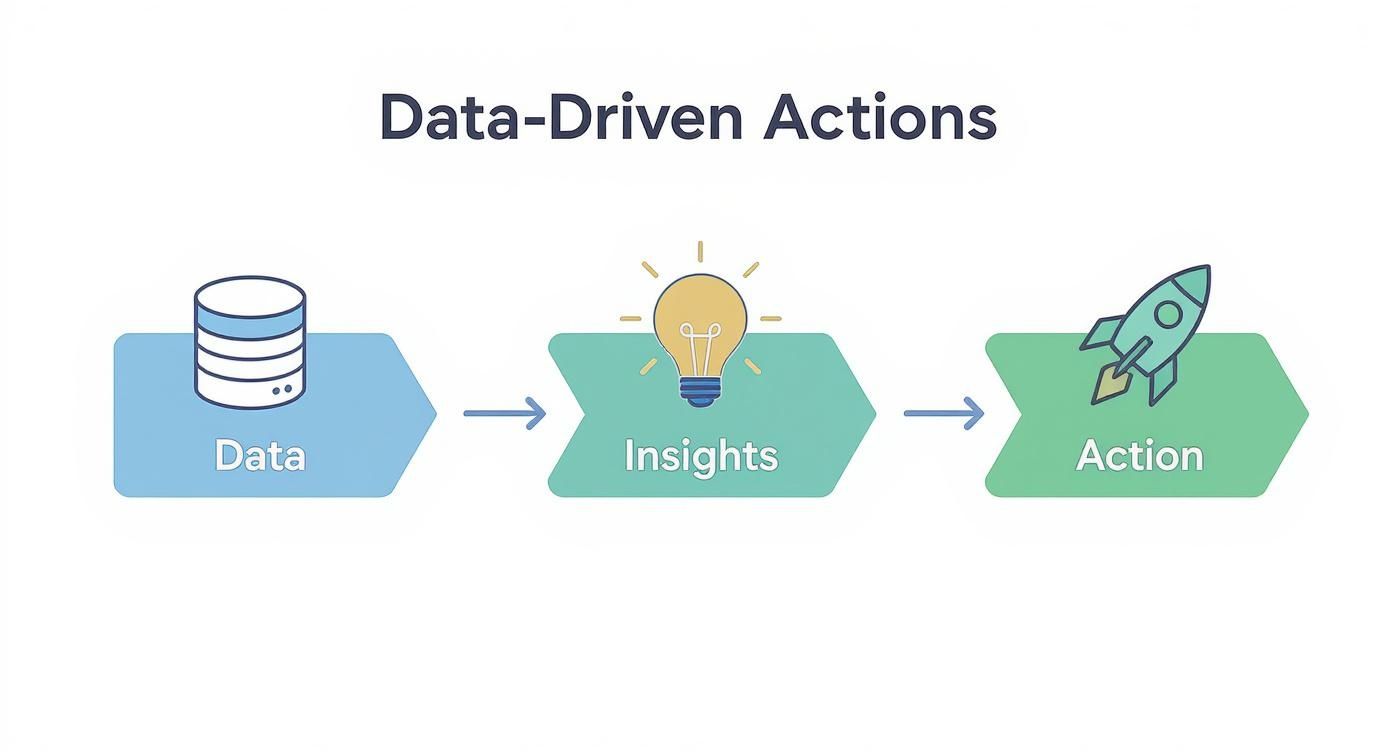
The journey is straightforward: bring your data together, let the AI find the signals in the noise, and then use those insights to make moves that actually boost your bottom line.
Phase 1: Consolidate Your Data Sources
Before you can predict a single thing, you need to see the whole picture. Right now, your brand's story is probably scattered across a dozen different platforms. This fragmentation makes clear, confident decision-making nearly impossible. The first step is just bringing it all together.
This means connecting the tools you live in every day:
- Your Store: Shopify is the heart of it all, holding your precious transaction and customer data.
- Your Marketing Stack: Think your email/SMS platform like Klaviyo and your big ad channels like Meta and Google Ads.
- Your Web Analytics: Google Analytics 4 (GA4) gives you the behavioral context—how people are actually interacting with your site.
Choosing an AI analytics platform like MetricMosaic that offers one-click integrations is a game-changer here. It completely automates the painful part, creating a single source of truth without you ever having to touch a spreadsheet.
Phase 2: Choose Your First High-Impact Use Case
Don't try to boil the ocean. Seriously. The secret to getting this right is to start small and focus on a single, high-leverage area of your business. Solve one critical problem first, prove the value to yourself and your team, and then expand from there.
For most DTC brands, the smartest place to start is predicting Customer Lifetime Value (LTV).
Why LTV? Because it's tied directly to your most important metric: profitability. When you can spot which new customers are likely to become your future VIPs from day one, you can immediately start making smarter calls on ad spend and retention. It changes everything.
Key Insight: Focusing on a single use case like LTV prediction gives you a clear, quick win and builds momentum. It fundamentally shifts your mindset from chasing short-term revenue to building sustainable, profitable customer relationships—the true foundation of any lasting DTC brand.
Other great starting points could be churn prediction or inventory forecasting, depending on what keeps you up at night. The goal is to pick one battle you know you can win.
Phase 3: Activate Insights and Avoid Common Pitfalls
Okay, your data is connected and you've picked a focus. Now the AI models start doing their thing, generating predictive insights. The final, and most crucial, phase is turning those insights into action. This is all about weaving this new intelligence into your daily workflow.
But as you get going, watch out for a few common tripwires:
- Ignoring Data Quality: Look, you don't need perfect data, but you do need consistency. Make sure your tracking and tagging are set up correctly in Shopify and your ad platforms. A good analytics tool can often help you spot and fix these issues anyway.
- Chasing Too Many Metrics: Stick to the KPIs that actually matter for your chosen use case. If you're all-in on LTV, then metrics like LTV:CAC ratio, repeat purchase rate, and payback period are your new North Stars. Forget the rest for now.
- Expecting Instant Perfection: Predictive models get smarter over time. The first predictions are incredibly valuable, but they become laser-accurate as they learn from more of your data. Be patient and focus on the trends.
By following this simple roadmap, you can demystify predictive analytics for ecommerce and start your journey with confidence. It’s not about becoming a data expert overnight; it’s about using smarter tools to make better decisions and build a more resilient, profitable Shopify brand.
Turning Information Overload into Inspired Action
We’ve covered a lot of ground—the what, why, and how of predictive analytics for your store. Let's bring it all back home. If there's one thing to take away, it's this: this isn't some far-off, enterprise-level luxury anymore. It's a real, accessible tool for ambitious Shopify brands ready to grow smarter, not just bigger.
The days of being buried in disconnected spreadsheets and dashboards that just leave you with more questions than answers are over. You don't have to operate on guesswork, wondering which marketing channels are actually profitable or which of your best customers might be about to ghost you. The new wave of AI analytics platforms is built specifically to translate your store's data into a clear, forward-looking roadmap.
Your First Step Forward
Knowing all this is one thing, but making the jump from learning to doing? That often feels like the hardest part. The trick is to start small and stay focused. Don't try to boil the ocean and solve every business problem at once. Instead, pinpoint the one area that, if you could just get it right, would make the biggest dent in your bottom line.
Just ask yourself one of these questions:
- How can I spot my future VIPs the moment they make their first purchase?
- Which of my ad channels are secretly burning cash on low-value customers?
- How can I get a heads-up before my best customers are about to churn?
Getting a real answer to just one of those can completely change the way you run your business. It’s the difference between reacting to last month’s sales report and proactively shaping next month's. It turns your data from a source of confusion into your sharpest competitive edge.
The goal isn't just to have more data; it's to get better answers. By focusing on one key question, you create a clear path to turn insights into action and action into profit.
The last step is moving from "I should look into that" to "I'm doing it." Tools available today, like MetricMosaic, are designed to give you these answers without needing a team of data scientists. A great place to start is just connecting your Shopify store to see what a platform can tell you with a quick data health checkup. That simple move could be the first step in turning your store’s data into the most powerful asset you have for building a resilient, profitable DTC brand.
Frequently Asked Questions
Jumping into predictive analytics can feel like stepping into a new world, and it's natural to have questions. As a Shopify founder or marketer, you need real answers that cut through the noise and show you what this technology can actually do for your store.
Let's break down some of the most common questions we hear.
Do I Need a Data Scientist to Use Predictive Analytics?
This is probably the biggest myth out there, and the answer is a firm no. You don't need a PhD to get value from your data anymore.
Modern AI analytics platforms are built for the rest of us—founders, marketers, and operators. They do all the heavy lifting in the background, running the complex models and spitting out the results as simple, actionable insights. Your job is just to connect your Shopify store, your email platform like Klaviyo, and your ad accounts. The platform handles the rest.
How Much Historical Data Do I Need to Get Started?
You don't need years and years of data to get going. While more is always nice, most modern tools can start delivering really solid predictions with just three to six months of consistent sales and marketing data.
Key Insight: It's less about the sheer volume of data and more about its quality and consistency. A good AI model is designed to find meaningful patterns even in smaller datasets, so you can start forecasting trends and understanding your customers right away.
Can Predictive Analytics Really Improve My ROAS?
Yes, big time. This is where predictive analytics really shines. It helps you shift your mindset from chasing cheap, one-off conversions to focusing on long-term profitability.
By predicting the future LTV of customers coming from different channels, you gain the confidence to invest more heavily in the campaigns that bring in your best buyers. It also helps you spot the audiences most likely to convert or buy again, so you can build laser-focused campaigns and stop wasting money on clicks that go nowhere.
Is This Too Complicated or Expensive for a Small Brand?
It definitely used to be. Not that long ago, this kind of tech was reserved for massive corporations with deep pockets and entire data science teams.
That's all changed. The new wave of AI analytics tools is built specifically for the Shopify world. They’re designed with simple, plug-and-play interfaces and have subscription pricing that makes sense for small and growing brands. The whole point is to make this technology accessible, turning it from a massive expense into one of your biggest profit drivers.
Ready to stop guessing and start predicting? MetricMosaic is the AI-powered analytics co-pilot designed for ambitious Shopify brands. Unify your data, get clear answers in plain English, and receive proactive recommendations that boost ROAS, LTV, and profitability. Start your free trial today at https://www.metricmosaic.io and turn your store's data into your most powerful asset.