Unlocking Growth with Customer Experience Analytics
Transform your Shopify data into profit. This guide explains how customer experience analytics and AI deliver actionable insights for higher LTV and ROAS.
At its core, customer experience analytics is about pulling together data from every single customer touchpoint to really understand their journey, what they like, and how they behave. It's the art of turning raw numbers into a clear story—one that tells you why people buy from you, stick around, or decide to leave.
For a growing Shopify brand, it’s how you finally connect all the dots to drive retention and, ultimately, profit.
Why Your Shopify Data Feels So Fragmented
Sound familiar? You're sitting on a mountain of data from Shopify, Google Analytics, Klaviyo, and all your ad platforms. But getting a straight answer about your customer's journey or marketing ROI feels next to impossible. This is one of the most common—and costly—frustrations for DTC founders.
You have all the individual pieces of the puzzle: ad clicks, email opens, purchase history, even support tickets. The problem is they're all scattered across different systems. Trying to stitch this all together manually in a spreadsheet is a nightmare. It’s slow, full of errors, and never quite gives you the full picture.
It’s like trying to build a puzzle with pieces from five different boxes. This fragmented view forces you into guesswork, which leads to wasted ad spend and a ton of missed opportunities to improve ROAS, CAC, and LTV.
From Chaotic Data to a Clear Growth Roadmap
This is where modern customer experience analytics completely changes the game. It’s not about adding another confusing dashboard to your tech stack. It’s about using AI to automatically pull all these separate data sources together and turn that complexity into a clear, actionable story.
Think of it as a new way to listen to your customers, but at scale. Instead of just seeing that a customer bought something, you can see the entire journey that got them there:
- The exact Meta ad that first grabbed their attention.
- The email campaign that re-engaged them and brought them back.
- The specific product pages they browsed before adding to the cart.
- The post-purchase survey that told you how happy they were.
This holistic view is crucial because it connects marketing spend directly to customer lifetime value (LTV), allowing you to make smarter decisions that boost profitability and long-term growth.
The demand for these unified insights is exploding. The global customer experience analytics market is already pegged at USD 12.6 billion in 2024 and is on track to hit nearly USD 56 billion by 2035. This massive growth is fueled by AI and machine learning making it possible to finally understand and optimize every customer interaction. You can learn more about this trend and see how AI-driven analysis is quickly becoming a non-negotiable competitive advantage.
What Customer Experience Analytics Actually Means
Let's cut through the jargon. In plain English, customer experience analytics is about piecing together the complete story of your customer's journey. It’s the process of gathering and analyzing data from every single touchpoint to truly understand their behavior, what they love, and where they get stuck.
Think of it like creating a highlight reel for every single person who interacts with your brand. This reel starts with the first ad they ever clicked, follows them through every email they opened, every product they viewed, and every purchase they made—right up to their tenth order and beyond.
For a DTC brand running on Shopify, this means trying to connect the dots between your storefront, email campaigns from Klaviyo, support chats, social media comments, and ad platforms like Meta. Stitching that all together manually? It’s practically impossible. This is where the magic happens—when AI steps in to analyze the entire reel, instantly spotting patterns a human could spend weeks trying to find.
From Manual Guesswork to AI-Powered Insight
Without a unified view of your customer, you’re stuck guessing what’s actually driving growth and what’s quietly killing your conversions. AI-powered customer experience analytics changes the game entirely by connecting actions to outcomes, replacing hours of manual data crunching with clear, story-driven insights.
This isn't just about getting fancier reports. It's about fundamentally changing how you operate—moving from reacting to yesterday's numbers to proactively shaping tomorrow's customer journey.
Brands that obsess over their customers see profits that are 60% higher than those that don't. This isn't a fluffy metric; it’s a direct line to a healthier bottom line, fueled by making smarter, data-backed decisions.
Let's break down what this shift actually looks like for a growing Shopify store.
| Challenge | Traditional Approach (Manual) | AI-Powered CX Analytics (Automated) |
|---|---|---|
| Understanding LTV | Guessing which channels bring in high-value customers based on first-purchase AOV. | Instantly identifying the specific Meta campaigns that attract customers with the highest lifetime value. |
| Fixing Cart Abandonment | Glancing at Shopify reports and making broad assumptions about why people are leaving. | Pinpointing the exact stage in your checkout that's causing the most drop-offs and suggesting specific fixes. |
| Improving Retention | Sending a generic "we miss you" email to every customer who hasn't bought in 90 days. | Using predictive insights to spot at-risk customers before they leave and triggering a personalized win-back flow to save them. |
At the end of the day, customer experience analytics gives you the answers to your most pressing business questions. It shows you which marketing channels are actually making you money, what friction points are costing you sales, and exactly how to create experiences that turn one-time buyers into loyal fans for life.
Focusing on the Metrics That Fuel DTC Growth
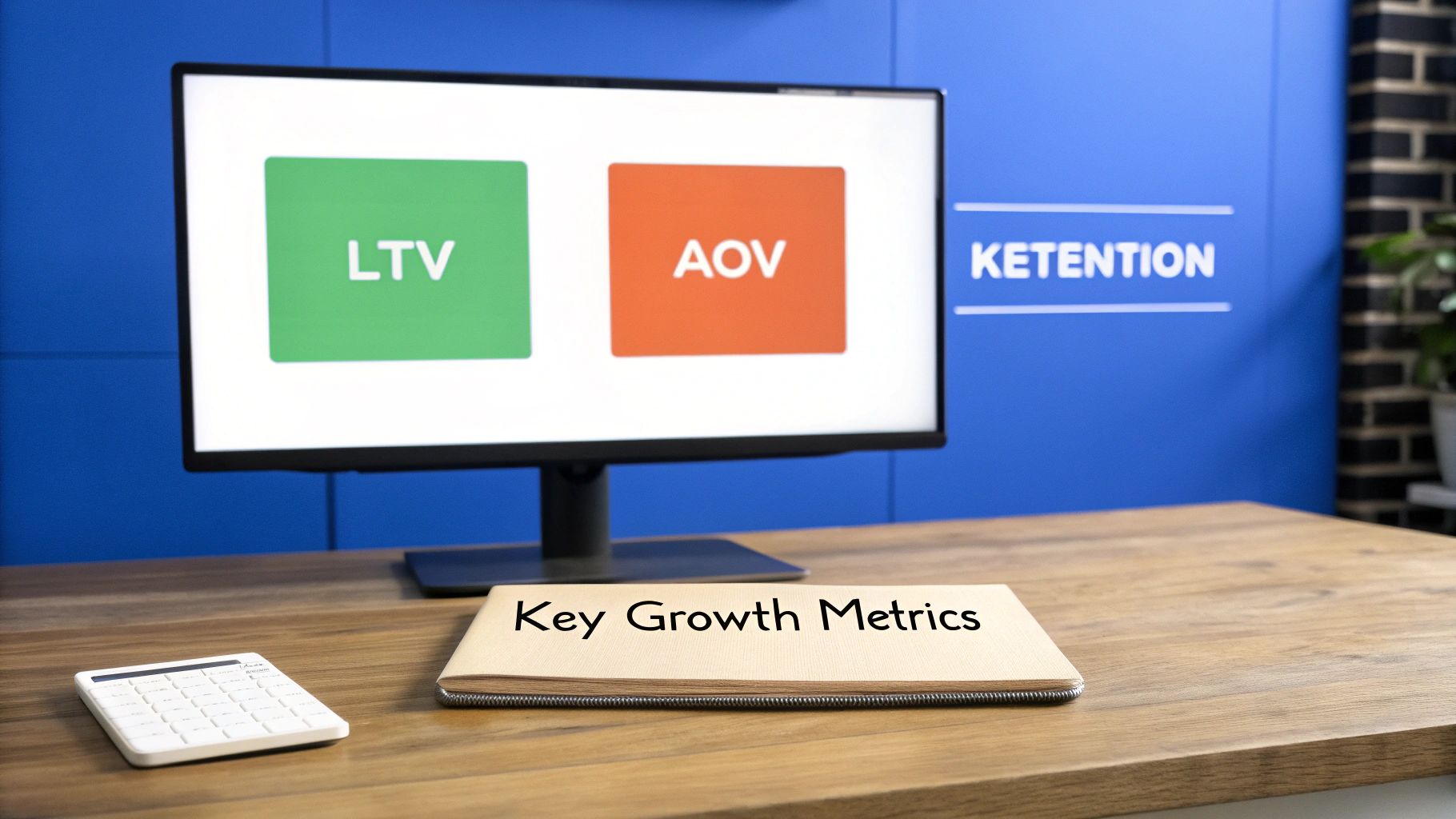
Traffic spikes and a flood of Instagram likes feel great, but they don't actually pay the bills. For any growing Shopify brand, real success comes down to a handful of core metrics that paint the true picture of your business's health. Customer experience analytics is what brings these numbers to life, showing you not just what’s happening, but the why behind it.
Instead of staring at isolated numbers in different dashboards, AI-powered tools connect them into a single, cohesive story. You can finally see how a small tweak to your checkout experience creates a powerful ripple effect across the entire business, boosting both profitability and loyalty.
Moving Beyond Simple Definitions to Drive Action
Knowing your Customer Lifetime Value (LTV) is one thing. Knowing exactly what levers to pull to increase it is something else entirely. The real magic of customer experience analytics is its ability to tie every single insight back to a core growth metric.
Let's break down the KPIs that actually matter for DTC success.
Customer Lifetime Value (LTV): This isn't just a number; it's the total profit you can realistically expect from a customer over their entire relationship with your brand. AI can predict LTV for different customer segments, showing you which acquisition channels are bringing in the most valuable, long-term fans.
Average Order Value (AOV): This is the average amount a customer spends per order. AI-driven basket analysis can uncover hidden purchasing patterns, revealing products that are frequently bought together. With that insight, you can create high-converting product bundles or smarter post-purchase upsells that naturally bump up your AOV.
Understanding the relationship between your metrics is the secret weapon. For instance, obsessing over your LTV-to-CAC (Customer Acquisition Cost) ratio ensures you're not just acquiring customers, but profitable ones who will actually stick around.
The Power of Retention in a Competitive Market
We all know it’s far more expensive to acquire a new customer than to keep an existing one. That’s precisely why your Customer Retention Rate is arguably the single most important metric for sustainable growth. It’s the percentage of customers who keep coming back to buy from you over time.
A high retention rate is the clearest sign you’re delivering an exceptional customer experience. The entire field of customer analytics is booming because brands are finally realizing the power of data-driven loyalty. Valued at USD 14.82 billion in 2025, the market is projected to nearly double by 2030, all driven by the demand for hyper-personalized experiences. You can explore the full research on customer analytics trends to see how leading brands are using this data.
AI helps you get ahead of churn before it even happens. Predictive analytics can flag customers showing early signs of disengaging—maybe their purchase frequency has dropped, or they've stopped opening your emails. This gives you the chance to trigger a targeted, automated win-back campaign with a personalized offer, saving the relationship and protecting your revenue. By focusing on these core metrics, you shift from reactive problem-solving to proactive, data-driven growth.
Turning Customer Insights into Profitable Actions

Let's be honest, staring at metrics is only half the job. For a busy Shopify operator, the real magic of customer experience analytics is how it guides you toward profitable decisions. Data sitting on a dashboard is just a line item; data that tells you what to do next is a growth engine.
This is where smart, AI-driven analytics closes the loop between seeing a number and making a change. Instead of just showing you a chart and leaving you to guess, modern platforms deliver clear, story-driven recommendations you can actually use.
Let's walk through three practical examples to see how this plays out for a growing DTC brand.
Use Case 1: The Leaky Bucket Fix
The Problem: Your churn rate is ticking up, but you have no clue why people are leaving. The generic "we miss you" email is getting zero traction, and you're burning cash trying to re-acquire customers you already had.
The Insight: An AI-powered cohort analysis spots a critical pattern. Customers who buy a specific entry-level product and don't return within 45 days have a staggering 90% churn probability. Digging deeper, it shows their support tickets are often filled with questions about how to use the product.
The Action: You set up a targeted, automated email and SMS flow that kicks in 30 days after that first purchase, but only for this specific group. The messages include a helpful video tutorial, a small discount on a complementary product, and a direct line to a priority support agent.
The Result: You slash churn in this high-risk segment by 25%. You've effectively plugged a major leak in your revenue bucket and given your overall LTV a healthy boost.
Use Case 2: The Perfect Product Bundle
The Problem: Your Average Order Value (AOV) has been stuck for months. You've tried those generic "frequently bought together" apps, but they aren't really changing what people add to their carts.
The Insight: A smart basket analysis tool finds something interesting. Customers who buy your top-selling skincare serum are very likely to come back within three weeks to grab your new hydrating face mist. They're buying them separately, which costs you more in shipping and creates a clunky experience for them.
The Action: Armed with this insight, you create a "Hydration Duo" bundle, pairing the serum and mist at a slight discount. You plaster it on the serum’s product page and set up a post-purchase upsell offer for anyone who only buys the serum.
The Result: Your AOV climbs by 18% in a single quarter. The bundle quickly becomes a new bestseller, and that simple upsell starts capturing extra revenue you were leaving on the table.
Use Case 3: The ROAS Maximizer
The Problem: You’re dumping a ton of money into Meta ads. Your top-of-funnel numbers look great, but you can't confidently say which campaigns are actually making you money in the long run. You have a nagging feeling some campaigns are just attracting one-and-done discount chasers.
The Insight: By connecting ad spend directly to LTV, your analytics platform tells a different story. That "Summer Sale" campaign with the amazing initial ROAS? The customers it brings in have an LTV that's 40% lower than average. Meanwhile, a smaller, evergreen campaign focused on product education attracts customers with an LTV that's 2x higher.
The Action: You pull 30% of your budget from the low-LTV sale campaign and funnel it directly into scaling the high-performing educational campaign.
The Result: Your initial ROAS might dip for a week, but your 6-month and 12-month profitability skyrockets. You're now paying to acquire loyal fans, not just one-time buyers, setting your brand up for sustainable growth.
How to Actually Implement CX Analytics in Your Shopify Store
Getting started with advanced analytics used to be a massive headache. The good news? Modern AI-powered tools have made it surprisingly simple for Shopify brands of any size. Forget the old days of needing a data science team on payroll. Today, it’s all about picking the right platform and, more importantly, asking the right questions.
The goal isn't just to collect data—it's to create a smarter workflow that actively drives growth. This isn’t a set-it-and-forget-it task. It's a fundamental shift in how you operate.
There's a reason the global market for customer experience analytics is exploding, projected to hit USD 42.29 billion by 2032. Brands are seeing a real, measurable return from this tech. You can read more about the market's rapid growth and see why it’s becoming a must-have for DTC success.
Step 1: Consolidate Your Data Sources
First things first: you have to break down the data silos. Right now, your customer’s story is fragmented, scattered across Shopify, your ad channels (Meta, Google), your email platform (Klaviyo), and Google Analytics.
A solid customer experience analytics platform acts as a central hub, automatically stitching all this information together.
This single step is crucial. It’s what lets you finally connect ad spend directly to LTV, trace a customer's entire journey from their first click to their fifth purchase, and get one reliable source of truth for your business.
Step 2: Choose the Right AI-Powered Platform
Once your data is flowing into one place, you need a tool that does the heavy lifting for you. Don't settle for yet another dashboard filled with endless charts. You need a platform built specifically for eCommerce that delivers actionable, automated insights.
Look for features that solve real DTC problems, not just display data:
- Automated cohort analysis to see how customer value changes over time.
- Real-time LTV and CAC tracking so you know if your marketing is profitable.
- Predictive insights that can flag at-risk customers before they churn.
The whole point is to find a tool that transforms overwhelming complexity into dead-simple clarity.
The biggest shift happens when you can just talk to your data. Next-generation tools like MetricMosaic use conversational analytics, letting you ask plain English questions like, "What were my top 10 products by profit last month?" and get an instant answer. This makes AI your growth co-pilot, not just another piece of software.
Step 3: Start Asking the Right Questions
With your platform live, the focus shifts from setup to strategy. Instead of getting lost in spreadsheets trying to figure out what happened, you can finally start asking the questions that actually unlock growth.
Move past basic reporting and start digging deeper:
- Why did that one Meta campaign produce customers with a 2x higher LTV?
- What is the perfect time to send a win-back email to a specific customer segment?
- What’s next? Based on my current trends, which product categories are about to take off next quarter?
This is how you turn your store's data from an overwhelming mess into your biggest competitive advantage. It's about taking that first step with confidence.
Turning Data Overload into a Competitive Edge
We’ve walked through the why, what, and how of customer experience analytics. Now it’s time to put it all together and make it work for you.
For ambitious Shopify brands, the days of manually exporting CSVs and wrestling with spreadsheets are officially over. The real competitive advantage today comes from understanding your customers on a much deeper level—and acting on those insights faster than everyone else.
This isn't about creating prettier reports. It's about turning your store's data into your most valuable asset. The benefits here are real and hit your bottom line directly: better profitability, higher LTV, and growth that actually lasts.
The good news is that the process for turning raw data into a real strategy is much simpler than you might think. It boils down to a few key steps.
This visual breaks down the core workflow for getting started with customer experience analytics.
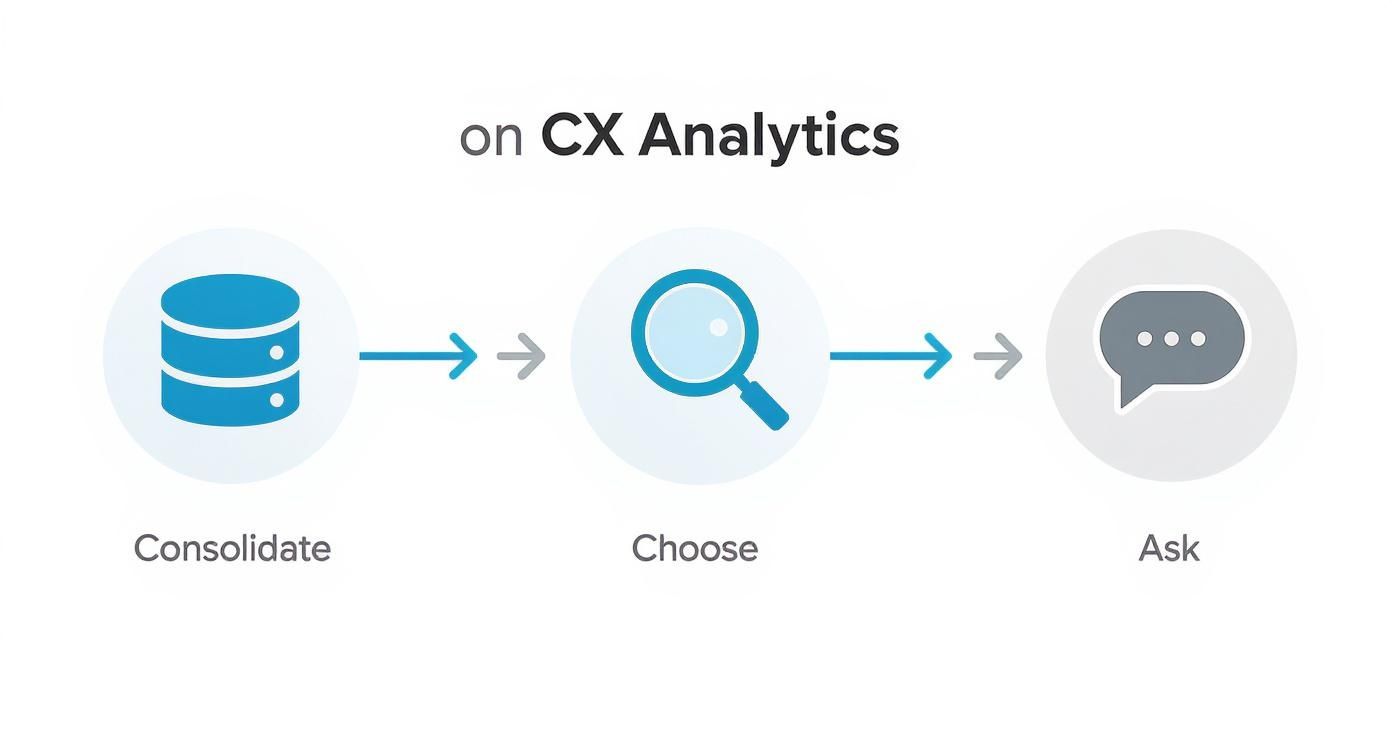
Ultimately, you consolidate your data, find the right platform to make sense of it, and start asking smarter questions to find those pockets of growth. Your store's data holds the key to your next big breakthrough, and with the AI-powered tools available today, turning that data into a genuine advantage has never been more within reach.
A Few Common Questions
How Long Does It Take to See Results?
This is the question every Shopify founder asks, and the answer is probably faster than you think. While understanding the big, long-term trends will naturally take a few months, you can find game-changing insights almost immediately.
We're talking about things like a broken checkout link that's silently killing your conversion rate or a specific ad that's outperforming everything else and needs more budget. You can spot these kinds of opportunities within the first few weeks. Modern analytics tools are built to deliver quick wins that boost your bottom line now, while you build the foundation for long-term, sustainable growth.
Is Customer Experience Analytics Expensive?
It used to be. For a long time, this kind of deep analysis was only available to massive enterprise brands with their own data science teams on payroll. But that's not the world we live in anymore. Today, AI has made powerful customer experience analytics a completely realistic tool for growing DTC brands.
Instead of seeing it as a cost, think of it as an investment. How much are you losing to wasted ad spend right now? What about customer churn or missed opportunities to increase LTV? The ROI from plugging just one leaky funnel or finally identifying your most profitable customer segment often pays for the platform many times over.
Will My Customer Data Be Secure?
Absolutely. For any brand built on customer trust, data privacy isn't just a feature—it's everything. Any reputable analytics platform is built with security as its absolute foundation, fully compliant with regulations like GDPR.
Think of it this way: your data is only used to generate insights for you. It's never shared or sold. The platform is just a secure processor that connects to your existing tools (like Shopify and your ad accounts) via secure APIs. The entire goal is to help you understand your own business better so you can serve your own customers better.
Ready to turn your Shopify data into your biggest competitive advantage? MetricMosaic is the AI-powered growth co-pilot that unifies your data and delivers the story-driven insights you need to boost ROAS, LTV, and profitability. Start your free trial and see what your data is trying to tell you.