Unlocking Revenue with Market Basket Analytics on Shopify
Discover how market basket analytics can uncover hidden product pairings, boost your AOV, and drive sustainable growth for your Shopify store.
As a Shopify founder, you're juggling a dozen things at once. Traffic is coming in, orders are shipping out, but you can't shake the feeling you're leaving money on the table. You see individual sales, but the bigger story of how your customers actually shop feels scattered across a dozen different tools. This is a super common growing pain for DTC brands.
Your data is everywhere—Shopify for orders, Google Analytics 4 for site behavior, Meta Ads for customer acquisition. Trying to piece it all together manually is a nightmare. It makes it almost impossible to spot the subtle relationships between products, leaving you with big questions and no real answers on how to boost your Average Order Value (AOV) or Lifetime Value (LTV).
From Data Chaos to Strategic Clarity
Operating with blind spots is expensive. You might know your top-selling product is a hit, but you're completely missing that customers almost always buy it with another, less popular item. This is where AI-powered market basket analytics comes in, transforming that mess of fragmented data into clear, actionable insights for your Shopify store.
It’s a shift from just processing orders to actually understanding shopping behavior, replacing manual data crunching with automated clarity.
From Data Chaos to Strategic Clarity
This table shows the shift from common data frustrations for DTC brands to the clear solutions AI-powered market basket analytics provides.
| Common Challenge | Market Basket Analytics Solution |
|---|---|
| Fragmented data across Shopify, GA4, and ads. | Unifies sales data to find product relationships automatically. |
| Unclear ROI on marketing and bundling efforts. | Pinpoints product combos that naturally sell together, improving ad and bundle success. |
| Guesswork on what to cross-sell or upsell. | Provides a data-backed roadmap for increasing Average Order Value (AOV). |
| Missed opportunities for personalization. | Reveals customer buying patterns to power targeted recommendations. |
Let’s be honest, as a founder, you're a growth strategist, not a data scientist. Trying to manually connect the dots in spreadsheets is a recipe for frustration. AI-powered analytics tools do the heavy lifting for you, transforming raw Shopify sales data into a strategic advantage.
Here's how this solves real-world problems for your DTC brand:
- No More Data Puzzles: Instead of exporting CSVs and trying to match up reports, AI finds the meaningful product relationships for you, straight from your sales data.
- Smarter Ad Spend: When you know which products drive add-on sales, you can build smarter campaigns and bundles with a much higher chance of converting. This has a direct impact on your return on ad spend (ROAS) and customer acquisition cost (CAC).
- Unlock Hidden Growth: This is the key to finding new revenue streams. It gives you a clear path to boosting your store's AOV and customer lifetime value (LTV). We dive deep into this in our complete guide on how to increase average order value.
In short, market basket analytics isn’t just another dashboard to stare at. It's a tool that turns your sales data into a competitive edge. It helps you stop guessing what your customers want and start knowing.
This whole approach is about uncovering the unspoken "if-then" rules happening in every cart. If a customer buys your best-selling skincare serum, what are they most likely to buy with it? Answering that one question is the first step to plugging revenue leaks and building a more profitable, data-driven Shopify business.
Making Sense of Market Basket Analytics Without Jargon
Let's cut through the noise. Market basket analytics is just a fancy term for finding hidden connections between the products people buy. It’s less about abstract data science and more about decoding real human behavior. It’s the leap from knowing what your customers bought to finally understanding how they shop your Shopify store.
This is all about turning messy, scattered data into clear, actionable signals for growth.
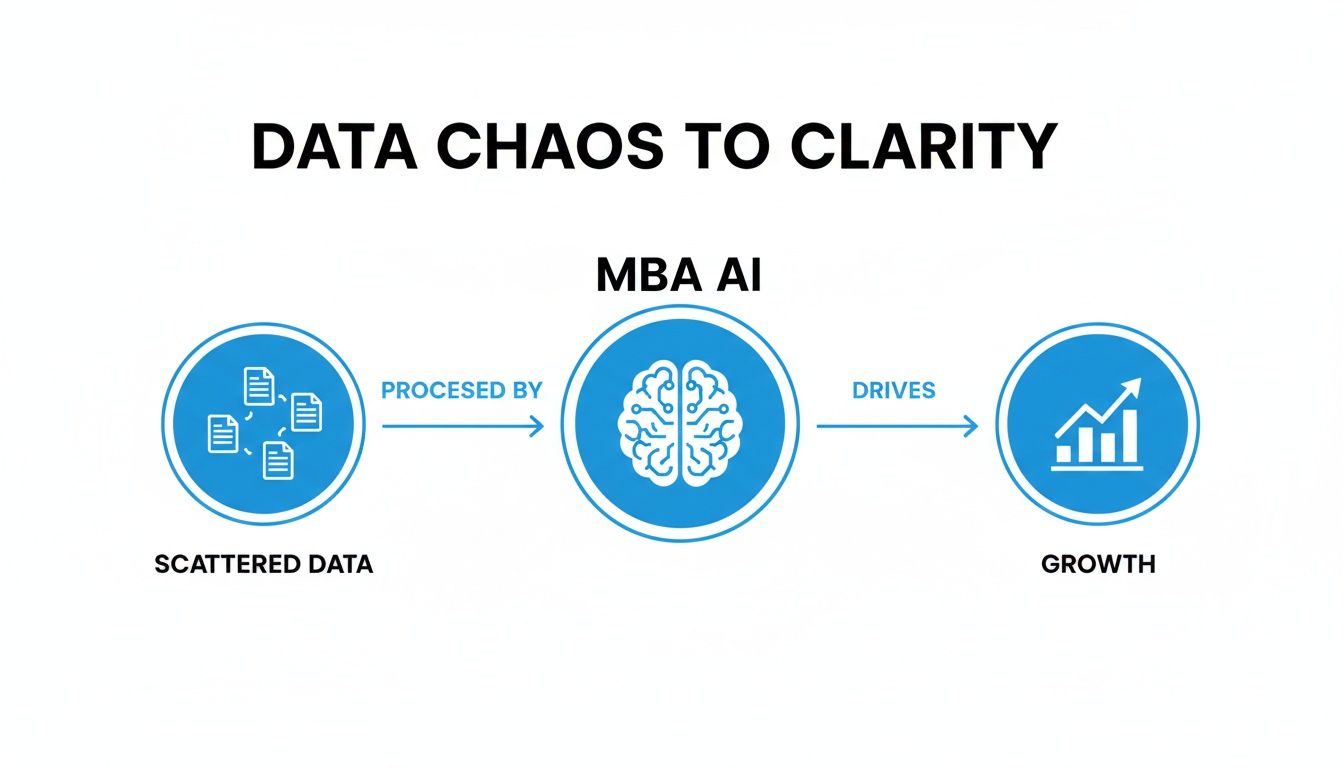
As you can see, modern AI-powered tools take fragmented Shopify data, run it through an analytics engine, and spit out a clear path forward—no more manual guesswork.
The most famous (and maybe legendary) example is the "beer and diapers" story. Back in the day, a big supermarket chain dug into their data and found something weird: men who bought diapers on Friday evenings also tended to grab a six-pack of beer. The connection was surprisingly strong. So, they moved the beer next to the diapers. The result? A significant sales lift for both items.
The same principles apply to your Shopify store, but now AI does the heavy lifting for you. You don't need a team of data scientists; you just need the answers.
The Three Core Ideas Behind It All
To really get what's happening, you need to know about three simple but powerful metrics. An AI platform like MetricMosaic crunches these for you automatically, but understanding them helps you see the magic behind the curtain.
- Support (Popularity): This is just how often a product, or a pair of products, shows up in all your orders. Think of it as a basic popularity contest. If a product has high support, it’s in a lot of carts.
- Confidence (Predictability): This is the "if-then" metric. If a customer buys Product A, what’s the chance they’ll also buy Product B? For a coffee brand, this answers, "If someone buys our ‘Morning Kick’ beans, how likely are they to add ‘Paper Filters’ to that same order?"
- Lift (The Real Connection): This one is the most important. Lift tells you how much more likely two products are to be purchased together than by pure chance. A lift score above 1.0 means there’s a real, non-random relationship. A lift of 3.0, for example, means those two products are bought together 300% more often than you’d expect.
Lift is your secret weapon. It separates random coincidence from genuine buying patterns, pointing you directly to the product pairings that will actually drive up your Average Order Value (AOV) and boost profitability.
How AI Puts This on Autopilot
As a busy Shopify founder, you don't have time to manually calculate support, confidence, and lift across thousands of orders. It's impossible. This is exactly where AI analytics tools step in and act as your co-pilot. They plug right into your Shopify data and do all the math in seconds.
But the AI doesn't just hand you a spreadsheet of raw numbers. It tells you the story behind them. Instead of seeing "Lift = 4.2," you get a clear recommendation. These insights are also a fantastic starting point for more advanced strategies. For instance, you can take these product association rules and use them to create incredibly specific customer segments for better retention.
To see how that works, check out our guide on using RFM for customer segmentation. By combining insights on what people buy with how frequently and recently they shop, you can build hyper-personalized campaigns that actually convert.
Six Actionable eCommerce Growth Playbooks
Discovering those powerful product relationships is a great first step. But for a busy Shopify founder, insights only matter when they lead to action. The real magic happens when you translate those findings into specific, repeatable growth strategies that actually boost your bottom line.
Think of these playbooks as your direct line from data to revenue. You're no longer guessing which products to bundle or what emails to send. Instead, you're using definitive evidence straight from your own customers' buying habits. This isn't about complex theory; it’s about making smarter decisions, faster, to improve your key metrics like AOV, LTV, and retention.

Playbook 1: Build Smarter Product Bundles
The most direct way to act on market basket findings is by creating product bundles your customers have already proven they want. High-lift pairings are your blueprint for bundles that sell because they reflect natural demand, not just a marketer's hunch.
How to Execute:
- Identify High-Lift Pairs: Use an AI analytics tool to find product combos with the highest lift scores in your store. You're looking for pairs where the Lift is 3.0 or higher—that signals a strong, non-random connection.
- Create the Bundle: In Shopify, build a new product that’s a "kit" or "bundle" of these items. Price it with a small discount, say 10% off, compared to buying them separately. This sweetens the deal and makes the value obvious.
- Promote Strategically: Feature these bundles on your homepage, in email campaigns, and as a one-click add-on in the cart. Frame them as a "Perfect Pair" or "Customer Favorite Kit."
Playbook 2: Optimize On-Page Recommendations
Those "Frequently Bought Together" or "You Might Also Like" sections on your Shopify site are prime real estate. Market basket analytics lets you power these with real data instead of just showing best-sellers or recently viewed items—which are often way less effective.
This simple shift takes your product discovery from generic to hyper-relevant, making that add-to-cart click much more likely.
Key Insight: When recommendations are based on proven buying behavior, they feel less like a sales pitch and more like a helpful suggestion, dramatically improving the customer experience.
By tailoring these suggestions, you directly increase your Average Order Value (AOV) by making it ridiculously easy for customers to find the complementary products they probably wanted anyway.
Playbook 3: Power Up Your Klaviyo Flows
Email marketing becomes a whole different beast when you personalize it with purchase data. Market basket insights are a goldmine for your post-purchase and win-back flows in platforms like Klaviyo.
Instead of sending a generic "Thanks for your order!" email, you can follow up with a targeted cross-sell campaign based on exactly what the customer just bought.
Step-by-Step Implementation:
- Segment by Antecedent: Create a segment of customers who bought "Product A" (the first item in your high-lift pair) but did not buy "Product B" (its partner).
- Trigger a Targeted Flow: A few days after their purchase, send an automated email showcasing Product B. Use copy like, "The perfect companion to your new [Product A]" or "Customers who bought [Product A] also loved this."
- Offer a Small Incentive: A small, time-sensitive discount on Product B can be the perfect nudge to encourage that second purchase and start building a habit.
This turns a one-time transaction into a relationship and is a fantastic way to boost customer Lifetime Value (LTV). For more ideas on this, check out our detailed post on top e-commerce growth strategies.
Playbook 4: Restructure Site Navigation and Layout
The way you organize your Shopify store can either guide customers toward a bigger purchase or create frustrating dead ends. Use your analytics to inform your site's architecture. If you find a strong link between two different product categories (like "Yoga Mats" and "Herbal Teas"), make that connection obvious.
Feature a "Relax and Recharge" collection on your homepage that includes both. Or simply add a link to the Herbal Teas category right on your Yoga Mat product pages. It's a small change that reduces friction and helps customers discover products they might have otherwise missed.
Playbook 5: Inform Ad Creative and Targeting
Your paid ad campaigns on platforms like Meta can see a serious ROAS lift when you let market basket data guide them. For DTC brands, knowing which product pairs have natural affinity allows you to create ads that showcase a solution, not just a product. This leads to higher conversion rates and a lower Customer Acquisition Cost (CAC).
For example, if you sell apparel, you might discover that 40% of shoe buyers also add a specific matching bag. Use your strongest product pairings to create ad creative that shows the items together. For targeting, build lookalike audiences from customers who have already purchased these high-value bundles to find new buyers with similar habits.
Playbook 6: Fine-Tune Inventory and Supply Chain
Finally, market basket analysis is an incredibly practical tool for managing inventory. Knowing that a spike in sales for Product A will almost certainly be followed by a spike for Product B lets you forecast demand with much greater accuracy.
This helps you avoid costly stockouts of those complementary items, ensuring you don't miss sales because a popular add-on is unavailable. You can also make smarter purchasing decisions, ordering correlated items together to potentially cut shipping costs and stock your warehouse to meet real, interconnected demand.
While these playbooks are powerful, remember that broader strategies to improve ecommerce customer experience and drive growth are always fundamental to long-term success.
Optimizing Inventory to Boost Your Profit Margins
While market basket analytics is a marketing powerhouse, its impact on your Shopify store’s financial health and profitability is just as significant. It’s a powerful tool that moves beyond driving the next sale and helps you build a more resilient, profitable operation. By understanding exactly how your products are purchased together, you can make smarter decisions about what you stock, when you stock it, and how much you buy.
This isn’t about just having enough inventory; it’s about having the right inventory. When you know that your best-selling "Sunrise" coffee blend has a high lift with "Reusable Filters," you can proactively manage stock levels for both. This prevents the frustrating (and costly) scenario where a customer adds the coffee to their cart but abandons it because the filters they always buy with it are sold out.
From Smart Forecasting to Increased Cash Flow
For DTC founders, cash flow is king. Tying up capital in slow-moving or unprofitable inventory is a silent business killer. Market basket analysis gives you a data-backed way to optimize your purchasing and free up that cash for growth.
AI-powered analytics can help Shopify brands reduce stockouts by a remarkable 20-30%. By analyzing sales patterns, you can identify not just complementary items but also potential substitutes. For example, if one popular SKU stocks out, knowing the next-best alternative allows you to adjust marketing and prevent lost sales. This insight has allowed major retailers to slash overstock by 25% while boosting product availability.
This directly translates into a healthier bottom line and improved profitability:
- Reduced Carrying Costs: You spend less on storing products that aren't contributing to sales.
- Higher Stock Turn: Your inventory moves faster, converting into revenue more efficiently.
- Increased Available Capital: Cash that was once locked in a warehouse is now free for marketing, product development, or other growth initiatives.
The goal is to create a supply chain that mirrors real customer demand. When your purchasing is directly informed by buying behavior, you waste less money, satisfy more customers, and build a stronger financial foundation for your brand.
Uncovering Hidden Profit Drains
Perhaps the most powerful financial benefit is the ability to identify "basket-draggers." These are low-margin products that frequently get purchased with your high-margin bestsellers. On the surface, they look like harmless add-on sales, but they can slowly erode your overall profitability without you even noticing.
An AI-powered analytics platform can connect your market basket findings directly with your product-level profitability data. This uncovers insights like: "Your top-selling t-shirt is frequently bought with a low-margin accessory that barely breaks even." Armed with this knowledge, you can make strategic decisions.
Actionable Steps to Take:
- Re-evaluate the "Dragger": Can you find a new supplier to improve its margin? Is it worth keeping at all?
- Suggest a Better Alternative: Use your on-page recommendations to steer customers toward a similar, but more profitable, accessory.
- Adjust Your Bundling Strategy: Ensure your bundles are built around high-margin pairings, not just popular ones.
By actively managing these subtle profit drains, you protect your margins on every single transaction. To take this a step further, you can dive deeper into a full product profitability analysis to ensure every item in your catalog is pulling its weight. This synergy between understanding purchase behavior and financial performance is where sustainable growth is born.
The Future of Analytics Is Conversational and Predictive
The days of staring at static dashboards, hoping to find a growth opportunity, are over. As a Shopify founder, your time is your most valuable asset. Hunting through endless charts for one small nugget of insight just isn't a good use of it.
The next wave of DTC analytics is all about speed, clarity, and having a direct conversation with your data.
This is where next-gen trends like conversational analytics come in. Think of it like having an AI co-pilot for your business. Instead of trying to build a complicated report, you just ask a question in plain English: “What products do people buy most often with our new skincare serum?” And you get an instant, clear answer, backed by the data.
This completely removes the technical barrier between you and your business intelligence. You don't have to be a data expert to get expert-level answers anymore. It turns analytics from a passive reporting tool into an active, strategic partner that helps you make smarter decisions, faster.
Moving From Reporting to Forecasting
Conversational analytics helps you understand what’s happening now, but the real competitive edge comes from knowing what’s happening next. This is where predictive insights change the game.
Traditional market basket analysis is great at showing you what has happened. But next-generation AI tools can forecast what will happen.
This means the system isn't just reporting on past trends; it’s actively predicting future buying behaviors. It can spot emerging product pairings and recommend new bundles before they become obvious in your sales data. You get to stay ahead of customer demand instead of just reacting to it.
Instead of you hunting for opportunities, AI surfaces them for you. It tells the story hidden in your data, delivering actionable growth strategies directly to you, so you can focus on execution.
How Story-Driven Data Delivers Action
The future of analytics isn’t about drowning in more data; it's about getting clear, actionable narratives. An AI-powered platform like MetricMosaic doesn't just spit out a lift score. It tells you a story: "Customers who buy your 'Organic Cotton Tee' are 4.5x more likely to buy your 'Canvas Tote Bag' in the same order. We recommend creating a 'Weekend Essentials' bundle to increase AOV by an estimated 12%."
This story-driven approach gives you everything you need to act:
- The What: A clear, high-potential product pairing.
- The Why: The specific data (the lift score) that proves the connection.
- The How: A direct, actionable recommendation (create a bundle).
- The Impact: The projected outcome (a 12% AOV increase).
Ultimately, this evolution turns your Shopify data from a confusing, fragmented resource into your most powerful growth engine. It’s about replacing complexity with clarity, and manual data-crunching with an intelligent co-pilot dedicated to helping you scale faster and more profitably. The focus is no longer on simply collecting data, but on turning it into decisive, revenue-generating action.
Turn Your Shopify Data Into Your Greatest Asset
Alright, let's put all the pieces together.
The truth is, market basket analytics isn't some complex, high-minded concept reserved for retail giants anymore. With the right AI-powered tools, it’s a practical, high-impact growth lever that any ambitious Shopify brand can pull.
By digging deeper than just surface-level sales numbers, you start to understand the why and how behind every purchase. This gives you a direct line to increasing AOV, LTV, and your overall profitability. To really make this happen, applying the principles of business intelligence is what separates brands with basic reports from those with a true strategic advantage.
From Learning to Doing: Your Next Step
The era of guesswork is over. You don't have to wonder which products to bundle, what to cross-sell in your next Klaviyo campaign, or how to get your inventory right. The answers are already sitting there in your own sales data.
Think of this as your invitation to shift from just learning about this stuff to actually doing it. Instead of getting lost in manual data-crunching, you can get clear, story-driven recommendations that tell you exactly what move to make next.
The real goal here is to turn your store's raw information into its most reliable engine for growth. When data becomes your co-pilot, you build a more resilient, profitable, and intelligent DTC brand.
Your next step is simple: start a conversation with your data. Ask it the questions you’ve always wanted to ask, and get the clarity you need to scale faster. It’s time to stop letting your data sit on the sidelines and turn it into the active, competitive advantage that drives every decision you make. This is how you stop just running your Shopify business and start engineering its growth.
A Few Common Questions
If you're like most Shopify founders, you probably have a few practical questions about putting market basket analytics to work. Let's tackle some of the most common ones.
What Data Do I Need to Get Started?
Here's the best part: you already have everything you need. The core ingredient is your Shopify order history.
AI-powered market basket analytics plugs right into your store's existing transaction data. You don't have to worry about complicated integrations or tracking down external datasets. A good analytics platform will pull every order, see which products were bought together, and handle the heavy lifting for you. The more sales history you have—six months is a great starting point—the richer your insights will be.
How Long Does It Take to See Results?
This isn't some drawn-out data science project that takes months to deliver. With the right AI-powered tools, you can get your first set of genuinely useful insights within hours of connecting your Shopify store. The platform processes all your historical data almost instantly to find the strongest product connections.
You’ll quickly see clear, story-driven recommendations like, "Customers who buy your best-selling hoodie are 4x more likely to add a specific pair of socks to their cart." These are the kinds of insights that give you immediate, actionable ideas for bundles and cross-sells.
Is This Too Complex for a Small Team?
Not at all. In fact, this technology is built for busy founders and small teams who don't have a data scientist on staff.
Forget about wrestling with spreadsheets or trying to remember complex formulas. Modern AI tools automate the whole process, from gathering the data to showing you what it all means. Next-gen platforms even use conversational analytics, turning a complex analysis into a simple conversation that gives you the answers you need to grow your store.
Ready to stop guessing what your customers want and start knowing? MetricMosaic is the AI-powered growth co-pilot for Shopify that turns your store's data into clear, actionable revenue strategies. Start your free trial and uncover your store's hidden opportunities today.