How to Increase Average Order Value: A Founder's Guide to AI-Driven Growth
Learn how to increase average order value using AI-driven analytics. A practical guide for Shopify founders to diagnose leaks and apply data-backed tactics.
Spending a fortune on Meta ads just to see your revenue flatline? If you're a Shopify founder stuck on the customer acquisition treadmill, you know the feeling. The constant pressure to drive more traffic can feel like you're just pouring water into a leaky bucket, and the fragmented data from a dozen different apps isn't helping you find the leak.
The key to profitable, sustainable growth isn't just about getting more customers; it's about maximizing the value of the ones you already have. This is where boosting your Average Order Value (AOV) changes the game for your DTC brand.
But let's be real. The idea of manually digging through Shopify reports and messy spreadsheets to find the right products to bundle is a nightmare. You know you should be doing something to increase cart size, but figuring out what to do and where to even start feels overwhelming. That guesswork is costing you margin and holding back your growth.
Why AOV Is Your Untapped Profit Engine
Focusing on AOV is one of the most efficient ways to grow your Shopify brand. You’re not chasing down new, cold traffic. You're simply helping your existing, high-intent shoppers discover more of what they'll love in a single purchase.
This isn’t just a vanity metric. A higher AOV directly impacts your bottom line and makes your entire marketing engine more efficient.
Here's why it's so critical for DTC founders:
- Boosts Profitability: A higher AOV almost always means a fatter profit margin per order. Your fixed costs—like shipping and handling—get spread across a larger revenue base. It's the fastest path to better unit economics.
- Improves ROAS: When every conversion is worth more, your Return on Ad Spend (ROAS) naturally climbs. Suddenly, your acquisition channels look healthier, and you can scale your ad spend with confidence.
- Enhances Customer Lifetime Value (LTV): When you introduce customers to more of your product line in their very first purchase, you set the stage for greater loyalty and much higher future spending.
The real challenge is bridging the gap between theory and action. Manually sifting through data is slow, painful, and imprecise. This is where AI-powered analytics gives you a massive competitive advantage. An intelligent platform like MetricMosaic replaces manual data crunching, cutting through the complexity to automatically surface the insights you need to make smart, confident decisions—fast.
For instance, a clean, AI-driven dashboard can instantly show you how your AOV is trending alongside other key metrics, all without wrestling with a single CSV file.

This single view helps a founder see the story behind the numbers, immediately spotting connections that would be completely lost in a spreadsheet. This guide is a clear, founder-friendly playbook, showing you how to use next-generation tools to pinpoint where your AOV is leaking and turn small cart adjustments into significant, predictable revenue growth.
Here’s a quick overview of the tactics we’ll be diving into, broken down by how fast you can get them live versus their long-term strategic value.
AOV Growth Tactics Quick Wins vs. Long-Term Strategy
| Tactic | Impact Potential | Implementation Speed | Best For |
|---|---|---|---|
| Free Shipping Threshold | Medium | Fast | Brands with a clear AOV and predictable shipping costs. |
| Product Bundling | High | Medium | Stores with complementary products or "better together" items. |
| Post-Purchase Upsells | High | Fast | Getting a second "yes" from customers who just converted. |
| Cart Cross-Sells | Medium | Medium | Suggesting relevant add-ons before checkout. |
| Volume Discounts/Tiers | Medium | Fast | Encouraging customers to stock up on consumable products. |
| Price Anchoring | Medium | Fast | Highlighting the value of premium options or bundles. |
| Product Recommendations | High | Long-Term | Creating a personalized shopping experience that drives discovery. |
This table is just a starting point. The real magic happens when you combine these tactics based on what your own Shopify data is telling you. Let's dig into how to find those insights.
Diagnosing AOV Leaks with AI Analytics
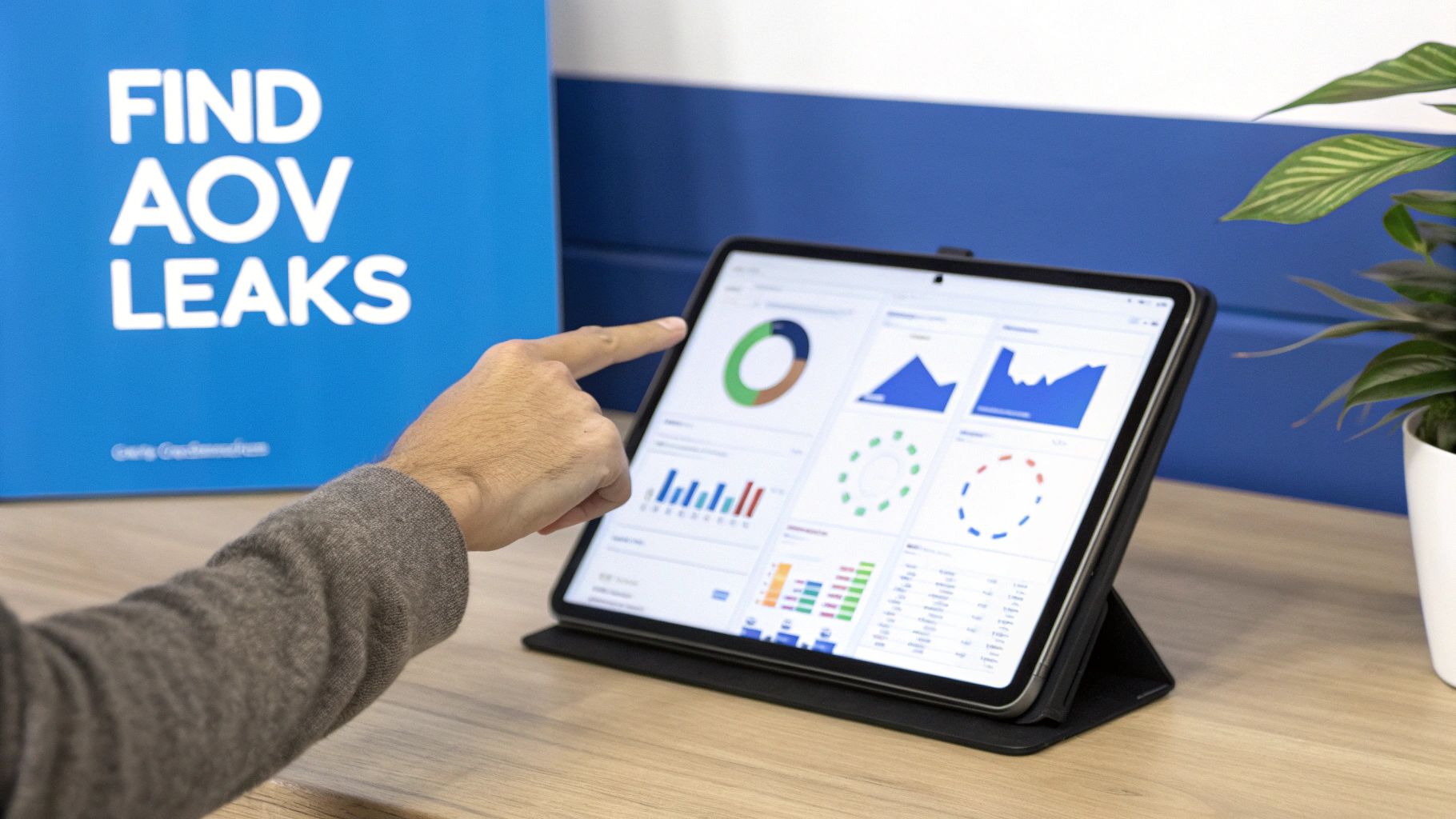
Before you can fix a problem, you have to find it. For a busy Shopify founder, trying to pinpoint AOV opportunities by manually digging through data is like searching for a needle in a haystack. It’s slow, tedious, and often misleading.
You might pull a report on your best-sellers, sure. But that report won't tell you why they sell well or what other products customers almost bought alongside them.
This is where AI-powered analytics completely changes the game. Instead of drowning in spreadsheets, an intelligent platform like MetricMosaic surfaces the critical insights for you, automatically. It replaces hours of manual data-crunching with clarity, letting you stop guessing and start making strategic, data-backed moves.
The real power here is the shift from staring at static reports to having a dynamic conversation with your data. This is the promise of conversational analytics.
Asking Your Data the Right Questions
Imagine asking your analytics platform a question in plain English and getting an instant, visualized answer. This isn't science fiction; it's what next-gen tools now make possible for any Shopify brand. It moves you from being a passive observer of your data to an active investigator, rapidly uncovering those hidden growth levers.
You can start asking highly specific, action-oriented questions like:
- "Which products are most often purchased alone?" This immediately flags your best candidates for a new bundle or cross-sell offer.
- "Show me customer segments with the lowest AOV." Now you can spot audiences that need more targeted offers or better product recommendations.
- "What's the AOV for first-time buyers who came from Meta ads last month?" This tells you how effective your acquisition channels are at driving high-value customers.
An AI co-pilot takes these natural language questions, connects the dots across your Shopify and marketing data, and delivers a clear, actionable answer in seconds.
Key Takeaway: AI analytics turns your store's complex data into an interactive resource. Instead of digging for answers, you can simply ask—saving countless hours and revealing opportunities you would have otherwise missed.
This direct line to insights helps you benchmark your performance in a meaningful way. Shopify stores worldwide have a huge range in AOV, with the global average sitting somewhere between $85 and $92. But the top 20% of merchants? They're hitting averages of $109 or more.
We've seen that smart optimization tactics can boost AOV by over 50%. The potential is massive, and it's sitting right there in your data. You can discover more insights on Shopify AOV benchmarks to see how you stack up.
From Reactive Reports to Predictive Insights
It gets even better. Beyond just answering your questions, AI analytics can give you predictive insights that help you get ahead of customer behavior. The system can identify groups of shoppers who are statistically likely to spend more if you just give them the right offer at the right time.
For instance, an AI might flag a segment of customers who have bought a specific skincare product twice and are now "due" for a third purchase. It could then suggest hitting them with a "stock up and save" bundle or a tiered discount, knowing this group is primed to convert on a higher-value offer. This is proactive, not reactive, growth.
An AOV diagnostic report in a platform like MetricMosaic can visualize these opportunities instantly.
This kind of report doesn't just show you numbers; it tells you a story. It reveals which customer segments or traffic sources are underperforming and where the biggest uplift potential lies. With story-driven data, you move beyond charts to get clear, narrative explanations of why things are happening, turning complexity into a clear path for action.
Proven Plays to Boost Your Shopify AOV
Alright, your AI analytics have done the heavy lifting and pointed out the biggest opportunities. Now it’s time to act. This isn't about throwing random discounts at the wall and hoping something sticks. It’s about deploying smart, data-backed strategies that feel helpful to your customers while padding out your Average Order Value.
We’re moving past the basics here. Forget guesswork. We're diving into tactics that use your own Shopify data to build offers your customers genuinely want, like intelligent product bundles based on what they actually buy together and post-purchase upsells that strike while the iron is hot.
Craft Intelligent Product Bundles
Bundling products is one of the fastest ways to lift your AOV. But the magic isn't in just grouping random items together. It's about creating a complete solution for your customer, guided by real purchase data. This is where AI-powered analytics makes all the difference.
Instead of guessing, you can lean on a platform like MetricMosaic to instantly spot those "frequently bought together" patterns. The system crunches thousands of orders to find non-obvious pairings that your customers are already creating on their own.
For instance, a DTC brand selling camping gear might find that customers who buy their flagship portable stove also grab a specific coffee press and a pack of fire starters. Armed with that insight, they can create a "Morning Brew Camp Kit." Simple. Effective. Data-driven.
This works so well because:
- It feels like a better deal: The customer gets an all-in-one kit, often with a slight discount, making the whole purchase feel smarter.
- It makes shopping easier: You’re saving them the hassle of hunting down all the complementary items themselves.
- It’s based on proven behavior: You're not forcing an unnatural combination; you're just making an existing customer habit official.
This is a world away from the old method of manually digging through order histories—a slow process that often misses the subtle connections an AI can spot in seconds.
Set a Data-Informed Free Shipping Threshold
Let's be honest, "free shipping" is a powerful psychological lever. We all know customers who would rather add another item to their cart than pay a few bucks for delivery. The trick is setting a threshold that actually nudges the cart size up without demolishing your margins.
Guessing is a dangerous game here. Set the threshold too high, and you'll see cart abandonment spike. Set it too low, and you’re just giving away shipping on orders you would have gotten anyway, which eats directly into your profit.
Your data is your North Star. Instead of just looking at your overall AOV (which can be easily skewed by a few huge orders), the smarter play is to focus on your modal order value—the single most common order total in your store.
If your AI analytics show the most frequent order value is $65, setting your free shipping threshold at $75 is a strategic move. It feels completely achievable for most of your customers, encouraging them to add just one more small thing to their cart.
This small, data-driven tweak can have a huge impact on your overall AOV and revenue. It turns a generic marketing tactic into a precision tool for growth, tuned perfectly to how your Shopify customers actually shop.
AOV Tactic Comparison for Shopify Stores
| Tactic | Primary Goal | Ideal For | Metric to Track |
|---|---|---|---|
| Product Bundles | Increase items per order and perceived value. | Complementary products (e.g., skincare routine, camera kit). | Units Per Transaction (UPT), Bundle Take Rate. |
| Shipping Thresholds | Nudge customers to add one more small item. | Stores with a wide range of product prices. | Conversion Rate, Cart Abandonment Rate. |
| Post-Purchase Upsells | Capture peak buying intent without cart friction. | Low-cost add-ons, refills, or travel sizes. | Post-Purchase Conversion Rate, Revenue Per Visitor. |
| Tiered Rewards | Gamify the shopping experience to hit higher spend levels. | Consumable goods or brands with strong repeat business. | AOV by Customer Segment, Tier Attainment Rate. |
This table should give you a good sense of which lever to pull based on your products and goals. Now, let's talk about one of the most powerful, low-friction tactics on the list.
Master the Post-Purchase Upsell
The moment a customer clicks "Complete Purchase" is pure gold. Their trust is at its absolute peak, their payment info is already in, and their buying intent is 100% confirmed. This is the perfect, frictionless moment to present a relevant upsell.
A post-purchase upsell is an offer you make after the initial transaction is complete but before the customer hits the final confirmation page. This is so important because it doesn't add any friction or risk to the original conversion.
Using a Shopify app that's plugged into your analytics, you can serve up hyper-relevant, one-click offers.
Example 1: The Complementary Add-On
A customer just bought a new leather handbag. The post-purchase offer could be a bottle of leather cleaner and conditioner for 20% off. It’s a natural, genuinely helpful suggestion.Example 2: The Travel-Size Version
Someone buys a full-size bottle of your best-selling face serum. The immediate upsell? A travel-size version, perfect for their gym bag or an upcoming trip.
Your analytics can help optimize these offers by figuring out which upsells have the highest take rate for specific initial purchases. Over time, the AI learns which pairings work best, basically automating your AOV growth. Better yet, this data feeds back into your pre-purchase bundling strategy, creating a powerful growth loop.
Use Tiered Rewards to Gamify Spending
People are wired to love hitting goals and earning rewards. You can tap into this by creating tiered incentives that encourage customers to reach the next spending level.
This goes way beyond a simple "spend X, get Y" deal. It creates a mini-game right at checkout.
Here’s what a tiered system could look like for a DTC snack brand:
- Tier 1: Spend $50, get free shipping.
- Tier 2: Spend $75, get free shipping + a free sample pack of a new flavor.
- Tier 3: Spend $100, get all of the above + 15% off your next order.
This structure works wonders because it clearly shows the customer exactly what they need to do to unlock the next reward. For the shopper with a $68 cart, that jump to $75 to snag a free product feels like a total no-brainer. That small "level up" behavior, multiplied across thousands of orders, can have a massive impact on your store's AOV.
Testing and Implementing Your AOV Strategy
A brilliant idea is useless without flawless execution. Now that your AI analytics have diagnosed your AOV opportunities and picked your tactics, it’s time to roll them out on your Shopify store.
This isn’t about just launching something and hoping for the best. It's about creating a tight feedback loop where you implement, measure, and then iterate for continuous growth.
The whole point is to make sure every single test gives you a valuable lesson, win or lose. For Shopify brands, that means setting up simple but effective A/B tests to validate your hunches before going all-in. Take a classic example: testing a free shipping threshold. Instead of just pulling a number out of thin air, you could run a test pitting a $75 threshold against an $85 one.
Moving Beyond Simple A/B Testing
The real magic happens when you connect your A/B test results to the metrics that actually run your business. A simple conversion rate lift doesn't tell you if the new offer is truly profitable or if it's bringing in the right kind of customer.
An AI analytics platform like MetricMosaic lets you see the ripple effects of your changes. You can track the AOV lift not just across the board, but within specific customer cohorts.
For instance, you might find that the $85 threshold absolutely crushed it with first-time buyers from your Meta ads campaign, boosting their AOV significantly, but had almost no effect on returning customers. That’s the kind of actionable insight you'd completely miss with manual analysis.
Founder-Friendly Tip: Don't just ask, "Did this test win?" Instead, ask, "What did we learn from this test?" A 'losing' test that shows a specific customer segment doesn't care about an offer is just as valuable as a 'winning' one.
Understanding these nuances is crucial for benchmarking your performance. For context, in the United States, the average order value for ecommerce sits around $153, while the global average is about $144.57. Comparing your segmented results against these figures helps you see where you have the most room to grow. You can discover more insights about eCommerce AOV benchmarks to see how your store really stacks up.
This visual below breaks down a typical workflow for growing AOV, layering different tactics together.
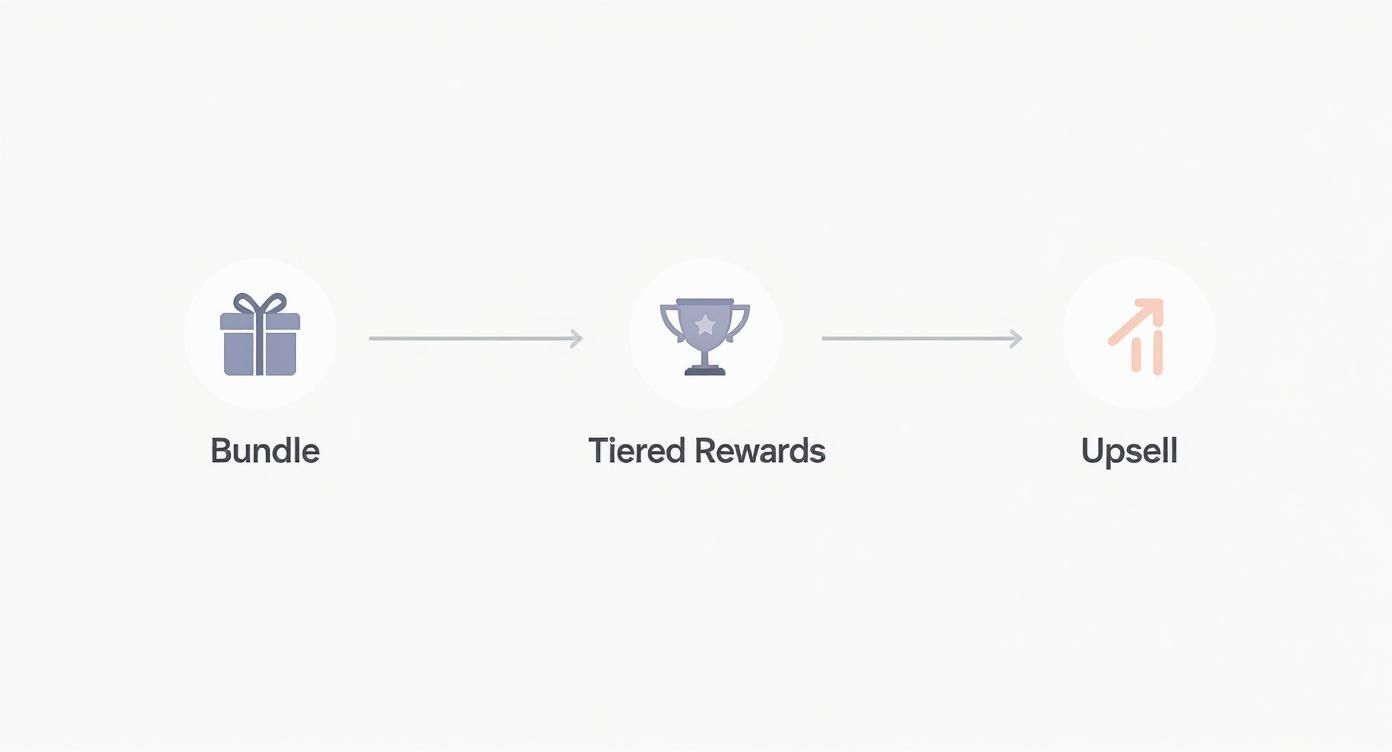
It shows how you can guide customers toward higher-value carts by combining things like bundling, rewards, and upselling into a cohesive strategy.
Measuring the True Impact on Profitability
Here's a step a lot of DTC founders skip: analyzing how AOV initiatives impact overall profitability and Customer Lifetime Value (LTV). It’s easy to pump up your AOV by throwing aggressive discounts around, but if you’re just killing your margins, you're not actually winning.
This is another spot where AI analytics really shines. It can automatically calculate the profitability of each order, factoring in all the discounts, shipping costs, and COGS.
This means you can confidently answer the big questions:
- Did our new product bundle increase AOV and profit per session?
- Is the higher AOV from our shipping threshold just getting eaten up by higher shipping costs?
- Are customers who grab the post-purchase upsell more likely to become high-LTV repeat buyers down the road?
By connecting your Shopify data to an intelligent analytics engine, you get a clear, story-driven view of what's happening. You stop just seeing that AOV changed and start understanding why it changed—and what that means for the long-term health of your business. This creates a powerful feedback loop: test an idea, measure its true financial impact, and use that insight to make your next move even smarter.
Measuring Success with Story-Driven Reports

Let's be real: your AOV strategy isn't a "set it and forget it" campaign. For sustainable growth on Shopify, you have to measure constantly and iterate intelligently. This is exactly where most analytics platforms drop the ball for DTC founders. They just throw a wall of disconnected charts at you and expect you to connect the dots yourself.
This old way of doing things leaves you with data that's only skin deep. You might see your AOV went up by 5% last week, but you’re left guessing why. Was it the new bundle? The free shipping test? A specific ad campaign that popped off? The answer is buried in there somewhere, but finding it feels like a full-time job.
From Static Charts to Actionable Narratives
This is where story-driven data changes the game entirely. Instead of just showing you a number, a platform like MetricMosaic gives you a clear, plain-English narrative that explains the cause and effect. It cuts through the complexity.
A "Story" insight doesn't just say, "AOV increased." It tells you something you can actually use:
"Your new 'Skincare Starter Kit' bundle, launched on Tuesday, was most effective with first-time buyers acquired from your Instagram Reels campaign. This segment had a 22% higher AOV than other new customers and has already led to a projected 15% lift in LTV over the next 90 days."
See the difference? A chart tells you what happened. A story tells you what to do next—in this case, you'd double down on that Instagram campaign and push that bundle hard to all new visitors. That’s the gap between data and actual intelligence.
Using Cohort Analysis to See the Long-Term Impact
One of the most powerful ways to see if your AOV initiatives are truly working is through cohort analysis. This just means grouping customers by when they first bought from you and watching their behavior over time. It helps answer the most critical question for a DTC brand: are the customers we're bringing in with these offers actually more valuable in the long run?
With an AI co-pilot, you can instantly see how different customer groups react to your strategies over weeks and months.
- Offer Impact: Did the cohort that got the "free gift over $100" offer have a higher repeat purchase rate after 60 days?
- LTV Growth: How does the LTV of customers who bought a bundle stack up against those who just bought a single item on their first order?
- Regional Performance: Are your AOV tactics landing better in certain regions?
Digging into these patterns is crucial, especially when you factor in regional buying habits. For instance, the global AOV for fashion e-commerce hovers around $102.30, but in North America, it jumps to $120.40. That's often driven by higher disposable income and a bigger response to things like free shipping thresholds. If your AOV strategy isn't hitting the mark with your key geographic segments, you're leaving cash on the table. You can explore more AOV patterns in fashion e-commerce to see how deep these differences go.
Forecasting Profitability with Predictive Insights
The final piece of the puzzle is shifting from looking in the rearview mirror to planning the road ahead. Next-gen analytics don't just report on the past; they help you forecast the future. Predictive insights can analyze the early behavior of customers who snagged your AOV offers and project their long-term profitability.
This lets you make smarter decisions, way faster. You can figure out if a new bundle is likely to be a long-term winner after just a few weeks of data, instead of waiting a whole quarter to find out. For any DTC brand trying to scale, that kind of agility is a massive advantage.
Ultimately, the goal is to stop just tracking metrics and start understanding the story behind your numbers. When your data tells you not just what happened, but why it happened and what to do next, you're no longer just running a Shopify store—you're building a smarter, more profitable business.
Common AOV Questions from Shopify Founders
As a Shopify founder, you're always looking for smart ways to grow. When it comes to boosting your average order value, it’s only natural to have questions about the real-world impact and potential landmines. Let's tackle the most common concerns I hear from founders head-on.
How Quickly Can I Expect to See Results?
This is always the first question, and the honest answer is: it depends on the tactic. The good news is some strategies can deliver a noticeable lift almost immediately.
Simple changes, like setting a data-backed free shipping threshold or launching a post-purchase upsell, can move the needle within days. These are quick wins because they tap into existing customer psychology. On the other hand, more sophisticated strategies—like building out personalized product recommendations or perfecting complex bundles—might take a few weeks to really dial in.
The key is not to wait for a massive, overnight change. An AI analytics tool lets you measure the incremental lift from day one. You can actually see AOV ticking up in specific customer cohorts or traffic segments, giving you those crucial early signals that your strategy is working long before the sitewide average makes a dramatic jump.
Will Increasing AOV with Discounts Hurt My Margins?
This is a huge, and very valid, concern for any founder focused on profitability. The fear is that you'll boost top-line revenue only to watch your net profit shrink. This is exactly what happens when brands get hooked on margin-killing, store-wide discount codes.
But the strategic approach is entirely different. It's about crafting margin-accretive offers that increase both AOV and your profit per order. For instance, bundling a high-margin accessory with a bestseller at a small discount can easily increase your total profit, even if the revenue per individual item is a bit lower.
This is where your AI analytics platform becomes your financial co-pilot. Instead of just guessing, you can model out the profitability of different offers. A tool like MetricMosaic can analyze profit per order, not just revenue, making sure your AOV-boosting tactics are actually putting more money in your pocket. It helps you find that sweet spot between a compelling offer and a healthy bottom line.
What Is the Biggest Mistake Brands Make?
By far, the most common mistake is throwing generic, one-size-fits-all offers at every single customer. We've all seen them: the irrelevant popup that interrupts your shopping or the "bestsellers" list that has nothing to do with what's in your cart. These tactics feel lazy and pushy, and frankly, they often do more harm than good.
This pitfall circles back to the core message of this entire guide: use your data to be genuinely helpful. Real AOV growth doesn't come from aggressive sales tactics; it comes from understanding what your customers are trying to accomplish and presenting them with relevant, personalized offers that solve a problem or make their purchase even better.
Instead of interrupting with a generic popup, use your data to suggest a complementary product that completes a set or solves a related problem. This simple shift transforms a sales pitch into a genuine service, building trust and increasing cart size naturally.
Do I Need a Ton of Expensive Apps to Do This?
This is a practical question for any founder keeping a close eye on the budget. While the Shopify App Store is packed with powerful tools, you don't need a dozen expensive subscriptions to get started.
Many of the most effective strategies can be implemented with Shopify's built-in features or with very affordable apps.
- Free Shipping Thresholds: This is dead simple. You can configure it right in your Shopify settings.
- Product Bundles: You can get this done with native Shopify apps or plenty of simple, low-cost third-party solutions.
- Post-Purchase Upsells: These usually require a dedicated app, but many offer free trials or inexpensive tiers so you can prove the ROI before committing.
Your most important investment is in your analytics foundation. Start by using an AI tool to diagnose where your biggest opportunities are with precision. Once your data tells you that a specific bundling or upsell strategy holds massive potential for your store, then you can confidently go out and find the right app to execute it. This data-first approach ensures you're investing in tools to solve a specific, proven problem—not just chasing shiny new features.
The takeaway is simple: stop guessing and start growing. Your Shopify data holds the key to a higher AOV, better ROAS, and a more profitable business. The next step is to unlock it. MetricMosaic is the AI-powered analytics co-pilot that turns your store's data into clear, actionable insights. See the story behind your numbers and get the proactive recommendations you need to move the needle. Start your free trial today.