Your Guide to RFM Customer Segmentation for Shopify Growth
Unlock growth with RFM customer segmentation. This guide shows Shopify brands how to identify best customers, reduce churn, and boost LTV with AI analytics.
Running a Shopify store means you’re sitting on a goldmine of customer data. But let's be honest, it probably feels more like a data-mess. Orders are in Shopify, email engagement is in Klaviyo, and performance reports are scattered across a dozen ad platforms. This fragmented data makes it nearly impossible to see the big picture, leaving you with critical questions about who your best customers are and where to focus your marketing budget.
You're left trying to piece it all together yourself—exporting CSVs, wrestling with spreadsheets, and hoping the insights are still relevant by the time you find them. This data chaos forces you into generic, one-size-fits-all marketing that burns cash without building real customer relationships, killing your ROAS and LTV.
From Data Chaos to AI-Powered Clarity

For most DTC brands, this isn't just a minor headache—it's a serious growth killer. Without a clear, unified view of your customers, you’re flying blind. You can't confidently:
- Pinpoint your VIPs: Who are the real champions you should be rewarding to maximize their lifetime value?
- Spot at-risk buyers: Which loyal customers have gone quiet and are about to churn for good?
- Truly personalize marketing: How do you send the right offer to the right person at the right time to boost conversions and AOV?
This is where RFM customer segmentation becomes your secret weapon. It’s a powerful method that cuts through the noise of fragmented data to reveal the real patterns in how people buy from you.
RFM analysis isn’t just about looking at past purchases. It's about predicting future behavior. It helps you see who's most likely to buy again, who's slipping away, and where your biggest profit opportunities are hiding in plain sight.
Now, imagine an AI-powered system that automatically connects to your Shopify data, crunches all those numbers, and serves up these exact customer groups for you. Even better, it tells you precisely how to engage each one to improve retention and profitability. That's the power of next-generation analytics. Instead of getting bogged down in manual data crunching, tools like MetricMosaic transform complexity into clear, actionable stories.
This guide will show you how to use RFM customer segmentation to move from reacting to what’s happened to proactively shaping what happens next. We'll skip the jargon and give you practical, actionable takeaways to boost LTV, improve ROAS, and build a more profitable Shopify brand. It’s time to turn your everyday store data into your sharpest competitive advantage.
What is RFM and Why It's a Game-Changer for Your DTC Brand
As a DTC founder, you’re drowning in data. Website traffic, social likes, open rates—it’s easy to get lost in vanity metrics that don't actually tell you if your customer relationships are healthy. This is where RFM segmentation comes in. It cuts through the noise and focuses on what truly matters: actual buying behavior.
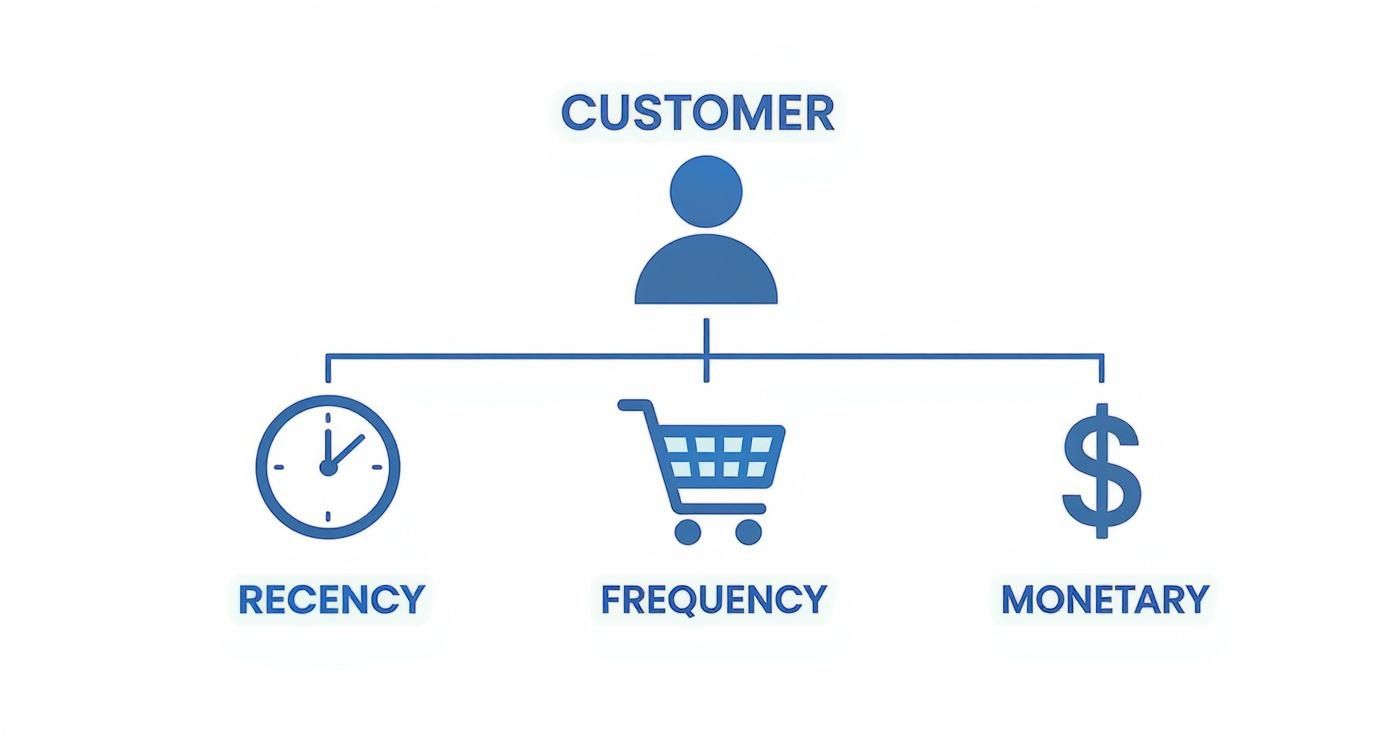
Think of RFM as the behavioral DNA of your customer base. It’s a beautifully simple model that gets to the heart of customer value by looking at everyone through three critical lenses:
- Recency (R): How recently did they buy? A customer who bought from your Shopify store last week is far more engaged than one who hasn't visited in a year. Recency is a powerful signal of current interest and a key predictor of your next sale.
- Frequency (F): How often do they come back? A customer with ten orders is a brand loyalist. A one-time buyer? A question mark. Frequency tells you who loves your products and has built a habit around your brand.
- Monetary (M): How much have they spent? This is straightforward—it separates your casual shoppers from your high-value VIPs, helping you understand who drives the most profit.
By combining these three scores, RFM analysis goes deeper than simple demographics. It doesn't care who your customers are; it cares about how they act. And for a growing DTC brand, that's everything.
Why Behavior Predicts Profit
Here’s the real magic: RFM is powerfully predictive. These three simple metrics, when combined, are one of the best indicators of a customer's future value and their likelihood to purchase again. It’s a time-tested way to separate your best customers from everyone else.
This isn't some new fad. A landmark modern approach to RFM segmentation study found that campaigns using RFM segmentation hit an average response rate of 4.2%—a massive 50% lift over generic campaigns. The same research showed companies using RFM boosted customer retention by 25% over 12 months.
For a growing Shopify brand, that’s game-changing. It means you can finally stop shouting into the void and start investing your marketing dollars where they'll have the biggest impact on LTV and profitability.
From Manual Spreadsheets to AI-Powered Clarity
Not long ago, building an RFM model was a nightmare reserved for enterprise brands with data science teams. It meant exporting massive CSV files from Shopify, battling complex spreadsheet formulas, and hoping the data was still relevant by the time you finished.
Today, AI has democratized this powerful technique. Modern AI analytics platforms like MetricMosaic connect directly to your Shopify store, crunch your entire order history, and serve up clear, actionable RFM segments in minutes. No spreadsheets, no manual data crunching.
This completely changes the game. RFM is no longer a static, once-a-year report. It’s a living, breathing view of your customer base, updated in real time. You can see who’s about to become a champion, who’s at risk of churning, and where your biggest opportunities are, right now.
How to Calculate RFM Scores (Without the Spreadsheets)
Knowing the theory behind RFM is great, but the real power comes when you start scoring your customers. This is where abstract order data transforms into a clear, actionable roadmap telling you exactly who to focus on to grow your Shopify store.
Let's be real: the old-school way of doing this was a painful, manual process that kept RFM out of reach for most DTC brands. You’d export your entire order history into a giant CSV, fight with complex formulas, and burn hours just to rank everyone. It was slow, error-prone, and the results were stale the second you finished. That kind of manual data-crunching is exactly what holds Shopify brands back.
The Modern, AI-Automated Approach
Today, an AI analytics tool like MetricMosaic connects directly to your Shopify store and automates this entire process. It securely syncs your transaction history, crunches the numbers for every customer's Recency, Frequency, and Monetary value, and assigns dynamic RFM scores without you ever having to open a spreadsheet.
This isn’t just about being faster; it’s about accuracy and clarity. The system automatically assigns a score from 1 to 5 for each of the three RFM pillars:
- A score of 5 is the best: your most recent buyers, most frequent shoppers, and biggest spenders.
- A score of 1 is the lowest: customers who haven't bought in a long time, only purchased once, or spent very little.
By combining these, every customer gets a simple three-digit RFM profile, from 555 (your absolute best customer) down to 111 (a long-lost, low-value buyer).
This scoring system is your new marketing command center. It instantly tells you who deserves the VIP treatment (the 555s) and who needs a gentle nudge to come back (like a 344). It cuts through the complexity and gets you straight to action, improving CAC and ROAS.
Decoding RFM Scores From 1 to 5
So what do these numbers actually mean for your Shopify brand? Think of it like a report card for customer behavior. The higher the score, the more valuable that customer is to your business right now. This simple framework is the foundation for building the hyper-targeted marketing campaigns that will drive up your LTV and profitability.
| Score | Recency (R) | Frequency (F) | Monetary (M) |
|---|---|---|---|
| 5 | Most Recent: Purchased in the last 30 days. These are your most active and engaged customers. | Most Frequent: Have made numerous purchases. These are your brand loyalists and repeat buyers. | Highest Spenders: Top 20% of customers by total money spent. These are your VIPs. |
| 4 | Recent: Purchased in the last 31-90 days. Still active but could be nurtured to buy again soon. | Frequent: Regular purchasers who form the core of your loyal customer base. | High Spenders: The next 20% of customers who consistently spend a good amount. |
| 3 | Fairly Recent: Purchased in the last 91-180 days. Their engagement is starting to cool off. | Occasional: Purchase from time to time but aren't yet in a habitual buying pattern. | Average Spenders: The middle 20% who represent your typical customer's spending habits. |
| 2 | Not Recent: Purchased in the last 181-365 days. These customers are at risk of churning. | Infrequent: Have only made a couple of purchases over a long period. Low engagement. | Low Spenders: The next 20% of customers who spend less than average. |
| 1 | Lapsed: Purchased over a year ago. These customers have likely churned. | One-Time Buyers: Made a single purchase and never returned. | Lowest Spenders: Bottom 20% of customers by total spend. |
With a simple, AI-powered framework like this, the health of your customer base becomes crystal clear. You can see who your champions are, who’s drifting away, and where the biggest revenue opportunities are hiding in your Shopify data. This is the smart way to approach RFM customer segmentation—no manual work, just clear, automated insights that drive growth.
From RFM Segments to Smarter Marketing Actions
You've done it. Your customers are scored and segmented. Now what? This is the moment your RFM customer segmentation model stops being a cool analytics project and becomes a real-deal growth playbook for your Shopify store. The power of RFM isn't just knowing who your Champions are; it's about treating them like champions.
You can't talk to a first-time buyer the same way you talk to a VIP who has bought ten times. Sending the same generic message to everyone is a surefire way to burn your ad budget and annoy your customers. By mapping marketing actions directly to RFM segments, you can finally deliver messages that feel personal, drive real action, and boost both LTV and ROAS.
Your Core Shopify RFM Segments
While you could create dozens of micro-segments, most DTC brands see the biggest wins by focusing on a handful of core groups. These segments tell the clearest story about who is buying from you and what they need next.
Let’s break them down:
- Champions (RFM Score 555): Your absolute best customers. They've bought recently, buy often, and spend big. They are the foundation of your revenue and your most powerful brand advocates.
- Loyal Customers (RFM Scores like 444, 545): The backbone of your Shopify store. They're consistent, frequent buyers who trust you and keep your cash flow healthy.
- Potential Loyalists (RFM Scores like 533, 434): Your rising stars. They're recent customers with decent frequency and spend. With a little nurturing, you can turn them into your next wave of Champions.
- At-Risk Customers (RFM Scores like 244, 345): These folks used to be great customers, but they’ve gone quiet. They haven't purchased in a while and are dangerously close to churning. You need to act fast to win them back.
- Hibernating (RFM Scores like 122, 221): They bought once or twice a long time ago and haven't been back. They're basically asleep, and it’ll take a strong, targeted offer to wake them up.
The real goal isn't just to find these groups. It's to build automated flows that pipe these segments directly into your marketing tools like Klaviyo, creating a smart system that reacts to customer behavior automatically to drive retention and profitability.
The Tactical Marketing Playbook for Shopify Growth
Let's connect these segments to actual, money-making actions. A classic case study found a supermarket chain's top 20% of customers—the highest RFM segments—were responsible for a massive 65% of total sales. By targeting these groups with specific campaigns, they increased repeat purchase rates by 30% and AOV by 22%, all while cutting marketing costs by 15%. You can dig into these powerful RFM findings yourself to see the full impact.
Here's a simple, actionable playbook that maps each key RFM segment to specific marketing goals and tactics for your Shopify store.
| RFM Segment | Description | Marketing Goal | Actionable Tactics (Email, Ads, On-site) |
|---|---|---|---|
| Champions | Your best customers: recent, frequent, and high-spending. | Reward & Retain: Nurture advocacy and maximize their LTV. | Email: Exclusive early access to new products, VIP-only discounts, and requests for reviews. Ads: Exclude them from top-of-funnel campaigns. Use their data to build high-quality lookalike audiences on Facebook. On-site: Offer a VIP tier in your loyalty program with special perks. |
| Loyal Customers | Consistent and frequent buyers who form your stable customer base. | Upsell & Appreciate: Increase their AOV and reinforce their loyalty. | Email: Offer product recommendations based on past purchases, bundle deals, and "thank you" notes with small rewards. Ads: Target them with new product launches and cross-sell campaigns for complementary items. On-site: Show personalized banners highlighting loyalty points. |
| Potential Loyalists | New customers who show promising buying behavior. | Engage & Nurture: Encourage their second purchase to build a buying habit and improve retention. | Email: Send a post-purchase nurture series with educational content and a modest incentive for their next purchase. Ads: Retarget them with social proof, user-generated content, and testimonials. On-site: Use pop-ups to encourage them to create an account or join your community. |
| At-Risk | Good customers who haven't purchased in a while and are close to churning. | Win-Back & Reactivate: Remind them of your brand's value and give them a compelling reason to return. | Email: Trigger an automated win-back flow with a "We miss you" message and a time-sensitive offer. Ads: Run targeted reactivation campaigns on social media showcasing "what's new" since their last visit. On-site: If they visit, use a welcome-back banner with a special discount. |
By running plays like these, you stop treating your Shopify data as a pile of numbers and start using it as an active engine for growth. This is exactly what next-gen AI-powered platforms like MetricMosaic are built for—turning complexity into clarity, and clarity into profitable action.
Automating RFM Segmentation with AI Analytics

Defining your RFM segments is a massive win, but if you’re still doing it by hand, you’re leaving most of the value on the table. The old-school approach to RFM customer segmentation is a painful memory for many DTC operators: exporting CSVs from Shopify, fighting with pivot tables, and burning hours just to assign scores.
Worse, that manual analysis is just a snapshot in time. The second you finish, it's already stale. A customer you labeled "Potential Loyalist" last week might have just become a "Champion," but your spreadsheet has no idea. This lag is a growth killer, leading to missed opportunities and wasted marketing dollars.
The Old Way vs. The AI-Powered Way
For any ambitious Shopify brand, the game isn't just about looking back at what happened; it's about acting on what's happening right now. This is where AI-powered analytics completely flips the script, taking RFM from a clunky, quarterly report to a living, breathing growth engine inside your business.
- The Manual Spreadsheet Method: A point-in-time analysis. It's slow, tedious, and always looking in the rearview mirror. By the time you act on the data, reality has already changed.
- The AI-Powered Platform Method: A live, always-on view of your customer segments. It plugs directly into your Shopify store and marketing stack, so your data is perpetually current and actionable.
This isn’t just about saving time. It’s a fundamental shift from reactive analysis to proactive strategy—a leap you must make to scale profitably.
Beyond Segmentation: Predictive Insights and Story-Driven Data
Modern analytics tools like MetricMosaic don't just automate scores. They layer on predictive intelligence, turning raw numbers into clear, forward-looking stories about your customers.
So instead of just telling you who is in your "At-Risk" segment, an AI co-pilot can tell you why. It might find that customers who haven't bought in 60 days and previously purchased from a specific collection have a 90% probability of churning. Now that's an insight you can use to spin up a targeted win-back campaign in minutes, saving a valuable customer relationship.
This is the core difference: static reports give you numbers, but AI-driven platforms give you a narrative. They tell you the story of your customer base and recommend the next chapter.
These systems can even start predicting what your best customers will buy next, analyzing their order history to suggest specific products they're statistically likely to love. Your analytics tool just went from a simple reporting dashboard to a strategic partner in growth.
The Rise of Conversational Analytics
The most advanced platforms are pushing this even further with conversational analytics, letting you simply talk to your data. Imagine asking your dashboard questions in plain English, just like you’d ask a human analyst.
Instead of navigating complex filters, you could just ask:
- "Show me my most valuable customers in California who bought in the last 30 days."
- "What's the LTV of my 'Loyal Customers' segment compared to last quarter?"
- "Create a list of 'At-Risk' customers to sync with my Klaviyo win-back flow."
This conversational approach shatters the final barrier between you and your data. Suddenly, deep RFM customer segmentation becomes accessible to everyone on your team, not just the data experts. By turning complex questions into simple conversations, AI makes your Shopify data a responsive tool that helps you make smarter decisions, faster.
Your Action Plan for RFM-Powered Growth
All this theory is great, but turning knowledge into action is what separates the brands that scale from those that stagnate. It's time to stop making marketing decisions on a hunch and start building your strategy on the solid ground of actual customer behavior. The old excuses about RFM being too complex are dead. AI has made this incredibly powerful technique accessible to every DTC founder.
Your Path from Data to Decisions
This roadmap is simpler than you think. This isn't about becoming a data scientist overnight. It’s about picking the right tools to turn the Shopify data you already have into clear, profitable actions that boost your bottom line.
Here’s the game plan:
- Stop Guessing, Start Analyzing: The first step is a mental shift. The answers to higher ROAS, better LTV, and stronger retention are already sitting in your Shopify order history, waiting to be unlocked.
- Connect Your Data in Minutes: Sign up for an AI-powered analytics tool like MetricMosaic that plugs directly into your Shopify store. It connects in minutes and starts analyzing your historical data instantly.
- Get Your Automated RFM Segments: The AI handles the heavy lifting, automatically calculating Recency, Frequency, and Monetary scores for every customer. You get your first automated RFM dashboard without ever touching a spreadsheet.
- Activate Your Segments in Klaviyo & Ads: Push these new segments—like 'Champions' and 'At-Risk' customers—straight into your marketing tools. Now you can run campaigns that are actually relevant and drive results.
The impact is not subtle. A study on an express delivery company found its top 10% of customers, identified through RFM, were driving a whopping 58% of total revenue. Their churn rate was just 5%, compared to 35% for lower-value segments. By focusing their efforts on these high-value groups, they boosted customer retention by 28% in just six months. You can read more about these impressive RFM results for yourself.
This is how fast-growing DTC brands build an unfair advantage. They turn their data from a confusing liability into their most powerful asset.
Your next move is clear. Connect your data, get your automated RFM segments, and start making smarter, more profitable marketing decisions today.
Burning Questions About RFM
Even the best plans spark a few questions. When you start digging into RFM customer segmentation, some common hurdles pop up. Here’s how to handle them.
How Often Should I Recalculate My RFM Segments?
For most stores, refreshing monthly is the sweet spot. It’s frequent enough to catch important shifts in buying habits without getting bogged down in daily noise.
However, during high-velocity periods like BFCM, switching to a weekly refresh with an automated tool can give you a massive advantage. You’ll be able to react to changes in customer behavior almost in real-time, personalizing offers and maximizing AOV.
How Do Returns and Refunds Factor In?
This is critical. If you get this wrong, your segments are useless. Your RFM model must calculate the Monetary (M) score using net revenue—that's total sales after subtracting refunds. This prevents someone who buys and returns a ton of product from being mislabeled as a ‘Champion.’ A smart AI analytics platform handles this automatically, ensuring your segments are always based on actual profit.
Can I Use These Segments in Klaviyo, Facebook Ads, and Other Tools?
You absolutely should—this is where the magic happens. The whole point of building these segments is to use them. Modern analytics tools are built to sync your segments directly into platforms like Klaviyo, Attentive, Facebook Ads, and Google Ads. Imagine automatically triggering a win-back flow in Klaviyo the moment a customer slips into the 'At-Risk' segment. Or building a killer lookalike audience on Facebook using only your 'Champions.' This is how you connect the dots between data and profit, driving up both your ROAS and LTV.
Ready to stop guessing and start growing? MetricMosaic connects to your Shopify store in minutes, automatically builds your RFM segments, and delivers the clear, story-driven insights you need to boost profitability.
Start your free trial today and turn your data into your biggest competitive advantage.