How to Calculate Return on Investment for Your Shopify Brand
Learn how to calculate return on investment for your Shopify store. This guide breaks down ROI formulas, why ROAS isn't enough, and how to automate tracking.

If you're running a Shopify brand, this probably sounds familiar: your ad spend keeps climbing, top-line revenue looks fantastic, but the actual cash hitting your bank account feels like a total mystery. It’s a frustrating loop of trying to stitch together a coherent story from a dozen different data sources. This fragmented data is a classic growing pain for small-to-mid-size Shopify brands.
You're left guessing which numbers to trust and wondering if your marketing dollars are actually fueling growth or just getting burned. Shifting your focus from revenue to true profit is the single most important step toward building a sustainable brand.
Why Most DTC Brands Get Profitability Wrong

The core challenge for Shopify operators is that data is everywhere, and none of it seems to agree:
- Shopify gives you a clear look at daily sales and revenue.
- Meta Ads reports a killer ROAS that just feels a little too good to be true.
- GA4 comes in with a completely different attribution story.
Each platform tells its own version of the truth, making it nearly impossible to get a reliable read on your actual return on investment. You're stuck in manual data-crunching mode, trying to make sense of unreliable reports.
The Problem with Vanity Metrics
The real issue is an over-reliance on vanity metrics like revenue or ROAS. While they're not useless, they don't tell you anything about your business's financial health. A high-revenue month can easily be an unprofitable one once you factor in all the costs that impact your Customer Acquisition Cost (CAC) and profitability.
True profit means digging deeper into your unit economics and understanding the complete cost picture.
This is where so many DTC brands get stuck. They scale their ad spend based on surface-level metrics, only to realize later they've been acquiring customers at a loss. Shifting your focus from revenue to profit is the single most important step toward building a sustainable, long-term brand.
To do this right, you have to account for every cost that eats into your margins—not just ad spend. We're talking about your Cost of Goods Sold (COGS), shipping and fulfillment, transaction fees, and even the salaries of your marketing team. Calculating a true, fully-loaded ROI requires a holistic view that pulls data from multiple systems.
You can start by getting a handle on specific profit metrics like the contribution margin ratio, but the real advantage comes when you can automate the whole process. AI-powered analytics simplifies this complexity, replacing manual data wrangling with clarity and turning confusing data into confident, profit-driven decisions.
The ROI Formula Every Founder Needs to Get Right

Before you get lost in a sea of analytics, there's one formula that every Shopify founder absolutely has to master. It’s the bedrock of your business’s financial health, and honestly, it’s surprisingly simple.
This calculation cuts straight through the noise of vanity metrics and tells you what really matters: are you actually making money?
The classic ROI formula looks like this:
(Net Profit from Investment – Cost of Investment) / Cost of Investment
You’ll usually multiply that result by 100 to see it as a clean percentage. If it’s positive, you’re in the green. If it’s negative, you’re losing cash. It really is that straightforward.
Putting the ROI Formula into Practice
Let's ground this in a real-world Shopify scenario. Imagine you've just launched a new sustainable skincare line.
- Cost of Investment: This is all the money you poured in to get this off the ground. Think product development, inventory ($8,000), plus the marketing launch—ad spend, influencer fees, the works ($2,000). That brings your total investment to $10,000.
- Net Profit from Investment: This is the revenue generated directly from that launch minus all associated costs. In the first quarter, Shopify shows $25,000 in sales for the new line. After COGS, fees, and shipping, your net profit is $15,000.
Now, let's just plug those numbers into the formula:
($15,000 - $10,000) / $10,000 = 0.5
Multiply by 100, and you’re looking at a 50% ROI. This means for every dollar you put in, you got that dollar back plus an extra $0.50 in profit. Not bad at all.
For a deeper dive specifically on the marketing side of this, check out this great guide on how to calculate marketing ROI and prove real impact.
This isn't just some modern business metric. It's a century-old concept that fundamentally changed how companies measure success by forcing them to look past flashy revenue numbers and focus on the true efficiency of their spending.
Where Did ROI Even Come From?
Believe it or not, this formula was born out of necessity. Back in 1914, a DuPont engineer named Donaldson Brown created it to bring some clarity to the company’s messy finances during World War I. General Motors quickly adopted his model, using it to set profit targets for new cars and completely shaking up corporate finance.
Getting this basic calculation down is your first step. It gives you a clear lens to judge any initiative, whether it's a single ad campaign or your entire business strategy.
But be warned: the "Cost of Investment" part can get tricky. Getting your customer acquisition costs wrong can throw your entire calculation off. For a closer look at that specific piece of the puzzle, read our guide on how to calculate cost per acquisition.
Moving Beyond ROAS to Calculate True Marketing ROI
For many Shopify founders, Return on Ad Spend (ROAS) is the north star. You live and die by the numbers you see in your Meta Ads dashboard, and a high ROAS feels like a massive win.
But here’s the hard truth from a seasoned growth strategist: ROAS is a dangerously incomplete metric. Relying on it alone can slowly bleed your business dry.
ROAS simply measures the gross revenue you generate for every dollar you spend on ads. It’s a vanity metric that completely ignores the real costs of doing business—the profit-killers that impact your Average Order Value (AOV) and Lifetime Value (LTV).
- Cost of Goods Sold (COGS)
- Shipping and fulfillment expenses
- Shopify transaction fees
- Software and app subscriptions
- Agency fees or creative costs
Focusing only on ROAS is like celebrating a full house without knowing how much the chips cost you. You might be winning the hand but losing the game.
The ROAS Trap: A Real-World Scenario
Let's break down two ad campaigns to see why this matters so much in the real world.
Campaign A: The High ROAS Illusion
You spend $5,000 on a Meta campaign pushing a trendy gadget. The ads are crushing it, pulling in $25,000 in revenue. Your dashboard is glowing with a 5x ROAS. Fantastic, right?
Not so fast. Once you factor in $18,000 for COGS and another $4,000 for shipping, your total cost is actually $27,000. You’ve just lost $2,000 on a campaign that looked like a home run.
Campaign B: The Quietly Profitable Workhorse
Now, let's say you spend that same $5,000 on a different campaign for a higher-margin product. This one only brings in $15,000 in revenue—a seemingly modest 3x ROAS.
But here's the kicker: this product has a much lower COGS ($6,000) and is cheaper to ship ($2,000). Your total cost comes to $13,000, leaving you with a clean $2,000 net profit.
This is the critical shift every scaling DTC brand must make: stop chasing top-line revenue and start protecting your bottom-line growth. To do that, you have to get comfortable with the relationship between ROAS and true ROI. Our detailed breakdown of ROAS vs ROI can help you nail down the distinction.
True marketing ROI tells you what's actually hitting your bank account, not just what's driving sales. It's the difference between scaling your revenue and scaling your profit—and only one of those builds a sustainable business.
In the cutthroat world of DTC, mastering this has turned scrappy Shopify stores into empires. To truly move beyond basic ROAS, it's crucial to first understand what is ROAS in digital marketing, how it's calculated, and where its limitations lie.
A Practical Framework for Bulletproof ROI Calculation
Forget the abstract theories for a minute. When you're running a Shopify store, you need a clear, actionable way to calculate ROI that goes deeper than surface-level vanity metrics like ROAS. The goal isn't just to see a number; it's to understand the story behind it so you can make smarter decisions about your budget and improve retention.
This is where having a real process makes all the difference. Think of it as a journey from just tracking ad spend to truly understanding your profit.
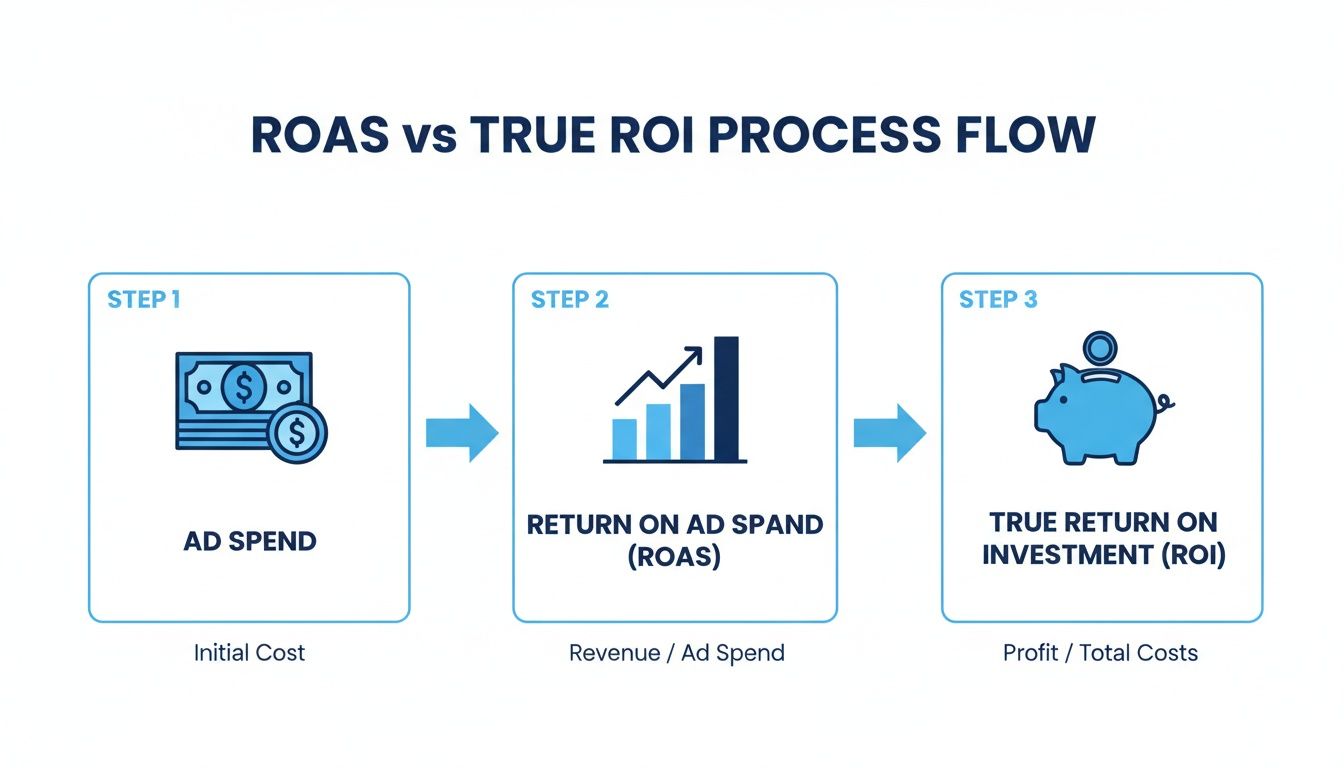
This visual really drives the point home: ROAS is just a checkpoint. The real destination is a profitable ROI after all your costs are factored in.
A Battle-Tested Approach to ROI
To build a reliable process, we can actually borrow a methodology used by some of the biggest companies in the world. Believe it or not, over half of the Fortune 500 use something called the ROI Methodology to turn fuzzy campaign results into hard numbers. By adapting its core ideas for DTC brands, we can bring that same level of clarity to our Shopify analytics. You can learn more about the official framework from the ROI Institute.
Here’s how you can apply this powerhouse framework to your own marketing, say for a new Meta Ads campaign:
- Pinpoint the Business Improvement: Start with a specific, measurable goal. Don't just aim for "more sales." A better target is something like a 12% lift in sales for a specific product line driven by the new campaign.
- Isolate the Campaign's Contribution: This is where most people get tripped up. You have to separate the campaign's impact from everything else. Using an AI-powered analytics platform like MetricMosaic can help you isolate that, for instance, 8% of that total sales lift was directly tied to this specific campaign, replacing hours of manual data crunching.
- Convert That Benefit to Dollars: Now, turn that percentage into real money. If that 8% lift translates to $150,000 in new Shopify sales, that’s your "Gain from Investment."
Accounting for Every Single Cost
One of the most common mistakes I see is stopping at ad spend. A truly bulletproof ROI calculation demands that you track down the fully-loaded costs. That means everything it took to get that campaign out the door.
The accuracy of your ROI lives and dies by how completely you track your costs. If you miss something like agency fees or creative production costs, you might think a losing campaign is a winner and make a terrible decision to scale it.
Your final cost sheet should include items like:
- Creative & Design: The real cost for all the ad visuals and copy ($20,000).
- Ad Spend & Delivery: The money paid directly to Meta to run the ads ($15,000).
- Tools & Integrations: Subscription costs for any specific tools you used, like landing page builders or GA4 integrations ($5,000).
Once you have both the isolated financial gain and the complete costs, you can finally calculate your true return. This is how you move your brand from a world of guesswork into a predictable growth engine.
Automating Your ROI with AI-Powered Analytics
Following a manual framework is a decent starting point. But let’s be honest—it’s slow and fragile.
For any growing Shopify brand, spending hours pulling CSV files from Shopify, Meta, and GA4 to stitch them all together in a spreadsheet just isn't a scalable strategy. It's a recipe for burnout, bad data, and missed opportunities. AI simplifies this entire process, transforming complexity into clarity.
Manual data crunching simply can't keep up with the speed of eCommerce. By the time you’ve finished your analysis, the market has already moved on, and your insights are stale. This is where AI-powered analytics platforms like MetricMosaic completely change the game.
From Manual Crunching to Automated Clarity
Next-gen analytics tools act as your central data hub. They automatically pull together data from all your key sources—Shopify, ad networks like Meta and Google, and email tools like Klaviyo—into one, reliable source of truth.
This integration delivers real-time, accurate ROI insights without you lifting a finger. No more wrestling with VLOOKUPs or pivot tables. Just a clear, always-on view of your profitability.
The real power of AI isn't just about making reports faster; it's about asking better questions and getting instant answers. It turns your data from a static spreadsheet into a dynamic conversation about your business's health.
This shift lets you move from reactive analysis to proactive strategy. Instead of spending your time building reports, you can focus on making decisions that actually grow the business.
The Rise of Conversational and Story-Driven Insights
The next generation of analytics takes this a step further, making data interaction as simple as having a chat. With conversational analytics, you can ask plain-English questions and get back immediate, visualized answers.
Imagine just typing: “What was the ROI of my Black Friday campaign, broken down by channel?”
Instead of losing half a day digging through spreadsheets, an AI co-pilot delivers the answer in seconds. This kind of capability democratizes data, empowering everyone on your team to make smarter decisions without needing to be a data scientist. An effective eCommerce analytics dashboard should provide this level of intuitive access.
But it gets even better. AI-driven platforms can now proactively surface predictive and story-driven insights. These aren't just raw numbers; they are AI-generated narratives that flag your most profitable opportunities or urgent risks.
For example, MetricMosaic might send you an alert that reads like this:
- Insight: "Your recent 'Summer Glow' campaign on Instagram is showing a 32% higher LTV-adjusted ROI than your other campaigns. The AOV from this campaign's cohort is 15% higher."
- Action: "Consider reallocating budget from lower-performing campaigns to scale this winner."
This is the future of DTC analytics. It’s not about drowning in data; it's about getting clear, actionable guidance that connects directly to your bottom line. By automating the "how to calculate return on investment," you free up your team to focus on the "what's next" for scaling your Shopify brand.
Common Questions About Calculating ROI
Even with the best formulas laid out, real-world questions always pop up the minute you start applying this stuff to your own Shopify brand. Let's run through a few of the most common ones I hear from DTC founders, so you can start making those confident, data-driven decisions.
What Is a Good ROI for a Shopify eCommerce Business?
It’s the million-dollar question, and the honest answer is: it depends. The niche you're in and how long you've been around both play a huge role.
That said, a 5:1 ratio (which works out to a 400% ROI on revenue) is a pretty solid benchmark to aim for with your DTC marketing. For every dollar you put in, you’re getting five dollars back in revenue before your costs. That’s a healthy place to be. Your true profit ROI will be lower, but this is a good top-level target.
If you’re just starting out, you might have to stomach a lower ROI to grab that initial market share and build momentum. But for more established brands, the goal should be to push that number higher to really pour fuel on sustainable growth. The most important thing is to track it over time and always look for ways to improve profitability.
How Often Should I Calculate ROI for Marketing Campaigns?
This depends on what you’re trying to measure. For the fast-paced stuff like Meta or Google Ads, you’ll want to keep an eye on ROAS pretty much daily. This lets you make quick, tactical tweaks to your ads and budget.
But for a true, fully-loaded ROI—one that bakes in things like Customer Lifetime Value (LTV)—you’re better off looking at it on a monthly or quarterly basis. This gives the data enough time to mature and show you the real, long-term impact of your campaigns and improve retention. The best AI analytics platforms will blend these views, giving you a real-time pulse on the immediate stuff while also tracking the bigger picture.
What Are the Biggest Mistakes Brands Make When Calculating ROI?
I see the same trip-ups time and time again. The good news is they're surprisingly easy to avoid once you know what to look for.
Here are the big ones:
- Confusing ROAS with ROI. This is number one, without a doubt. Brands get excited about a high ROAS and start scaling up, only to realize later they were losing money on every sale because they forgot to account for COGS and shipping.
- Relying on single-touch attribution. Giving all the credit to the last click is a classic mistake. It completely misses the full customer journey and makes your top-of-funnel efforts look like they aren't working, even when they’re essential.
- Forgetting about Customer Lifetime Value (LTV). Ignoring LTV massively undervalues any marketing you do around retention. It also skews your decisions away from channels that might bring in customers who spend more over the long haul.
- Working with siloed data. When you're trying to patch together reports from Shopify, Google Ads, Facebook, and your email platform, you're bound to end up with conflicting numbers and a whole lot of confusion.
Can I Calculate ROI Without an Expensive Analytics Tool?
You absolutely can. When you're starting out, a good old-fashioned spreadsheet is a perfectly fine way to go. You can manually export the data you need from Shopify and your ad platforms and piece it all together.
The catch is that this approach gets incredibly messy and time-consuming as your brand grows. Before you know it, you're spending hours every week just wrangling data, and the risk of human error skyrockets. This manual crunching is exactly what holds Shopify brands back.
An investment in an AI-powered analytics platform pays for itself quickly, not just in the hundreds of hours you save but in the accurate, predictive insights that lead to faster, more profitable decisions.
Ready to stop guessing and start growing with profit-driven clarity? MetricMosaic is the AI-powered growth co-pilot for Shopify brands that turns complex store data into clear, actionable stories. Unify your data, chat with your metrics in plain English, and get proactive insights that move the needle on ROAS, CAC, AOV, LTV, and retention. Start your free trial today.