Unlock Hidden AOV: A Founder's Guide to Market Basket Analysis
Unlock hidden revenue in your Shopify store with market basket analysis. Learn how to increase AOV and LTV with data-driven insights for DTC brands.
Ever wonder why a customer who buys your best-selling serum also seems to grab that new eye cream? The answer isn't a coincidence—it's a pattern. For busy Shopify founders, market basket analysis is the technique that uncovers these hidden connections in your customers' shopping carts, moving you from guesswork to data-backed decisions that actually grow your store.
Your Hidden Revenue Is Hiding in Your Shopify Data
If you’re running a DTC brand on Shopify, you’re sitting on a mountain of sales data. You know the secrets to boosting your Average Order Value (AOV) and customer lifetime value are buried in there somewhere, but turning fragmented reports from Shopify Analytics, GA4, and Meta Ads into a clear action plan feels like an impossible puzzle.
Most founders I talk to are caught in a frustrating loop. They spend hours trying to manually spot trends, guessing which products to bundle, what to suggest as a cross-sell, or how to personalize their next Klaviyo campaign. This approach isn't just a time-sink; it's unreliable and leaves money on the table. You're left with unclear ROI and a feeling that you could be growing faster if you just knew what the data was trying to tell you.
From Manual Data Crunching to AI-Powered Growth
This is where market basket analysis, powered by AI, breaks the cycle. It’s not just another report; it's a strategic lens that reveals the secret language of your customer's shopping habits. Instead of wondering which products go together, AI-driven analytics tells you exactly what your customers are already buying in tandem.
This guide is for DTC founders and marketers who need practical, actionable takeaways, not more theory. We’ll show how next-generation tools transform complexity into clarity, helping you:
- Increase Average Order Value: By creating product bundles and cross-sells your customers actually want.
- Improve Customer Retention & LTV: By personalizing your marketing with product recommendations that feel genuinely helpful.
- Boost ROAS and Profitability: By using purchase patterns to inform your ad creative and campaign targeting.
- Make Smarter Inventory Decisions: By ensuring items that are frequently bought together are always in stock at the same time.
And the best part? You don't need a data science degree. Modern AI tools, like those we've built into MetricMosaic, automate this entire process, replacing hours of manual data crunching with instant insights.
For instance, this screenshot shows how AI-powered conversational analytics can surface market basket insights in seconds.
Instead of wrestling with spreadsheets, a founder can simply ask their data for the top product pairs. What they get back is an immediate, actionable list to drive bundling and cross-sell strategies. We'll show you how these next-gen platforms turn complex transaction logs into simple, story-driven growth levers for your Shopify brand.
The Core Metrics That Drive Market Basket Analysis
To get the most out of market basket analysis, you need to understand the simple math that makes it work. Don't worry, this isn't a stats lecture. For a Shopify founder, it boils down to just three key metrics that find profitable product relationships hiding in your sales data. It's about how AI simplifies this complex analysis into something you can use daily.
Think of it like running a popular online coffee store. You know you sell a lot of espresso beans, but what else are customers adding to their carts alongside them? This is where the metrics come in to tell the story.
The whole process is straightforward, moving from raw data to real, actionable growth.
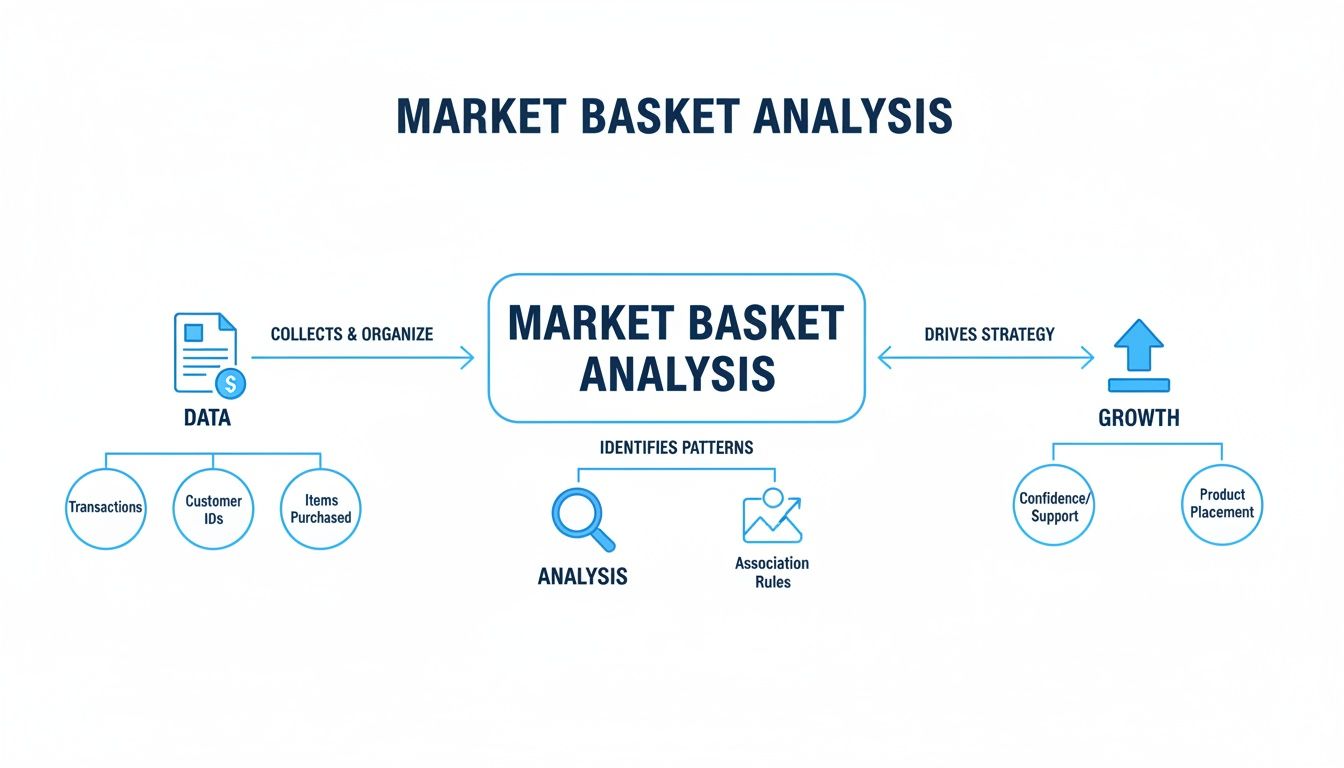
This flow shows how simple transaction data from your Shopify store gets transformed into strategic insights that can fuel your growth and improve profitability.
A Deeper Dive Into The Numbers
Let's break down the three metrics—Support, Confidence, and Lift—that power this analysis. Understanding how they work together is the key to separating random purchases from meaningful trends that can boost your CAC and LTV.
Here's a simple breakdown using our Shopify coffee store example.
Key Metrics of Market Basket Analysis Explained
| Metric | What It Asks | Simple Example | Why It Matters for Your Shopify Store |
|---|---|---|---|
| Support | "How often does this product show up in orders?" | If Espresso Beans are in 100 of 1,000 total orders, its Support is 10%. | It’s a popularity filter. High support helps you focus on items that are actually bought often enough to matter for your AOV. |
| Confidence | "If someone buys Product A, how often do they also buy Product B?" | Of those 100 orders with Espresso Beans, 70 also had a Milk Frother. Confidence is 70%. | This gives you a simple "if-then" rule. It's a good first signal that two products might be connected for a bundle. |
| Lift | "How much more likely is someone to buy B if they buy A?" | If Milk Frothers are in 14% of all orders, the Lift is 70% / 14% = 5. | This is the most important one. It confirms the relationship isn't just a coincidence because both items are popular. It's your key to true LTV growth. |
Let's unpack these a bit more from a founder-friendly perspective.
Support is your starting point—it's just a raw popularity count. You want to focus your analysis on items with decent support; otherwise, you might be chasing patterns based on just a handful of orders.
Confidence builds on that by creating a directional link. A 70% confidence score for "Espresso Beans → Milk Frother" is a strong signal, but it doesn't tell the full story. What if the Milk Frother is just a mega-popular product that everyone buys?
That's where Lift comes in. It’s the truth serum for your analysis. By comparing the co-purchase rate to the Milk Frother's overall popularity, it tells you the true strength of the relationship.
A Lift value greater than 1 means the two items are purchased together more often than random chance would suggest. A Lift of 5 is a massive signal—it tells you customers are 5 times more likely to buy a Milk Frother when they have Espresso Beans in their cart. Now that is a predictive insight you can build a strategy around to increase AOV and profitability.
This is a modern take on the classic "beer and diapers" story. A retail chain in the 90s found that men buying diapers were also very likely to grab beer. By placing the two items closer together, they boosted sales. It’s the same concept that powers the recommendation engines that increase AOV for ecommerce giants today.
Getting a handle on these three metrics is the first real step to turning your Shopify data into a competitive advantage. For a broader look at your store's health, you can dive deeper into other key eCommerce performance metrics.
How to Use Market Basket Insights in Your Shopify Store
Okay, so the theory makes sense. But for DTC founders, the real magic happens when you turn those numbers into actions that move the needle on your Shopify store's revenue. This is where market basket analysis stops being a concept and becomes a genuine growth engine.
This isn’t about generating more reports. It's about building a clear playbook of high-impact strategies that directly boost your KPIs, from Average Order Value (AOV) to customer retention and LTV.
Create Data-Driven Product Bundles
One of the most straightforward wins from market basket analysis is creating product bundles your customers are already telling you they want. When an AI analytics tool surfaces a strong Lift value between two products—say, a specific coffee maker and a particular brand of coffee filters—it’s a massive signal to package them together.
A skincare brand, for instance, might discover that its Vitamin C Serum and Hyaluronic Acid Moisturizer are constantly bought in the same order. Instead of just hoping customers add both to their cart, you can create a "Bright & Hydrated Duo" bundle. This not only bumps up your AOV but also makes the shopping experience simpler for your customers.
Market basket analysis has a proven ROI. Research cited by Harvard Business Review shows a 5% increase in customer retention can lead to a 25-95% jump in profit. In a real-world ecommerce example, 65% of ginger-turmeric shot buyers paired them in summer packs of 12. Creating bundles from this insight lifted AOV by 15-25% and cut stockouts by 30%. You can read more about these findings to see how powerful this can be.
By building compelling offers, you guide customers toward higher-value purchases. For a deeper dive on pricing them right, check out our guide on bundle pricing strategies.
Optimize Cross-Sells and Upsells
Your product pages, cart, and checkout are prime real estate for smart recommendations. Market basket analysis tells you exactly what to feature in those "You might also like" or "Frequently bought together" sections. It's time to ditch generic "most popular" items and start showing products with a proven co-purchase connection, improving your conversion rate and profitability.
When these sections are powered by real data from your Shopify store, they transform into powerful conversion tools. You're showing customers the exact items that complete their purchase, which feels less like a sales pitch and more like a helpful suggestion. The result? A better customer experience and a bigger cart size.
Personalize Email and SMS Marketing
The insights you uncover don't just live on your website. They're a goldmine for personalizing your marketing on platforms like Klaviyo. Armed with co-purchase data, you can build hyper-targeted campaigns that improve retention and LTV.
Here are a few actionable takeaways:
- Post-Purchase Follow-up: Someone buys a new espresso machine. Send them an automated email 30 days later with an offer on the specific espresso beans that have the highest Lift score with that machine.
- Replenishment Reminders: A customer bought your "Bright & Hydrated Duo." Send them a reminder when they're probably running low, and toss in a cross-sell for the eye cream that other "Duo" buyers frequently purchase.
- Win-Back Campaigns: Target a lapsed customer with an offer that bundles their last purchase with a product they're highly likely to be interested in.
This level of personalization makes your marketing feel relevant and valuable. You're not just blasting out generic promos; you're starting a conversation based on what you know they like, which directly improves ROAS and customer LTV.
How AI Automates Market Basket Analysis for Founders
The old way of doing market basket analysis was a non-starter for lean DTC brands. It was a whole project. You’d have to hire a data scientist, wait days while they wrangled messy spreadsheets, and try to make sense of complex outputs. It was slow, expensive, and totally disconnected from the daily rhythm of running a Shopify store.
For a founder who needs to make fast decisions on bundles and promotions, that process is too clunky. By the time you got the insights, the opportunity would be gone.
Next-generation AI analytics platforms completely change the game. They act as a growth co-pilot, automating the entire market basket analysis workflow. What used to be a complex data science project is now a simple, daily growth lever for your Shopify brand.
From Manual Crunching to Automated Stories
The biggest shift here is moving from reactive to proactive. Instead of you digging for insights, an AI-powered platform like MetricMosaic proactively surfaces them for you as story-driven data.
Here’s how AI handles the heavy lifting, replacing manual work:
- Automated Data Integration and Cleaning: The system plugs directly into your Shopify store and other sources, continuously pulling and cleaning your transaction data. This alone eliminates the tedious, error-prone manual work.
- Running the Algorithms: Behind the scenes, the AI is constantly running sophisticated association rule algorithms. It’s always scanning for statistically significant product relationships—you never have to write a single line of code.
- Translating Results into Plain English: This is where the magic really happens. Instead of spitting out a table of Support, Confidence, and Lift scores, the platform translates those findings into clear, actionable "Stories." It tells you what the data means in simple business terms.
Key Takeaway: An AI analytics platform doesn't just run the numbers; it interprets them. It might proactively tell you, "Customers who buy your 'Morning Glow Serum' are 4.5x more likely to also purchase the 'Night Repair Cream.' Consider creating a '24/7 Glow' bundle to increase AOV."
This approach turns complexity into clarity and action. You get to focus on strategy, not data wrangling.
Conversational Analytics: The New Frontier
Next-gen tools are taking this a step further with conversational analytics. This means you can ask your data questions in plain English and get instant answers. No more navigating complicated dashboards.
For a busy Shopify founder, this is a massive advantage. You can just type a question like:
- "What are the top 10 product pairs I should cross-sell to improve AOV?"
- "Show me products frequently bought with our new running shoes."
- "Which items have the highest lift score with our best-selling t-shirt?"
The AI co-pilot understands your question, runs the market basket analysis, and presents the results in a simple, story-driven format. It makes powerful data analysis as easy as talking to a seasoned growth strategist, empowering everyone on your team to make smarter decisions that boost profitability.
This level of automation is crucial for implementing effective e-commerce growth strategies without a huge team or budget.
A Step-by-Step Guide for Implementing Your Findings
Knowing which products your customers buy together is a powerful insight, but profit comes from action. This is where the rubber meets the road. Turning your market basket analysis results into real-world strategies for your Shopify store requires a clear, methodical approach. It’s about moving from a fascinating data point to a tangible increase in your Average Order Value (AOV) and customer lifetime value (LTV).
This isn't about launching a dozen initiatives at once. It's about a focused framework that starts with your highest-impact opportunities and ends with measurable results.
Step 1: Identify Your High-Lift Product Pairings
Your AI-powered analysis will surface a list of product associations. The first move is to zero in on the pairs with the highest Lift. A high Lift score (think greater than 3.0) confirms a strong, non-random relationship, making these pairs your prime candidates for bundling and cross-selling.
Filter your results to highlight the top 5-10 pairs with the strongest Lift and solid Support. These are your low-hanging fruit—the product combinations your customers are already telling you they want to buy together.
Step 2: Create Compelling Bundles in Shopify
Once you have your top pairings, the most direct way to capitalize on them is by creating product bundles. This strategy simplifies the buying decision and naturally boosts your AOV.
- Name Your Bundle: Give it a benefit-driven name. Instead of "Serum and Moisturizer," try "The Complete Hydration Kit." This frames the bundle as a solution.
- Set an Attractive Price: Offer a small discount (say, 10-15% off) to make grabbing the bundle a no-brainer. This makes it feel like a smart, value-driven choice.
- Use a Shopify App: Apps like Bundles or Fast Bundle make it easy to create and manage your offers seamlessly.
This tactical approach not only drives immediate revenue but also improves the customer experience by curating combinations you know are relevant.
Step 3: Set Up Targeted Cross-Sell Placements
Not every pairing needs to be a formal bundle. Use your insights to power smarter cross-sell and "Frequently Bought Together" sections on your product and cart pages. The goal here is to make relevant suggestions at the right moments.
A common pitfall is to analyze only at the item level. In a study of over 603,457 orders, researchers found that category-level analysis improved next-purchase prediction accuracy by 15-20%. This mirrors how top Shopify brands use GA4 and Meta Ads data to discover patterns, like 65% of customers buying one organic beverage flavor pair it with another, which helps them create bundles that boost sales by 25%. Find out more about how this analysis reduces cart abandonment.
Use apps like ReConvert or AfterSell to replace generic recommendations with data-backed suggestions based on your high-Lift pairs.
Step 4: Build Automated Email Flows in Klaviyo
Your market basket insights are a goldmine for email personalization. You can create automated flows in a tool like Klaviyo that feel helpful and timely, improving retention.
- Post-Purchase Cross-Sell: If a customer buys Product A, trigger an email 14-30 days later showcasing Product B, its highest-Lift companion. Frame it as "the perfect partner" for their recent purchase.
- Replenishment Reminder with Upsell: When a customer is due to reorder a consumable product, include a recommendation for a related item in the reminder email to increase LTV.
This strategy helps turn a one-time transaction into an ongoing relationship, directly improving customer retention and LTV.
Step 5: A/B Test Everything
Finally, never assume your new strategy is optimal. Data-driven implementation requires validation. A/B testing is critical to ensure your changes are actually moving the needle on profitability.
For example, when launching a new bundle, test the offer against a control group of site visitors who don't see it. Track key metrics like conversion rate, AOV, and revenue per visitor. This allows you to prove the real-world impact of your market basket analysis and confidently double down on what works.
To help you stay on track, we've put together a quick checklist that takes you from raw data to a live test.
Implementation Checklist From Insight to A/B Test
| Step | Action Item | Tool/Platform | Success Metric to Track |
|---|---|---|---|
| 1. Identify | Filter analysis results for top 5-10 pairs with high Lift (>3.0) and good Support. | MetricMosaic / Spreadsheet | List of prioritized product pairs |
| 2. Strategize | Decide on the implementation: formal bundle, "Frequently Bought Together," or email flow. | Team Brainstorm / Whiteboard | Documented strategy for each pair |
| 3. Build | Create the bundle, cross-sell widget, or email automation. | Shopify / ReConvert / Klaviyo | Live bundle or cross-sell feature |
| 4. Test | Set up an A/B test to measure the impact against a control group (no offer). | Google Optimize / VWO / App's built-in A/B test | Increased AOV, Conversion Rate |
| 5. Analyze | After 14-30 days, review test results for statistical significance. | A/B Testing Platform | Confirmed lift in target metrics |
| 6. Roll Out | If successful, roll out the winning variation to 100% of your audience. | Shopify / Respective App | Full implementation of the strategy |
Following a structured process ensures your data doesn't just sit in a spreadsheet. It gets put to work, driving real growth for your DTC brand.
A Few Common Questions About Market Basket Analysis
Even with a clear roadmap, jumping into a new way of analyzing your Shopify business can bring up a few questions. As a founder, you need to know if it's the right fit for your store and team. Let's tackle some of the most common ones we hear from DTC operators.
How Much Sales Data Do I Need to Start?
There's no single magic number, but you'll want at least a few thousand transactions to get meaningful results from market basket analysis. That volume helps ensure the product connections you uncover are real, statistically significant patterns—not just random one-offs. The more history you have, the more powerful your predictive insights become.
But the good news is you don't need a perfect dataset. Modern AI-powered platforms can dig into your existing Shopify sales history and find valuable connections right away, even if it's your first time trying this kind of analysis.
Is This Just Another Way to Cross-Sell?
Boosting Average Order Value (AOV) with smart bundles is a major win, but the insights from market basket analysis go way beyond that. They’re incredibly flexible for any DTC brand.
Here are a few actionable takeaways:
- Sharpen your marketing campaigns: If two products are frequently bought together, advertise them together in your Meta Ads. It can make your creative more relevant and boost ROAS.
- Rethink your store layout: Use the data to optimize your Shopify store’s navigation and collection pages, putting complementary items closer together.
- Make smarter inventory calls: Ensure items that are often bought in tandem are always in stock at the same time to prevent lost sales and improve profitability.
- Personalize your email flows: Spot unique customer segments in Klaviyo based on their buying habits and send them super-targeted messages to improve LTV.
Isn't Market Basket Analysis Super Complicated?
Traditionally, yes. You needed a data scientist and specialized software. It was a resource-heavy process out of reach for most small-to-mid-size Shopify brands. Thankfully, that's not the case anymore.
Modern AI analytics tools have made these powerful techniques accessible to everyone. The platform does all the heavy lifting—from pulling in the data and running the algorithms to explaining what the results actually mean in a story-driven format. Your team gets simple, actionable recommendations without needing a PhD in statistics, freeing you up to focus on growing the business.
This shift means founders can go from insight to action in hours, not weeks, turning their store data into a real competitive advantage.
Ready to stop guessing and start growing? MetricMosaic is the AI-powered analytics co-pilot that turns your Shopify data into clear, actionable revenue strategies. Discover your store's most profitable product bundles and customer patterns in minutes. Start your free trial today.