AI-Powered Bundle Pricing Strategies to Boost Your Shopify AOV
Unlock higher AOV on Shopify with our guide to bundle pricing strategies. Learn how AI-driven analytics helps you create product bundles that increase sales.
You’re pouring cash into Meta and Google ads, driving traffic to your Shopify store, but growth feels stalled. Customer acquisition costs (CAC) keep climbing, while your average order value (AOV) remains stubbornly flat. It’s the classic profitability puzzle every DTC founder is trying to solve: you're running hard just to stay in the same place.
This is the daily reality for countless small-to-mid-size Shopify brands. You know sustainable growth isn’t about just acquiring more customers; it’s about getting more value from every single one you already have. The problem? Your standard Shopify analytics dashboard gives you a rearview mirror look at your data—it tells you what sold, but it doesn't reveal the hidden relationships between your products. Those subtle buying patterns are a goldmine for increasing AOV, but they're buried in fragmented reports.
Unlocking Growth with Data-Driven Bundles
This is where bundle pricing strategies shift from a simple discount tactic to a powerful financial lever for your DTC brand. Imagine moving beyond guesswork. Instead of randomly pairing your bestsellers, what if you could use your own store's data to build irresistible bundles that customers are already primed to buy?
The goal isn’t just to sell more; it’s to sell smarter. A well-crafted bundle boosts AOV, increases your product attachment rate, and can even help you move slower-selling inventory, giving a direct shot in the arm to your store's cash flow and profitability.
The key to unlocking this growth is already sitting in your store's data. Next-generation, AI-powered analytics platforms like MetricMosaic transform that complexity into clarity. By running a market basket analysis, these tools sift through thousands of orders in seconds to spot which products are most frequently bought together. This replaces manual data crunching in spreadsheets with automated, actionable insights. You move from gut-feelings to data-backed decisions, creating bundles that resonate with your customers and fundamentally improve your store’s financial health.
Understanding Core Bundle Pricing Strategies
Let's break down bundle pricing in plain English. Think of it like a great restaurant creating the perfect combo meal. They could sell you a burger on its own, but offering it with fries and a drink is a win-win. You get a complete, satisfying meal, and the restaurant boosts the value of the sale.
For DTC brands on Shopify, this concept is a direct answer to the challenge of stagnant AOV. Instead of trying to squeeze more profit from a single-item sale, you create an offer so compelling that it naturally encourages customers to spend more.
This visual nails it—true profitability comes from combating rising acquisition costs and lifting AOV. Smart bundling is a critical piece of that puzzle.
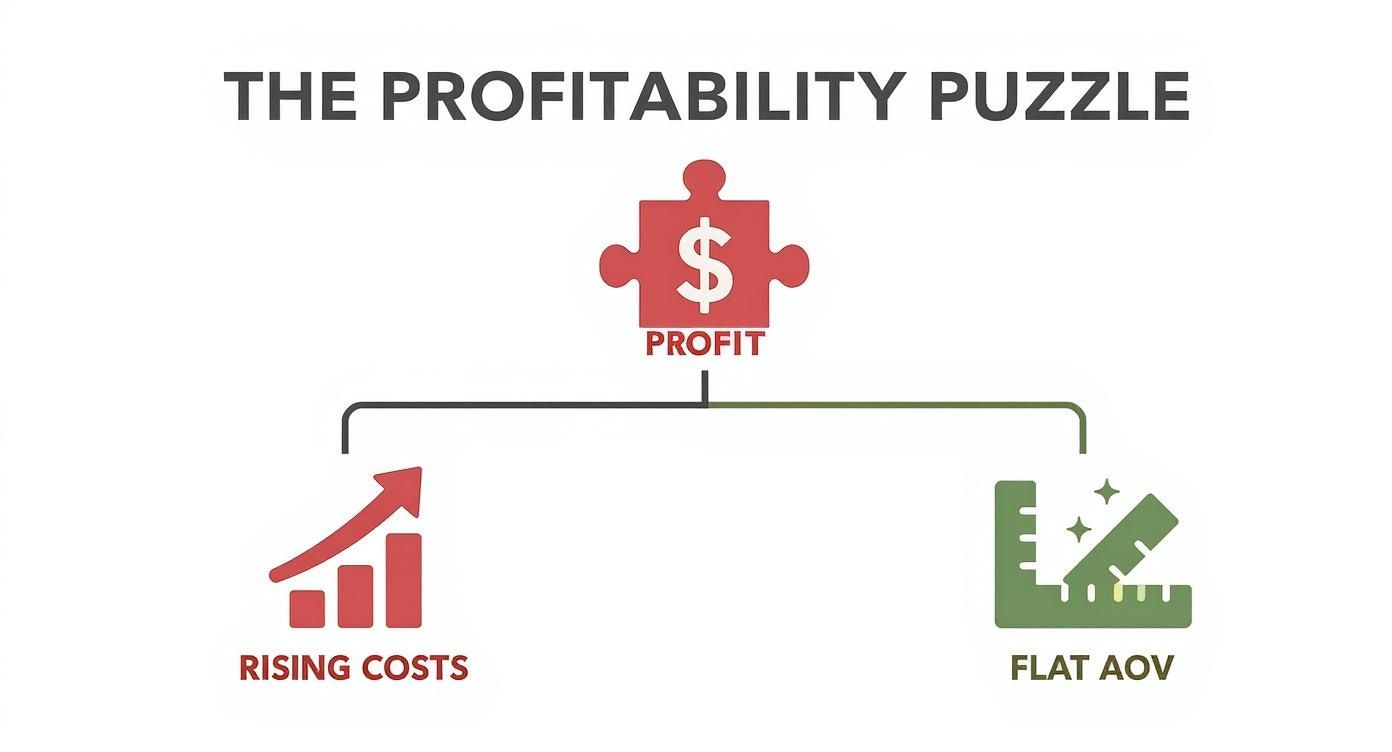
As you can see, bundling provides a direct lift to your AOV, helping to offset those rising ad costs and strengthen your bottom line. Let's get into the foundational strategies you can implement.
The Main Types of Product Bundles
Bundling isn’t a one-size-fits-all game. The right strategy depends on your product catalog, customer behavior, and your ultimate growth goals. The most common bundle pricing strategies fall into three core categories.
1. Pure Bundles
With a pure bundle, the products are only available as a package. A perfect example is a skincare brand’s "Complete Morning Routine" kit. You can't just buy the cleanser or the serum individually; you get the whole set. This approach simplifies the buying decision for new customers and guarantees a higher AOV from the very first purchase.
2. Mixed Bundles
This is the most popular and flexible strategy for Shopify stores. Mixed bundling offers customers a choice: buy the bundled package for a discount, or purchase each item individually. A coffee brand might sell its top roast, a branded mug, and a bag of filters as a "Starter Kit" for $40, while still allowing you to buy each item à la carte.
A mixed bundle gives customers choice while nudging them toward the higher-value option. It’s a powerful way to increase AOV without alienating shoppers who only want a single item.
3. Tiered or Volume Bundles
Tiered bundles encourage customers to buy more of the same item (or from the same category) to unlock bigger discounts. Think "Buy 2, Save 10%; Buy 3, Save 20%." This strategy is a powerhouse for consumable products like supplements, coffee, or beauty items—anything people tend to stock up on. It’s a direct incentive for larger orders that boosts both AOV and LTV.
Types of Bundle Pricing Strategies at a Glance
To make it even clearer, here’s a quick comparison to help you decide which approach is the right fit for your Shopify store.
| Bundle Type | How It Works | Best For | Primary Goal |
|---|---|---|---|
| Pure Bundle | Products are sold only as a package. | Introducing new customers to a complete solution or routine. | Simplify the buying decision and guarantee a higher initial AOV. |
| Mixed Bundle | Products can be bought together at a discount or separately. | Brands with hero products and complementary accessories. | Increase AOV without forcing customers into a package. |
| Tiered/Volume | Discounts increase as the customer buys more of the same item. | Consumable products or items customers frequently re-purchase. | Drive larger purchases and increase customer lifetime value (LTV). |
Each of these models offers a different lever for growth. But how do you choose the right products to bundle in the first place? This is where you move beyond manual guesswork in spreadsheets. Next-gen analytics tools dive into your Shopify sales data to reveal which products customers are already buying together naturally, giving you a data-backed starting point for building bundles that are practically guaranteed to convert.
A Deep Dive Into Popular Bundle Models
You've got the basics down. Now, let's move beyond theory and see how these bundle pricing strategies play out in the real world for Shopify and DTC brands.
Picking the right model isn't just about discounting. It’s about smart merchandising that matches the strategy to your product catalog and customer behavior. This is about strategic packaging, not just price-slashing.
Let's unpack the most common bundle models, digging into the pros, cons, and exactly who should be using each one.
Pure Bundling: The All-or-Nothing Approach
Pure bundling is as straightforward as it gets: products are sold only as a set. You can't cherry-pick individual components. Think of a skincare brand's "30-Day Clear Skin Kit" or a meal prep company's "Weekly Lunch Box." The choice for the customer is a simple yes or no.
This approach is fantastic for guiding new customers into a multi-step routine or system. It eliminates decision fatigue and guarantees a higher AOV right from that first purchase.
Pros:
- Guaranteed Higher AOV: Every bundle sale hits a minimum order value, giving that key metric a direct boost.
- Simplified Customer Choice: It removes "analysis paralysis" for new shoppers who don't know where to start.
- Increased Product Adoption: It gets multiple products into the customer's hands at once, increasing the odds they'll discover a new favorite and become a repeat buyer.
Cons:
- Lack of Flexibility: Customers who only want one specific item might leave, which can mean lost sales.
- Risk of Unwanted Items: If a customer dislikes one product in the bundle, it can sour their opinion of the whole package.
Ideal for: DTC brands selling systems or routines. This is a perfect match for beauty, wellness, supplements, and food/beverage companies where products deliver better results when used together.
Mixed Bundling: The Best of Both Worlds
Mixed bundling is the most popular and flexible strategy for Shopify stores. It offers customers a choice: buy the bundle for a discount, or purchase each item individually. This flexibility makes it a winner for nearly any DTC niche.
A classic example is a home goods brand offering a "Cozy Night In" set with a best-selling candle, a plush throw blanket, and a room spray. You can grab the set and save $15, or you can buy each item à la carte. This gently nudges customers toward the higher-value option without turning away someone who just came for the candle.
The power here is well-documented. One of the most famous examples is Microsoft Office. When they first bundled Word, Excel, and PowerPoint for less than the cost of buying them separately, it was a game-changer. By 1995, Office had captured over 90% of the market. Research showed this mixed bundling strategy likely boosted revenue by an estimated 30% compared to selling the apps individually. You can discover more insights on the power of bundle design from that study.
Tiered or Volume Bundling: The More You Buy, The More You Save
Tiered bundling, also called volume bundling, offers a bigger discount the more a customer buys. You’ve seen this countless times: "Buy 2 pairs of socks, get 10% off; Buy 4, get 20% off." It’s simple and incredibly effective at driving up AOV.
This model is a powerhouse for products people buy repeatedly.
Pros:
- Drives Higher Purchase Volume: It directly incentivizes customers to stock up, which is great for your AOV and immediate cash flow.
- Increases Customer Lifetime Value (LTV): By getting more product into their hands, you extend the time before they need to shop again, building habit and loyalty.
- Helps Move Inventory: It’s a super effective way to increase the sales velocity of specific SKUs.
Cons:
- Margin Compression: You have to be strategic with your discount tiers. Get it wrong, and you could wipe out your profitability on larger orders.
- Limited Applicability: This strategy shines for consumables or frequently used items. It's less effective for one-off purchases or durable goods.
Ideal for: Brands selling products people use up and re-buy. Think coffee, supplements, beauty products, cleaning supplies, or apparel basics like t-shirts and socks. It plays directly into the customer’s desire to stock up and save.
By understanding these core models, you can start identifying which bundle pricing strategies align with your Shopify store's catalog and growth goals, paving the way for a more profitable future.
How to Build Your First Data-Driven Bundle
Alright, theory is great, but turning these ideas into actual revenue is where the magic happens. You understand the why behind product bundles; now it’s time to build your first one. The big question is: where do you start? Which products actually belong together?
For years, the go-to method for Shopify founders was a painful slog: exporting thousands of orders into a massive spreadsheet and trying to wrestle with pivot tables to find an insight. This old-school approach is not just slow; it’s a minefield of potential errors.
Worse, it misses the subtle, non-obvious buying patterns that signal a killer bundle opportunity. This manual data-crunching is exactly the kind of low-value work that holds growing brands back. It’s frustrating, time-consuming, and often results in bundles based on a gut feeling instead of hard data.
Thankfully, there’s a much smarter way.
From Manual Spreadsheets to AI-Powered Insights
The modern, AI-powered approach changes the game entirely. Instead of you digging for insights, an AI analytics platform like MetricMosaic brings the insights directly to you. This is accomplished through a technique called market basket analysis.
Think of it as an AI co-pilot that has memorized every order your store has ever processed. This AI can instantly tell you which products are most frequently purchased together in the same cart. It answers the one question that matters most: "When a customer buys Product A, what else are they most likely to buy with it?"
This isn't about simply pairing your two bestsellers. AI uncovers less obvious but highly profitable combinations—like that specific accessory that’s almost always purchased with a mid-tier product. This is where you find the hidden gems for your bundle strategy. Here’s a look at market basket analysis in action, revealing the powerful connections between products.
The insights are immediate and clear. You can see exactly which products have a high "lift"—meaning the presence of one product dramatically increases the odds of another being purchased. This is the power of turning complexity into clarity.
Finding Your Perfect Bundle Combination
Using an AI-powered tool removes the guesswork from the entire discovery process. You can go from raw Shopify data to a confident decision in minutes, not days.
- Pick a "Seed" Product: Start with one of your hero products—a consistent top-seller that attracts a lot of traffic. This will be the anchor for your bundle.
- Run Market Basket Analysis: In a platform like MetricMosaic, you can use conversational analytics and simply ask, “What products are most frequently bought with our Premium French Press?” The AI analyzes your historical Shopify data to deliver a ranked list of correlated products.
- Validate the Opportunity: The analysis won't just show you what was bought together, but also the confidence (how often B is bought when A is bought) and the lift (how much more likely someone is to buy B when A is in their cart). A high lift score is a massive signal for a winning bundle.
A great bundle feels natural to the customer because it’s based on how people actually shop. AI-driven market basket analysis simply reveals the patterns that already exist in your data, giving you a proven recipe for success.
Pricing Your Bundle for Maximum Profitability
Once you’ve found the perfect products to pair up, the last piece of the puzzle is pricing. A common mistake is offering a discount so deep it erodes your profit margin. The goal is a discount that feels like a great deal to the customer but is still sustainable for your business.
To price your bundle correctly, you need a clear view of your product-level profitability. Here's a simple, effective formula:
- Calculate Total Individual Price: Add up the regular retail price of every item in the bundle. (e.g., Coffee Beans $18 + Mug $12 + Filters $5 = $35)
- Calculate Total COGS: Add up the cost of goods sold for all those items. (e.g., Beans COGS $8 + Mug COGS $5 + Filters COGS $1 = $14)
- Set Your Bundle Price: Offer a compelling discount that still protects your margin. A 10-15% discount off the total price is a solid starting point. (e.g., $35 x 0.85 = $29.75. Let's round it to a clean $29.99).
- Confirm Your Margin: Subtract your total COGS from the new bundle price to find your gross profit. ($29.99 - $14 = $15.99). Then, calculate your margin percentage to be sure. ($15.99 / $29.99 = 53.3%).
This process ensures every bundle you launch is a win-win, driving up your Average Order Value while protecting your bottom line. With an AI tool, you can even model different discount scenarios to see their impact on overall profitability before you push the bundle live.
Measuring the Success of Your Bundle Strategy
You’ve launched a new bundle on your Shopify store. That’s a great first step, but it’s just the beginning. The real growth happens in what you do next.
Winning with bundle pricing strategies isn’t a "set it and forget it" game. It’s about continuous measurement, learning, and optimization. If you aren't tracking the right KPIs, you're flying blind. You won't know if your new offer is actually improving profitability or just slowly chipping away at your margins.
This is a common pain point for DTC founders. Your standard Shopify reports show surface-level data, but they don't connect the dots. How can you tell if customers buying your new bundle are actually more valuable over the long run? This is where an AI analytics platform like MetricMosaic becomes your co-pilot, moving you beyond unreliable reports to find the clear, actionable signals that drive growth.
Key Metrics to Monitor for Bundle Performance
To understand your bundle's true impact, you have to look beyond just sales numbers. A successful bundle should lift several core business metrics. Here are the essential KPIs every founder needs on their dashboard.
- Average Order Value (AOV): This is the most direct measure of success. Did your bundle actually get customers to spend more per transaction? A rising AOV is the clearest sign your strategy is working.
- Profit Margin: AOV is a vanity metric if it's killing your profit. You must track your bundle's margin to ensure the discount is sustainable. An AI platform can provide product-level profitability, showing you the true margin on every bundle sold.
- Bundle Attachment Rate: This metric tells you what percentage of your total orders include a specific bundle. It’s a great way to gauge your offer's appeal. A low attachment rate might indicate the bundle isn't visible enough, the value isn't clear, or you've paired the wrong products.
- Customer Lifetime Value (CLTV): This is the ultimate report card for your strategy. Do customers who buy bundles stick around longer and spend more over their lifetime? A great bundle introduces people to more of your product line, turning them into loyal, high-value shoppers and improving retention.
The power of bundling isn't just theory. Take the telecom industry, for example. A 2018 European Commission study found that bundling services led to a 15% drop in customer churn. Why? Because customers who were locked into a convenient package were way less likely to jump ship. This shows the clear link between a good bundle and long-term customer loyalty. You can read the full research on bundling's market impact to see how this plays out across different industries.
Using AI Analytics to Turn Data into Action
Trying to track these KPIs in spreadsheets is a recipe for messy data and missed opportunities. For a growing Shopify brand, an AI-driven analytics platform is a must-have. You can stop manually crunching numbers and start getting immediate clarity and predictive insights.
The goal isn’t just to collect data; it's to get answers. An AI platform automates the analysis, telling a story with your data so you can spend your time making strategic decisions that actually drive growth, not wrestling with pivot tables.
For instance, tracking CLTV for bundle buyers is a nightmare with standard tools. An AI platform automates this with cohort analysis. It can instantly group all customers who bought a specific bundle during its launch month and compare their long-term spending against customers who didn't. This gives you a definitive answer on whether your bundle is creating more valuable customers.
Here’s how a next-gen platform visualizes CLTV for different customer cohorts.
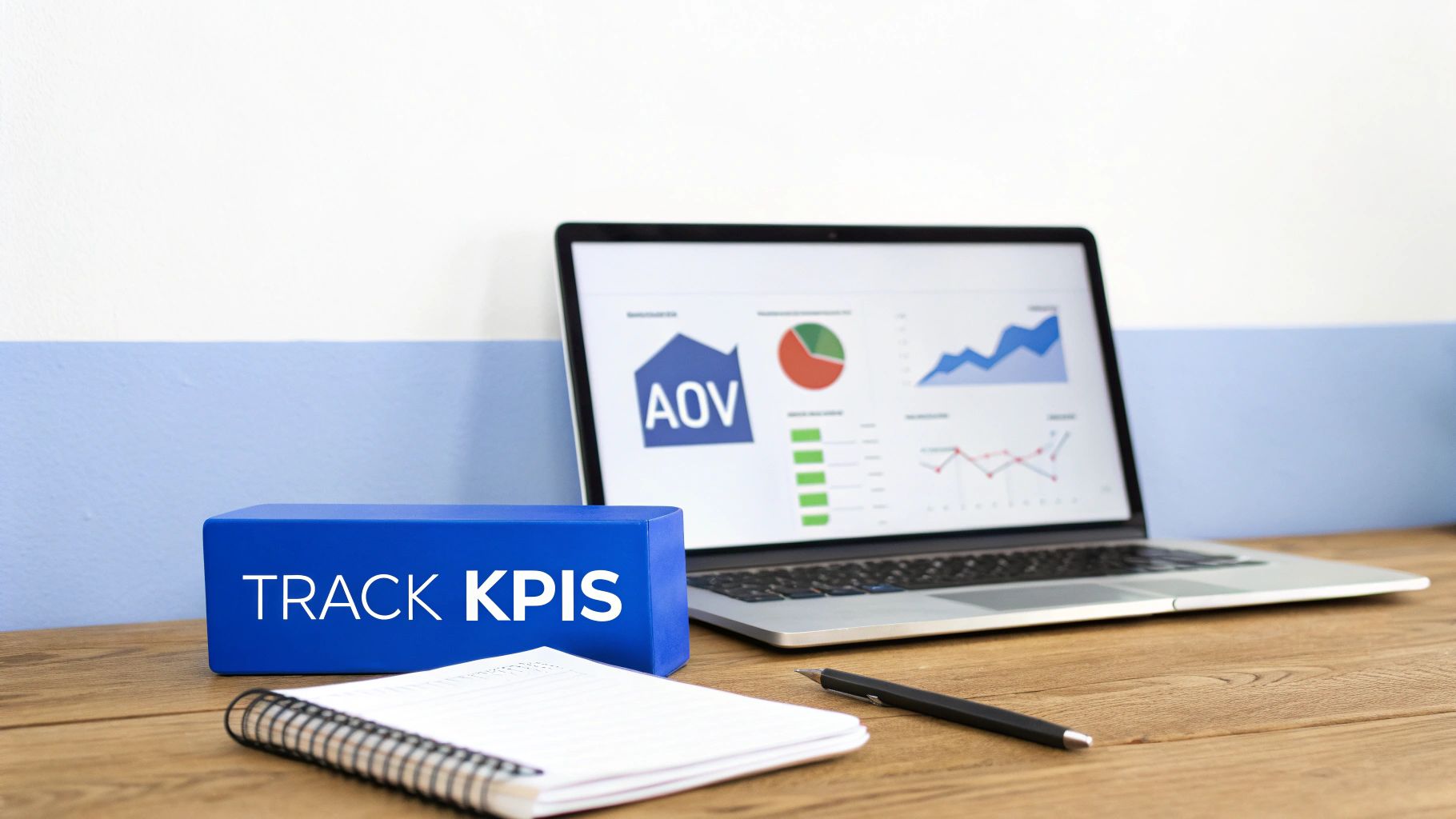
A visual like this tells a story instantly. You can see which groups of customers are bringing in the most value over time, allowing you to double down on the strategies that attract your best buyers. This is the difference between raw data and a competitive advantage.
Common Questions About Bundle Pricing
Even with a data-driven plan, launching a new bundling strategy can feel like a big step. It’s natural to have questions, especially when you’re balancing ambitious growth with protecting your profitability.
Let's tackle some of the most common questions we hear from Shopify founders.
How Do I Know Which Products to Bundle Together?
The best answer is to let your customer data guide you. You could pair your best-seller with a popular accessory and likely see some results, but the real growth comes from uncovering less obvious combinations.
This is where market basket analysis is a game-changer. AI-powered tools analyze your Shopify sales history to pinpoint products that are frequently bought together. It replaces guesswork with data, showing you exactly which pairings have the highest probability of success because your customers are already telling you what they want. It’s like turning your past sales data into a recipe for future revenue.
Will Offering Bundle Discounts Destroy My Profit Margins?
This is the biggest fear for most founders, and it's a valid one. But it's also entirely manageable. A bundle discount should never be a guess. The key is to have a crystal-clear picture of your product-level profitability before you set a price.
First, add up the Cost of Goods Sold (COGS) for every item in the bundle. Then, subtract that total from your proposed bundle price to see your gross profit. A good starting point is a discount in the 10-15% range. This is usually compelling enough to feel like a great deal for the customer without wiping out your margin. Always model the financial impact before you go live.
What Are the Best Shopify Apps for Creating Bundles?
The Shopify App Store is full of excellent options built for DTC brands. Some of the most popular choices are apps like Bundles.app, Bold Bundles, and Fast Bundle. They provide user-friendly interfaces for creating everything from simple fixed kits to more complex "buy X, get Y" promotions. The right one for you will depend on the complexity of your bundle strategy and your budget.
How Often Should I Test and Update My Product Bundles?
Your bundles shouldn't be a "set it and forget it" initiative. Customer preferences change, new trends emerge, and your product catalog evolves. Your bundling strategy needs to be just as dynamic.
A good practice is to review your bundle performance on a quarterly basis. Dive into the key metrics—AOV, attachment rate, and profit margin. This will quickly tell you which bundles are performing well and which ones may need a refresh or should be retired. Next-gen analytics can even provide predictive insights, spotting new bundling opportunities as fresh purchasing patterns emerge from your data, keeping you ahead of the curve.
Ready to turn your Shopify data into your biggest competitive advantage? MetricMosaic, Inc. is the AI-powered analytics co-pilot that uncovers actionable insights to boost AOV, LTV, and profitability. Stop guessing and start growing with story-driven analytics. Start your free trial today.