A Shopify Founder's Playbook for AI-Powered E-commerce Growth
Discover a proven e-commerce growth strategy to boost profits. This playbook offers actionable steps for Shopify and DTC brands using AI analytics to scale.
An e-commerce growth strategy isn't just a buzzword. For a DTC founder, it’s a concrete plan for growing your business profitably by acquiring and retaining high-value customers. It’s about building a repeatable system that takes all the noise from platforms like Shopify and turns it into clear signals for what to do next, powered by AI and smarter analytics.
Why Your Revenue Is Growing But Your Profits Aren't
It's a story I hear constantly from Shopify founders. The top-line revenue in the Shopify dashboard looks amazing, climbing month over month. Meta Ads are humming along, driving a ton of traffic. On the surface, everything is great. But when you look at the bank account, the numbers just don't add up.
If this sounds familiar, you're not alone. It's the single biggest sign that you're growing without a real strategy.
For most DTC brands, the problem boils down to fragmented data. You’re trying to stitch together a coherent story from a dozen different sources—Shopify sales, Meta ad clicks, GA4 sessions, and Klaviyo open rates. Each platform gives you a tiny piece of the puzzle, but none of them show you the whole picture of your profitability. The result? Unreliable reports and a foggy, incomplete understanding of your true ROI.
The Danger of Vanity Metrics
When you don't have a unified view of your data, it's dangerously easy to chase vanity metrics. Things like sessions, clicks, or even raw top-line revenue feel good, but they don't build a resilient business. You start making big decisions based on a hunch or, worse, incomplete information.
For example, a campaign with a super low cost-per-click might look like a huge win. But what if those cheap clicks come from customers who buy once and never come back? Was that ad spend truly profitable?
This is where so many Shopify brands get stuck. They pour more money into ad spend based on these surface-level numbers, only to find their customer acquisition cost (CAC) is spiraling out of control and eating away their margins. Profitability has to be understood at every single step of the customer journey.
This guide is designed to give you a repeatable framework to get past that roadblock. We’re going to shift the focus from manual data crunching in messy spreadsheets to a clear, actionable e-commerce growth strategy built on real profit.
By connecting every touchpoint—from the first ad impression to the crucial second purchase—you can finally see what’s truly driving your bottom line. Suddenly, concepts like your actual profit on ad spend or your contribution margin ratio become simple to grasp because the data is finally working for you, not against you.
AI-powered analytics, once a luxury reserved for massive enterprise companies, now act as the essential co-pilot for any ambitious DTC brand. It's what turns complexity into clarity, replacing manual data crunching with automated insights and letting you build a growth engine that’s not just scalable, but sustainable and—most importantly—profitable.
The Flywheel: A Repeatable System for E-commerce Growth
If you're tired of chasing revenue only to see your profits get squeezed, it's time to stop throwing random tactics at the wall. You need a system. A successful e-commerce growth strategy isn't some mythical, complex formula; it's a flywheel. Each stage builds momentum for the next, creating a self-sustaining engine that drives profitable growth.
Forget the old-school linear funnel. Think of this as a cycle where every customer you acquire and delight adds energy back into the system, making it cheaper and faster to get the next one. For Shopify founders, this is how you stop drowning in data and start building a real plan.
Most brands start here—with fragmented data and unreliable reports.
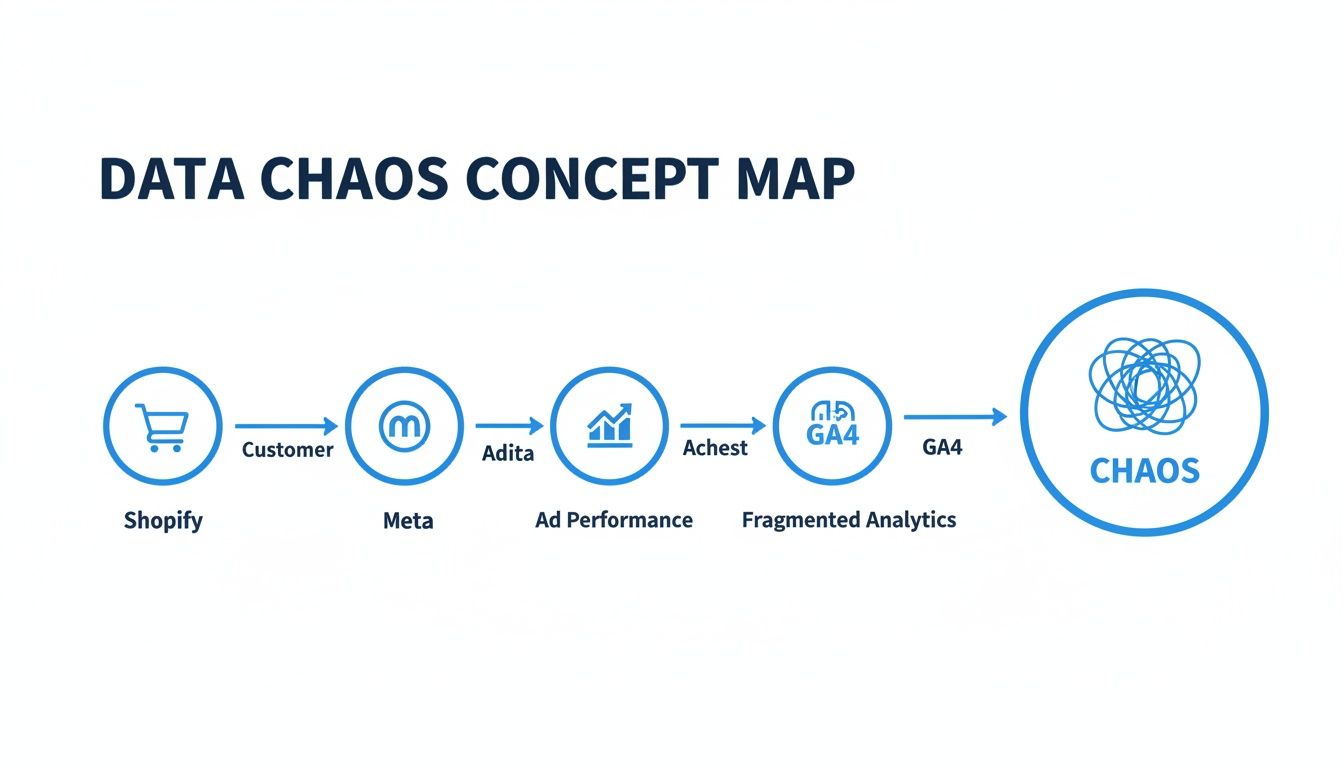
When your data from Shopify, Meta, and GA4 are all telling you different things, you can't see the full story. A solid framework puts all that data to work for you.
The Five Stages of the Growth Flywheel
Our entire growth model is built on five interconnected stages. The real magic happens when you understand how they feed into one another, turning your store into a predictable revenue machine. Each stage has its own job to do.
To help you visualize it, we've broken down the framework into a simple table. This is your high-level map for building a sustainable DTC brand.
| The E-commerce Growth Flywheel |
|---|
| This table outlines the five stages of the growth flywheel, showing how each part contributes to a self-sustaining system. Think of it as your cheat sheet for turning marketing efforts into long-term, profitable customer relationships. |
| Growth Stage | Primary Goal | Key KPI to Track |
|---|---|---|
| Audience | Identify your most valuable customer segments. | Lifetime Value (LTV) |
| Acquisition | Acquire those valuable customers profitably. | Customer Acquisition Cost (CAC) |
| Conversion | Turn visitors into first-time buyers. | Conversion Rate (CVR) |
| AOV | Increase the value of every single transaction. | Average Order Value (AOV) |
| Retention | Turn first-time buyers into repeat customers. | Repeat Purchase Rate |
Mastering how these five stages work together is the core of a modern growth strategy. Let's dig into what each one actually involves.
Stage 1: Audience Definition
Everything starts here. Instead of trying to be everything to everyone, you laser-focus on your most valuable customers—the ones with the highest potential Lifetime Value (LTV). You need to know who they are, where they came from, and what they buy. This isn't about guesswork; it's about finding the hidden patterns in your data.
Stage 2: Profitable Acquisition
Once you know exactly who you're targeting, your ad spend gets a whole lot smarter. You stop burning cash on low-value clicks and point your Meta or Google Ads budget toward acquiring customers who look just like your best ones. The goal here is simple: lower your Customer Acquisition Cost (CAC) without sacrificing quality.
Stage 3: Conversion Optimization
Getting traffic to your Shopify store is just the first step. This stage is all about making the journey from the product page to the "thank you" page as smooth as possible. We're talking about site speed, clear messaging, and killing any friction that makes someone think twice about hitting "buy."
Stage 4: AOV Maximization
A single-item order is nice, but a cart full of items is where the real profit is. The goal here is to increase your Average Order Value (AOV) with every transaction. Smart product recommendations, bundles that make sense, or a free shipping threshold can be all it takes to convince a customer to add one more thing to their cart.
Stage 5: Retention and LTV
This is where the flywheel really starts to spin. It costs so much less to keep a customer than to find a new one. This final stage is all about building loyalty through great email marketing, subscriptions, and experiences that feel personal. This is how you turn one-time buyers into your biggest fans and improve overall LTV.
This isn't just theory. It's a practical roadmap. When you focus on each stage, the effort you put into acquiring a customer pays you back over and over, directly fueling your bottom line and funding your next big move.
Every part of this flywheel spits out data. When you can unify that data with an AI-powered analytics platform, the wheel spins faster. Insights from your retention efforts (Stage 5) sharpen your understanding of who to target (Stage 1), which makes your next ad campaign even more efficient. That's the loop. That's how sustainable DTC brands win.
Measuring the Metrics That Actually Drive Profit
Your Shopify store is a machine with dozens of moving parts. To keep it running smoothly and actually growing, you can’t just stare at the speedometer—raw revenue or website traffic. You have to get under the hood and check the gauges that measure the health and efficiency of your growth engine.
These are the numbers that tell you if you're building a sustainable DTC business or just spinning your wheels. The global e-commerce market is blowing up, but to grab your piece of the pie, you have to speak the language of profit.
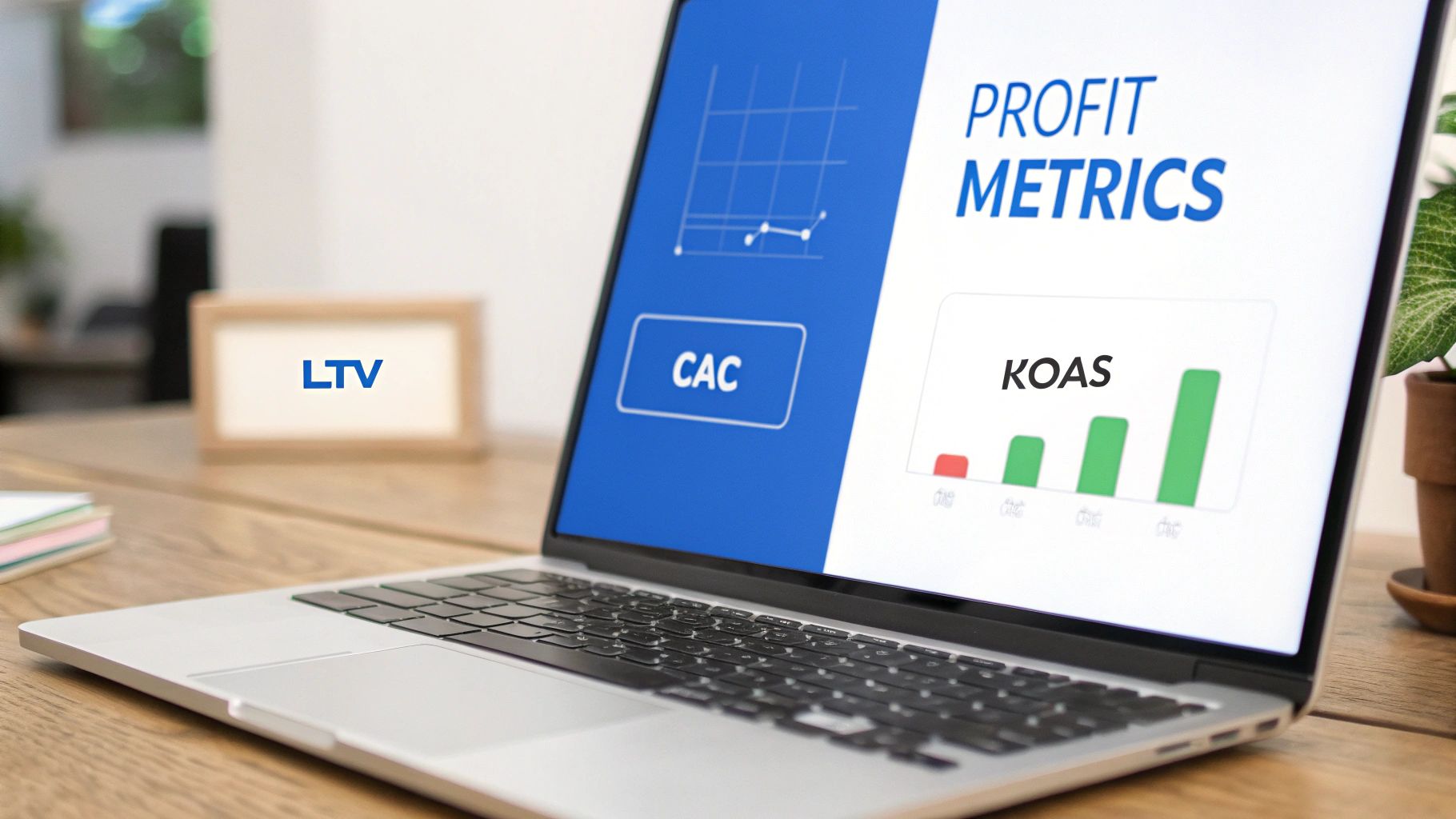
Let's cut through the noise and zero in on the handful of KPIs that truly form the foundation of a modern e-commerce growth strategy.
From Vanity to Value: The Core Profit Metrics
For any DTC founder, getting a handle on these five metrics is completely non-negotiable. They are the true north stars that should guide every single strategic decision you make, from where you spend your ad budget to which products you develop next.
- Customer Acquisition Cost (CAC): This is simply what it costs you in sales and marketing to get one new customer to click "buy" for the first time.
- Customer Lifetime Value (LTV): LTV is the total amount of revenue you can realistically expect from a single customer over their entire relationship with your brand. It’s the long-term prize for acquiring them.
- LTV-to-CAC Ratio: This is the ultimate health check for your business model. It pits the value of a customer (LTV) against the cost to get them (CAC). A healthy ratio, typically 3:1 or higher, signals that your acquisition engine is profitable and built to last.
- Return on Ad Spend (ROAS): A more immediate pulse check, ROAS measures the gross revenue you get back for every dollar you put into advertising. It tells you if a specific campaign is paying for itself right now. Understanding this is key, so check out this founder-friendly guide on How to Calculate Marketing ROI.
- CAC Payback Period: This tells you how many months it takes for a new customer to generate enough profit to cover their acquisition cost. A shorter payback period means you get your cash back faster, which you can then reinvest to fuel more growth.
Think of it this way: CAC is your investment, LTV is your total return, and the Payback Period is how long it takes to break even. Your entire game is to keep the investment low, push the return high, and get your money back fast.
Why Manual Tracking Is a Losing Game
Now, you could try to figure all this out by hand. You'd spend hours exporting data from Shopify, pulling ad reports from Meta and Google, and then trying to duct-tape it all together in some monster spreadsheet. It’s not just a headache; it's a recipe for costly mistakes.
By the time you finish your analysis, the data is already stale. You end up making decisions based on last week's numbers while your market is moving in real-time. This is where modern, AI-powered analytics platforms completely change the game for DTC brands.
The End of Spreadsheet Headaches
Imagine if these critical metrics were just... there. Calculated for you, automatically, and updated in real-time. An analytics co-pilot like MetricMosaic plugs directly into your Shopify store and marketing channels, unifying all that messy data into one clean, clear picture.
Instead of drowning in numbers, you get instant clarity on your most important KPIs. You can see your LTV-to-CAC ratio broken down by marketing channel, understand your true blended CAC across all platforms, and track the payback period for different customer cohorts. This is how you shift from being reactive to being proactive.
The platform does the heavy lifting, so you can focus on what you actually do best—building your brand and making amazing products. For a deeper look, check out our guide on the essential e-commerce performance metrics every founder should have on lock. This kind of automated clarity is the bedrock of a truly effective e-commerce growth strategy, turning your store's data from a liability into your most powerful asset.
How to Execute Your Growth Strategy Across Key Channels
A brilliant e-commerce growth strategy on paper is one thing. Actually making it happen is another. Once you have a unified picture of your data, you can finally stop juggling a dozen disconnected tactics and start running a synchronized plan—one where every channel pulls in the same direction to drive profitable growth.
Let's translate that growth flywheel we talked about into real-world actions across your most important channels.

This is about getting past the guesswork. No more wondering which Meta campaign really delivered value or if that new Klaviyo flow is actually improving customer lifetime value. It’s about making every dollar and every minute count, backed by clear, undeniable data.
Paid Media: Your Profit Engine
Paid media channels like Meta and Google Ads are often the fastest way to get in front of new customers. The flip side? They can also be the fastest way to burn through your cash if you’re flying blind. The goal here is to stop chasing cheap, top-of-funnel metrics like CPA and start acquiring customers with the highest predicted lifetime value.
Imagine this scenario for your Shopify store. You’re running two Google Ads campaigns:
- Campaign A: Bringing in customers with a low $25 CAC.
- Campaign B: Bringing in customers with a higher $40 CAC.
Old-school thinking says to pour money into Campaign A and cut Campaign B. But what if your AI-powered analytics reveal that customers from Campaign B have a 3x higher LTV and a much shorter CAC payback period? This predictive insight changes everything. Suddenly, you realize Campaign B is your true profit engine. That's the kind of clarity a unified data strategy delivers.
Owned Media: Your Retention and AOV Machine
Your owned channels—we're talking mainly about email and SMS—are where you build real relationships. This is how you turn one-time buyers into loyal fans, and it’s an incredibly powerful lever for boosting both AOV and retention. But blasting your entire list with the same generic campaign rarely moves the needle.
Instead, you have to use your data to get personal and strategic. By analyzing product-level profitability and purchase behavior, you can uncover which items are most likely to spark a second purchase.
For example, a data-backed insight might show that customers who buy your best-selling "Performance Tee" are 75% more likely to make a second purchase within 60 days if they're shown the "Endurance Shorts."
You can act on that immediately. Just create a segmented Klaviyo flow that targets first-time "Performance Tee" buyers with a perfectly timed offer on the shorts. This isn't just a random cross-sell; it’s a data-validated play to increase repeat purchase rates and LTV.
Earned Media and Attribution: Your Brand Amplifier
Earned media—think influencer marketing, PR, organic social—is fantastic for building brand credibility and reaching new audiences. The problem is, it has always been notoriously difficult to measure. How do you really know if that influencer partnership drove profitable sales or just a temporary spike in vanity traffic?
This is where a sophisticated understanding of your data becomes non-negotiable. Tying earned media efforts back to actual sales requires seeing the entire customer journey clearly. A customer might discover you on Instagram, search for you on Google a week later, and finally buy through an email. First-click or last-click attribution would give all the credit to a single channel, completely missing the bigger picture.
For Shopify brands looking to get this right, our guide on multi-touch attribution models breaks down how to get a much more accurate read on channel performance. With the right analytics, you can see how different touchpoints work together. This gives you the confidence to invest in the channels that build long-term value, not just short-term clicks.
By connecting all your channels into one cohesive e-commerce growth strategy, you turn fragmented efforts into a powerful, synchronized engine for sustainable success.
Turning Your Shopify Data Into a Competitive Advantage
Every DTC founder has heard the advice: "be data-driven." It's good advice, but in practice, it often means long nights staring at a dozen different dashboards and trying to stitch together a coherent story from fragmented spreadsheets.
The real competitive edge isn’t just having data. It's about turning that firehose of information into clear, actionable intelligence—and doing it fast.
For Shopify brands, the game is finally changing. You no longer need a dedicated data science team to get sophisticated answers from your store's numbers. The manual data-crunching that used to burn days of your time can now be done in seconds, thanks to smarter tools.
Conversational Analytics: The New Way to Get Answers
Imagine having an analytics co-pilot you can just talk to. This is the idea behind conversational analytics. Instead of digging through ten different reports to connect the dots, you just ask a direct question in plain English.
"Which marketing channel had the best LTV-to-CAC ratio last month?"
"Show me the conversion rate for first-time visitors from our latest Meta campaign."
"What's the average time between the first and second purchase for our top customer cohort?"
This completely removes the technical barrier between you and the answers you need. An AI-powered platform like MetricMosaic’s MosaicLive feature essentially acts as your personal data analyst, translating your questions into complex queries and delivering back simple, story-driven data. It lets you move at the speed of your curiosity, so you can validate a hunch or spot an opportunity without derailing your entire day.
From Reactive Reports to Proactive Stories
The other big shift is moving from reactive reporting to proactive insights. A standard dashboard tells you what happened yesterday. A proactive, AI-driven engine tells you why it happened and what you should think about doing next.
This is where AI-generated "Stories" come in. Think of them as automated narratives that surface critical insights you might have otherwise missed. A Story could alert you that your conversion rate suddenly dropped for a specific customer segment in California, for example, pinpointing the issue so you can fix it before it snowballs. These are the predictive insights that let you get ahead of problems.
The screenshot below shows just how simple this can be.
Here, a simple question about campaign performance gets an immediate, data-rich answer. Complex analysis becomes a simple conversation.
This proactive approach is crucial, especially as you scale. The fastest-growing e-commerce brands need a rock-solid, data-driven way to identify which geographic segments or product lines offer the highest profit potential—a task perfectly suited for AI analytics.
By unifying all your data streams—from Shopify sales and ad spend to customer behavior—an AI co-pilot can build the complete narrative for you. You get a holistic view that connects every part of your growth strategy, ensuring your decisions are based on the full picture, not just an isolated metric. For more on structuring this, check out our guide to building a comprehensive ecommerce analytics dashboard.
This is how you make your data work for you, turning it into your sharpest and most reliable competitive advantage.
So, What's Next? Turning This into Profitable, Predictable Growth
Let's be real—sustainable e-commerce growth isn't about finding a secret formula or getting lucky. It’s the outcome of a repeatable, data-backed system that helps you turn all that chaotic noise from your various platforms into clear, confident action.
The growth flywheel we’ve walked through—Audience, Acquisition, Conversion, AOV, and Retention—is your blueprint. Think of it as a mental model that stops you from just throwing random marketing tactics at the wall and hoping something sticks. Instead, it helps you build a cohesive engine for profit. But like any engine, it only runs well when it’s fueled by clean, unified, and genuinely actionable data.
From Learning to Doing
This is the part that really matters. The leap from learning about these concepts to actually doing something with them is where true growth happens. It starts when you move beyond just staring at dashboards and begin asking deeper, more pointed questions about your business. To get the wheels turning, take a look at some proven growth strategies to scale your revenue and think about how you can adapt them to your own DTC model.
The whole point is to build a business where every single decision—from your ad budget to your next email campaign—is made with confidence. That confidence comes from a complete, holistic understanding of your numbers, not just a few isolated touchpoints.
Your Final Takeaway: Stop managing spreadsheets and start managing a strategy. An effective growth strategy gives your Shopify brand the clarity to not just get bigger, but to do it profitably and predictably, even when the market gets tough.
The kind of tools that make this possible are no longer just for the enterprise giants. With an AI co-pilot like MetricMosaic, you can give your brand the insights you need to turn everyday store data into your sharpest competitive edge. The clarity you need is already there, sitting in your data—it’s time to unlock it.
Your E-commerce Growth Questions, Answered
Growing an e-commerce brand is tough, and it's easy to get stuck on certain questions. Let's clear up a few of the most common ones I hear from founders and marketers trying to build a solid growth strategy.
What Is the Difference Between a Growth Strategy and a Marketing Plan?
It’s easy to mix these two up, but the difference is critical.
Think of your e-commerce growth strategy as the blueprint for the entire business. It's the high-level "why." It answers the big questions: Who is our ideal customer? What is our real value proposition? And, most importantly, how will we scale profitably? This is where you live and breathe metrics like LTV and CAC to make sure the fundamental business model works.
A marketing plan is the "how." It’s the list of specific tactics you'll use to bring that strategy to life—firing up a Meta Ads campaign, building out a new Klaviyo flow, or launching a new influencer program. Your marketing plan is all about execution, and it should always be in service of the bigger growth strategy.
Which E-commerce KPIs Should I Track Daily?
You can drown in data if you try to track everything every day. For your daily check-in, you want to focus on the vital signs—the leading indicators that tell you if the business is healthy right now.
While LTV is a long-term strategic metric, your daily dashboard should have these four front and center:
- Return on Ad Spend (ROAS): Simple and direct. Are the ads I’m paying for today making money today?
- Conversion Rate (CVR): Are people who visit the site actually buying? A sudden drop here can be an early warning of a broken link or a technical bug on your Shopify store.
- Average Order Value (AOV): How much is each customer spending per transaction? This tells you if your bundling or upsell tactics are working in real-time.
- Customer Acquisition Cost (CAC): What’s it costing to get a new customer through the door today?
Watching these gives you a real-time pulse on the business, so you can spot problems or jump on opportunities without getting bogged down in long-term analysis.
How Can AI Analytics Help a Small Shopify Brand?
For a small or mid-sized Shopify brand, AI-powered analytics is a massive leveler. In the past, you'd have to hire a data analyst or spend days buried in spreadsheets to get real answers. Now, you get an automated co-pilot to do the heavy lifting for you.
For instance, a good AI tool can automatically surface a "Story" that tells you a specific ad campaign is bringing in customers with a 30% higher predicted LTV, even if its initial cost-per-acquisition looks a bit high. It completely cuts out the manual work and gives you an insight you can act on immediately, helping you put your budget where it will generate the most long-term value.
The real magic of AI is that it turns messy, disconnected data into a clear story. It answers the "so what?" behind the numbers, finally connecting what you spend on ads to the profit you see months down the line.
How Often Should I Review and Adjust My Strategy?
Your e-commerce growth strategy should be solid, but not set in stone. The core of who you serve and why won't change often, but the way you execute needs to be flexible.
Here's a good rhythm I've seen work for a lot of brands:
- Weekly: This is for tactical reviews. How are the ad campaigns performing? Are the email flows converting? Make small tweaks here.
- Monthly: Zoom out a bit. Look at channel-level performance. How's our blended ROAS? What's our CAC on Google versus Meta?
- Quarterly: This is the big strategy check-in. Re-evaluate your core assumptions. Is our target audience still the right one? Are we on track to hit our LTV to CAC goals for the year?
This cadence keeps you agile enough to react to performance data and market shifts without getting whiplash from changing your high-level direction every other week.
Ready to stop guessing and start growing? MetricMosaic is the AI-powered growth co-pilot that unifies all your data and turns it into clear, actionable strategies. See how our story-driven analytics can help you scale your Shopify brand profitably.