How a Multi-Touch Attribution Model Ends the Guesswork for Shopify Brands
Stop guessing your marketing ROI. A multi-touch attribution model gives Shopify brands the clarity to scale faster and boost profitability with AI.

What exactly is a multi-touch attribution model? Think of it as the ultimate referee for your marketing budget, giving credit where it's due across the entire customer journey. Instead of dumping 100% of the credit on the very last ad a customer clicked, it acknowledges that every touchpoint—from the first TikTok video they saw to the influencer post they swiped up on—plays a vital role in the final sale. It’s how you finally see the whole story, not just the last chapter.
Why Your Shopify Ad Spend Feels Like a Guessing Game

As a Shopify founder, you live and breathe growth. You're running campaigns on Meta, spinning up creatives for TikTok, and bidding on keywords in Google Ads. The sales are rolling in, which feels great, but a nagging question keeps you up at night: which of these channels are actually driving profitable growth, and which are just eating my budget?
It’s a frustration every DTC brand knows intimately. Your Shopify dashboard shows a sales spike, and your Facebook Ads manager is glowing with a healthy return, so you push more budget in. But what if that Facebook ad was just the finish line of a much longer race? What if the real hero was an influencer post two weeks ago that first introduced them to your brand? Without a clear answer, you're stuck in a cycle of expensive guesswork.
The Problem With Last-Click Attribution
The culprit behind this confusion is an outdated and deeply flawed measurement method: last-click attribution. It’s the default setting for most ad platforms and even your standard Shopify reports. This model gives every ounce of credit for a sale to the very last thing a customer clicked before buying.
Imagine a soccer game where only the goal-scorer gets any recognition. This model completely ignores the midfielder who made the perfect pass and the defender who started the whole play. In marketing terms, this means your top-of-funnel channels—the ones introducing new customers to your brand and building trust—get absolutely zero credit for their hard work.
The Blind Spot: Relying only on last-click data is a recipe for bad decisions. You might slash the budget for a high-value awareness campaign on TikTok because it doesn't "convert," while you keep overspending on a branded Google search campaign that just mops up customers who were already going to buy from you anyway.
From Fragmented Data to Actionable Clarity
This broken picture creates a cycle of guesswork that chews through your ad spend and stalls your growth. You end up wasting money on channels that only look like they’re working while missing huge opportunities to scale the ones that are actually bringing new customers in the door. This is where a proper multi-touch attribution model, powered by AI, completely changes the game.
By mapping out the entire customer journey, this approach finally gives you the clarity you need to make confident, data-driven decisions. Instead of just seeing the final click, AI stitches together every touchpoint to tell you the complete story of how customers discover, engage with, and eventually buy from your brand. This holistic view is the key to dialing in your most important DTC metrics, like:
- Return on Ad Spend (ROAS): When you know which channels genuinely influence purchases, you can put your money where it will actually drive profitable returns.
- Customer Acquisition Cost (CAC): Pinpointing your most effective acquisition channels helps you drive down the cost of getting each new customer and scale sustainably.
Moving beyond last-click isn't just an analytics tweak. It's a fundamental shift in strategy that turns your scattered Shopify data into a powerful competitive advantage.
Understanding Multi-Touch Attribution
Think of the last-click model like giving all the credit for a championship win to the player who scored the final basket. It’s simple, but it completely ignores the rest of the team—the defenders, the playmakers, and the one who made the critical assist.
A multi-touch attribution model sees the whole game. It gives credit to every player who touched the ball and contributed to the win. It tells the complete story of how a customer goes from a curious browser to a loyal fan of your brand.
For your DTC store, this means mapping out that entire customer journey. A multi-touch model tracks everything from the first blog post they read, to the TikTok ad that caught their eye, and the final retargeting email they clicked. It recognizes that each of these touchpoints played a part.
Instead of a single, often misleading, data point, you get a rich narrative of how all your marketing channels are actually working together.
The Shift From a Single Snapshot to the Full Story
The idea of multi-touch attribution isn't new. It was born out of the chaos of early digital advertising. By the 2010s, as customer journeys got messier, marketers knew they needed a smarter way to assign credit. Relying on simplistic single-touch methods just wasn't cutting it anymore. You can learn more about the history of marketing measurement to see just how far we've come.
This shift is a game-changer for any Shopify founder trying to scale. Sticking with last-click is like trying to navigate a city with only the final destination plugged into your GPS—you have no clue which roads actually got you there. This leads to some seriously flawed assumptions:
- You undervalue your opening plays: Channels like organic social or top-of-funnel video ads that introduce your brand almost never get the last click, so they look like they aren't working.
- You overvalue your closers: Branded search and retargeting ads clean up, getting all the credit when they’re often just capturing customers who were already sold.
This warped view leads directly to wasted ad spend and stalled growth. You end up cutting the budget for the very channels that are filling your funnel, while pouring more money into campaigns that are just taking credit for everyone else's hard work.
How AI Makes Multi-Touch Attribution Finally Doable
In the past, building a true multi-touch attribution model was a massive undertaking. It usually meant having a dedicated data analyst buried in complex spreadsheets, trying to piece everything together manually. For most DTC brands, the sheer volume of data—every click, view, and session—was just too much to handle.
This is where AI-powered analytics platforms completely change the equation. Instead of you doing the manual data-crunching, an AI engine connects directly to your Shopify store, your ad accounts like Meta and Google, and your email platform like Klaviyo. It automatically stitches together every single customer touchpoint into one coherent journey.
The Big Idea: AI doesn't just collect your data; it finds the story within it. It analyzes thousands of customer paths to figure out which combinations of touchpoints are most effective at driving sales, boosting LTV, and bringing down your CAC.
This means you, the founder or marketer, can skip the grunt work and get straight to the insights. An AI-driven multi-touch model gives you a clear, story-driven view of what’s really working. It tells you which TikTok campaigns are bringing in new customers and which email flows are best at sealing the deal, turning a mountain of complexity into simple, actionable clarity.
Choosing the Right Attribution Model For Your Store
So you've decided to move beyond the fog of last-click. Smart move. But now comes the next big question: which multi-touch attribution model is actually right for your Shopify store?
Think of these models as different lenses for looking at your customer journey. Each one brings certain touchpoints into sharp focus while blurring others. The right choice depends entirely on your business goals, your sales cycle, and the story you’re trying to understand.
Picking the wrong model can leave you with a picture that’s just as skewed as last-click, and that leads to some painful budget mistakes. Let's cut through the jargon and look at the most common models to find a solid starting point for your brand.
This decision tree nails the core choice you're making: are you content with a single, final snapshot, or do you need the full movie of every interaction that led to a sale?
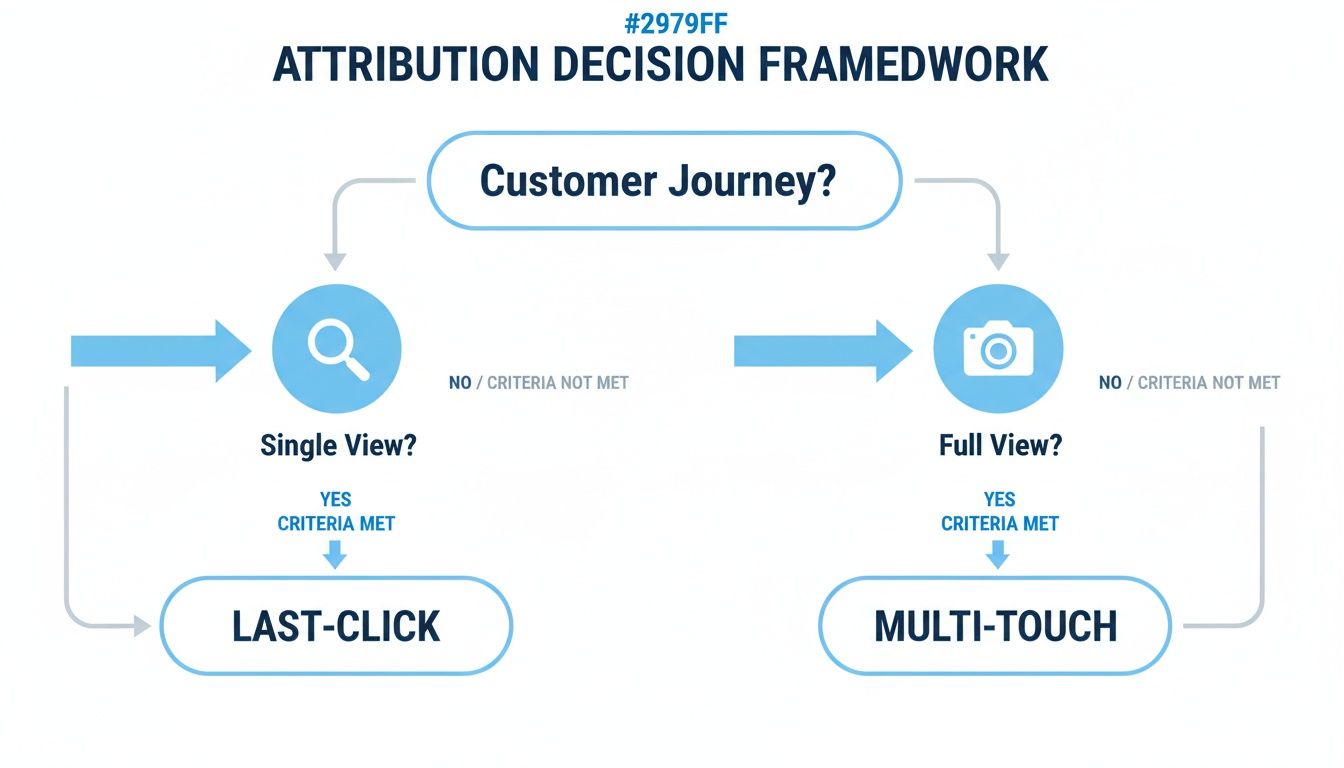
Moving to multi-touch is a strategic decision. It’s about embracing the beautiful mess of the modern customer journey to pull out real, actionable insights.
To help you compare your options, here’s a quick breakdown of how the most common rule-based models stack up for DTC brands.
Comparison of Common Multi-Touch Attribution Models for Shopify Stores
| Attribution Model | How It Works | Best For Shopify Brands Who... | Potential Blind Spot |
|---|---|---|---|
| Linear | Spreads credit evenly across every touchpoint in the journey. | Have a shorter sales cycle and want a simple, balanced view of all contributing channels. | Can undervalue the major "aha!" moments and the final conversion triggers by treating all touches as equal. |
| Time-Decay | Gives the most credit to the touchpoints closest to the sale. | Run time-sensitive promotions or have a longer consideration phase where final nudges are key. | Risks underfunding top-of-funnel marketing that introduced the customer to the brand in the first place. |
| Position-Based (U-Shaped) | Credits the first and last touches the most (e.g., 40% each), splitting the rest among the middle touches. | Are focused on both new customer acquisition and efficient conversion. | Can minimize the impact of important mid-funnel nurturing, like blog posts or email sequences. |
| Algorithmic (Data-Driven) | Uses machine learning to calculate the actual impact of each touchpoint based on historical data. | Have significant conversion volume and want the most accurate, dynamic view of marketing performance. | Requires more data and technical sophistication to implement correctly; can feel like a "black box." |
Each model tells a slightly different story. The goal is to find the one whose narrative most closely matches how your customers actually behave.
Linear: The Democratic Model
The Linear attribution model is the simplest of the bunch. It’s the ultimate democracy—every single touchpoint gets an equal vote.
If a customer clicked a Facebook ad, read a blog post, and then opened a retargeting email before buying, each of those three interactions gets exactly 33.3% of the credit. No arguments, no favorites.
- Best for Shopify Brands Who: Have a relatively short sales cycle or just want a baseline understanding of all the channels that played a part. It's a great, simple place to start.
- Potential Blind Spot: By treating a casual blog view and a "buy now" click the same, it can seriously undervalue the moments that actually sealed the deal.
Time-Decay: The Closer-Focused Model
The Time-Decay attribution model works on a simple premise: the closer a touchpoint is to the sale, the more important it was.
Think of it like cramming for an exam—the stuff you reviewed right before the test is what you remember most. Here, the touchpoints just before the purchase get the most credit, while interactions from weeks ago get progressively less. This is gold for brands where the final push is everything.
- Best for Shopify Brands Who: Rely on flash sales or have longer, more considered purchases where a final discount code or cart abandonment email does the heavy lifting.
- Potential Blind Spot: It's easy to look at the data and think your top-of-funnel channels are worthless. This model can starve your awareness efforts of the credit they deserve.
U-Shaped: The Bookend Model
Also known as the Position-Based model, the U-Shaped model champions two key moments: the first hello and the final handshake.
It typically gives 40% of the credit to the first touchpoint that brought someone in and 40% to the last one that closed the sale. That remaining 20% is sprinkled across all the interactions in between.
This model is a powerful choice for DTC brands that live and die by both new customer acquisition and efficient conversion. It honors the channel that found the customer and the one that got them to pull out their credit card.
These rule-based models are popular because they’re easy to grasp and set up. But the real cutting edge is in more dynamic, data-driven approaches. While models like Linear and U-Shaped use fixed rules, algorithmic MTAs use your own data to calculate each touchpoint's true impact. You can discover more about these attribution methods to really go down the rabbit hole.
Ultimately, choosing the right multi-touch attribution model is a critical step in turning your Shopify data into a genuine growth engine. Each one tells a unique story, and your job is to find the one that best reflects your customer’s journey and your biggest business goals.
The Future Is Algorithmic Attribution Powered By AI

While the rule-based models we've covered are a massive leap from last-click, they still operate on a set of fixed assumptions. You're basically telling your data how to behave based on a strategy you've already decided on.
But what if your data could tell its own story?
This is where the real game-changer for ambitious Shopify brands comes in: the data-driven or algorithmic multi-touch attribution model. Instead of forcing your numbers into a one-size-fits-all box, this approach uses machine learning to build a custom attribution model that's completely unique to your store.
It’s like going from a generic, off-the-rack suit to one that's been perfectly tailored. An algorithmic model sifts through thousands—or even millions—of your actual customer journeys to figure out which touchpoints truly influence a conversion for your specific audience and products.
Moving Beyond Rules to Reality
Not long ago, this kind of analysis was totally out of reach for most DTC brands. It meant hiring a full-time data science team and spending a fortune on computing power. Today, AI-powered analytics platforms like MetricMosaic make this kind of advanced capability accessible to any Shopify founder who wants to grow smarter.
Here’s how it fundamentally changes your approach:
- It Finds Hidden Patterns: AI can spot subtle correlations a human would almost certainly miss. Maybe it discovers that customers who watch a specific TikTok video and then see a particular Facebook ad are 3x more likely to convert.
- It Adapts on the Fly: Your customers’ behavior isn’t static, so your attribution model shouldn't be either. An algorithmic model is always learning and adjusting as new data rolls in, making sure your insights are never stale.
- It Assigns Credit Fairly: Instead of assigning arbitrary percentages, the model gives credit based on the proven statistical impact of each touchpoint.
This approach gives you the clearest, most accurate picture of your marketing ROI. You'll move from making educated guesses to making data-backed decisions with complete confidence.
The Power of AI in Action: Imagine your AI model uncovers that a series of blog posts on product sourcing, while rarely getting the last click, is consistently part of the journey for your highest LTV customers. A rule-based model might have completely undervalued this content. But an algorithmic one flags it as a critical piece of your retention strategy, giving you the green light to invest more in similar content.
Uncovering the True Value of Your Marketing
The difference between a rule-based model and an algorithmic one isn't just academic—it's substantial. Industry research shows that algorithmic models often shift large chunks of conversion credit away from last-click channels like branded search. They give proper value to the upper-funnel investments in social media, content, and display ads that actually introduce and nurture new customers. You can dig deeper into how these advanced models reshape channel ROI to see the full impact for yourself.
This shift directly impacts your bottom line. When you can finally see the true value of your awareness campaigns, you can scale them confidently. You’ll be driving sustainable growth instead of just capturing demand that was already there.
From Hindsight to Foresight
Perhaps the most powerful thing about AI-driven attribution is its ability to move beyond explaining the past to start predicting the future. By understanding the DNA of a successful customer journey, next-gen systems can offer predictive insights and story-driven recommendations.
An AI analytics co-pilot might surface conversational insights like:
- "Your projected ROAS for the 'Summer Glow' TikTok campaign is 2.5x higher than your Meta campaign. We recommend shifting $5,000 of your budget."
- "Customers who engage with your email welcome series before their first purchase have a 40% higher predicted LTV."
This transforms your analytics from a rearview mirror into a GPS for growth. You’re no longer just reporting on what happened; you’re getting clear, actionable directions on how to make better decisions tomorrow. For a busy Shopify founder, that means less time buried in spreadsheets and more time executing strategies that actually move the needle on profitability.
Putting Your Attribution Insights Into Action

Getting a clear view of your customer's journey is a fantastic start. But insight without action is just an expensive hobby. The real power of a multi-touch attribution model is that it gives you the confidence to make smarter marketing decisions—the kind that actually moves the needle on your bottom line.
It's time to take those insights and turn them into profit for your Shopify store. This is about more than just looking at reports. It's about reallocating your budget, optimizing your creative, and refining your whole strategy based on what the data proves is working.
Confidently Reallocate Your Ad Spend
One of the first and biggest wins you'll get from multi-touch attribution is the ability to shift ad spend with surgical precision. Last-click data often tells a dangerously simple story, tricking you into pouring money into bottom-funnel channels while starving the top-of-funnel campaigns that bring new customers in the door.
Think about this classic DTC scenario:
- Last-Click View: Your Facebook retargeting campaign is crushing it with a 5x ROAS. Meanwhile, your new TikTok awareness campaign looks like a dud at 0.8x ROAS. The obvious move? Kill the TikTok ads and double down on Facebook.
- Multi-Touch View: Your algorithmic model tells a different story. It shows that 70% of customers who converted from that Facebook ad first discovered your brand through the TikTok campaign. Suddenly, that TikTok campaign isn't a failure; it's the engine filling your funnel with high-intent buyers.
With that kind of clarity, the right decision is a no-brainer. Instead of gutting the TikTok budget, you can now scale it confidently, knowing it's the real source of your most valuable customers. This is how you stop reacting to bad data and start building a predictable growth machine.
Optimize Creative for Every Stage of the Funnel
A full-funnel view doesn't just tell you where to spend your money; it tells you what to say at each step. When you understand which ads are driving that first touchpoint versus which ones are closing the deal, you can tailor your messaging for maximum impact.
Your attribution data will start revealing patterns you can act on:
- Top-of-Funnel (Discovery): If you see that unboxing videos on TikTok are the primary first touch, you know to invest in more authentic, UGC-style content that entertains and introduces your brand.
- Mid-Funnel (Consideration): When your data shows blog posts comparing product features are a key middle touchpoint, it’s a clear signal to create more educational content that answers questions and builds trust.
- Bottom-of-Funnel (Conversion): If your model gives a ton of credit to cart-abandonment emails, you can obsess over those offers—fine-tuning them with specific discounts or testimonials to get hesitant buyers across the finish line.
This strategic approach lets you speak to your customers with the right message at the right time, dramatically improving your conversion rates across the entire journey.
Improve LTV by Understanding Repeat Buyers
The relationship with your customer doesn't end after the first purchase. A good multi-touch attribution model is also a killer tool for understanding and boosting Customer Lifetime Value (LTV). By analyzing the complete journey of your repeat buyers, you can pinpoint the exact drivers of loyalty.
For instance, your model might reveal that customers who join your loyalty program through a post-purchase email sequence have a 35% higher LTV over their first year. That’s not just an interesting stat; it’s a bright, flashing sign telling you to double down on that email flow and optimize it for every new customer.
By connecting attribution insights to core DTC metrics like ROAS, CAC, and LTV, you can draw a straight line from a clearer understanding of your marketing to better profitability. It’s the key to building a resilient Shopify brand that grows not by guesswork, but by data.
Your Next Step Toward Smarter Shopify Growth
Look, if you've made it this far, you get it. Relying on last-click attribution is like trying to drive across the country with only the last turn of your GPS directions. It tells you how you arrived, but you have no clue about the long highway stretches, scenic detours, and crucial pit stops that actually made the journey possible.
You miss the full story—the discovery ads, the engaging content, and the timely emails that guided your best customers right to your Shopify store.
We’ve pulled back the curtain on multi-touch attribution, and how a modern, AI-powered approach gives you the full picture you need to grow with real confidence. All that fragmented data that used to lead to gut-feel decisions can finally be woven into a clear narrative of what actually drives a sale.
From Learning to Doing
What does this all boil down to? Empowerment.
You no longer have to guess where your most valuable customers are coming from or which channels deserve the next dollar from your budget. With the right tools in place, you can stop just reporting on what happened last month and start making confident, forward-looking decisions that directly boost ROAS, lower CAC, and increase LTV.
The next move is yours: it's time to go from awareness to action.
Stop making critical budget decisions with shaky, incomplete data. It’s time to see for yourself how an AI-powered analytics platform can turn your marketing from a confusing cost center into a predictable, highly efficient growth engine.
Turning your everyday store data into your biggest competitive advantage isn't some complex, resource-heavy pipe dream anymore. It’s a real, accessible option for DTC brands ready to build their future on a foundation of clarity.
It all starts by connecting your data sources and letting the AI tell you the true story behind your growth.
Got Questions? We've Got Answers.
Diving into the world of marketing attribution can feel a bit like learning a new language. It’s powerful, but it’s normal to have a few questions. Here are some of the most common ones we hear from Shopify founders and marketers thinking about making the switch to a multi-touch attribution model.
How Is This Different From What I Already See In Shopify Analytics?
Great question. Your standard Shopify Analytics dashboard is built on a last-click model. It gives 100% of the credit for a sale to the very last link a customer clicked before buying. This often makes channels like branded search or direct traffic look like superstars while completely ignoring the hard work your other channels did to get that customer there in the first place.
A multi-touch attribution model, on the other hand, tells the whole story. It looks at the entire customer journey and gives credit where credit is due—from that first TikTok ad they saw, to the blog post they read, to the final email that sealed the deal. You get a much clearer, more honest picture of how all your marketing efforts are actually working together to drive sales.
Do I Need to Be a Data Scientist to Use This for My DTC Brand?
Absolutely not. It used to be that you needed a team of analysts to even think about multi-touch attribution. Not anymore. Modern analytics platforms are built for the people in the trenches—the founders and marketers making the big decisions every day.
The Takeaway: Tools like MetricMosaic are designed to do the heavy lifting for you. They plug right into your Shopify store and ad accounts, pulling all the data together and running the complex models automatically. The insights are served up in simple, story-driven dashboards, so you can stop wrestling with spreadsheets and start making smarter moves.
This means you can get all the benefits of sophisticated analytics without needing a data science degree. It’s about turning your store's data into your biggest advantage, plain and simple.
How Fast Will I See Results After Switching to a Multi-Touch Model?
You'll start seeing "aha!" moments almost as soon as your data is connected and processed. The real results, the ones that hit your bottom line, start showing up when you begin acting on those insights.
For instance, you might see that a top-of-funnel channel you were underfunding is actually punching way above its weight. By confidently shifting some of your ad spend there, you could see a real lift in your ROAS and a drop in your customer acquisition costs in just one marketing cycle. The key isn't a one-time fix; it's about using this continuous stream of clear data to refine your strategy over time for steady, profitable growth.
Ready to stop guessing and start growing with clarity? MetricMosaic is the AI-powered growth co-pilot for Shopify brands that turns complex store data into your most powerful asset. Start your free trial today and see the full story behind your sales.