¿Qué es la Tasa de Retención de Clientes?
Entiende qué es la tasa de retención de clientes y por qué es crucial para tu negocio.
As a Shopify fundador, you're constantly juggling métricas. ROAS, CAC, conversión rates—it feels like you're drowning in a sea of fragmented datos from a dozen different platforms. You’re pulling informes from Shopify, Google Analytics, and your ad accounts, trying to stitch together a clear picture of ROI, but it’s a manual, time-consuming grind. Qué if the clave to sustainable crecimiento isn't buried in those complex spreadsheets, but in one poderoso number that measures cliente loyalty?
Why Retención Is The Bedrock Of A Profitable Store
For most DTC marcas, the diario battle is acquiring new clientes. Pero while you’re focused on the top of the embudo, your hard-won clientes might be quietly slipping out the back door. Esto is where focusing on one simple, poderoso metric can cut through the noise: customer retención rate.
So, what is it, really? En plain English, it’s the percentage of clientes who stay loyal to tu marca over a specific period. Think of it as the heartbeat of your Shopify tienda. A high tasa de retención tells you that your productos, marca, and cliente experience are resonating. A low one is a red flag that something is broken. En a world where ad costs are only going up, your existing clientes are your single most valuable asset.
It's More Than Just A "Nice-A-Have" Metric
Understanding your tasa de retención is crucial because it’s tied directly to your profitability. A high tasa de retención means you spend less money on anuncios trying to replace clientes who abandono. Eso simple shift has a massive impact on your bottom line.
For any serious Shopify marca, this is non-negotiable. Aquí’s why:
- It Fuels Your LTV: Clientes who stick around buy again (and again), supercharging their valor de vida del cliente (LTV) without you spending another dime on adquisición.
- It Speeds Up CAC Payback: The faster a cliente makes that second compra, the quicker you earn back what you spent to acquire them (your CAC).
- It Creates True Marca Fans: Happy, loyal clientes don't just buy from you; they become your best marketers, driving poderoso word-of-mouth referrals for free.
Here's a quick reference to keep these core ideas straight.
Customer Tasa de Retención En A Glance
| Component | What It Means Para Your Store |
|---|---|
| The Metric | The percentage of clientes who continue to buy from you over a specific time. |
| High Rate | Your productos, marca, and cliente experience are resonating. People like what you're doing. |
| Low Rate | Something is off. Clientes aren't finding enough value to come back. |
| Its Impact | Directly boosts LTV, shortens CAC payback period, and creates marca advocates. |
This isn't just theory; it's a simple calculation that reveals the health of your cliente base.
The Standard Retención Formula
The classic formula for calculating cliente tasa de retención (CRR) is pretty straightforward:
CRR = ((Clientes at End - New Clientes) / Clientes at Start) × 100
Let’s break that down with a real-world Shopify example. Say your tienda started the quarter with 500 clientes. Por the end of the quarter, you had 520 total clientes, but you know you acquired 60 new ones during that time.
Here's the math: ((520 - 60) / 500) x 100 = 92%
Your tasa de retención for that quarter would be 92%. It’s a foundational metric, and as puedes learn from the team at Zendesk.com, it’s just the starting point for digging deeper into cliente loyalty.
How to Calcular Tasa de Retención for Your Store
Alright, let's get our hands dirty. Para many Shopify fundadores, pulling the numbers for cliente tasa de retención feels like a chore, but I promise it’s simpler than you think. The standard formula gives you a fantastic, high-level look at how loyal tus clientes really are.
The Standard CRR Formula
The classic formula only needs three numbers from your Shopify analítica or cliente list. Primero, you just have to pick a time period to look at—let's use a single quarter for this example.
You'll need to grab these three datos points:
- (S) Clientes at the Start: The total number of clientes you had on day one of the quarter.
- (E) Clientes at the End: The total number of clientes you had on the very last day of the quarter.
- (N) New Clientes Acquired: Cómo many marca-new clientes made their first compra during that same quarter.
Once tienes those, the math is easy. Esto diagram shows exactly how those pieces fit together.
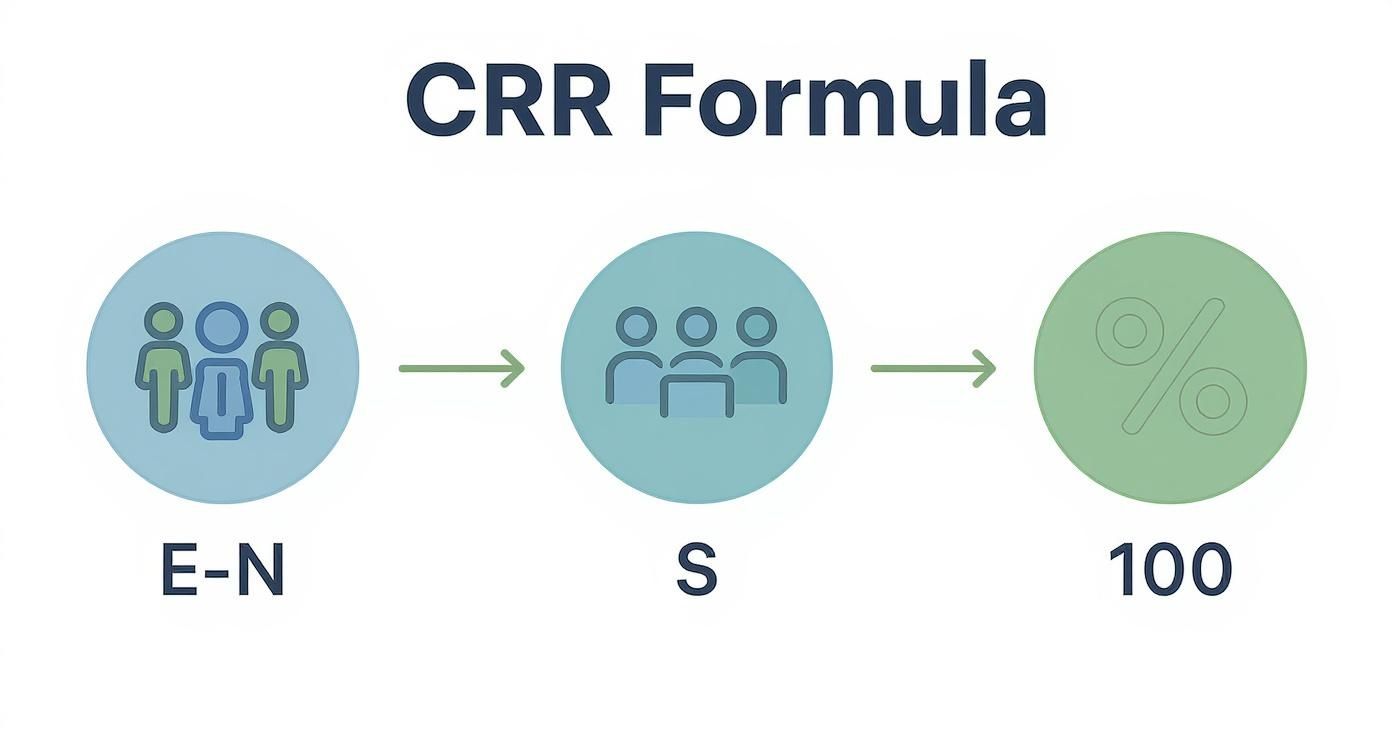
What this formula does is strip out all the new clientes you acquired. It isolates your existing cliente base to show you exactly what percentage of them stuck around.
CRR in Action: A DTC Coffee Marca Example
Let's make this real. Imagine you're running a directo al consumidor coffee suscripción marca on Shopify. We'll use the formula to see how you did last quarter.
- Customers at Start (S): You kicked off Q1 with 1,000 active subscribers.
- Customers at End (E): Por the end of Q1, your total cliente count grew to 1,200.
- New Clientes (N): Tu marketing team crushed it and brought in 250 new coffee lovers.
Now, we just plug those numbers into the formula:
CRR = ((1,200 - 250) / 1,000) x 100
CRR = (950 / 1,000) x 100
CRR = 95%
A 95% cliente tasa de retención for the quarter is fantastic. It’s a strong signal that tu marca is healthy and your coffee is hitting the spot. Pero this one number doesn't tell you the whole story. Por ejemplo, are the clientes you got from that Black Friday sale sticking around longer than the ones from a February influencer post?
Going Deeper with Cohorte Analysis
While the standard CRR is a great starting point, the real magic is in cohort analysis. Esto just means grouping clientes together based on when they first bought from you—like your "January 2024 cohorte" or your "BFCM 2023 cohorte."
Instead of lumping everyone into one big bucket, you rastrear the retención of each specific group over time. Esto is how you uncover which marketing channels, descuento estrategias, or even which first productos create the most loyal clientes.
Doing this by hand is a nightmare of spreadsheets. Esto is where impulsado por IA analítica tools like MetricMosaic come in. It automates the painful manual datos crunching, segmenting tus clientes into cohortes and showing you the "why" behind your retención numbers, not just the "what."
Why Retención Is Your Clave to Profitability
A strong cliente tasa de retención isn’t just a nice-to-have metric for your pitch deck. It's the absolute engine of a profitable Shopify tienda. Como a fundador, you're always in a tug-of-war between rising cliente adquisición costs (CAC) and the relentless push for crecimiento. Retención is how you win.
Think about it. Cada time a cliente you already paid to acquire buys again, their valor de vida del cliente (LTV) climbs without you spending another dime on anuncios. Esto immediately shrinks your CAC payback period, putting that marketing investment back in your pocket faster. Suddenly, tienes more cash to reinvest in scaling tu marca—whether that’s more inventario, bigger ad campañas, or hiring your next clave team member.
But the real magic of retención goes much deeper than just payback periods.
The Compounding Effect of Loyalty
Your most loyal clientes are, by far, your most poderoso and cost-efectivo marketing channel. They don't just buy more often; they become genuine marca advocates.
They’re the ones leaving glowing reviews, telling their friends about your productos, and driving the kind of high-value, word-of-mouth referrals that you simply can't buy. Esto organic crecimiento is what separates a flash-in-the-pan tienda from a resilient, defensible DTC marca.
The link between retención and profitability isn’t just a straight line; it’s exponential. Research has shown that boosting cliente retención by a mere 5% can crank up ingresos anywhere from 25% to 95%. Esto happens because retained clientes buy more, cost less to service, and bring in new compradores for free. It’s no wonder so many marcas are investing in technology to keep clientes happy, a trend puedes see in these customer support trends and statistics.
The core economic truth of comercio electrónico is simple: it’s far cheaper to delight an existing cliente into a repeat compra than it is to acquire a marca-new one from scratch.
Turning Datos En a Resilient Business
This is where an impulsado por IA analítica platform like MetricMosaic becomes a fundador's secret weapon. Instead of staring at a single, flat retención number, you get the story behind why tus clientes stick around (or why they don't).
AI can instantly sift through thousands of Shopify datos points to tell you things like:
- Which productos are your repeat compra superstars, so you know exactly what to feature in your next retención campaña.
- Which marketing channels deliver clientes with the highest LTV, helping you embudo your ad budget toward long-term ganancia, not just first-time ventas.
- Predictive insights that flag which cliente groups are at risk of churning, giving you a chance to step in with a targeted offer before they’re gone for good.
By connecting the dots between your what is cliente retención rate and your bottom line, AI transforms a reactive metric into a proactive tool for building a more durable and profitable negocio.
What Is a Good Tasa de Retención in Comercio Electrónico?
So, you’ve calculated your cliente tasa de retención. The next question is always the same: “...is that any good?”
The honest answer? It depends. Allí's no magic number that works for every comercio electrónico marca. Qué’s fantastic for one tienda could be a five-alarm fire for another.
Context is everything. Tu negocio modelo and industry are the two biggest factors that shape what a "good" tasa de retención looks like for your Shopify tienda. A suscripción marca selling coffee beans has a completely different set of expectations than a boutique selling seasonal swimwear.
Benchmarks Across Different DTC Sectors
One of the most common mistakes is comparing your tienda to a totally unrelated negocio. It’s a fast rastrear to either a false sense of security or a whole lot of unnecessary panic.
To set realistic goals, tienes to benchmark your rendimiento against businesses that actually look like yours.
Here’s a rough guide to what podrías expect:
- Subscription & Consumables: Estos businesses live and die by repeat clientes. A solid annual tasa de retención often lands between 60% and 80%. Think meal kits, supplements, or skincare—modelos built entirely on repurchasing.
- Fashion & Apparel: Esto world is much more transactional, driven by trends and new collections. An annual rate of 30% to 40% is usually considered pretty strong.
- Beauty & Cosmetics: Loyalty runs deep here. Con productos people use diario and repurchase often, beauty marcas can see retención rates from 40% to 55%.
- Home Goods & Furniture: Estos are big, infrequent compras. A cliente might love their new sofa, but they aren't buying another one next month. A lower annual rate of 20% to 30% is perfectly normal.
To give you a clearer picture of how these numbers stack up, we've compiled some average retención rates across common comercio electrónico and DTC industries. Use this table to get a feel for where tu marca fits in.
Ecommerce Retención Benchmarks Por Industry
A comparison of average cliente retención rates across various DTC and comercio electrónico sectors to help you benchmark your Shopify tienda's rendimiento.
| Industry / Negocio Model | Average Tasa de Retención (Annual) |
|---|---|
| Media & Entertainment | 84% |
| Professional Services | 84% |
| Subscription & Consumables | 60% - 80% |
| Beauty & Cosmetics | 40% - 55% |
| Food & Beverage | 35% - 50% |
| Fashion & Apparel | 30% - 40% |
| General Ecommerce | 38% |
| Home Goods & Furniture | 20% - 30% |
As puedes see, the numbers are all over the place. Mientras some industries like media can hit an 84% tasa de retención, general comercio electrónico sits closer to a 38% average. Esto datos, which puedes dig into more with these industry retención benchmarks on ExplodingTopics.com, really shows the unique challenge DTC marcas face.
The clave takeaway is this: stop chasing a universal "good" number. Instead, focus on understanding the typical retención curve for your specific niche and then work on consistently improving your own baseline. Eso's how you build a real competitive advantage.
Actionable Estrategias to Mejorar Your Retention
Knowing your cliente tasa de retención is the first step. Actually improving it is where the real crecimiento happens.
For a busy Shopify fundador, this isn't about launching a dozen complex initiatives. It’s about focusing on high-impact tactics that don't require a huge team or budget. The goal is to make clientes feel seen and valued—turning a simple transaction into a genuine relationship.
It all starts the second they hit "confirm pedido."

Nail the Post-Compra Experience
That window of time between a cliente clicking "buy" and their package landing on their doorstep? Eso's your golden opportunity. Their excitement is at an all-time high. Don't waste it.
Instead of a generic, transactional email, build a simple post-compra flow that keeps the conversation going. A three-part welcome series can do wonders:
- Order Confirmation: Go beyond the receipt. Add a personal thank you from the fundador, share tu marca story, or offer a quick tip on how to use their new producto.
- Shipping Notification: Keep the excitement building. Let them know it's on the way with a clear seguimiento link. Maybe even tease a few other productos they might like.
- "It's Arrived!" Check-in: A few days after delivery, pop into their inbox to ask how they're liking everything and proactively offer help.
This easy, automatizado flow transforms a functional moment into a relational one. It’s the perfect setup for their next compra.
Reward Loyalty and Solicit Feedback
Making tus clientes feel like insiders is one of the most poderoso retención plays puedes make. A simple loyalty program is often the quickest way to get there.
It doesn’t need to be some complicated, multi-tiered system. Offering points for compras, rewarding referrals, or giving VIPs early access to ventas can make a massive difference.
When clientes feel appreciated, they're not just buying a producto; they're investing in a marca they trust. A well-designed loyalty program is a direct line to making that happen.
At the same time, necesitas be actively listening. Ask for reviews and feedback—not just for social proof, but to genuinely entender their experience. Use surveys, follow-up emails, or even a quick Instagram poll to gather those crucial información valiosa.
The clave? Act on what you learn. Cuando clientes see you implementing changes based on their feedback, it proves you’re paying attention. Eso builds incredible trust.
Turn Cliente Service into a Crecimiento Engine
Every support ticket is a relationship-defining moment.
When something goes wrong—a shipping delay, a damaged producto—it's a test. Your response can either lose a cliente for good or turn them into a lifelong fan. Responding quickly, with empathy, and a generous solution can transform a frustrated comprador into your biggest advocate.
This is where smart tools can help smaller teams punch way above their weight. AI-driven platforms like MetricMosaic can surface predictivo información valiosa, flagging clientes who are showing early signs of abandono. Esto lets tu equipo proactively reach out with a solution or a special offer before they decide to walk away.
Suddenly, cliente service isn't a reactive cost center. It’s a proactive retención machine.
From Guesswork to Crecimiento with AI Analytics
Let's be honest. Manually calculating your cliente tasa de retención by wrestling with spreadsheets is a painful, time-consuming slog. Para most fundadores, this mess of fragmented datos leads to more questions than answers. Podrías have a retención number, but tienes no idea about the story behind it.
This is where modern AI analítica tools completely change the game. Instead of just giving you a single, blended metric, an AI platform pulls together tus datos from Shopify, your ad platforms, and email marketing to show you the whole picture. It trades manual datos-crunching for automatizado, story-driven información valiosa that actually make sense.
Uncovering the "Por qué" Behind Your Retención Rate
AI analítica goes way beyond the basic math. It starts answering the strategic questions that actually move the needle on crecimiento. Imagine getting an automatically generated cohorte analysis that shows you which TikTok campañas are bringing in your most loyal, highest-value clientes. Picture a predictivo insight that flags at-risk compradores before they abandono, giving you a window to step in with a targeted win-back offer.
This is what a unified, AI-driven tablero looks like in action.

A tablero like this instantly visualizes how different groups of clientes behave over time. It transforms a complex wall of retención datos into a clear, easy-to-read story.
Transforming Datos into Proactive Strategy
With next-gen tools, puedes now have a conversation with tus datos. Imagine just asking, "What is my tasa de retención for clientes who bought Producto X?" in plain English and getting an immediate, visual answer. Esto trend, known as conversational analítica, replaces the need for fumbling with complicated filters or waiting on manual informes.
This shift is crítico. It transforms the question of what is cliente retención rate from a reactive, backward-looking number into a proactive tool for building tu negocio. You stop just measuring the past and start actively shaping the future.
This is exactly how top DTC marcas are turning their everyday tienda datos into a serious competitive advantage. They aren't just calculating their retención—they're constantly improving it with the kind of clarity and precision that only AI can provide.
Your Top Retención Questions, Answered
As Shopify fundadores start to really dig into their retención numbers, a few questions always seem to surface. Nailing down these details is clave to getting a clear, honest picture of your tienda’s health.
What’s the Difference Entre Tasa de Retención and Tasa de Abandono?
The easiest way to think about it is that they're two sides of the same coin. Your Customer Retención Rate is the percentage of clientes you hold onto over a specific period. Churn Rate is the flip side—the percentage of clientes you lose in that same window.
So, if you managed to keep 85% of tus clientes this quarter, your tasa de abandono is automatically 15%. They both tell a story, but focusing on what drives retención helps you build a more positive, proactive estrategia around creating real loyalty.
How A menudo Should I Actually Calcular Esto?
For most comercio electrónico marcas, a dual rhythm works best. Calculating your tasa de retención monthly is perfect for getting a quick read on how your latest marketing campañas, producto drops, or new post-compra flows are performing. You see the impact almost immediately.
But you also need to zoom out. Seguimiento retención quarterly and annually smooths out the inevitable mensual bumps and gives you a much better strategic view of tu marca’s overall health and the long-term loyalty you're building.
Is a 100% Tasa de Retención Even Possible?
It's a great goal to have in the back of your mind, but honestly? No. A 100% tasa de retención isn't a realistic or even a healthy target for a growing comercio electrónico negocio. Clientes will always abandono for reasons totally outside your control—their financial situation changes, they move, or their needs just evolve. It's a natural part of negocio.
Instead of chasing an impossible number, focus on achieving a high, stable tasa de retención that stacks up well against others in your niche. The real victory is in making small, consistent improvements that build on each other, month after month.
Ready to stop guessing and start growing? Your cliente tasa de retención is more than a number—it’s a roadmap to profitability. Por focusing on loyalty, puedes impulsar LTV, lower your CAC, and build a more resilient DTC marca.
MetricMosaic unifies all your Shopify datos and uses AI to tell you the story behind your numbers. Find out which campañas impulsar the most loyal clientes and get predictivo información valiosa to reducir abandono before it happens. Start your free trial today.