Estrategia de Optimización de Conversión: Marco Completo
Un marco completo para desarrollar tu estrategia de optimización de conversión.
A solid conversion optimization strategy is all about systematically turning more of your website visitors into customers. For Shopify brands, it means you stop focusing only on driving clicks and start maximizing the value of every single person you've already paid to get to your site.
Think of it as the ultimate fix for a leaky revenue bucket.
Why Your Shopify Store Is Leaking Revenue
Every Shopify founder knows this feeling all too well. You pour your budget into Meta ads, you obsess over your Google Shopping campaigns, and you fine-tune your email flows. Traffic is coming in waves. But when you check the bottom line, the sales just don't quite line up with the ad spend.
It feels like you’re constantly trying to fill a bucket that has a massive hole in it.
This isn't just a hunch—it's the daily reality for DTC brands drowning in fragmented data. You're jumping between Shopify Analytics, Google Analytics, your ad platforms, and probably a half-dozen other tools, trying to piece together a coherent story. Each platform tells you a different part of the story, but none gives you the full picture. You're left guessing which changes will actually move the needle.
This is exactly where a modern conversion optimization strategy becomes your most powerful tool. It’s not about guesswork or randomly changing button colors; it’s a structured way to find and plug those revenue leaks for good.
The Real Cost of a Low Conversion Rate
The impact of a leaky funnel is way bigger than you might think. The average global website conversion rate hangs around 2.9%. That means for every 100 visitors, a staggering 97 of them leave without buying anything.
While that number is just a benchmark, it shines a light on the huge opportunity most brands are missing. As you can see in this deep dive on conversion rate statistics, even tiny, incremental improvements can dramatically boost your revenue and profitability.
Think about it this way: doubling your conversion rate from 2% to 4% has the same revenue impact as doubling your traffic—but without spending another dime on ads. It directly improves your ROAS and lowers your Customer Acquisition Cost (CAC), building a much more sustainable, profitable business.
From Chaotic Data to Clear Action
The biggest challenge has always been knowing where to start. How do you find the biggest leaks in your customer journey without losing weeks of your life crunching numbers in spreadsheets? Aquí es donde AI-powered analytics platforms like MetricMosaic completely change the game. Instead of just throwing dashboards of raw data at you, these tools analyze your store's performance and deliver story-driven insights.
This visualization shows the simple but powerful process of turning traffic into optimized revenue by identifying and fixing leaks.

The key takeaway? Optimization is the bridge between attracting visitors and generating sales, making it a non-negotiable part of growth.
An effective CRO strategy, guided by smart analytics, turns all that complexity into clarity. It helps you:
- Pinpoint Friction: Automatically see where customers are dropping off, whether it's on a specific product page or somewhere in the checkout flow.
- Understand the "Why": Go beyond knowing that people are leaving to understanding why they're leaving, using predictive insights and behavioral analysis.
- Prioritize with Confidence: Focus your limited time and resources on the changes that will have the biggest impact on your bottom line.
A strong conversion optimization strategy isn't a one-off project; it's a continuous growth loop. You test, you learn, you implement, and you repeat, turning your everyday store data into an undeniable ventaja competitiva.
Building Your CRO Foundation with Smart Data
Before you can fix the leaks in your revenue bucket, you have to find them first. A solid conversion optimization strategy never starts with guesswork; it begins with a clear, data-driven picture of what’s actually happening in your Shopify store. This is your foundation.
For too long, DTC founders have been forced to manually stitch together reports, getting lost in endless spreadsheets just to understand the customer journey. You see traffic in Google Analytics, 'add to carts' in another tool, and final sales in Shopify. The real story—where and why customers drop off—gets completely lost in the noise.
Aquí es donde AI-powered analytics cambia el juego. Instead of you hunting for insights, the insights come to you. Modern tools like MetricMosaic automatically analyze your entire conversion funnel, pinpointing the exact stages where you're losing the most potential revenue.

From Vanity Metrics to Actionable Funnel Analysis
Your first move is to audit your conversion funnel. This isn't about chasing feel-good metrics like page views. It’s about zeroing in on the specific actions that move a visitor closer to becoming a customer.
We can break these down into two key categories:
- Macro-Conversions: This is the big one—the final sale. It’s the primary metric that directly grows your revenue and profitability.
- Micro-Conversions: These are the smaller, but critical, steps a customer takes along the way. Think of actions like viewing a product, adding an item to their cart, initiating checkout, or signing up for your email list.
Each micro-conversion is a vital checkpoint. A drop-off at any of these stages is a leak. By tracking the conversion rate between each step, you can identify your funnel's weakest links with precision. Por ejemplo, if 80% of visitors view a product but only 10% add it to their cart, you've just found a massive opportunity for optimization right on your product pages.
A proper funnel audit isn't just about finding problems; it's about finding your highest-leverage opportunities. It tells you exactly where to focus your limited time and resources for the biggest impact on AOV and LTV.
To really dig in, you need to know which metrics matter at each stage. Here's a quick breakdown of what we recommend tracking.
Key Shopify Metrics for Your CRO Audit
| Funnel Stage | Primary Metric | What It Tells You | AI-Powered Insight Example |
|---|---|---|---|
| Awareness & Acquisition | Bounce Rate | Are visitors immediately leaving? High rates often signal a mismatch between ad creative and landing page content. | "Your bounce rate for Facebook traffic is 45% higher than for Google Ads traffic." |
| Consideration (PDPs) | Add-to-Cart Rate | Is your product page compelling enough? Low rates point to issues with images, copy, pricing, or social proof. | "Product X has a 3% add-to-cart rate, which is 50% lower than your site average." |
| Intent (Cart/Checkout) | Checkout Initiation Rate | Are shoppers ready to buy but hitting a snag? This metric reveals friction between the cart and the first checkout step. | "Mobile users are 20% less likely to initiate checkout compared to desktop users." |
| Conversion (Checkout) | Cart Abandonment Rate | Why are customers dropping out at the last second? This often points to unexpected shipping costs, a long form, or trust issues. | "Cart abandonment spikes by 30% at the shipping step for international orders." |
Looking at your funnel this way transforms a messy pile of data into a clear roadmap for what to test next.
Your Shopify Funnel Audit Checklist
Manually auditing this entire journey can be a real grind. But with an AI analytics co-pilot, the process becomes more like a conversation. You can ask questions in plain English, like, "Where is the biggest drop-off in my checkout process?" and get an immediate, story-driven answer. This swaps hours of data crunching for instant clarity.
To guide your audit, focus on these critical stages of the Shopify customer journey:
- Homepage & Collection Pages: Is it dead simple to understand what you sell and who you sell to? Are CTAs like "Shop Now" prominent and compelling? High bounce rates here often suggest a disconnect with your ad messaging or a confusing user experience.
- Product Detail Pages (PDPs): Aquí es donde desire turns into intent. Are your images high-quality? Is the product description persuasive and benefit-driven? Is vital info like shipping and returns easy to find? A low 'add to cart' rate is a massive red flag that your PDP isn't doing its job.
- Cart & Checkout: This is the final hurdle. Are there unexpected shipping costs causing sticker shock? Is the process complicated with too many fields or a required account creation? High cart abandonment rates often point to friction and trust issues in these final, crucial steps.
By systematically examining the conversion rates between each of these stages, you build a clear map of your customer's path to purchase. An AI-driven platform doesn’t just show you the numbers; it uses predictive insights to tell you why a drop-off might be happening. It might identify that customers on mobile devices are abandoning checkout at a 30% higher rate, giving you a specific, actionable problem to solve.
This is the foundation upon which every successful CRO program is built.
Generating Hypotheses That Actually Drive Sales

Alright, you've crunched the numbers and audited your funnel. You know where your Shopify store is leaking cash. Now for the fun part: building a backlog of smart, testable ideas to plug those leaks.
Aquí es donde a real conversion optimization strategy separates itself from just randomly trying things. We’re moving beyond a vague gut feeling like "our product page needs work" and into powerful, actionable ideas that drive real growth.
The best ideas come from blending different sources of insight—combining the "what" (your analytics) with the "why" (your customer behavior) to get a complete picture.
Sourcing High-Impact Ideas
Your most potent hypotheses will almost always spring from one of three places. By triangulating what you learn from each, you can get past the obvious fixes and start uncovering ideas that tap into deep-seated customer motivations.
Quantitative Data (The "What"): This is all the stuff you found in your audit. It’s the hard numbers from your analytics—things like a scary bounce rate on a key collection page or a dismal add-to-cart rate on your bestseller. This data points you directly to the scene of the crime.
Qualitative Data (The "Why"): Aquí es donde you find the human story behind the numbers. Session recordings, heatmaps, customer surveys, and support tickets tell you why people are getting stuck. You might watch a session recording and see five different people trying to click on a non-clickable lifestyle image. Boom. That's a huge clue.
Competitive Analysis (The "How"): Take a look at how your direct competitors and other best-in-class DTC brands are solving similar problems. Are they using video testimonials? Do they feature Klarna or Afterpay prominently? This isn't about blind copying; it’s about gathering inspiration for potential solutions to the problems your own data has already flagged.
Uncovering Hidden Objections with AI
Let’s be honest, manually sifting through hundreds of customer reviews or survey responses to find the "why" is a massive time sink no founder has. Aquí es donde AI analytics tools like MetricMosaic feel like a true co-pilot for your CRO program.
These platforms can tear through thousands of pieces of customer feedback in seconds, using natural language processing to spot recurring themes and hidden objections. Imagine instantly seeing that 20% of your negative reviews mention confusion around your return policy. That's not a guess—it's a clear, high-impact problem you can immediately tackle on your product and checkout pages.
A strong hypothesis is simply a bridge. It connects a problem your data has identified with a potential solution you can test. It's an educated guess about a specific change that will lead to a specific, positive outcome.
Crafting a Testable Hypothesis
Once you have an idea, it’s critical to frame it in a way that’s specific, measurable, and testable. A weak hypothesis is "Improve the product page." A strong one follows a simple but powerful structure.
The Framework: By [Making This Change], we will [See This Improvement in a Key Metric] because [This Is the Reason Why].
Let's see it in action with a real-world Shopify example:
- Weak Idea: "Add social proof to the product page."
- Strong Hypothesis: "By adding a carousel of customer-submitted photos directly below the product description, we will increase the add-to-cart rate by 10% because it provides powerful visual social proof and helps shoppers imagine the product in their own lives."
This framework forces you to connect a specific action to a measurable goal and back it up with a clear rationale. It not only makes designing your A/B tests way easier but also ensures you learn something valuable from every single experiment—whether it wins or loses.
Brands that get this right see a huge return. For instance, just adding a product video to a landing page can lift conversions by as much as 80%. It’s a testament to the power of making targeted, trust-building changes based on solid hypotheses.
How to Prioritize Your Tests for Maximum Impact
Okay, you’ve done the hard work. Your funnel audit has laid bare exactly where you’re losing customers, and your team has a long list of smart, data-backed ideas to patch the leaks. This is a great place to be, but it also brings a new challenge—one that can feel paralyzing for a busy Shopify founder: what do you test first?
Trying to test everything at once is a recipe for disaster. It leads to muddled data, wasted ad spend, and a ton of frantic effort for minimal returns. A truly effective conversion optimization strategy isn't just about having good ideas; it's about executing the right ideas in the right order to build momentum.
Frameworks for Founder-Friendly Prioritization
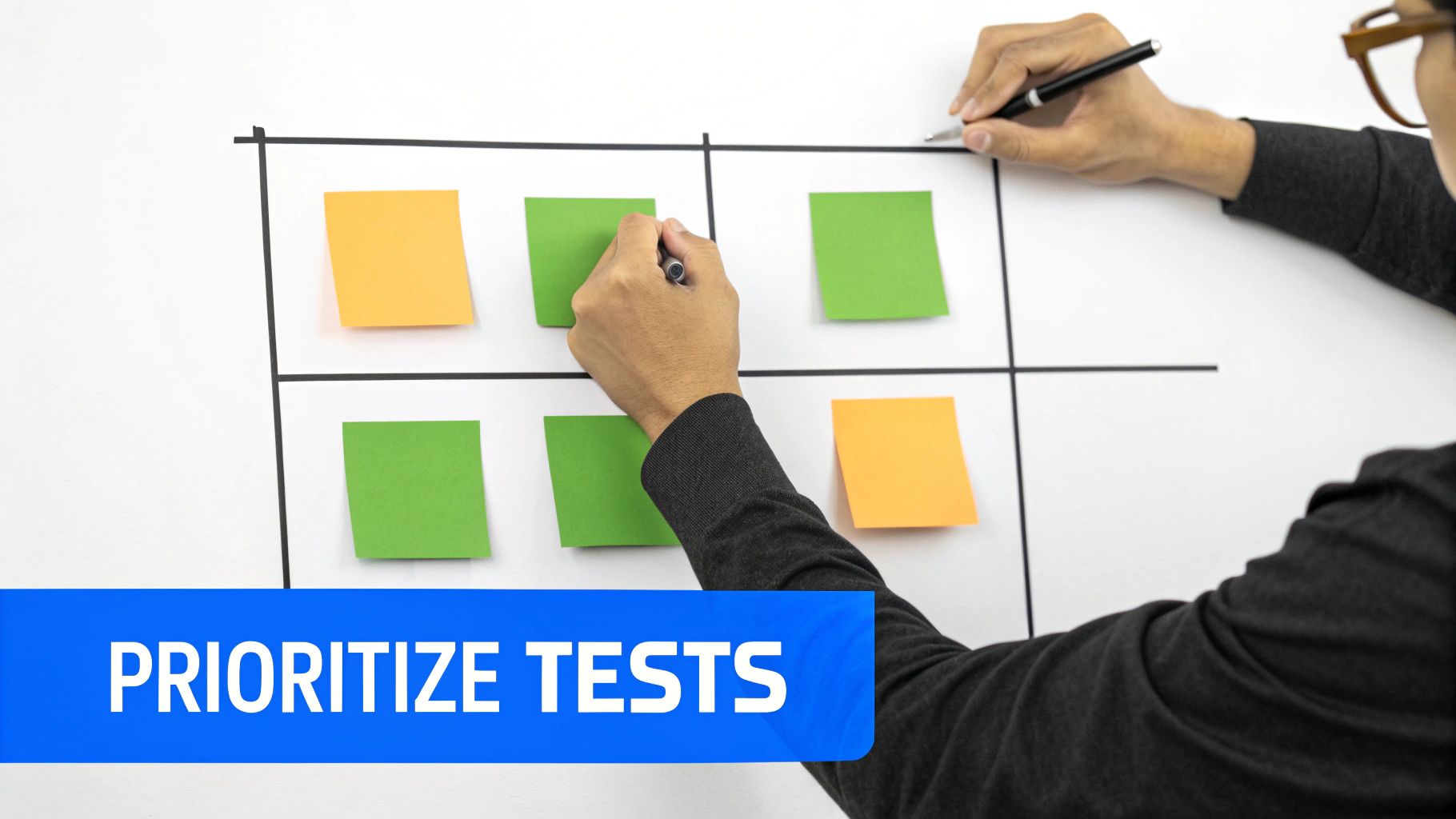
Instead of just going with your gut, smart DTC brands use simple scoring frameworks to bring some much-needed objectivity to their testing roadmap. Two of the most popular and practical frameworks are PIE and ICE. They’re great because they force you to think critically about each idea beyond just the potential upside.
The PIE Framework (Potential, Importance, Ease): This model asks you to score each hypothesis from 1 to 10 across three key dimensions.
- Potential: How much room for improvement is there on this page?
- Importance: How valuable is the traffic here? A test on your checkout page (high-value traffic) is way more important than one on your 'About Us' page.
- Ease: How quickly and cheaply can this test actually get built?
The ICE Framework (Impact, Confidence, Ease): This is a slight variation that’s become my personal favorite. It swaps a couple of factors for a different lens.
- Impact: If this test is a winner, how big of a deal will it be for our main goal (like revenue or AOV)?
- Confidence: How sure are you this will actually work? Is it backed by solid data or just a hunch?
- Ease: How simple is it to build and launch?
Once you’ve scored each idea, you just average the scores. The hypotheses with the highest numbers float to the top of your testing queue. This simple process immediately brings clarity to your roadmap, helping you lock in a few quick wins that build momentum and help fund the more ambitious experiments down the line.
Supercharging Prioritization with Predictive Analytics
These frameworks are incredibly useful, but let’s be honest—they still rely heavily on your team’s subjective scoring for "Impact" and "Confidence." What if you could add a layer of machine intelligence to that decision?
Aquí es donde the next generation of AI-powered analytics is changing the game for Shopify stores.
Prioritization is the strategic lever that turns a list of ideas into a revenue-generating machine. It ensures your most limited resource—time—is always focused on the experiments most likely to move the needle.
Imagine a tool like MetricMosaic that doesn’t just show you data but actively helps you decide what to do next. By analyzing your store's unique performance data and benchmarking it against patterns from thousands of other successful DTC brands, it can offer predictive insights into which optimization ideas are most likely to work for your business.
Por ejemplo, the platform might see your low add-to-cart rate on mobile and suggest that a test focusing on your image gallery has a 75% higher probability of success than changing the button color. This is the future of conversion optimization—moving from educated guesses to intelligent, data-driven prioritization.
It turns your CRO program from a manual, gut-feel effort into a guided growth strategy, ensuring you're always working on the highest-impact tests first.
Running Experiments That Deliver Clear Answers
This is the fun part—where your strategy moves from a document into the real world. You’ve pinpointed your store's leaks, developed some solid, data-backed hypotheses, and built a prioritized roadmap. Now it’s time to actually launch the experiments that will give you the answers you need to grow.
For a lot of Shopify founders, the idea of running A/B tests feels a little intimidating. It brings up images of complex statistical models and maybe even needing a data science degree. The reality, though, is that modern tools have made it incredibly accessible for any DTC brand to run a powerful testing program.
The goal is simple: get a clear, confident answer to the question your hypothesis posed.
Designing a Clean and Fair Test
A successful experiment always starts with a clean setup. The most common method is an A/B test, sometimes called a split test. You show one version of a page (the control, 'A') to a portion of your audience and a modified version (the variant, 'B') to another. Then you just measure which version was better at achieving your primary goal, whether that's a higher add-to-cart rate, more email signups, or, of course, more sales.
To make it a fair fight between your control and variant, you have to nail a few basics to maintain data integrity:
- Randomized Traffic: Your testing tool absolutely must assign visitors randomly to each version. This is non-negotiable for preventing bias.
- Sufficient Duration: Don't call a test the second a variant pulls ahead. You need to run it long enough to account for different shopping behaviors—think weekdays versus weekends. A good rule of thumb is at least two full weeks.
- Statistical Significance: This sounds super technical, but the concept is simple. It’s just a measure of confidence that your result isn't a random fluke. Most tools aim for a 95% confidence level before declaring a winner.
Avoiding these common pitfalls is everything. Ending a test too early or misreading random swings in data can trick you into rolling out a "winner" that actually hurts your conversion rate in the long run.
From Raw Data to a Clear Story
Aquí es donde the real leap forward is happening for Shopify brands. In the past, analyzing test results meant exporting raw data and trying to make sense of it all yourself. It was a headache. Now, AI-powered analytics platforms can do the heavy lifting for you.
Instead of just spitting out "Variant B won," a tool like MetricMosaic translates that result into a clear, story-driven report. It actually connects the dots from the change you made directly to its impact on your bottom line.
Example of an AI-Powered Insight: "Your test on the product page was a success. By adding video testimonials (Variant B), you increased the add-to-cart rate by 14% with 98% statistical significance. This change is projected to generate an additional $4,500 in revenue per month."
This is the difference between having data and having a decision. It moves you from asking "what happened?" to knowing "what should we do next?" without you needing to become a part-time analyst. It turns your CRO strategy from a complex technical chore into a straightforward business-growth engine.
Learning from Every Outcome
Here’s a secret: not every test will be a winner, and that’s perfectly okay. De hecho, it’s a crucial part of the process. An experiment that "fails" to beat the control isn't a failure at all; it's a valuable learning opportunity that helps you understand your customers on a deeper level.
When a test doesn't produce an uplift, ask yourself a few questions:
- Did this result completely invalidate the core assumption of my hypothesis?
- Was the change I tested big enough to actually impact user behavior?
- What does this tell me about what my customers really want or worry about?
Por ejemplo, let's say a test simplifying your checkout form didn't improve conversions. That might tell you that form length isn't the main point of friction after all. Maybe the real issue is a lack of trust signals or that your shipping costs aren't clear enough. This "losing" test just saved you from investing more time in the wrong area and pointed you toward a much better hypothesis for your next experiment.
Whether you roll out a winning change or learn from a losing one, every single experiment makes your conversion optimization strategy smarter. It builds a powerful, continuous loop of improvement that will fuel sustainable growth for your Shopify brand.
Common Questions About Shopify Conversion Optimization
Even with a solid framework, building a real conversion optimization strategy can bring up a lot of questions. As a Shopify founder, you’re constantly juggling growth projects with the day-to-day grind of running the business.
Let’s dig into some of the most common hurdles we see DTC brands hit when they start getting serious about CRO. Aquí es donde the right mindset—and the right tools—can help you break through analysis paralysis and find a steady rhythm of testing, learning, and growing.
What Is a Good Conversion Rate for a Shopify Store?
This is, hands down, the most common question I get. The honest answer? It's way more nuanced than you'd think. You'll hear benchmarks like 2-3% thrown around, but a "good" conversion rate is totally unique to your brand, your price point, and your audience.
Things like your average order value (AOV), traffic sources, and niche play a huge part. For instance, a high-ticket furniture store could be wildly profitable with a 0.5% conversion rate. Mientras tanto, a fast-moving cosmetics brand might need to clear 4% just to keep the lights on.
Instead of obsessing over a universal number, your real goal should be to create your own upward trend. A better question to ask is, "Is my conversion rate improving month-over-month?" A great CRO strategy is all about continuous, incremental improvement, not hitting some arbitrary target. Aquí es donde AI analytics can give you a huge leg up by benchmarking your performance against a cohort of similar stores, giving you a much more relevant and actionable target to aim for.
How Long Should I Run an A/B Test on Shopify?
The ideal duration for any A/B test comes down to two things: your store's traffic volume and the expected impact of the change you're making. The main objective is always to reach statistical significance—a fancy way of saying you can trust that your results are real and not just a random fluke.
For most small-to-mid-size Shopify stores, this usually means running an experiment for at least two full weeks. That timeframe is critical because it helps smooth out any weird shopping behavior that pops up on weekdays versus weekends. A high-traffic store might get a statistically significant answer in just a few days, but a smaller, more niche brand might need to let a test run for a full month to collect enough data.
The single biggest mistake founders make is calling a test the moment one version pulls ahead. Let the data mature. Use an A/B test calculator or a platform with built-in significance tracking to tell you when the experiment is officially done.
Can I Do CRO Without a Big Budget or Dedicated Team?
Absolutely. De hecho, this is where a smart conversion optimization strategy paired with modern tools gives smaller DTC brands a serious advantage over larger, slower-moving incumbents. You don’t need a data scientist on payroll to make huge improvements to your store.
The trick is to start with a focused approach. Use the insights from your initial data audit to zero in on the highest-impact spots on your site—which is almost always your product pages, cart, and checkout flow. From there, you can use Shopify apps or third-party platforms with user-friendly visual editors to launch simple but powerful tests.
Think about experiments you can build without a developer:
- Rewriting a headline to be more benefit-driven.
- Testing a different primary product image.
- Changing the text on your "Add to Cart" button.
- Placing a trust badge or customer testimonial near a key decision point.
The real game-changer here is using AI-driven analytics platforms that do the heavy lifting for you. These tools simplify the complicated parts of CRO—like funnel analysis and figuring out what to test next—and turn your store's data into clear, actionable insights. This empowers a founder or a small marketing team to run a powerful optimization program that drives real revenue growth, no massive budget required.
Ready to stop guessing and start growing? MetricMosaic is the AI-powered growth co-pilot for Shopify that turns your complex store data into clear, actionable revenue opportunities. Unify your analytics, get predictive insights, and build a winning conversion optimization strategy faster. Start your free trial today.