What is Market Basket Analysis? A Shopify Founder's Guide to Unlocking Hidden Revenue
What is market basket analysis? Learn how this AI-powered technique uncovers hidden revenue in your Shopify data to boost AOV, LTV, and customer loyalty.

You're a Shopify founder, which means you're swimming in data. Shopify Analytics, Google Analytics, Klaviyo reports, Meta Ads dashboards... the numbers are everywhere. But when you try to connect them, you're left with more questions than answers. You feel like customers who buy your best-selling serum also buy the matching face wash, but it's just a hunch. You're making critical decisions about bundles and cross-sells based on guesswork.
This feeling of fragmented data and unclear ROI is the invisible ceiling holding back so many DTC brands. You have the raw materials for growth, but the actual insights are buried in spreadsheets. This is where market basket analysis, powered by AI, changes the game.
It's a data science technique that answers a simple, powerful question: “What products do my customers buy together?” For a Shopify brand, the answer isn't just interesting—it's a direct roadmap to increasing Average Order Value (AOV), boosting profitability, and creating marketing that actually connects.
Your Shopify Data Is Hiding Untapped Revenue
If you run a Shopify store, you know the feeling. You’re drowning in data from Shopify Analytics, Google Analytics, and a half-dozen marketing apps. You’ve got the numbers, but finding the actual story in all those spreadsheets feels impossible.
The real insights—the why behind your customers' purchases—are buried. You have a hunch that people who buy your best-selling face cream also buy the nighttime serum, but you're just guessing.
This guesswork is the difference between a brand that's just getting by and one that's scaling profitably. And this is exactly where market basket analysis comes in, simplified by AI to turn that complexity into clarity.
From Guesswork to a Growth Strategy
Forget the academic jargon. Think of market basket analysis as a way to listen to what your customers are already telling you with their wallets. It’s about spotting the hidden connections between products to find new ways to grow your AOV and LTV.
For a busy founder, this means you can finally move past basic sales reports and answer the questions that really matter:
- Which items are almost always bought together? This is your roadmap for creating no-brainer cross-sells on product pages and in the cart.
- What are the unexpected pairings? Maybe your customers who buy dog leashes also love a specific type of coffee mug. That’s a unique bundle opportunity your competitors would never think of.
- How do we actually increase Average Order Value (AOV)? By seeing these patterns, you can design your store and your promotions to naturally guide customers toward a bigger cart.
For a modern DTC brand, market basket analysis turns your sales history into a crystal ball. You can anticipate what your customers need next, create an experience that feels made for them, and build a more profitable store, one order at a time.
Ultimately, this isn't about adding more complexity; it's about finding clarity. Instead of swimming in spreadsheets, you get a clear plan for boosting AOV and making your marketing dollars work harder. It's the first step to unlocking the powerful stories your store’s data is waiting to tell.
Understanding Market Basket Analysis in Plain English
So, what exactly is market basket analysis?
Forget the data science jargon for a second. Think of yourself as a detective for your own Shopify store. You're not just glancing at total sales; you're meticulously examining every single shopping cart that checks out, looking for clues and patterns in how people actually shop.
When you do this at scale, you uncover powerful insights. It's the difference between knowing what products are popular and understanding how they sell together. This isn't some new fad; it's a classic retail strategy that's been around for decades. Its use really took off in the 1990s with the boom in electronic sales data. An early study of 1.2 million supermarket transactions found that over 15% of them contained items that were frequently bought together, exposing massive cross-sell opportunities that were previously invisible. You can read more about the history of market basket analysis on TechTarget.com.
This whole process is about turning your raw Shopify data—a chaotic stream of orders—into a clear roadmap for growth.
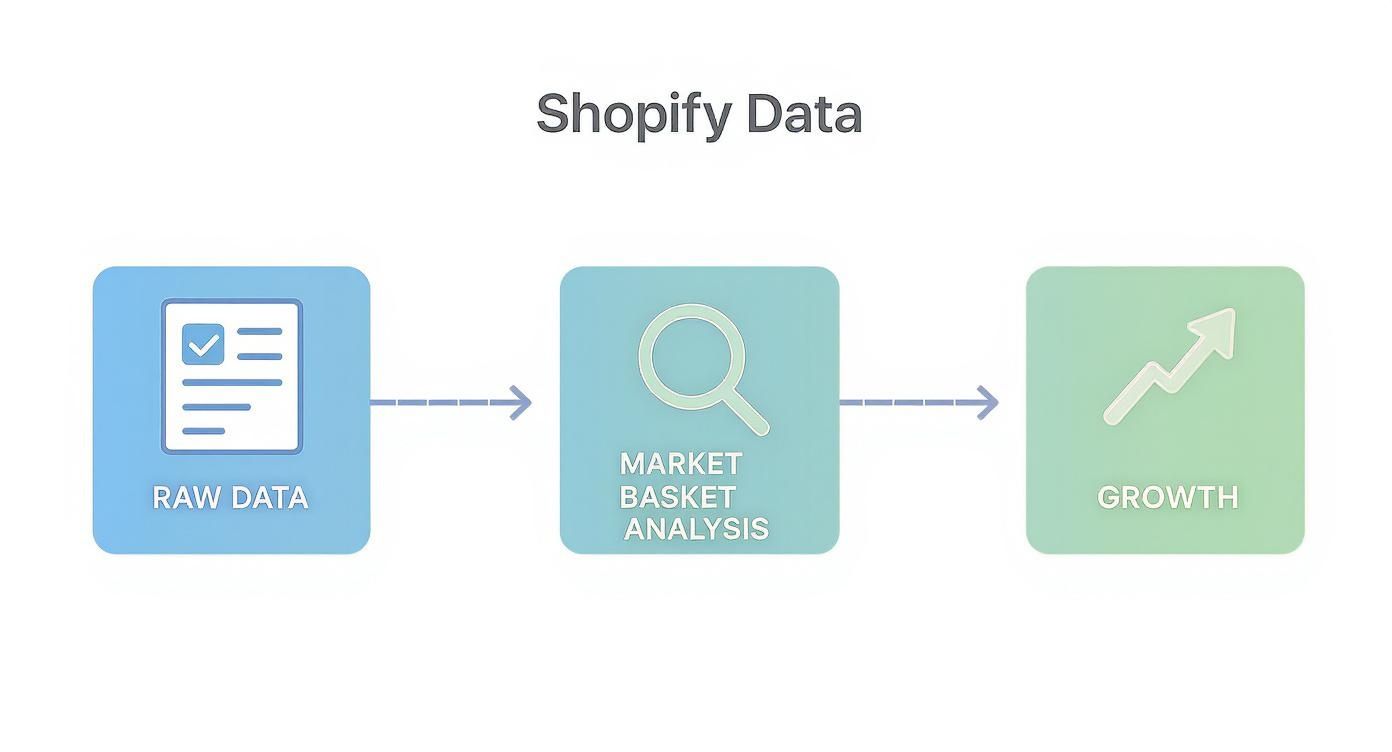
The workflow is simple: raw data goes in, hidden patterns are uncovered, and you get direct fuel for growth strategies like smarter bundles and personalized marketing.
The Three Core Metrics Demystified
To really get what your data is telling you, you only need to understand three key ideas. Not too long ago, calculating these required a data scientist and a lot of manual data crunching. Today, modern AI-powered analytics tools automate this, translating complex stats into simple, actionable insights.
Let’s use a DTC skincare brand as our running example.
Here’s a quick reference table to break down the key metrics you'll encounter.
| Market Basket Analysis Metrics Explained |
| :--- | :--- | :--- |
| Metric | What It Measures | Example for a DTC Skincare Brand |
| Support | The overall popularity of a product pairing across all orders. | Vitamin C Serum and Hydrating Sunscreen appear together in 50 out of 1,000 orders. Their support is 5%. |
| Confidence | The likelihood of someone buying Product B if they've already bought Product A. | 100 people bought the serum; 50 of them also bought the sunscreen. The confidence is 50%. |
| Lift | How much more likely a pair is bought together than by random chance. | Customers who buy your Charcoal Face Mask are 4x more likely to also buy a Silk Pillowcase. The lift is 4.0. |
These metrics work together to give you a full picture, moving from general popularity to specific, predictive relationships.
1. Support: How Popular Is a Product Pairing?
Support is the most straightforward metric. It simply tells you how often a specific combination of items shows up in all your transactions. Think of it as a popularity contest for your product pairs.
If your Vitamin C Serum and Hydrating Sunscreen are found together in 50 out of 1,000 total orders, the support for that pairing is 5%. A high support value is a great starting point—it means the pairing is common enough to be a reliable candidate for a bundle or a "Frequently Bought Together" section.
2. Confidence: If They Buy This, Will They Buy That?
Confidence gets a bit more predictive. It answers a crucial question: "Of all the customers who bought Product A, what percentage also bought Product B?"
Let’s stick with our example. If 100 people bought the Vitamin C Serum, and 50 of them also snagged the Hydrating Sunscreen, the confidence of Serum → Sunscreen is a solid 50%. That’s a strong signal. It gives you the... well, confidence... to recommend the sunscreen to anyone who adds the serum to their cart, knowing there's a good chance they'll bite.
3. Lift: Uncovering the Surprise Connections
This is where the real magic happens. Lift tells you how much more likely two products are to be purchased together than if it were just random chance. A lift value greater than 1.0 means there's a real, non-random relationship there.
Lift is your secret weapon for finding non-obvious growth opportunities. High confidence might tell you that people who buy shampoo also buy conditioner (no surprise there). But high lift might reveal that customers who buy your Charcoal Face Mask are suddenly 4x more likely to also buy a specific Silk Pillowcase.
Now that's an insight. It’s an unexpected connection you would never find just by guessing. This opens the door to a unique "self-care" bundle or a hyper-targeted email campaign that your competitors haven't even thought of. AI is particularly good at digging through mountains of data to find these hidden high-lift gems.
By automating the analysis of Support, Confidence, and Lift, next-gen tools like MetricMosaic let you skip the number-crunching and jump straight to making strategic decisions. You get to focus on what you do best: growing your brand.
Turning Insights into Action: Four Proven Growth Strategies
Knowing the theory behind Support, Confidence, and Lift is one thing. Actually using it to grow your Shopify store? That’s what matters. The patterns you find aren't just cool data points; they're a direct roadmap to smarter decisions that will boost your key metrics like AOV, Customer Acquisition Cost (CAC), and LTV.

For a busy Shopify founder, this is about putting data-backed strategies to work that have a direct impact on your bottom line and profitability. Below are four battle-tested tactics DTC brands can roll out immediately to turn these insights into real growth.
1. Build Smarter Cross-Sells and Upsells
The most obvious win from market basket analysis is a massive upgrade to your cross-sell and upsell game. You can stop showing those generic "You might also like" carousels and start populating them with products your data proves people actually buy together.
Let's say your analysis flags a high Confidence score for "Espresso Blend Coffee Beans → Milk Frother." That's a huge signal. It's your green light to:
- Add a dynamic cross-sell: On the Espresso Blend product page, add a "Complete Your Setup" section that prominently features the Milk Frother.
- Create an in-cart offer: When someone adds the coffee beans to their cart, hit them with a pop-up or a banner with a one-click offer to add the frother.
This isn’t pushy. Because it’s backed by real customer behavior, it feels more like a helpful suggestion than a hard sell, which is why it converts so much better. You’re meeting customers where they are and solving their next problem before they even have to think about it.
2. Create High-Converting Product Bundles
Bundling isn't just a way to move old inventory. It's one of the most effective levers you can pull to increase your Average Order Value (AOV). Market basket analysis removes the guesswork and tells you exactly which products to package together for maximum appeal. You’re basically creating offers that feel like a no-brainer to your customers.
Imagine your data uncovers a high Lift value between your "Weekend Duffel Bag" and a "Leather Passport Holder." That connection might not be obvious at first glance, but the data shows it's a real, non-random pattern. Boom. You've got your next bundle: "The Traveler's Essentials Kit."
By bundling items that your customers are already buying together, you remove friction. You're not trying to convince them of a new need; you're simply packaging a solution they’ve already validated with their own buying habits.
Price the bundle with a small discount—say, 10% off the combined price—to make it even more compelling. This not only pushes up AOV but also improves your retention by making your products feel more valuable.
3. Personalize Email and SMS Campaigns
Generic marketing blasts are dead. Your market basket data is a goldmine for creating hyper-targeted email and SMS campaigns that people actually want to open. You can segment your audience based on what they've bought before and send them offers that just click, improving both retention and LTV.
Think about how powerful these tactics are:
- Post-Purchase Follow-ups: A customer just bought your best-selling "Performance Running Shorts." Your data shows a strong link to your "Moisture-Wicking Socks." A week later, you send them a targeted email: "Loving the shorts? Complete your run with the socks our customers swear by."
- Smarter Replenishment Reminders: A subscriber is about to get their next shipment of "Daily Face Moisturizer." You can slip a targeted cross-sell right into the reminder email: "Time to restock your moisturizer! P.S. Did you know most people who love it also buy our Gentle Face Cleanser?"
This kind of personalization shows you get your customers. It builds a real relationship that directly improves LTV, turning your marketing from a generic megaphone into a helpful, one-on-one conversation.
4. Optimize Store Layout and Merchandising
Finally, you can use these insights to strategically design your entire online store. It's the digital version of a supermarket putting the milk at the back of the store to make you walk past everything else. You can arrange your Shopify collections, navigation, and homepage to naturally guide shoppers toward related products.
If your analysis shows that "Yoga Mats" and "Meditation Cushions" are almost always bought together, you can optimize your digital merchandising right away:
- Create a "Mindfulness" Collection: Group these products and other related items into one easy-to-find collection right in your main navigation.
- Feature it on your homepage: Build a "Shop the Look" or "Build Your At-Home Studio" section on your homepage that showcases the yoga mat and cushion together.
This simple logic guides the customer journey, making it incredibly easy for them to find products they were probably going to look for anyway. By cutting down the clicks needed to find complementary items, you make the whole experience smoother and dramatically increase the odds of a bigger, more profitable order.
How to Implement Market Basket Analysis for Your Store
For a busy Shopify founder, knowing what market basket analysis is only gets you halfway. The real question is how you can actually put it to work without getting lost in a technical rabbit hole.
For years, this kind of analysis was a massive time sink, something only brands with dedicated data teams could even attempt.

The old way was painful. It was slow. And frankly, it worked against the very agility that makes a DTC brand successful in the first place. It was a barrier, keeping powerful insights locked away behind a wall of complexity.
The Old Way: A Manual Grind
Until recently, running a market basket analysis on your own meant diving headfirst into a brutal, multi-step process that no founder has time for. This approach wasn’t just tedious; it was full of potential errors and became stale the moment you finally finished it.
The typical manual workflow was a nightmare. It looked something like this:
- Export Your Data: First, you’d pull massive CSV files of your transaction history straight from your Shopify admin. Fun.
- Clean and Format: Then came the spreadsheet chaos. You’d burn hours cleaning up the data, deleting useless columns, and wrestling it into a format a script could even read.
- Run Complex Scripts: Finally, you or a developer would have to write and run code using Python or R. This meant installing special libraries and having a deep understanding of algorithms like Apriori or FP-Growth just to crunch the numbers.
- Interpret the Results: If the script even ran correctly, you were left with a static report—just a wall of raw numbers for Support, Confidence, and Lift. You were still a huge step away from a clear, actionable strategy.
For a fast-moving brand, this method is a complete non-starter. It’s too slow, too complicated, and demands a skill set far outside the core job of building a great product and brand. By the time you found an insight, your customers had already moved on.
The New Way: AI-Powered Analytics
Fortunately, the game has completely changed. Modern, AI-powered analytics platforms are built to kill this friction entirely. Instead of you working for the data, the data finally works for you. These tools are designed specifically for the needs of Shopify and DTC brands.
This new approach automates the entire process, turning what was once a week-long data project into a few minutes of discovery.
Here’s how it works:
- Seamless Integration: An AI analytics tool like MetricMosaic plugs directly into your Shopify store and other key data sources (like Klaviyo or Meta Ads) with a few clicks. No more downloading or cleaning CSVs. Ever.
- Automated Analysis: The platform automatically pulls in and analyzes millions of transactions in near real-time. It runs the heavy-lifting algorithms constantly in the background, so your insights are always fresh.
- Story-Driven Insights: This is the most critical difference. Instead of dumping a spreadsheet on you, AI-powered tools deliver a clear narrative. They don’t just show you the numbers; they tell you the story behind them.
AI transforms your raw transaction data from a messy puzzle into a clear story about your customers. It surfaces proactive, predictive insights, like "Customers who buy your 'Performance Tee' are 5x more likely to also buy 'Compression Socks.' Consider bundling them for a 15% AOV lift."
This is a fundamental shift. It empowers you to skip the tedious data-crunching and jump straight to making smarter decisions. You can now use next-gen trends like conversational analytics to simply ask questions in plain English—like "What are the most common product pairings this month?"—and get an instant, visual answer.
The focus moves from data prep to data-driven action, giving you the edge you need to grow faster and smarter.
Common Pitfalls to Avoid and Success Metrics to Track
Knowing how to use market basket analysis is one thing. Knowing what not to do is just as important. I’ve seen countless DTC brands get fired up about the potential here, only to stumble into a few common traps that completely derail their efforts.
The biggest mistake? Focusing only on the obvious pairings.
Sure, your data will confirm that people who buy shampoo also buy conditioner. Great. But that’s not an insight; it’s a given. The real gold is buried in the non-obvious connections with a high Lift—those weirdly brilliant pairings that your competitors would never think of. Ignoring them is just leaving AOV on the table.
Another classic blunder is mistaking correlation for causation. Just because two items are frequently bought together doesn't mean one causes the other to be purchased. Maybe it’s a seasonal trend, the result of a recent ad campaign, or just pure coincidence. It's on you to apply some common sense and test your theories before you blow up your merchandising strategy based on a statistical fluke.
The goal isn't just to find patterns. It's to find profitable patterns you can reliably act on. Sidestep these pitfalls, and you'll be building your strategy on solid ground, not just statistical noise.
Measuring What Matters Most
Market basket analysis isn't an academic exercise—it's an engine for real financial results. To make sure your work is actually paying off, you need to be tracking the right Key Performance Indicators (KPIs). Instead of getting lost in a sea of metrics, just focus on the ones that tie directly back to your bottom line and overall profitability.
For your Shopify store, here’s what you should be watching like a hawk:
- Average Order Value (AOV): This is the most direct signal you have. If your bundles, cross-sells, and recommendations are hitting the mark, your AOV should be climbing.
- Items Per Order: A rising AOV is good, but is it just because you hiked prices? Or are people actually buying more stuff? This metric tells you if your strategies are truly encouraging bigger baskets.
- Conversion Rate on Recommendations: Are people actually clicking on and buying the products you're putting in front of them? Keep an eye on the conversion rate for your "Frequently Bought Together" widgets or personalized emails to see what's actually working.
- Customer Lifetime Value (LTV): Smart recommendations don't just pump up a single sale; they create a better customer experience that builds loyalty. If your LTV is on the rise, you know your personalized approach is turning one-time buyers into repeat fans.
This kind of analysis has huge implications outside of retail, too. The financial industry, for example, uses it to sniff out fraud. One study looked at 10 million credit card transactions and found a fascinating pattern: fraudulent purchases often paired high-value electronics with gift cards. This combo showed up in just 0.5% of legitimate orders but a whopping 12% of fraudulent ones. By flagging those patterns, the company cut its fraud losses by $45 million. If you want to dive deeper, you can explore the uses of market basket analysis on Turing.com.
By focusing on these core KPIs, you connect your data insights directly to business outcomes. It’s how you prove the ROI of your work and carve out a clear path to profitable growth.
From Data Overload to Competitive Advantage
Your Shopify store data is your single greatest asset for smart, sustainable growth. For most founders, though, it feels more like a flood of disconnected spreadsheets and confusing reports. The problem isn't a lack of data; it's the challenge of turning all that complexity into a clear, actionable strategy.
Market basket analysis is the bridge that gets you from data overload to a real competitive edge. It's what takes a DTC brand from making reactive, gut-feel decisions to building a proactive, data-driven growth plan.
Stop Guessing What Customers Want
The truth is, you don't need to become a data scientist to find powerful insights. The old, manual methods of crunching numbers are being replaced by a much smarter, automated approach. Modern AI-powered analytics tools do the heavy lifting for you, turning millions of individual transactions into a clear story about what your customers actually do.
Instead of wrestling with CSV files and pivot tables, you can get straight to the answers you need.
- What are my top cross-sell opportunities this month to improve ROAS?
- Which products should I bundle to maximize AOV and profitability?
- How can I personalize post-purchase flows to increase LTV and retention?
You already have all the answers you need to grow faster. They are locked inside your sales data, just waiting to be discovered. AI-powered analytics is the key that unlocks them.
It’s time to stop guessing what your customers want and start listening to the story their data is already telling you. By adopting an automated, story-driven approach to analytics, you can turn your everyday store data into your most powerful tool for building a more profitable and resilient brand. The insights are right there—you just need the right way to see them.
A Few Common Questions
Even with a solid plan, a few practical questions always pop up when Shopify founders start digging into market basket analysis. Here are the ones we hear the most.
Isn't This Super Expensive to Set Up?
It definitely used to be. The old way meant hiring data scientists or signing a massive check for enterprise software. That’s not the world we live in anymore.
Today, AI-powered analytics platforms have made this kind of analysis totally accessible for DTC brands. Modern tools plug right into your Shopify store and automate the heavy lifting for a simple monthly fee. You get a clear return on investment (ROI) without needing a dedicated data team.
How Much Data Do I Actually Need?
More data is always nice, but you don't need millions of orders to find gold. Most Shopify stores with a decent sales history—even just a few thousand transactions—have enough information to start seeing real patterns.
AI tools are especially good at finding statistically significant connections in smaller datasets. You can start finding actionable insights almost immediately.
What’s the Difference Between This and Customer Clustering?
Great question. They sound similar but solve for different things.
Clustering is about grouping similar customers. It lumps people together based on shared behaviors or traits, creating segments like "high-LTV weekend shoppers" or "first-time discount buyers."
Market basket analysis, on the other hand, focuses on the relationships between products. It doesn't care who bought them, just that they were frequently bought together.
Here’s the simple way to think about it:
- Clustering tells you who your people are.
- Market Basket Analysis tells you what those people buy together.
Both are incredibly powerful, but they answer completely different strategic questions.
Ready to stop guessing and start seeing the hidden stories in your sales data? MetricMosaic connects to your Shopify store in minutes, using AI to turn your raw data into clear, actionable growth strategies.
Start your free trial of MetricMosaic and uncover your first profitable product bundle today.