What is GMV? A Founder's Guide to Shopify's True North Metric
Curious what is gmv and how it fuels growth? This guide breaks down the GMV formula, how it differs from revenue, and steps to boost it profitably.

If you’re running a Shopify store, you’re practically swimming in data. You check the dashboards, you track your sales, you analyze every campaign. But somewhere in that flood of numbers, a nagging question pops up: "Are these the right numbers? Are we actually growing?"
Maybe you've seen revenue climb, but profitability feels flat. Or you're spending more on ads, but you can't clearly connect the spend to real top-line growth. It's a classic problem for DTC brands. The sheer volume of fragmented data can hide the real story of your business's health, making it impossible to know which levers to pull.
The issue often starts with focusing on metrics that don't give you the full picture. You might obsess over revenue, but that number already has discounts and refunds stripped out, masking critical details about what your customers are really doing.
This is where Gross Merchandise Volume (GMV) comes in. For a DTC founder, it’s your true North Star.
Your True North Star Metric
Think of GMV as the purest, most unfiltered measure of your store's sales activity. It’s the total top-line demand for your products before anything gets taken out—no deductions, no fees, no returns.
For any DTC brand, especially on a platform like Shopify, GMV gives you that essential high-level view of your market traction and the sheer scale of your operation.

This single metric is a massive indicator of economic activity. To put it in perspective, the top 10 eCommerce giants generated a combined GMV of around $3.5 trillion in 2022. That figure alone shows you the immense scale this metric reflects. If you want to go deeper, you can explore more eCommerce statistics to see the full picture.
By starting with GMV, you can finally answer some of your most critical questions with real clarity:
- Is demand for our products actually growing? GMV gives you a clean, unadjusted look at how much customers are willing to spend.
- What was the true impact of our last marketing campaign? It measures the total value of all transactions generated, giving you an immediate signal on campaign effectiveness before returns start muddying the waters.
- How does our sales volume compare season over season? GMV provides a consistent, apples-to-apples basis for comparing performance over time.
GMV isn’t just another number to add to your spreadsheet. It’s the foundational metric that gives all your other data context. It’s the big picture that helps you see the forest, not just the trees.
Moving from a mess of fragmented reports to a clear understanding of GMV is the first real step toward making smarter, data-driven decisions. Instead of getting lost in manual data crunching, AI-powered analytics can help you turn this one metric into actionable growth strategies, finally converting all that data confusion into decisive action.
Explaining GMV for Shopify Founders
So, what exactly is GMV? Let's cut through the jargon. In plain English, Gross Merchandise Volume is the total dollar value of every single product sold through your store over a specific time frame. It’s the raw, unfiltered number that shows you the total customer demand for what you're selling.
Think about a customer's shopping cart. They've added a few of your products, and the subtotal hits $120. That $120 is the GMV for that single order. It's the number before they punch in that "WELCOME15" discount code, before shipping is added, and before any sales tax is tacked on.
This makes it the purest measure of your store's top-line performance and how much traction you have in the market.

The Simple GMV Formula
The calculation itself is refreshingly straightforward. You don’t need to wrestle with complex spreadsheets, and modern AI-powered analytics platforms like MetricMosaic can track this for you in real-time. Still, every DTC operator should know the basic formula.
It's simply:
GMV = (Number of Products Sold) x (Average Price of Products)
Let’s make this real with a quick example from a hypothetical Shopify store.
A Practical Shopify Example
Imagine your DTC brand, "Glow Skincare," just wrapped up a solid month. You dive into your sales data and see:
- Hydrating Serums Sold: 200 units at $50 each
- Vitamin C Creams Sold: 150 units at $60 each
To get your GMV for the month, you just do the math:
- Serum GMV: 200 units * $50/unit = $10,000
- Cream GMV: 150 units * $60/unit = $9,000
- Total Monthly GMV: $10,000 + $9,000 = $19,000
Your total GMV is $19,000. That number tells a simple, powerful story: your customers wanted to buy $19,000 worth of your products. It's a clean indicator of sales volume before any other business costs muddy the waters.
Why GMV Isn't the Same as Revenue (And Why It Matters)
This is where many founders get tripped up. GMV measures the total value of transactions, not the cash that hits your bank account. Metrics like revenue and profit are calculated after GMV, once you start subtracting things like discounts, returns, and all your operating costs.
Understanding this is the first step toward accurately gauging your store’s health. It’s the difference between seeing how much customers wanted to buy versus how much money you actually collected.
To clear things up, here’s a simple breakdown of how GMV stacks up against other key metrics.
GMV vs Revenue vs Profit A Clear Breakdown
This table contrasts GMV with other critical financial metrics to eliminate confusion and highlight their distinct roles in business analysis.
| Metric | What It Measures | What It Excludes | Why It Matters for a Shopify Store |
|---|---|---|---|
| GMV | The total gross value of all goods sold before any deductions. | Discounts, returns, shipping fees, taxes, and cost of goods sold (COGS). | Shows raw customer demand and market traction. It’s a pure signal of your brand's growth and scale. |
| Revenue | The actual income your business generates from sales after immediate deductions. | Shipping fees, taxes, and operating expenses like marketing or salaries. | Reflects the money you actually collect from sales after discounts and returns. It’s a more realistic measure of income. |
| Profit | The final amount of money left after all business expenses have been paid. | Nothing. It's the bottom line after all costs are subtracted. | The ultimate measure of your business’s financial health and sustainability. Can you actually make money? |
Seeing these metrics side-by-side makes the picture much clearer. GMV is your starting point—a measure of scale and desire. Revenue is what you bring in. And profit is what you keep.
This clarity helps you isolate the impact of your marketing and product strategy. Is your GMV climbing but your revenue is flat? You might be leaning too heavily on discounts that are killing your margins. On the flip side, a healthy, growing GMV is the first real sign that your brand is resonating with your audience. It’s the foundational metric that sets the stage for a much deeper analysis of your brand's financial health.
Alright, we've covered the what. Now let's get into the why—why Gross Merchandise Volume is such a fundamental metric for your brand's health.
Think of GMV as your store’s pulse. A strong, steady, and growing GMV sends a powerful signal that your brand is healthy, desirable, and has nailed its product-market fit. It’s the leading indicator that shows you the vitality of your entire operation long before the final profit numbers are tallied.
While profit is always the end game, GMV tells you if you're even on the right path to get there.
The Ultimate Test of Market Demand
At its heart, GMV is the purest, most unfiltered measure of market demand for what you sell. It cuts through all the noise—discounts, shipping fees, operational costs—to answer one simple question: Are people excited to buy your stuff?
A consistently climbing GMV is proof that your brand is resonating with your audience. This is exactly the kind of top-line traction that potential investors, partners, and even acquirers look for first. It’s hard evidence that you’ve built something people genuinely want.
For a DTC founder, GMV is your most immediate feedback loop from the market. It tells you the story of your brand's desirability before the complexities of finance and operations even enter the picture.
A Real-Time Barometer for Marketing Impact
One of the best practical uses for GMV is tracking the immediate impact of your marketing. Wondering if that new Meta ad campaign or Klaviyo flow is actually driving sales? A corresponding spike in GMV gives you a clear, almost instant answer.
Think about it in these real-world scenarios:
- Flash Sale: You run a 24-hour sale. Watching GMV hour-by-hour tells you exactly when the campaign caught fire and what its total sales-generating power was.
- Influencer Collab: An influencer posts about your product. The immediate lift in GMV shows you if their audience is actually converting, helping you quickly size up the initial ROI of that partnership.
- New Product Launch: On launch day, GMV is the number you’re glued to. It quantifies the hype and initial demand you’ve built, giving you a clear verdict on the launch's success.
This rapid feedback lets you be far more agile. Instead of waiting weeks for reconciled revenue reports, you can make faster, smarter decisions about where to put your marketing dollars next.
Your Role in the Broader DTC Ecosystem
For anyone selling on Shopify, your store's GMV is also a piece of a much bigger story. It reflects your contribution to the platform's massive ecosystem. Shopify's success is built on the collective success of its merchants, and its own reported GMV is a key barometer for the health of the entire DTC world.
And that world is huge. In 2023, Shopify merchants processed a staggering $235.91 billion in Gross Merchandise Volume, a 20% jump from the year before. That number highlights the collective power of brands just like yours. You can dig into more eCommerce market trends on opensend.com if you're curious.
Ultimately, while you absolutely need metrics like profit, AOV, and LTV to dig into the nuances, GMV remains the foundational health check. It measures the raw scale and momentum of your brand, setting the stage for all the deeper analysis to come.
Common Pitfalls That Can Distort Your GMV
Gross Merchandise Volume is a fantastic health indicator for your store, but only when the data is clean. An inflated or distorted GMV can be dangerously misleading, making your brand look healthier than it really is and sending you down the wrong strategic path.
It’s like a car’s speedometer showing 60 mph when you’re actually doing 40—the number looks good, but it doesn’t reflect reality.
As a Shopify founder, you have to be aware of the common culprits that can skew this critical metric. Getting this right ensures your GMV is a reliable tool for making decisions, not just a vanity number that masks underlying problems.
This map breaks down the core roles of GMV, showing how it measures initial demand, tracks campaign impact, and signals overall business growth.
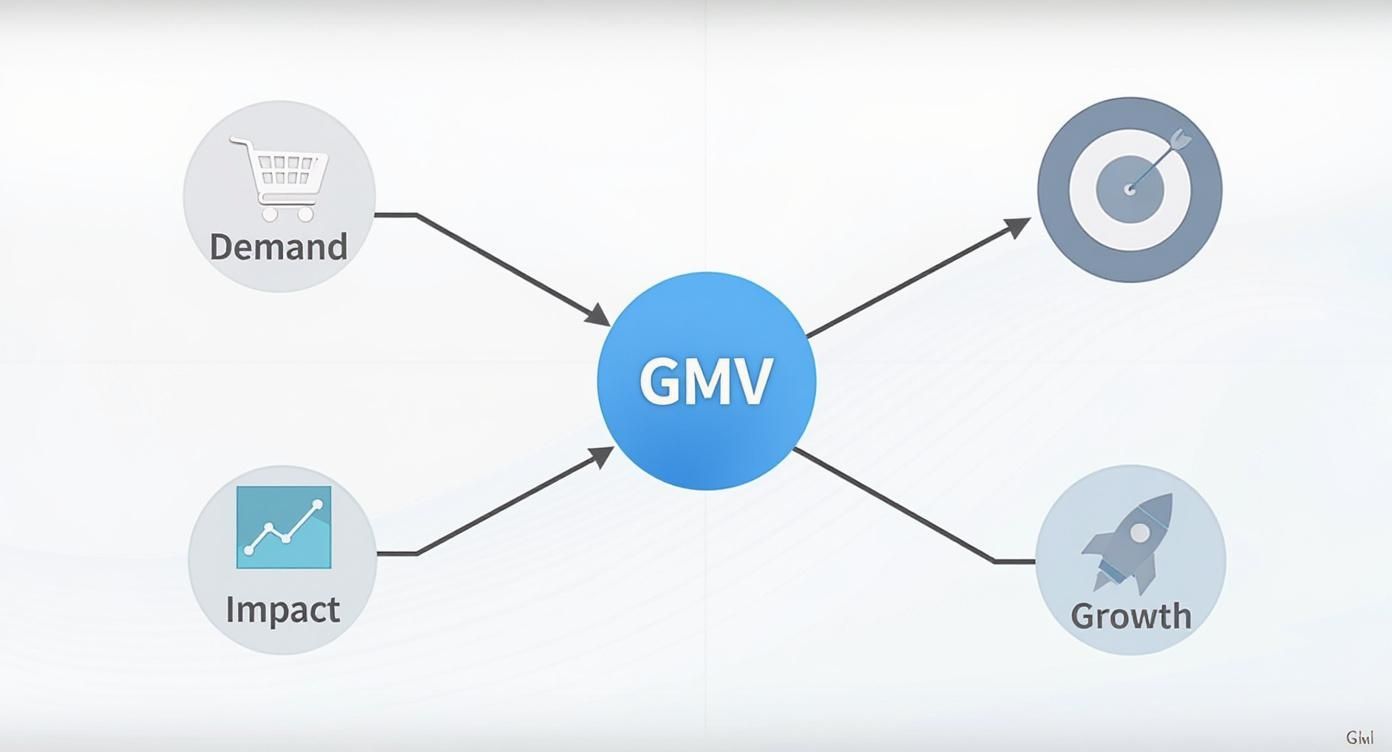
The visualization really clarifies that GMV acts as a foundational metric. It gives you a clear signal of your brand's market traction before all the other financial details get factored in.
The Hidden Story of Returns and Refunds
The most common pitfall is ignoring the impact of returns. By definition, GMV is calculated before returns and refunds are deducted. This is useful because it gives you a pure picture of initial customer demand.
The problem is, a high return rate can make your business appear much bigger and more successful than it actually is.
Imagine your Shopify store pulls in $100,000 in GMV for the month. That’s a great milestone. But if $25,000 of that merchandise is eventually returned, your Net Merchandise Value (GMV minus returns) is only $75,000. The initial $100k GMV signaled strong demand, sure, but the high return rate points to a serious issue—maybe with product quality, inaccurate descriptions, or a poor customer experience.
Relying solely on that top-line GMV number without tracking your return rate alongside it is a classic mistake. It hides churn and customer dissatisfaction, which are silent killers for any DTC brand.
Mistaking Shipping Fees and Taxes for Product Sales
Here’s another easy mistake: including ancillary charges like shipping fees and sales taxes in your GMV calculation. True GMV should only reflect the total value of the merchandise you sold. These extra costs aren't part of the product's price and don't represent customer demand for your actual goods.
Including them just inflates your GMV and gives you an inaccurate read on your product sales performance. For instance, if you sold a $50 shirt with $5 shipping and $3 in tax, the GMV for that item is $50, not $58. You always want to strip out these pass-through costs to get a clean signal on your store’s performance.
Think of it this way: GMV measures the value customers place on your products. They aren't buying "shipping" or "tax"—they're buying what you create. Keep your focus on that value.
The Double-Edged Sword of Deep Discounts
Finally, let's talk about discounts. Aggressive sales can be a tempting way to juice your GMV numbers quickly. Run a 40% off sitewide sale, and you’ll almost certainly see a spike in sales volume. Your GMV chart will shoot up, and on the surface, it looks like a massive win.
But at what cost? While GMV is calculated before discounts are applied (using the original product price), the resulting revenue and profit margins tell a very different story. That GMV spike might come with near-zero or even negative profitability.
This is the ultimate vanity metric trap. You’re driving top-line activity that doesn’t translate to a healthy bottom line. Sustainable growth isn't just about growing GMV; it's about growing it profitably. A smart strategy connects GMV goals to other key metrics like ROAS, CAC, and LTV to ensure you’re building a business that actually lasts.
How to Grow GMV Without Sacrificing Profitability
Chasing a higher Gross Merchandise Volume is a great goal, but pursuing that top-line number at all costs is a classic DTC trap. The real game—and the secret to building a brand that lasts—is growing GMV sustainably.
This means every bump in sales activity should actually make your business financially healthier, not weaker. It’s about shifting the focus from just "more sales" to "more valuable sales."
Profitable GMV growth doesn’t come from margin-crushing discounts. It’s built on smart, data-driven strategies that make the customer experience better while lifting your most important metrics.
Here’s a playbook of actionable tactics you can use to grow your GMV while protecting—and even boosting—your profitability.
Boost Average Order Value with Smart Upsells
The single fastest way to grow GMV without spending another dime on customer acquisition is to get each customer to spend more in a single transaction. This is all about raising your Average Order Value (AOV).
Forget those generic "you might also like" pop-ups. Modern AI-powered analytics can help you build intelligent bundles and upsell strategies based on what people are actually buying.
- Data-Driven Bundles: Dig into your Shopify data to see which products are constantly purchased together. An AI tool can spot these patterns instantly, letting you create no-brainer bundles like a "Morning Skincare Routine" kit that nudges the AOV just a little bit higher than the items sold separately.
- Targeted Post-Purchase Upsells: Don't break the checkout flow. Instead, hit them with a relevant, high-margin add-on after the sale is complete. For example, if someone just bought a coffee machine, you could offer a subscription to your best-selling espresso beans at a small discount. It’s a frictionless way to tack on more value to the order.
Imagine a beauty brand discovers that customers buying their star foundation often come back within 30 days to grab the matching concealer. By offering that concealer as a one-click post-purchase upsell, they capture that second sale right away, bumping up both AOV and GMV in one smooth move.
Optimize Your Conversion Rate on Key Pages
Driving traffic to your store is expensive. Every single visitor who bounces without buying represents a missed opportunity and wasted ad spend. Improving your Conversion Rate (CRO) is how you turn more of that hard-won traffic into actual GMV.
Stop guessing what works and let your data show you exactly where the friction is.
Your store data is telling you a story about what your customers want and where they get stuck. The key is having a tool that can translate that data into plain English, so you can take action.
Focus your energy on the pages that have the biggest impact:
- Product Pages: Are your images compelling? Are descriptions clear and focused on benefits? Run some A/B tests on things like your call-to-action button color or adding customer testimonials to see what gets more people to click "Add to Cart."
- Checkout Process: Nothing kills a sale faster than a clunky checkout. Analyze your funnel to see exactly where people are dropping off. Simply removing a few unnecessary fields or offering more payment options can give you a major lift in completed orders.
Expand to New Customer Segments and Channels
Lasting GMV growth often comes from finding new audiences. This starts with understanding who your best customers are and then figuring out how to find more people just like them.
For a little perspective on what scale looks like, just look at the giants. The leading platforms by GMV, China's Taobao and Tmall, process a combined total of over $1.4 trillion. That staggering number comes from serving massive, distinct customer segments. You can learn more by exploring the top online marketplaces worldwide on salehoo.com.
You’re not operating at that scale (yet!), but the principle is identical. An AI analytics platform can help you build an ideal customer profile by analyzing the cohorts with the highest Lifetime Value (LTV).
For instance, an apparel brand might discover through cohort analysis that a small but ridiculously profitable segment is men aged 35-44 who only buy performance wear. That insight is gold. They can launch hyper-targeted campaigns on platforms where that audience lives, effectively opening up a new market and driving fresh, profitable GMV.
When you tie your GMV growth initiatives directly to core metrics like AOV, LTV, and ROAS, you ensure your top line isn’t growing in a vacuum. You’re building a stronger, more resilient business with every single sale.
Moving Beyond Spreadsheets with AI Analytics
Are you still buried in spreadsheets, trying to piece together how your marketing spend is impacting your Gross Merchandise Volume? For too many DTC founders, that's the reality—a slow, clunky process that feels more like an accounting chore than a strategic advantage. You know the answers are in the data, but wrestling with CSVs and pivot tables is a massive time sink that rarely leads to a clear "aha!" moment.
It doesn’t have to be this way. This is where modern analytics platforms like MetricMosaic completely change the game for Shopify brands. Instead of just spitting out a raw GMV number, these tools tell you the story behind it. They turn your data from a static, rearview mirror into a guide for what's coming next.
This shift—from manually crunching numbers to getting automated, narrative insights—is how you build a real competitive edge. It’s about clarity and speed.
From Static Reports to Conversational Insights
Imagine you could just ask your data questions, almost like you’re talking to an analyst. That’s exactly what conversational analytics lets you do. No more digging through ten different reports to find one answer.
For instance, you could just type:
- "What drove our GMV growth last month?"
- "Which marketing channel had the best GMV-to-CAC ratio?"
- "Show me the GMV from customers who bought our new product line."
An AI co-pilot sifts through all the noise and gives you a straight answer in seconds, often connecting the dots between performance and a specific campaign, product, or customer group. What used to take hours of manual analysis now takes a few moments, freeing you up to think about strategy, not spreadsheets.
The point of analytics isn't just to show you data; it's to give you answers. By making data accessible through plain English, AI closes the gap between complex information and confident action for busy founders.
Predictive Insights That Guide Your Next Move
Looking back at last month's performance is useful, but what if you could get a reliable glimpse into the future? By analyzing historical trends, seasonality, and the momentum from your current campaigns, AI can deliver surprisingly accurate forecasts.
This screenshot from a MetricMosaic dashboard shows a clear visual of GMV trends, right alongside the key drivers like AOV and conversion rate.
As you can see, the dashboard doesn't just track where you've been. It forecasts where you're headed, giving you a proactive look at your business's trajectory.
This kind of forecasting is a game-changer for inventory planning, budget allocation, and setting growth targets that are ambitious but achievable. It turns your Shopify data into a true strategic asset. You can start anticipating market shifts and making decisions ahead of the curve, instead of just reacting to last quarter's numbers. With this level of clarity, you're not just running a brand; you're steering it toward profitable growth with data-backed confidence.
Common Questions About GMV, Answered
Once you've got a handle on Gross Merchandise Volume, a few specific, real-world questions almost always pop up for DTC founders. Let's walk through the most common ones so you can use this metric with complete confidence.
Does GMV Include Shipping Costs and Taxes?
Nope. True GMV should never include the extra stuff like shipping fees or sales tax. Think of it this way: the goal is to measure the raw value of the products customers actually wanted to buy. It’s a pure signal of demand for what you sell.
When you start adding in those extra fees, you're just inflating the number and getting a fuzzy picture of your actual sales performance. For a clean, reliable signal, always look at the pre-tax, pre-shipping value of the items in the cart.
How Should I Handle Returns and Refunds?
This is a really important one. GMV is calculated before you factor in any returns or refunds. That initial number is still super valuable because it shows you the total demand your marketing and brand managed to drum up. But it’s only half the story. You have to track your return rate right alongside it.
Some founders track a metric called Net Merchandise Value (NMV), which is just your GMV minus the value of all the returned goods. For a complete picture, you need to look at both:
- GMV shows you how good you are at generating initial sales.
- The gap between your GMV and NMV is where the story gets interesting. A big gap might point to problems with product quality, customer satisfaction, or maybe your product descriptions are setting the wrong expectations.
Is a High GMV Always a Good Thing?
Not always. Let me be clear: a high and growing GMV is usually a fantastic sign that you're gaining market traction and scaling up. But context is everything.
If that growth is coming from massive, margin-killing discounts, sky-high customer acquisition costs, or a reliance on low-margin hero products, you could be in a tricky spot. Your top-line number looks great, but your business could actually be losing money on every sale.
The healthiest Shopify brands grow their GMV sustainably. The focus isn't just on a bigger number, but a better one, driven by increasing Average Order Value (AOV) and Customer Lifetime Value (LTV). That’s how you make sure top-line growth actually turns into real, sustainable profit.
How Often Should I Be Tracking My Store's GMV?
The right cadence really depends on where your brand is at and what you’re focused on right now. At a bare minimum, you should be reviewing your GMV monthly and quarterly. This gives you a clear view of long-term trends and helps you measure progress against your goals.
But during crunch time—like a new product launch, a big marketing campaign, or the holiday rush—tracking GMV weekly or even daily is a smart move. It gives you invaluable, real-time feedback on what’s working. This is where modern analytics tools come in, automating the tracking and even sending you alerts when something significant changes. It keeps you ahead of the game without getting buried in spreadsheets.
Ready to move beyond spreadsheets and get the full story behind your GMV? MetricMosaic is the AI-powered analytics co-pilot for Shopify that turns your complex data into clear, actionable insights for profitable growth. Start your free trial today and see what your data is really trying to tell you.