How to Reduce Customer Acquisition Cost on Shopify (Without Guessing)
Tired of rising ad costs? Learn how to reduce customer acquisition cost with AI-driven analytics and proven strategies for your Shopify brand.

You're a Shopify founder staring at your ad dashboard, and the numbers just aren't adding up. You're pouring more money into Meta and Google, but the cost to land a new customer keeps creeping up, eating into your margins with every campaign. Your data is fragmented across Shopify, Google Analytics, and your ad platforms, leaving you with unreliable reports and a gut feeling that you're burning cash somewhere, but you can't pinpoint exactly where.
This isn't just a feeling; it's the reality for most direct-to-consumer (DTC) brands today. They're stuck in a brutal cycle of skyrocketing ad costs and shrinking returns, trying to make critical budget decisions with a blurry view of their true ROI.
And it’s not slowing down. Over the past decade, acquisition costs have exploded. The average CAC for an e-commerce business is projected to hit around $70 per new customer in 2025. That's a mind-boggling jump from just $29 back in 2013, even when you factor in marketing and returns.
We’re talking about a 222% increase in just over a decade, making profitable growth harder than ever to achieve. You can read more about the rising costs of e-commerce acquisition on loyaltylion.com.
This guide is your playbook for reversing that trend. We're going to walk through the core levers you can pull—from diagnosing attribution blind spots with AI to optimizing your entire funnel—to bring your CAC back under control and turn your store's data into a competitive advantage.
To give you a quick lay of the land, here are the key strategies we'll be breaking down.
Key Levers to Lower Your Shopify CAC
| Strategy Lever | Core Action | Primary Goal |
|---|---|---|
| Diagnose & Measure | Unify your data from Shopify, ad platforms, and analytics with an AI-powered tool to get a single source of truth. | Identify what’s actually driving profitable growth versus what’s just burning cash. |
| Prioritize & Act | Focus on the top 2-3 highest-impact channels and campaigns that are performing best for high-LTV customers. | Allocate budget and resources where they will deliver the highest return on ad spend (ROAS). |
| Optimize Creative | Use predictive insights to test and iterate on ad creative, copy, and offers tailored to your best audience segments. | Increase ad engagement and conversion rates with more relevant messaging. |
| Boost CRO & AOV | Improve your Shopify store's conversion rate and find ways to increase the average order value (AOV). | Maximize the revenue you generate from every click and visitor you've already paid for. |
| Integrate LTV | Tie your acquisition efforts to customer lifetime value (LTV) to acquire more valuable customers. | Shift focus from cheap one-time buyers to profitable long-term relationships. |
These levers work together, creating a powerful system for sustainable, profitable growth. Let's dive in.
The Limits of Manual Analysis
The root of the problem is that the old way of doing things—manually pulling reports and patching them together in spreadsheets—just doesn't cut it anymore. As a Shopify operator, you’re trying to make sense of data from a dozen different places: your Shopify sales, Google Analytics traffic, Meta Ads performance, Klaviyo email flows, and more.
Stitching all that together is a nightmare. It’s not just tedious manual data crunching; it's riddled with errors and makes getting a clear, unified view of performance nearly impossible.
This fragmented approach leaves you with more questions than answers:
- Which campaigns are actually bringing in profitable, long-term customers?
- Are you blowing your budget on channels that look good on a last-click basis but have terrible LTV?
- How can you scale your ad spend with any real confidence in your ROAS?
This is where AI-powered analytics helps you move from data chaos to clarity.
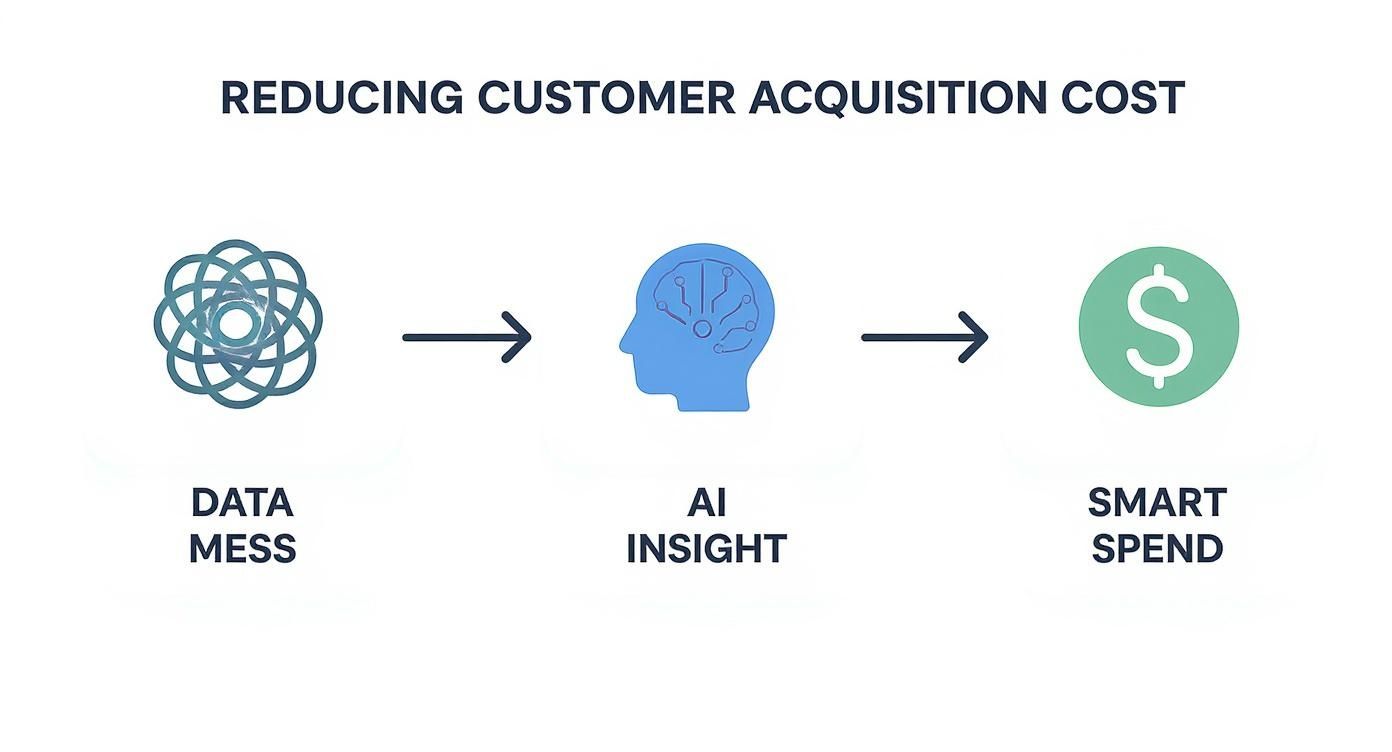
The goal is to connect your tangled data sources into a single, intelligent system that gives you clear insights and helps you make better spending decisions.
The goal is to shift from a reactive 'spend more' mindset to a proactive 'spend smarter' strategy. True growth isn't about outspending your competitors; it's about out-thinking them with better data.
This guide will show you exactly how to make that shift. We'll explore how modern, AI-powered analytics can transform your Shopify data into an actionable roadmap for sustainably lowering your CAC and unlocking real, profitable growth.
It’s time to stop flying blind and start making decisions with confidence.
Figuring Out Your True CAC with AI Analytics
Before you can lower your customer acquisition cost, you have to know what it actually is.
For most Shopify founders, this is the first, and biggest, roadblock. You're staring at a dozen different dashboards—Shopify, Google Ads, Meta, TikTok—and every single one tells a slightly different story. Trying to stitch it all together into one reliable number feels less like analysis and more like detective work.
This is exactly where the old-school spreadsheet approach falls apart. Relying on manual calculations for your blended CAC (total sales and marketing spend divided by new customers) isn't just slow, it's dangerously misleading. It doesn't tell you which channels are pulling their weight and which ones are just lighting your money on fire. You're left guessing where to put your next dollar.
Moving Beyond Last-Click Attribution
The most common trap I see DTC brands fall into is leaning too heavily on last-click attribution. This model gives 100% of the credit for a sale to the very last thing a customer clicked before buying. It’s simple, sure, but it’s a deeply flawed way to understand a modern customer journey.
Think about it. A customer might see your brand on a TikTok video, read a review on a blog, get hit with a retargeting ad on Instagram, and then finally click a Google Shopping ad to make a purchase. Last-click attribution completely ignores those first three crucial touchpoints, making your top-of-funnel efforts look worthless. This leads to terrible budget decisions, like cutting a TikTok campaign that’s actually filling your pipeline with high-value future buyers.
AI-powered analytics platforms like MetricMosaic fix this by automatically pulling data from all your sources—Shopify, ad platforms, and analytics—into a single source of truth. They use smarter attribution models to map the entire customer journey, giving you a clear, honest picture of how each channel really contributes to a sale.
This unified view is where you finally stop guessing and start diagnosing.
Uncovering Your Most Profitable Pockets of Customers
Let's be honest: not all customers are created equal. Some buy once and vanish. Others become loyal, high-spending advocates for your brand. The real key to reducing your long-term CAC is to acquire more of the latter. Trying to identify these high-value segments manually is nearly impossible, but it’s a core strength of AI analytics.
An AI platform can instantly comb through your customer data and surface story-driven insights, like:
- Which channels bring in the best customers? It can identify which channels deliver customers with the highest lifetime value (LTV), not just the lowest initial CAC.
- Which products are your gateway drugs? It can pinpoint which products are the most common first purchases for your best customers, giving you a hero product to feature in your acquisition campaigns.
- Where are your hot spots? It can highlight cities or regions where your ROAS is highest, letting you double down with more focused ad targeting.
This level of detail changes the conversation from a generic "our CAC is $50" to a strategic "our CAC for customers we get from YouTube who buy again within 60 days is just $35, and their LTV is 4x higher."
For example, a modern analytics dashboard can visualize your blended CAC and ROAS in real-time, right next to each other.
This view immediately shows you which platforms are driving profitable growth versus those that might need another look.
Pinpointing Wasted Ad Spend with Surgical Precision
Once you know which cohorts and channels are your winners, the next step is to find and kill the waste. AI is brilliant at this, flagging inefficiencies that you’d almost certainly miss in manual reports. Instead of you hunting through ad manager, an AI co-pilot proactively tells you where the problems are.
Here’s an example of an AI-generated, story-driven insight: "Your 'Summer Sale' campaign on Meta has a 25% higher CPA than your evergreen campaigns, but it's bringing in customers with a 15% lower 90-day LTV. You should consider moving $5,000/month from this campaign to your top-performing 'New Arrivals' campaign to improve overall ROAS."
This kind of specific, actionable advice is a game-changer for any Shopify brand. It turns a mountain of data into a clear to-do list for lowering your CAC. It's why AI in customer acquisition has become so powerful, with some brands reporting up to a 50% reduction in CAC. By using AI for predictive analytics and automated segmentation, brands can target high-value prospects with incredible efficiency. You can find more insights on this topic and learn how AI is fixing CAC math on cahoot.ai.
By getting a true diagnosis of your CAC with AI, you build the foundation for a smarter, more profitable growth strategy. You finally get the clarity you need to confidently invest in what works and cut what doesn't.
Optimizing Creative and Audiences with Predictive Insights
Once you’ve nailed down your true CAC, the next battleground for efficiency is your creative and audience targeting. It’s no secret that great ads aimed at the right people are the engine of profitable growth. But for most DTC brands, this is a frustrating cycle of guesswork, creative fatigue, and wasted spend on audiences that just don't stick.
We've all been there. You launch a campaign that crushes it for a week, only to see performance inexplicably tank. You’re left wondering: was it the image? The headline? The audience? Without clear data, you’re just throwing spaghetti at the wall, which is a fast way to burn through your budget.
This is where AI-driven analytics completely change the game, shifting you from guessing to knowing. Instead of just looking at surface-level metrics like click-through rate (CTR), you can finally dig deeper to understand what truly resonates with your most valuable customers.
Go Beyond CTR to Understand Creative Impact on Profitability
A high CTR feels good, but it’s a vanity metric if those clicks don't turn into profitable sales. The real goal is to run ads that attract customers who will stick around and spend more over their lifetime. This means you have to connect ad creative performance directly to post-purchase behavior, LTV, and ultimately, profitability.
An AI analytics platform automates this connection for you. It can analyze creative from Meta and Google alongside sales data from Shopify to tell a much richer story. You can finally answer the questions that actually matter for your bottom line:
- Does user-generated content (UGC) bring in a higher LTV customer than our polished studio shots?
- Do our video ads drive a higher average order value (AOV) on the first purchase?
- Which ad headline is most effective at converting customers who end up making a second purchase?
This level of insight allows you to reduce customer acquisition cost not by chasing cheaper clicks, but by investing in the creative that attracts better, more profitable customers from day one.
Using Conversational Analytics to Find Winners Faster
One of the most powerful next-gen trends emerging is conversational analytics. Instead of spending hours building complex reports, you can simply ask your data questions in plain English, just like talking to a growth strategist.
Imagine typing into a platform like MetricMosaic:
"Which ad creative drove the highest AOV from new customers in the last 30 days?"
Within seconds, you get a clear, visual answer—no VLOOKUPs or pivot tables required. This speed and simplicity empower your whole team to make smarter decisions, faster. You can quickly spot your winning ad formulas and double down on what’s proven to work, maximizing your return on ad spend (ROAS). This approach turns every campaign into a learning opportunity, helping you build a creative playbook based on hard data, not just gut feelings.
Building Better Audiences with Predictive AI
Just as important as what you show is who you show it to. Building effective lookalike audiences is a cornerstone of scaling on platforms like Meta, but it’s often a shot in the dark. You might create a lookalike from your entire customer list, but that list lumps one-time discount shoppers in with your true VIPs.
This is where predictive analytics comes in. AI can analyze your entire Shopify customer base to identify the specific traits and behaviors of your highest-LTV cohorts. It then helps you build a seed audience made up of only these top-tier customers.
A lookalike audience built from this hyper-qualified seed list is exponentially more powerful. You’re telling the ad platform to find more people who look just like your best customers, not just any customer. This leads to:
- Higher Conversion Rates: The audience is more qualified and naturally interested in what you sell.
- Improved LTV: You’re acquiring customers who are predisposed to become repeat buyers.
- Lower Effective CAC: Even if the initial cost per acquisition is similar, the long-term value these customers bring makes your ad spend far more efficient.
By combining AI-driven creative analysis with predictive audience building, you create a powerful feedback loop. You learn what creative resonates with your best customers, then use that insight to find more of them. This is how you systematically and sustainably reduce customer acquisition cost and build a much more resilient acquisition engine for your Shopify store.
Boosting On-Site Conversion and Order Value

Driving your CAC down isn’t just about making your ads cheaper. A massive piece of the puzzle, and one that's often overlooked by DTC founders, is what happens after the click. You've already paid to get a visitor to your Shopify store—now the real work begins.
The focus has to shift from pure acquisition to on-site optimization. By lifting your conversion rate and your Average Order Value (AOV), you make every single marketing dollar work harder. This makes your entire business more resilient, especially when ad costs inevitably creep up.
Turn Purchase Data into Smarter Product Recommendations
One of the fastest ways to bump up your AOV is to show customers other products they’ll actually want. Generic "You might also like" widgets are table stakes. The real edge comes from using AI to go deeper.
AI-powered analytics tools can comb through your Shopify purchase history, uncovering hidden buying patterns you'd never spot on your own. Instead of just showing off best-sellers, they reveal genuine product affinities.
- Market Basket Analysis: This is where the magic happens. It tells you which products are most frequently bought together. For example, you might discover that customers who buy your "Performance Running Tee" are 3x more likely to also grab your "Moisture-Wicking Socks" in the same order.
- Personalized Recommendations: Based on what a visitor is browsing and what's in their cart, the system can dynamically suggest the perfect add-on. It's a completely personalized shopping experience that feels helpful, not spammy.
Armed with this data, you can build irresistible bundles and upsells that boost your AOV without annoying your customers.
Create Compelling Bundles and Upsells
Once you have these AI-driven insights, you can stop guessing and start building offers that are practically guaranteed to convert. If your data shows a strong link between two products, you can package them as a "Complete the Look" bundle and knock a few bucks off the total price.
Not only does this increase the order value, but it also genuinely helps the customer by making their shopping experience easier. You can also use this same data to power your post-purchase upsells on the thank-you page—presenting a super-relevant offer right when their intent to buy is at its absolute peak.
A 10% increase in your store's AOV can completely offset a 10% rise in ad costs. This buffer is critical—it makes your acquisition efforts more profitable and sustainable, even when the ad market gets more competitive.
This simple math shows just how powerful on-site optimization is. It’s a direct lever to reduce customer acquisition cost without ever having to touch your ad campaigns. You’re just making every customer you acquire more valuable.
Streamline Your Checkout to Reduce Abandonment
Every single bit of friction in your checkout process is costing you sales. A confusing form, a surprise shipping fee, or a missing payment option can send a would-be customer clicking away forever.
With the average cart abandonment rate hovering around a staggering 70%, even tiny improvements here can have an outsized impact on your conversion rate and, by extension, your effective CAC.
You need to use your analytics to find the leaks in your funnel.
- Are they bailing at the shipping page? Try testing a free shipping threshold.
- Is the payment page the biggest drop-off point? Make sure you're offering express checkout options like Shop Pay, Apple Pay, and PayPal.
- Is your form too long? Cut any field that isn't absolutely essential. Make it fast and painless.
Every customer you save from abandoning their cart is one you don't have to pay to re-acquire. By focusing on boosting conversion and AOV, you build a much more efficient, profitable engine for your Shopify brand. You stop just acquiring customers and start maximizing their value from day one.
Connecting Retention and LTV to Your Acquisition Strategy
The smartest Shopify brands know a secret that many others learn the hard way: acquisition and retention are two sides of the same coin.
If you’re just pouring money into acquiring customers who only buy once, you don't have a growth strategy—you have an expensive series of one-off transactions. To actually reduce customer acquisition cost in a sustainable way, you have to tear down the wall between how you get customers and how you keep them.
It’s all about a mental shift. Stop seeing CAC as a simple cost and start treating it as a strategic investment in long-term profitability. The real leverage comes when you stop treating every new customer the same and begin focusing your ad spend on attracting the kind of people who are most likely to stick around.
From First Click to Lifetime Value
For most DTC founders, the biggest headache is connecting the dots between a customer's first touchpoint and their lifetime value. Which ad campaign brought in the customers who eventually made a second or third purchase? Did that influencer collab deliver one-and-done buyers or true brand evangelists? Trying to answer these questions with spreadsheets is a complete nightmare of manual data crunching.
This is exactly where AI-powered analytics gives you a massive edge. A platform like MetricMosaic automatically stitches your ad platform data together with your Shopify sales and retention data. Suddenly, you have a single view that lets you calculate LTV by channel, campaign, and even down to the specific ad creative.
By understanding the LTV of customers from different acquisition sources, you can confidently spend more to acquire the right customers—those who will deliver a higher return over time, fundamentally changing your CAC equation.
With this insight, you're no longer just chasing the lowest cost-per-click. You're hunting for the highest long-term ROAS.
Using Acquisition Data to Power Retention
Once you know where your best customers are coming from, you can start using that intel to build a smarter, more personal post-purchase experience. This is all about using your acquisition insights to kickstart the retention cycle from the moment they check out.
Here are a few practical ways to put this into action:
- Segment Your Welcome Flows: Don't send the same generic welcome email to everyone. A customer who came from a TikTok ad featuring a specific dress will respond better to a different welcome series than someone who found you through a Google search for "sustainable activewear."
- Personalize Early Offers: Use their first purchase and acquisition channel to inform the very first offer you send them. Did they buy a starter kit? The logical next step is an offer for a restock or an accessory that complements their original purchase.
- Create Targeted Win-Back Campaigns: AI can spot at-risk customer cohorts using predictive analytics. If you know that customers acquired from a specific Facebook campaign tend to drop off after 60 days, you can proactively launch a targeted win-back offer around day 45 to keep them in the fold.
Justifying Higher Spend for Higher Value
This LTV-centric approach also helps you make sense of rising ad costs. Industry benchmarks show some serious variation here. For e-commerce, the average CAC in 2025 is expected to land somewhere in the $64–$87 range. While some industries have no choice but to justify high initial spend, smart DTC brands can use these insights to get a massive efficiency advantage. You can dig deeper into these benchmarks by exploring the average customer acquisition costs on gocustomer.ai.
When you know, for a fact, that a customer from YouTube has a 3x higher LTV than a customer from a display ad, you can confidently justify paying a higher CAC for that YouTube traffic. This data-backed approach allows you to outbid less-informed competitors on the channels that actually matter, securing the customers who will drive your brand's growth for years to come.
Your Questions on Lowering CAC Answered
https://www.youtube.com/embed/OwCATJh4lNg
If you're trying to scale a Shopify brand, wrestling with customer acquisition cost is part of the game. It can feel like a moving target, but you're not alone in asking these questions. Getting clear answers is the first step to building a more profitable growth engine, so let's dig into some of the most common questions we hear from DTC founders and marketers.
What Is a Good Customer Acquisition Cost for a Shopify Store?
This is the million-dollar question, and the honest answer is: it depends. There's no universal magic number. A "good" CAC is always relative to your store's own economics, especially your Average Order Value (AOV) and, more importantly, your Customer Lifetime Value (LTV).
A healthy rule of thumb most DTC brands shoot for is an LTV:CAC ratio of at least 3:1. In plain English, for every dollar you spend bringing a new customer in the door, you want to see them generate at least three dollars in gross margin over their entire relationship with you.
When you're just starting out, it's common to see your CAC uncomfortably close to your AOV. That’s a classic cash-burning scenario. This is where AI analytics becomes a game-changer. By understanding which channels deliver customers with a higher LTV, you can get comfortable with a higher initial spend for those specific audiences, knowing they’ll pay off down the road.
How Can AI Actually Help Me Reduce Ad Spend Without Hurting Sales?
The real power of AI isn't about blindly slashing your budget—it's about making your budget smarter. It’s about shifting ad spend from areas of waste to pockets of opportunity, making every single dollar work harder and improving your profitability.
Instead of a broad, one-size-fits-all approach, AI analytics platforms dig deep into your data. They pinpoint the specific campaigns, ad sets, or keywords that are draining your budget without delivering profitable customers (the ones with a low LTV). It’s surgical precision, not guesswork.
An AI-powered platform might surface a predictive insight like this: "Your 'Weekend Flash Sale' campaign is driving clicks, but its customers have a 20% lower repeat purchase rate than your 'Best Sellers' campaign. We recommend reallocating $2,500 from the flash sale to the evergreen campaign to boost your 90-day LTV."
See what happened there? It’s not about spending less overall. It's about eliminating what’s not working and doubling down on what is, which naturally improves your Return on Ad Spend (ROAS) and helps to reduce your blended customer acquisition cost.
How Long Does It Take to See a Reduction in CAC Using These Methods?
You can actually see the initial impact surprisingly fast. Once you connect an AI analytics tool to your Shopify store and ad accounts, you can start getting diagnostic insights in as little as 24-48 hours.
These first insights are often the low-hanging fruit—things like identifying your most and least profitable campaigns. Acting on them can start lowering your CAC within the first 1-2 weeks.
The deeper, more strategic improvements will take a bit longer. Optimizing your entire funnel for LTV and fine-tuning your on-site conversion rate will yield more significant, sustained reductions over 1-3 months. You’re not just applying quick fixes; you’re building a more efficient, data-driven system for growth as you gather more data and dial in your strategy.
Can I Do This Myself with Spreadsheets or Do I Need a Special Tool?
You can technically track a basic CAC in a spreadsheet, but as a Shopify founder, your time is your most valuable asset. The manual data crunching involved is incredibly time-consuming and dangerously prone to human error.
The real challenge—and where spreadsheets completely fall apart—is trying to accurately blend data from multiple sources like Shopify, Google, Meta, and TikTok. And trying to connect first-click acquisition data to long-term LTV? That’s nearly impossible to do manually without a team of data scientists.
This is where AI-powered platforms shift from a "nice-to-have" to an essential part of a modern DTC tech stack. They handle all the heavy lifting of data blending and analysis, freeing you up to focus on strategy and execution. More importantly, they deliver predictive insights and tell a story with your data that a spreadsheet never could, turning complexity into clear, actionable steps to reduce customer acquisition cost.
Ready to turn your Shopify store's data into your most powerful growth asset? MetricMosaic is the AI-powered analytics co-pilot that transforms complexity into clarity and action. Stop guessing and start making data-backed decisions that lower your CAC and boost your profitability.