How to Improve Ecommerce Conversion Rate: A Founder's Guide to Plugging Revenue Leaks
Discover how to improve ecommerce conversion rate with data-driven insights, proven tactics, and AI analytics to boost sales and loyalty.
As a Shopify founder, you live and die by your conversion rate. You've mastered the art of getting traffic to your store, but when those visitors don't turn into customers, it feels like your marketing budget is evaporating into thin air. You're swimming in fragmented data from Shopify, Google Analytics, and your ad platforms, but trying to connect the dots just leads to more questions and unreliable reports.
This is a universal challenge for growing DTC brands: you have plenty of data, but zero clarity. You're left guessing what's broken. Is it slow-loading product pages? Surprise shipping costs? A clunky mobile checkout? Every guess is a gamble with your time and money, and all the while, your store continues to leak revenue.
Moving Beyond the Guesswork
The old way of doing analytics—manually crunching numbers in spreadsheets—gives you a rearview mirror perspective. It’s slow, full of errors, and rarely uncovers the why behind customer behavior. This is where AI-powered analytics platforms like MetricMosaic change the game for DTC operators. They automate the heavy lifting, weaving data from all your tools into a single, cohesive story.
Instead of getting lost in dashboards, you get clear, actionable insights in plain English. For example, MetricMosaic’s story-driven data might proactively alert you that "73% of first-time visitors from your latest Meta campaign are bouncing from a specific product page without adding to cart." Suddenly, a vague problem like "low conversion rate" becomes a specific, solvable issue.
This guide treats conversion rate optimization (CRO) not as a guessing game, but as a precise, data-driven science. We’ll walk through how to:
- Diagnose the Leaks: Use AI-simplified analytics to pinpoint the exact friction points in your Shopify funnel.
- Prioritize the Fixes: Zero in on the changes that will have the biggest impact on your profitability, ROAS, and CAC.
- Measure What Really Matters: Look past simple conversion numbers to see how your changes affect critical metrics like AOV, LTV, and customer retention.
By swapping guesswork for AI-driven clarity, your Shopify store's data becomes your most powerful growth tool. It’s time to stop feeling overwhelmed by fragmented reports and start making confident decisions that plug the leaks and boost your bottom line.
This analytics-first playbook will show you how to systematically improve your ecommerce conversion rate, turning more of that hard-won traffic into loyal, profitable customers.
Find Your Conversion Blockers with Data
Before you can fix the leaks in your revenue bucket, you have to find them. Improving your ecommerce conversion rate isn't about throwing random changes at your Shopify store and hoping something sticks. It’s about being a detective—using smart data analysis to diagnose the exact points of friction that are costing you sales.
Vague problems get vague solutions. But specific, well-defined problems? Those you can solve.
The goal is to move from a broad assumption like "our conversion rate is low" to a focused, actionable insight. Is the rate low across all traffic sources, or is one specific ad campaign just not pulling its weight? Is it a problem on every device, or are your mobile users hitting a wall they can't get past?
This is where segmenting your analytics becomes your secret weapon. By slicing your data into smaller, more manageable pieces, you start to see the real story behind the numbers.
Start by Segmenting Your Funnel
Drilling down into your data reveals patterns that are completely invisible from a 30,000-foot view. You have to follow the clues your users leave behind to understand their journey.
Here are the critical segments every DTC founder should be analyzing:
- Traffic Source: Are visitors from your TikTok ads bouncing instantly while your email subscribers from Klaviyo convert beautifully? This tells you whether you have a traffic quality problem or a landing page that doesn't match the ad's promise, directly impacting your CAC and ROAS.
- Device Type: It’s normal for mobile conversion rates to lag behind desktop. But a massive gap often screams UX issues. Maybe your "Add to Cart" button is a pain to tap on a small screen, or your checkout flow isn't optimized for mobile wallets.
- New vs. Returning Visitors: If new visitors aren't converting, it could be a trust issue—maybe they need more social proof or a clearer value proposition. If your loyal returning visitors aren't buying, you might have a problem with product discovery or pricing, which affects LTV and retention.
Think of this process as mapping out how traffic flows through your site and, more importantly, where it's leaking out.
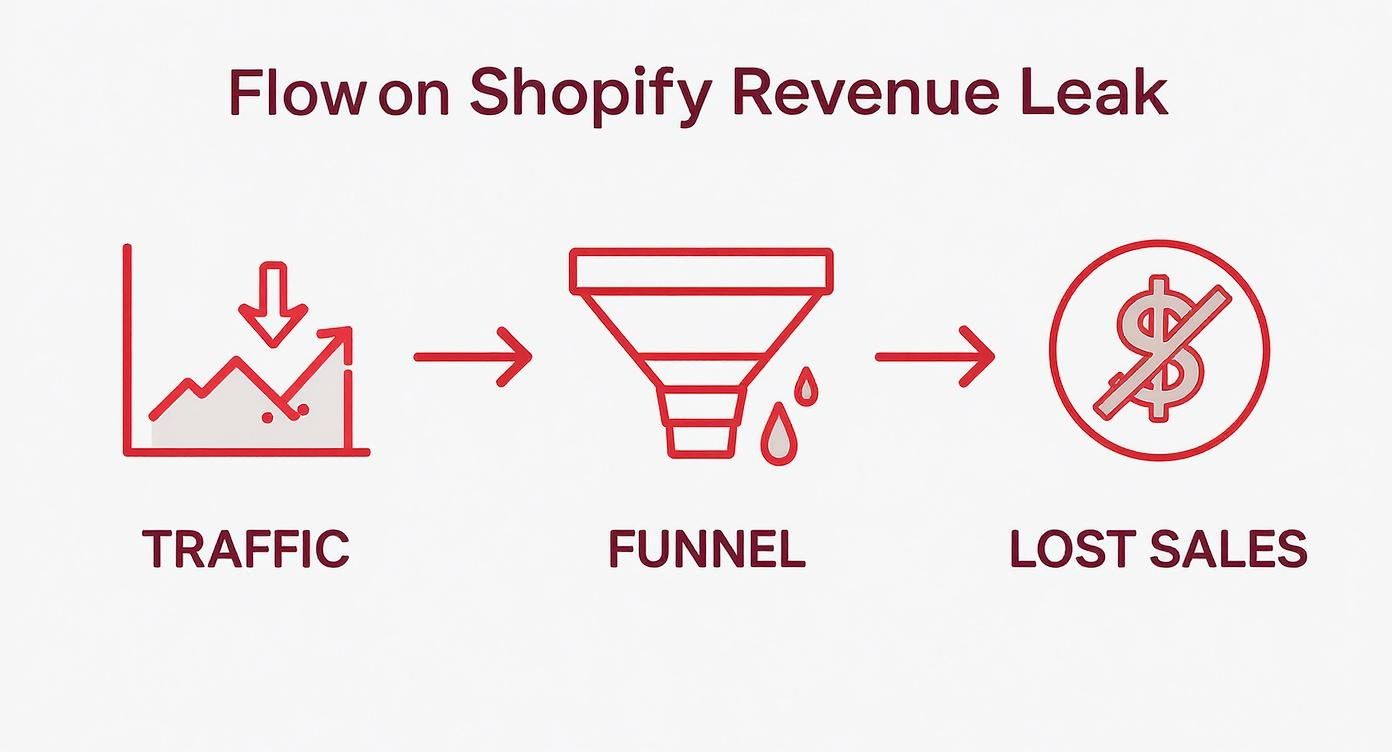
Every drop from that funnel is revenue you could have captured with the right fix in the right place.
Let AI Connect the Dots
Honestly, manually digging through Google Analytics and Shopify reports to connect these dots can feel like searching for a needle in a haystack. For a busy founder, it’s a tedious process that replaces action with analysis paralysis.
This is where next-gen trends like conversational analytics and predictive insights completely change the game. Instead of you hunting for insights, an AI-powered platform does the heavy lifting, automatically surfacing opportunities for you. It stitches together data from your Shopify store, ad platforms, and email marketing tools to generate "Stories" that tell you what’s happening in plain English.
A tool like MetricMosaic transforms a vague problem like 'our conversion rate is down' into a specific, actionable insight like, '70% of Android users arriving from our spring campaign are abandoning checkout at the shipping step.'
That’s the difference between guessing and knowing. It ensures you focus your limited time and resources on the fixes that will actually move the needle on your profitability.
To put this into practice, here's a quick diagnostic checklist that shows how this analytics-first mindset shifts the way you approach problems.
Conversion Rate Optimization Diagnostic Checklist
This table contrasts the old-school, manual way of hunting for issues with a more modern, AI-powered approach that gets you to the "why" much faster.
| Diagnostic Area | Key Questions to Ask | AI-Powered Solution (MetricMosaic Example) |
|---|---|---|
| Traffic Quality | Are specific channels driving low-intent traffic? Do ad campaigns have a high bounce rate? | MetricMosaic automatically flags campaigns with high bounce rates and low conversion, suggesting a potential ad-to-page mismatch that's hurting ROAS. |
| Site Performance | Is a slow-loading page causing users to drop off? How does site speed impact different segments? | The platform monitors page load times and correlates speed degradation with dips in conversion, pinpointing problematic pages. |
| User Experience (UX) | Where are mobile users getting stuck? Is the navigation confusing? Is the "Add to Cart" button effective? | Story-driven data alerts you to friction points, like an unusual drop-off rate on a specific product page for mobile users. |
| Checkout Funnel | At which step (shipping, payment) are most users abandoning their cart? Does this vary by device or region? | A "Story" alerts you: "Checkout abandonment increased by 15% for users in California after the new shipping policy was introduced." |
| Pricing & Offers | Are discount codes being used as intended? Is the perceived value of a product misaligned with its price? | The system can track discount code usage by cohort to see if it drives repeat purchases (higher LTV) or just attracts one-time bargain hunters. |
This systematic, data-first approach is the foundation of effective CRO. It ensures you're not just making changes for the sake of it, but implementing targeted solutions that solve real user problems and improve profitability.
Your High-Impact CRO Action Plan
Okay, you’ve done the hard work of diagnosing the conversion killers and you know exactly where your Shopify store is leaking revenue. Now for the million-dollar question every founder asks: with a dozen potential fixes, where do you actually start?
The answer isn’t to chase every tiny tweak or follow every "best practice" you read online. It's about ruthless prioritization. You need to focus on changes that directly improve key performance indicators like AOV, CAC, and LTV.
This isn't about a massive, expensive site overhaul. Think surgical precision. We're going to make smart, targeted improvements that deliver the biggest wins, fast. For most DTC brands I've worked with, the highest-leverage opportunities always fall into three buckets: mastering mobile, simplifying checkout, and building unbreakable trust.
Prioritize the Mobile Shopping Experience
For any modern DTC brand, mobile isn't just another channel—it's the channel. The overwhelming majority of your traffic, especially if you're running ads on platforms like Meta and TikTok, is coming from a smartphone. If that experience is clunky, slow, or frustrating, you're literally paying to turn customers away.
Improving the mobile shopping journey is one of the most effective levers you can pull. By 2025, mobile commerce is set to claim 59% of all online retail sales. We've seen that mobile-optimized sites with smooth checkouts and fast load times can boost their mobile conversion rates by up to 20%. It's not uncommon for brands investing in responsive design and one-click purchasing to see a 10-15% lift within six months. You can find more ecommerce statistics on Flowlu.com.
Here are a few actionable takeaways you can implement right now:
- Simplify Navigation: Ditch the clutter. Use a clean, collapsible "hamburger" menu and make your search bar impossible to miss. Nobody should have to pinch and zoom to find what they're looking for.
- Optimize for Touch: Make sure every button, especially "Add to Cart" and "Checkout," is big enough and placed where a thumb can easily tap it. It sounds small, but it makes a huge difference.
- Compress Your Images: Large image files are conversion killers. A one-second delay in mobile page load can tank conversions by 7%. Use a tool to shrink file sizes without turning your product photos into pixelated messes.
Simplify and Streamline Your Checkout Process
The checkout is the final hurdle. It’s where browsers become buyers. Every extra field they have to fill out, every unexpected cost that pops up, and every moment of confusion is a golden opportunity for them to abandon their cart. Your job is to make buying from you completely effortless.
Think about it: your customer has already decided they want your product. Don't give them a reason to second-guess that decision now.
The best checkout process is one the customer barely remembers. It should feel so seamless and intuitive that completing the purchase is the most natural next step.
Here’s how to make that happen:
- Offer Express Checkout Options: This is non-negotiable in today's world. Integrating one-click payment solutions like Shop Pay, Apple Pay, and Google Pay lets customers skip the tedious manual entry of their address and card details—a major friction point on mobile.
- Enable Guest Checkout: Forcing people to create an account before they can buy is a classic conversion killer. Let them check out as a guest, then give them the option to create an account after the sale is complete.
- Be Transparent with Costs: Surprise fees are the #1 reason for cart abandonment. Period. Show all costs, including shipping and taxes, upfront. A shipping calculator in the cart can work wonders for building that initial trust.
Build Trust with Powerful Social Proof
In the world of DTC ecommerce, trust is your most valuable currency. A new visitor, especially one who clicked on a paid ad, is naturally skeptical. They're asking themselves, "Is this brand legit? Is this product any good? Can I really trust them with my money?"
You have to answer those questions for them with compelling social proof woven directly into your product pages and checkout flow. This isn’t about just having a reviews page; it’s about strategically placing trust signals at critical decision-making moments.
Effective social proof tells a story. For instance, a skincare brand can show user-generated photos of customers with glowing skin. A clothing brand can feature testimonials that specifically praise the fit and quality of the fabric.
Actionable Takeaways for Building Trust:
- Place Trust Badges Strategically: Don’t hide your secure payment logos (Visa, Mastercard, PayPal) or any security seals. Make them prominent right where a customer is about to enter their payment information.
- Integrate User-Generated Content (UGC): Use a Shopify app to pull authentic customer photos and videos directly onto your product pages. Seeing real people using and loving your product is far more convincing than any marketing copy you could ever write.
- Feature Detailed Testimonials: Go beyond just a star rating. Highlight the reviews that address common hesitations about sizing, effectiveness, or shipping times.
By focusing your energy on these three high-impact areas, you’ll move from random acts of optimization to a strategic plan that tackles the most common and costly conversion blockers for Shopify brands.
Use AI to Create Personalized Shopping Journeys
Let's be honest, the one-size-fits-all website experience is dead. Once you've nailed the basics—a smooth mobile UX and a frictionless checkout—the next big win for your conversion rate comes from personalization. For a busy founder, that word used to scream "expensive" and "complicated." Not anymore. AI has made it possible for any brand to deliver a truly personal touch.
This isn't just about plastering a customer's first name in an email. It's about making your entire Shopify store feel like a conversation. AI works behind the scenes, watching how shoppers behave and then instantly serving up the right product recommendations, the perfect offer, or the most helpful piece of content.
Imagine a loyal customer lands on your homepage and, instead of your standard new arrivals, she sees a handpicked selection of items that perfectly match the dress she bought last month. That's what we're talking about—transforming your store from a static catalog into an intelligent shopping assistant that knows what your customers want before they do.
Go Beyond Basic Product Recommendations
We've all seen the standard "You might also like" carousels. They're a decent starting point, but AI lets you get so much smarter. Instead of just showing similar items, it can actually understand the intent behind someone's clicks and suggest things that make contextual sense.
This is about swapping manual data-crunching for automated intelligence that gets your product catalog and customer base on a deep level. It’s about making the experience feel alive.
Here are a few practical ways you can put this into action on your Shopify store:
- AI-Powered Site Search: Your search bar should be more than a keyword-matcher. An intelligent search can understand synonyms, typos, and intent. When someone searches for "summer tops," it should know to show best-selling tank tops and short-sleeve blouses, not just products with the literal word "summer" in the name.
- Dynamic "Shop the Look" Bundles: A customer is looking at a killer dress on a product page. An AI engine can instantly pull in the exact shoes and accessories from the photoshoot, making it ridiculously easy for them to add more to their cart and boost your Average Order Value (AOV).
- Personalized Landing Pages: If you're running a Facebook ad campaign for your new vegan leather bags, the landing page should reflect that. AI can dynamically change the hero image and product grid to focus only on the vegan collection, creating a perfectly seamless journey from ad to site and improving ROAS.
Create Hyper-Segmented Email and SMS Flows
Personalization doesn't stop when a visitor leaves your website. It’s absolutely essential for your retention marketing, especially if you're a DTC brand using a platform like Klaviyo. Trying to manually create dozens of customer segments is a nightmare that no one has time for.
By connecting your Shopify data with your marketing tools, AI can spot high-value segments you'd probably never find on your own—like "high-LTV customers who haven't bought anything in 60 days but just viewed the new collection."
This is how you get away from sending generic "we miss you" emails. That specific segment doesn't need a generic discount; they need an exclusive early-access link to the new collection you know they're interested in. It's a targeted nudge that can reignite their interest and secure another purchase, directly boosting retention and LTV.
The Real-World Impact of AI Personalization
This isn't just about creating a slick user experience; it's about a measurable impact on your bottom line. Brands that get this right see incredible results.
AI-driven product recommendations have been shown to lift conversion rates by up to 30%, and some brands have seen as much as a 15% bump in AOV. Even better, deeply segmented and personalized email campaigns boast an average conversion rate of 10.3%. The ROI is staggering, often generating $36 to $40 for every dollar spent. You can dig into more of the numbers on ecommerce conversion rates at RedStagFulfillment.com.
Tools like MetricMosaic are built for this. They don't just unify your data; they use predictive insights to automatically surface these high-potential segments. The platform tells you who to talk to and what they want to buy, turning your customer data into an automated growth engine. The end goal is to make every single customer feel like your store was built just for them.
Measure What Matters: From Conversion Rate to Profitability
So, you ran an A/B test on your product page and saw a 20% lift in add-to-carts. That’s a win, right?
Maybe. But for a savvy brand owner, the real question is: what does that actually mean for the business? A temporary spike in a single metric is nice, but it doesn't tell you anything about the long-term health of your store.
Chasing small conversion bumps without understanding their impact on profitability is like winning a battle but losing the war. Sure, you might convert a visitor today with a steep discount, but you could find they never return, completely tanking your Customer Lifetime Value (LTV). This is where we need to shift our thinking from just a higher conversion rate to building a more resilient, profitable business.
The goal isn't just to make one sale; it's to acquire a customer who sticks around.
Beyond the One-Time Sale
To get a true read on your optimization efforts, you have to look past the initial transaction. The real story lies in the metrics that reflect sustainable growth—the numbers that tell you if you’re building a brand or just running a promotion.
There are really three pillars of long-term DTC success:
- Average Order Value (AOV): How much are customers spending in a single go? Are your site changes actually encouraging larger carts through better recommendations or bundling?
- Customer Lifetime Value (LTV): This is the holy grail. It’s the total revenue you can expect from a single customer over their entire relationship with you. A higher LTV means you can afford to spend more to acquire customers, giving you a massive competitive edge.
- Cohort Retention: This involves grouping customers by when they first bought from you (e.g., the "May 2024 cohort") and tracking how many come back to buy again over time.
Trying to calculate these manually, especially LTV and cohort retention, is a founder’s nightmare. It’s a painful process of exporting data from Shopify, trying to stitch it all together in a spreadsheet, and praying you didn’t mess up a formula. This is exactly why AI-driven analytics platforms like MetricMosaic are so valuable—they act as a growth co-pilot, automating this complex analysis so you can focus on strategy.
Use Cohort Analysis to Validate Your Wins
Let's circle back to that A/B test. You launched a redesigned product page in June with a simpler layout and more user-generated content. Instead of just popping the champagne over the initial conversion lift, you can use cohort analysis to ask a much smarter question:
Are the customers we acquired in June (after the change) more valuable than the ones we acquired in May (before the change)?
An AI analytics tool can show you this almost instantly. You might discover that the June cohort not only converted at a higher rate but also has a 15% higher repeat purchase rate after 60 days. That’s a validated win. You didn't just sell more stuff in June; you acquired a stickier, more valuable group of customers. This is the kind of insight that proves your CRO efforts are contributing directly to long-term profitability.
Connect Attribution to Customer Value
The final piece of the puzzle is figuring out where your best customers are coming from. Traditional attribution models often give all the credit to the last click, which rarely tells the whole story. We’ve all seen it: a customer might see your TikTok ad, read a blog post a week later, and then finally convert from a Klaviyo email. Which touchpoint actually mattered most?
AI-powered attribution moves beyond this simplistic view. It analyzes the entire customer journey to assign credit more accurately, but more importantly, it connects those channels directly to LTV.
With a platform like MetricMosaic, you can finally get clear answers to the questions that really matter:
- Which Meta campaign is driving customers with the highest LTV?
- Do customers from Google Ads have a better retention rate than those from our affiliate partners?
This kind of clarity is a game-changer. It allows you to double down on the channels that bring in not just one-time buyers, but loyal fans who will fuel your growth for years. By measuring what truly matters, you stop optimizing for vanity metrics and start building a fundamentally stronger brand.
Common Ecommerce Conversion Questions
When you're running a Shopify store, figuring out how to improve your conversion rate can feel like chasing a moving target. You're juggling a million things, and it's tough to know where to focus. Let's cut through the noise and tackle the questions we hear most often from founders just like you.
What Is a Good Ecommerce Conversion Rate?
Ah, the million-dollar question. The honest, and maybe slightly frustrating, answer is: it depends. There's no single magic number. What's "good" for one brand could be terrible for another, and it all comes down to things like your industry, how much your products cost, and where your traffic is coming from.
Think about it this way: a fast-fashion brand selling $50 dresses might hit a 4% conversion rate pretty regularly. But a high-end furniture store with an average order value of $2,000 would be popping champagne for a 0.5% conversion rate.
Just to give you a rough ballpark, here are some typical ranges:
- Fashion & Apparel: 2.0% - 4.0%
- Beauty & Cosmetics: 3.0% - 5.0%
- Electronics: 1.0% - 3.0%
- Food & Beverage: 2.5% - 4.5%
My advice? Stop obsessing over industry averages. The only benchmark that truly matters is your own. A "good" conversion rate is one that’s getting better every month. Your own historical data is your most powerful measuring stick.
How Quickly Can I See Results from CRO?
You'd be surprised. Small, smart changes can deliver results almost immediately. I've seen brands boost conversions in a week just by fixing a broken link in their checkout or making their mobile menu less of a headache.
But let's be real—true, lasting growth is a marathon, not a sprint. The real wins come from building a system of continuous improvement. It’s a cycle:
- Dig into your data to find a real problem.
- Roll out a specific fix for that one thing.
- Measure what happens—not just to your conversion rate, but to your AOV and LTV too.
- Lather, rinse, repeat. Take what you learned and move on to the next opportunity.
This is where an AI-powered analytics platform can be a game-changer. Instead of you hunting for clues, it points you directly to the highest-impact problems, helping you get faster results by focusing on what actually matters.
How Can I Start Optimizing with a Small Budget?
You don't need a huge budget to see big improvements. In fact, your most powerful tool is something you already have: your store’s data. Getting a better conversion rate on a budget isn't about spending more; it's about being more strategic.
Start with these low-cost, high-impact moves:
- Analyze your funnel. Use whatever analytics you have and find the single biggest leak in your customer journey. Is everyone bailing on the product page? Or getting stuck at shipping? Put all your energy there first.
- Just talk to your customers. Seriously. Send a simple email to recent buyers asking, "What almost stopped you from purchasing from us?" Their answers are pure gold.
- Lean into User-Generated Content (UGC). Ask your customers to share photos with your products. Feature them everywhere. That kind of real-world social proof is free, and it builds trust better than almost anything else.
The goal is to stop guessing and start making precise, data-driven decisions. By focusing on the fundamentals—really understanding your customers and making it easier for them to buy—any Shopify brand can start plugging revenue leaks and building a much more profitable business.
Ready to stop guessing and start growing? MetricMosaic is the AI-powered analytics co-pilot for Shopify brands that turns complex data into clear, actionable growth strategies. Uncover your biggest conversion opportunities and get the story-driven insights you need to improve profitability, ROAS, and LTV.