The Growth in Sales Formula Your Shopify Store Needs to Master
Unlock your DTC brand's potential with the growth in sales formula. Learn to calculate and interpret key metrics for sustainable success on Shopify.
Ever feel like you're drowning in numbers from your Shopify Analytics dashboard? You’re not the only one. So many DTC founders have a mountain of fragmented data but can’t seem to find the story it’s telling. You see revenue tick up or down, but the why is always a mystery, hidden somewhere between unreliable reports from Meta Ads, Google Analytics, and your email provider. The result? Unclear ROI and a constant feeling that you're leaving growth on the table.
This guide is about shifting your mindset from just watching numbers to actually understanding what’s driving them. We'll start with the foundational growth in sales formula and show you how next-generation, AI-powered tools are replacing manual data crunching, turning complexity into clarity and action. It’s the key to turning your everyday store data into a competitive advantage.
Your Sales Data Is a Goldmine. Are You Digging?
Thinking about sales growth isn't just about patting yourself on the back for a good month. It's about building a predictable revenue engine for your DTC brand. When you consistently measure growth, you can start answering the tough questions that separate the Shopify stores that scale from the ones that stagnate.
Your Shopify data tells a story about what your customers want, which marketing efforts are hitting the mark, and where your next big opportunity is hiding. The growth formula is the first chapter of that story.
Instead of getting lost in endless spreadsheets, your real goal should be to spot patterns quickly and act on them. This simple calculation is your first step toward a more sophisticated, data-driven way of running your eCommerce business. It helps you:
- Validate your strategy: Find out if that new marketing campaign, product launch, or site tweak is actually moving the needle on ROAS and profitability.
- Identify momentum shifts: Catch a downward trend before it turns into a real problem, or double down on what’s working when things are on the upswing.
- Set realistic goals: Use your historical growth rates to forecast future performance and set targets for your team that are ambitious but achievable.
Honestly, getting a handle on this basic concept is the first step toward making your analytics work for you, not against you. It's the foundation for improving everything from CAC and AOV to LTV and retention.
Calculating Your Core Sales Growth Metrics
To get a real feel for your Shopify store's momentum, you have to look past the total revenue number on your dashboard. The real story isn't just what you made; it's the rate of change that tells you where you're headed. Let's break down the essential formulas every DTC brand needs to have in their back pocket.
Think of your sales data as a treasure map. It’s not just a collection of transactions; it’s a web of connections linking your marketing spend, your customers' habits, and which products are actually hitting the mark.
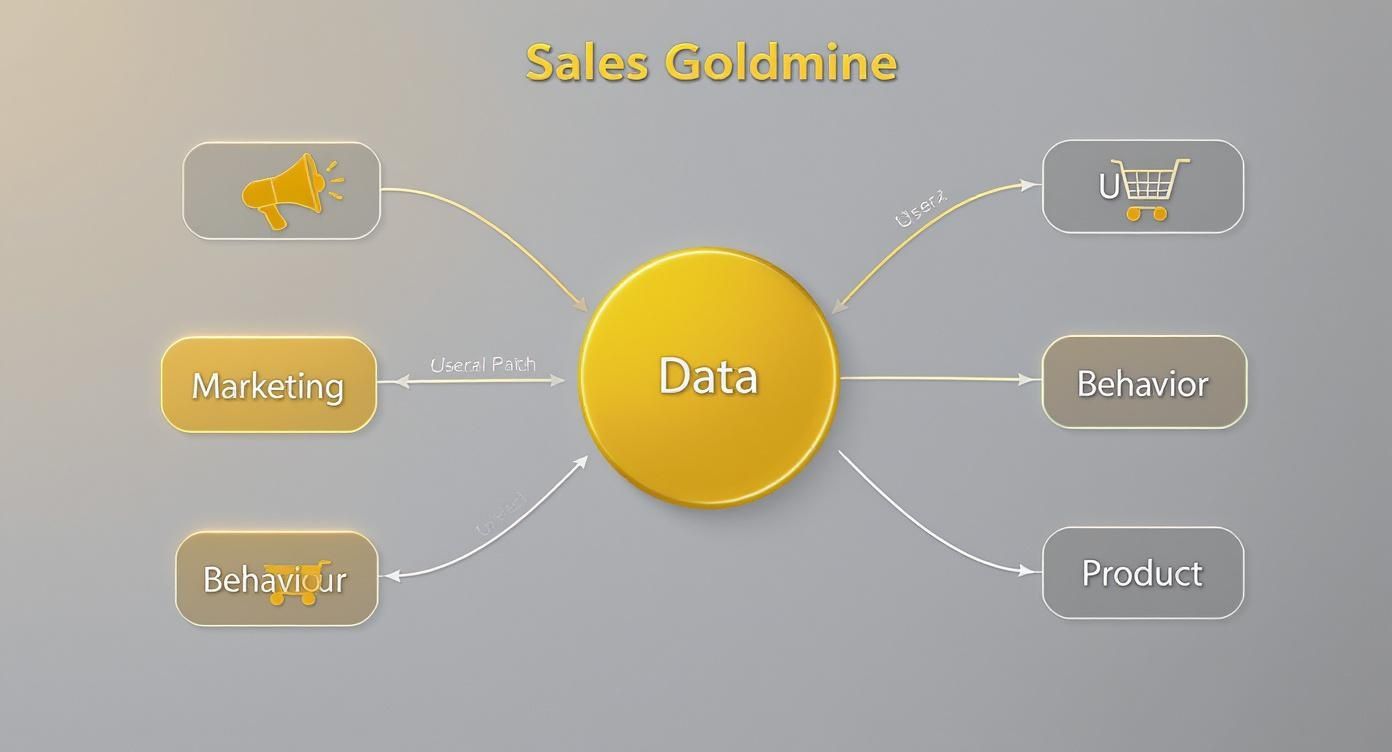
Every single sale leaves clues about which marketing channels are working, what makes your products click, and the journey customers take from discovery to checkout.
The Basic Growth in Sales Formula
The most fundamental growth in sales formula is all about measuring the percentage change between two points in time. It's the simplest way to get a standardized look at your performance, whether you're comparing this week to last week or this year to last year.
The formula is dead simple: ((New Sales - Old Sales) / Old Sales) x 100
Let's say your Shopify store pulled in $20,000 last month (Old Sales) and ramped up to $25,000 this month (New Sales).
- Calculation: (($25,000 - $20,000) / $20,000) x 100
- Result: 25%
Boom. Your sales grew by 25% this month. That one number is so much more powerful than just saying you made an extra $5,000. It gives you context and a real benchmark to beat next month.
This isn't just for small-scale comparisons, either. On a global scale, retail ecommerce sales are expected to jump from $5.08 trillion in 2022 to $6.42 trillion by 2025. That's a massive 26.38% growth, showing just how quickly e-commerce is eating up the retail world. You can dig into the full analysis of these global ecommerce trends to see how your own growth stacks up.
For quick reference, here are the key formulas we'll be covering.
Key Sales Growth Formulas at a Glance
This table is your cheat sheet for the most important sales growth calculations. It’s a handy reference for understanding what each formula tells you about your DTC store's health.
| Formula Type | Calculation | What It Tells You |
|---|---|---|
| Percentage Growth | ((New - Old) / Old) x 100 |
The fundamental rate of change between any two periods. |
| Month-over-Month (MoM) | ((Current Month - Last Month) / Last Month) x 100 |
Your short-term speed. Did that new ad campaign work? |
| Year-over-Year (YoY) | ((Current Period - Same Period Last Year) / Same Period Last Year) x 100 |
Your long-term health, smoothing out seasonal ups and downs. |
| Compound Annual Growth Rate (CAGR) | (Ending Value / Beginning Value)^(1 / # of Years) - 1 |
The average annual growth rate over multiple years. |
Keep these handy as you analyze your performance—they’re the building blocks for deeper insights.
Month-over-Month (MoM) Growth
Month-over-Month (MoM) growth is your go-to for tracking short-term momentum. It’s the exact same percentage growth formula we just used, but applied specifically to compare one month against the previous one.
MoM growth is like the speedometer for your Shopify brand. It shows how fast you're accelerating or decelerating right now, making it perfect for judging the immediate impact of a flash sale, a new product launch, or a big marketing push.
Comparing March sales to February sales gives you your March MoM growth. Tracking this consistently helps you get a feel for your store’s rhythm and see what’s working (or not) in your day-to-day tactics.
Year-over-Year (YoY) Growth
If MoM growth is the short sprint, Year-over-Year (YoY) growth is the marathon. This metric compares your performance in a specific period—like a month or a quarter—to the exact same period in the previous year.
So why is this an absolute must for any DTC brand? One word: seasonality.
- Example: A swimwear brand will almost certainly see sales dip in November compared to October. The MoM growth will be negative, and that’s okay.
- The real question is: How did November 2024 do compared to November 2023?
If your sales are up 15% YoY, you know you're on the right track, even if the MoM number looks scary. YoY growth cuts through the noise of seasonal trends and gives you a true, honest look at your brand's underlying health and market position over the long haul.
Putting Your Growth Formulas into Action
Knowing the theory behind sales growth is great, but the real magic happens when you apply it to your own Shopify store. Let's get our hands dirty and walk through exactly how to turn those raw numbers into real insights using a tool you probably have open right now: a simple spreadsheet.
First things first, you need your data. Head over to your Shopify Admin, click on Analytics > Reports, and pull up the "Sales over time" report. Go ahead and export your net sales data for the last two full months, along with the same two months from last year. This is your raw material.
Calculating MoM and YoY Growth in a Spreadsheet
Got your numbers? Perfect. Open up a blank Google Sheet or Excel file. We'll use a straightforward example for a DTC skincare brand to make this tangible.
Here’s a clean way to structure your data so you can see both your Month-over-Month (MoM) and Year-over-Year (YoY) growth at a single glance.

This simple table immediately tells a story. The brand saw a solid 20.0% MoM jump from March to April 2024—nice! But its YoY growth for April was a more measured 10.0%. This tells us that while recent efforts are paying off, the bigger picture shows a slower pace of growth compared to last year.
To get these percentages yourself, you just need to plug in the formulas we covered earlier.
- For MoM Growth (Cell D3): Punch in
=((C3-B3)/B3)and format the cell as a percentage. This compares April 2024 to March 2024. - For YoY Growth (Cell E3): Use
=((C3-C2)/C2)and format it as a percentage. This stacks April 2024 up against April 2023.
With just a couple of simple formulas, you've turned a boring list of numbers into a powerful diagnostic tool. You can now track your short-term momentum and your long-term trajectory, side-by-side.
Interpreting Your Results Like a Strategist
Getting the numbers is just the first step. The real skill is asking why. What's the story behind a strong MoM but a flat YoY? This is where your intuition as a founder meets the hard data.
A growth percentage is never just a number; it's the result of every marketing campaign, product decision, and customer interaction you've had. Your job is to connect the dots and find the narrative behind the math.
For instance, our skincare brand's 20% MoM spike in April could be the direct result of a killer Mother's Day email campaign. But the softer 10% YoY growth might hint that the market is more crowded this year, or that last year's big influencer push set a really high bar.
Context is everything. Did you run a massive sale last April that you skipped this year? Did a competitor just launch a nearly identical product? This level of analysis elevates you from a scorekeeper to a strategist, empowering you to make smarter calls on what to do next. It's also precisely this kind of manual dot-connecting that platforms like MetricMosaic are built to automate, instantly surfacing the story behind your sales figures.
Common Mistakes in Measuring Sales Growth
Seeing that revenue number climb in your Shopify dashboard feels incredible, but it can sometimes hide serious problems brewing just beneath the surface. Too many DTC founders fall into common traps when they track growth, giving them a dangerously incomplete picture of their store’s health.
Getting the growth in sales formula right means you have to sidestep these pitfalls.
The most common mistake? Focusing on gross sales instead of net sales. Gross sales—the total top-line revenue before any deductions—can be incredibly misleading. A huge spike might look like a win, but what if it came from a steep discount that also drove a 30% jump in returns? Your actual take-home profit could be tanking.
True growth isn't about how much you sell; it's about how much you keep. Always use net sales (gross sales minus returns and discounts) for your growth calculations to get an honest, accurate view of your financial health and profitability.
Relying on gross sales is like celebrating a full bucket without realizing it’s riddled with holes. You need to know how much water is actually staying inside.
Ignoring the Impact of Seasonality
Another frequent error is panicking over the natural ups and downs of your business calendar. If you run a Shopify store selling swimwear, a drop in sales in October isn't a crisis—it's completely expected. Comparing October's numbers to September's is just setting yourself up for a flawed analysis.
This is where Year-over-Year (YoY) growth becomes your most valuable metric. Instead of stressing about a slow January after a record-breaking holiday season, you should be asking, "How did this January compare to last January?"
- Bad analysis: "Our sales dropped 50% from December to January. We're in trouble!"
- Smart analysis: "Our January sales are up 15% YoY. We're growing steadily, even with the predictable post-holiday dip."
Ignoring seasonality leads to reactive, emotional decisions. Understanding it allows for calm, strategic planning built on long-term trends, not short-term noise.
Relying on Blended Growth Numbers
Finally, looking only at your overall, or "blended," sales growth can mask critical issues at the channel or product level. Your total revenue might be up 10%, but what if that growth is coming from a single heroic marketing channel while two others are bleeding cash?
A blended number won't tell you that your best-selling product has seen a 20% sales decline, which is being propped up by a new product launch. This is dangerous because you won’t spot weaknesses until they become massive threats.
You have to segment your growth analysis to truly understand what's driving performance. This is where modern AI analytics tools shine, automatically breaking down your growth by channel, product, and customer segment to give you the full story behind the numbers.
Moving Beyond Spreadsheets with AI Analytics
Let's be honest: manually plugging numbers into a spreadsheet to calculate your growth in sales is a grind. It’s a necessary first step for a new Shopify store, but it's not where you find your competitive edge. That old-school process is slow, full of potential for human error, and completely disconnected from the rest of your business data. As a founder, your time is far too valuable to be spent debugging formulas.

This is exactly where AI-powered analytics platforms like MetricMosaic come in. Think of them as a growth co-pilot for your DTC brand, handling all the tedious number-crunching so you can get back to making smart, fast decisions that boost your ROAS, AOV, and LTV.
Automation and Accuracy at Scale
AI analytics tools immediately solve the biggest headaches of manual tracking. They instantly and accurately calculate all your core metrics—MoM, YoY, and even trickier ones like Compound Annual Growth Rate (CAGR)—without you lifting a finger.
AI doesn't just do the math; it ensures the math is always correct and up-to-date. It kills the risk of a simple copy-paste error in a spreadsheet derailing your entire quarterly strategy.
This kind of automation frees you from the endless cycle of exporting, cleaning, and calculating data. Instead, you get a real-time, reliable view of how your business is doing, letting you jump on opportunities the moment they appear.
This is critical in a market that moves as fast as ecommerce. For example, U.S. ecommerce sales hit a massive $292.9 billion in Q2 2025 alone, a 6.2% jump from the previous quarter. That growth blew past total retail, which only grew by 3.8% in the same timeframe. You can dig into the numbers yourself in the official report on U.S. retail and ecommerce sales.
Unlocking Deeper Strategic Insights
Real growth comes from understanding the "why" behind your numbers, and this is where AI truly changes the game for Shopify founders. It goes way beyond simple calculations to uncover complex patterns and trends that are practically invisible in a spreadsheet.
AI-driven platforms can deliver:
- Predictive Analytics: Imagine getting a forecast that shows which products are about to trend next month based on how your customers are behaving right now. This lets you get ahead of inventory and marketing spend instead of just reacting.
- Story-Driven Data: Instead of a static report, AI can surface proactive insights like, "Your ROAS from Meta ads dropped 15% last week for this specific customer segment." More importantly, it can suggest what to do about it.
- Conversational Analytics: This is where things get really interesting. You can just ask questions in plain English, like, "What was our sales growth from last month's Klaviyo campaign?" and get an instant, accurate answer with charts.
By handing off the manual labor to AI, you trade mind-numbing data entry for forward-looking strategic insight. It’s a shift that lets you stop reacting to what happened last month and start actively shaping your future growth.
Common Questions About Sales Growth
As you start plugging these formulas into your own Shopify store's data, a few common questions always seem to surface. Let's tackle them head-on with some straight-up, founder-friendly answers.
What’s a Good Monthly Sales Growth Rate for a Shopify Store?
Honestly, anyone who gives you a single "magic number" is selling something. A "good" rate is completely dependent on your industry, how long you've been in business, and your brand's stage.
A brand-new DTC store might see an explosive 50-100% month-over-month growth as it finds product-market fit. On the other hand, a more established, multi-million dollar Shopify store might be thrilled with a steady and sustainable 5-15% MoM growth.
The best benchmark isn't some random industry figure; it's your own historical performance. The real goal is sustainable, profitable growth—not just chasing a vanity percentage. This is where a sharp, AI-powered analytics tool comes in, helping you see what a healthy trajectory looks like for your business, in your specific context.
How Do I Calculate Growth with a High Volume of Returns?
This is an absolutely critical point for any eCommerce brand. You have to, without fail, calculate your growth using Net Sales, not Gross Sales. Your Net Sales is the real number: your total revenue after you’ve subtracted all returns and discounts.
Using gross revenue is just lying to yourself. It inflates your performance and can hide serious problems with product quality or a discount strategy that's bleeding you dry. It tells you what you shipped, not what you actually earned.
Trying to separate this data manually is a recipe for a headache. It's exactly why modern analytics platforms automatically sync with your Shopify data to base all growth calculations on the true, post-return revenue that actually hits your bank account.
Can I Use This Growth Formula for Other Metrics?
Yes, and you absolutely should. The core percentage growth formula—((New Value - Old Value) / Old Value) * 100—is one of the most versatile tools in your kit. It's not just for revenue.
You can and should apply the exact same logic to measure the pulse of other vital eCommerce metrics. Use it to track the rate of change for:
- Website Traffic: Is the top of your funnel actually growing?
- Conversion Rates: Are you getting better at turning those clicks into customers?
- Average Order Value (AOV): Are people spending more each time they check out?
- Customer Lifetime Value (LTV): Is your customer retention strategy working?
Tracking the growth of these underlying metrics is key, as they are often the canaries in the coal mine—the leading indicators of where your sales are headed next. Seeing all these trends visualized together is how you get the complete story of your business's health and momentum.
Stop guessing and start growing. MetricMosaic pulls all your Shopify data into one clear view, delivering AI-powered insights that tell you exactly what's driving growth and where to focus next. Ditch the spreadsheets and discover the story your data is waiting to tell you.