Your Shopify First-Party Data Strategy: A Founder's Guide to Durable DTC Growth
Unlock sustainable growth for your Shopify store. Learn how a first-party data strategy improves targeting, boosts retention, and lowers ad costs.
A first-party data strategy is your game plan for collecting, organizing, and actually using the information your customers give you directly. It's the data they willingly share with your Shopify brand every single day—every click, every purchase, every email signup.
It’s a fundamental pivot away from renting audiences on platforms like Meta to owning your customer relationships outright. This isn't just a "nice-to-have" for your DTC brand; it's how you build a real, durable advantage in a world that’s getting more private by the day.
Why Your Old Shopify Growth Playbook Is Broken
Feeling like you're pouring more money into ads just to tread water? You're not the only one. Your customer data is a fragmented mess, scattered across Shopify, Google Analytics, and a dozen different ad platforms. Trying to get a clear picture of what’s actually driving growth feels next to impossible, leaving you with unreliable reports and unclear ROI.
For years, the direct-to-consumer growth playbook was ridiculously simple: find a cool product, fire up some Meta ads, and watch the Shopify orders come in. But that playbook is now officially torn up, leaving founders with dwindling returns and customer acquisition costs (CAC) that just keep climbing.
The root of the problem is a deep-seated reliance on third-party data—the very foundation that iOS updates and browser privacy changes have systematically dismantled. This is the new normal.
The Great Data Shift
The marketing world has moved on from borrowed data. A staggering 87% of organizations now say first-party data is their top collection priority. This isn't just another trend; it's a seismic shift driven by privacy laws and the walled gardens being built by browsers like Chrome and Safari. You can get the full story in this marketing data report.
This shift means the old tricks of dropping third-party pixels everywhere for laser-sharp targeting are over. Your ability to find new customers and truly understand the ones you have is eroding, day by day.
The only sustainable path forward is to build a powerful first-party data strategy. It transforms data from a technical headache into your most valuable asset, creating a foundation for profitable, long-term growth that you control.
From Renting to Owning Your Audience
Think about it this way: relying on ad platforms is like renting an audience. You pay for access, but you never actually own the relationship. The second the platform tweaks its algorithm or changes its privacy rules, your entire business feels the shockwave.
Building your own first-party data asset is about owning, not renting. It's about systematically collecting and using information from on-site behavior, purchase history, and email engagement to build direct, resilient relationships with the people who buy from you.
It's time to stop paying rent and start building equity in your audience.
What a First-Party Data Strategy Really Means
Let's be honest, "first-party data strategy" sounds like something reserved for enterprise data teams. But it's not. For a Shopify founder, it’s the simple, powerful practice of collecting, organizing, and actually using the information your customers give you directly. Every purchase, every email signup, every click, every survey response—it's all part of their story.
This direct line to your customer is your new unfair advantage. You stop guessing what strangers want based on shaky third-party signals and start building your growth engine on direct, consensual, and incredibly accurate insights. AI-powered analytics platforms make this possible by automating the manual data crunching, turning complexity into clarity.
Building a Moat in a More Private World
Relying entirely on ad platform algorithms is like building your house on rented land. You're completely at the mercy of the landlord. When Meta or Google changes the rules of the game—and they always do—your ROAS and CAC are the first casualties. A first-party data strategy is about owning your land and building an asset that you control, brick by brick.
This approach makes your brand resilient. It's your insulation against wild algorithm swings and the slow, inevitable death of third-party cookies. The data is simply better because it comes straight from your audience. No more guesswork, no more stale, aggregated data that leads to marketing that just doesn't land. You can find out more about how AI and signal loss are elevating first-party data.
A first-party data strategy is your plan to systematically turn customer interactions into your most powerful growth asset. It’s the bridge between raw data and creating experiences that make customers feel seen, understood, and valued.
Connecting Your Data to Your Bottom Line
For a Shopify founder, this isn't just a technical project; it's a direct line to a healthier P&L. When you truly understand your customers, you see real, tangible improvements across every DTC metric that matters.
- Lower Customer Acquisition Cost (CAC): Stop wasting money on broad targeting. You can build lookalike audiences from your actual best customers, making every ad dollar work harder.
- Higher Return on Ad Spend (ROAS): When you sync precise customer segments to your ad platforms, you can deliver hyper-relevant messages that convert better and cost less. Simple as that.
- Increased Lifetime Value (LTV): Knowing someone's purchase history and behavior means you can create personalized retention campaigns that bring them back again and again.
Ultimately, this isn't just about data—it's about building relationships. It’s the foundation for creating the kind of personalized experiences that turn one-time buyers into your brand’s biggest fans. This is how modern DTC brands win.
The Four Pillars of Your DTC Data Flywheel
Building a first-party data strategy can sound intimidating, but it's really just a system. The best way to think about it isn't as a one-and-done project, but as a growth flywheel—a cycle where each part feeds the next, creating powerful, unstoppable momentum for your Shopify brand.
This flywheel has four key parts. Get these right, and you'll turn that messy pile of raw data from a liability into your single greatest asset for profitable growth.
The whole process is about creating a continuous loop: you collect data, organize it, and then use it to create better experiences, which in turn generates more data.
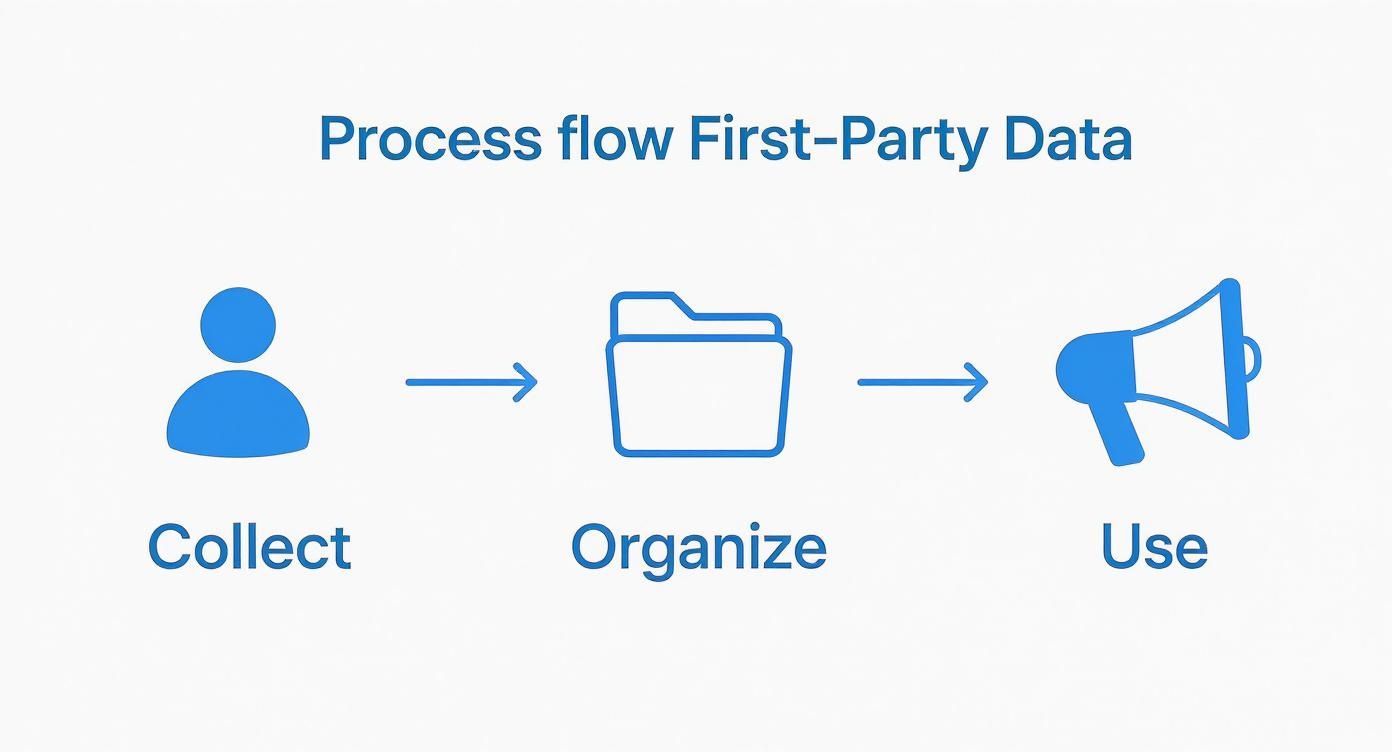
It’s a simple but powerful idea. Data isn't something you just store away; it's a living resource that needs to be actively managed to drive real value.
Pillar 1: Collection
First things first, you need to ethically gather the information your customers are already sharing with you at every turn. This isn't about sneaky tracking. It’s about building a value exchange—customers give you information because they know it leads to a better, more personalized experience.
Your Shopify store is an obvious goldmine, but a truly effective strategy casts a wider net. You want a rich blend of what people buy, how they behave, and what they tell you directly.
This table breaks down the core data sources every Shopify brand should be tapping into.
Key First-Party Data Sources for Shopify Brands
| Data Source | Example Data Points | Primary Use Case |
|---|---|---|
| Shopify | Purchase history, AOV, products viewed, add-to-carts, abandoned checkouts. | Understanding purchase behavior and identifying high-value customers. |
| Email & SMS Platforms | Open/click rates (Klaviyo), campaign conversions (Attentive), list segments. | Measuring channel engagement and attributing revenue. |
| Website Analytics | Pages visited, time on site, traffic source (Google Analytics 4), conversion paths. | Analyzing the full customer journey and site performance. |
| Ad Platforms | Ad clicks, impressions, conversions (Meta Ads). | Connecting ad spend to actual customer acquisition and LTV. |
| Customer Surveys | Post-purchase feedback ("How did you hear about us?"), quiz results. | Capturing direct customer voice and preference data (zero-party data). |
| Loyalty & Reviews | Points earned, reward redemptions, product reviews, star ratings. | Identifying brand advocates and understanding product sentiment. |
These sources form the foundation of your flywheel. The quality and depth of the data you collect here will directly impact the power of everything that follows.
Pillar 2: Unification
Collecting data is one thing, but making sense of it is another. Right now, that valuable customer info is probably scattered everywhere—your Shopify admin, your Klaviyo account, your Meta Ads manager, and Google Analytics all have their own version of reality. That fragmentation is the biggest roadblock to seeing the complete picture.
Unification is all about pulling those scattered puzzle pieces together into a single, reliable source of truth. It’s about creating one clear, cohesive profile for each customer. Instead of wrestling with spreadsheets, modern tools like AI-powered analytics platforms do this heavy lifting for you automatically.
Unifying your data creates that coveted 360-degree customer view. This isn’t just a technical exercise—it’s the bridge that lets you move from siloed channel tactics to a truly customer-centric growth strategy.
Pillar 3: Segmentation
Now for the fun part. With all your data collected and unified in one place, the real magic can begin. Segmentation is where you slice your customer base into smaller, meaningful groups based on shared traits, behaviors, or value. This is how you finally stop shouting the same message at everyone and start having personalized conversations at scale.
Forget generic "all subscribers" email blasts. Now you can build incredibly precise audiences designed to achieve specific goals.
- High-Value VIPs: Your top spenders who deserve white-glove treatment.
- Potential Churn Risks: Customers who made one purchase but haven't been back in 90 days.
- Likely-to-Buy-Again: New customers who are already showing high-intent signals, like visiting the site multiple times after their first order.
- Category Loyalists: Shoppers who only ever buy from your skincare collection, not your makeup.
These segments become the strategic building blocks for smarter marketing. They let you tailor every message, offer, and ad for maximum impact.
Pillar 4: Activation
Finally, activation is where your data starts making you money. It's the simple act of taking those powerful segments you just built and putting them to work across all your marketing channels. This is what closes the loop between insight and action, turning your unified data into cold, hard cash.
Activation means syncing your segments directly into the tools you use every day.
- Smarter Emails: Send a targeted "we miss you" campaign in Klaviyo specifically to your "Potential Churn Risks" segment.
- Lower Ad Costs: Build a lookalike audience on Meta Ads from your "High-Value VIPs" segment to find more people just like your best customers, crushing your ROAS goals.
- A Better On-Site Experience: Use a tool like Intelligems to show personalized product recommendations on your Shopify store to your "Category Loyalists."
This is the pillar that connects your first-party data strategy directly to your bottom line. It ensures every piece of data you collect is ultimately driving smarter, more profitable growth.
Putting Your First-Party Data to Work
Okay, let's move past the theory and get into what really matters: results. Having a clean, unified customer list is a fantastic first step, but the real magic happens when you activate that intelligence.
This is the moment your data stops being a passive asset collecting dust in a database and becomes your single most powerful growth driver. It’s not about just running more campaigns; it’s about running smarter ones. Every move you make is now backed by a real understanding of who your customers are and what they actually want.
The result? A direct, measurable impact on the Shopify metrics you care about most.
Driving Tangible Growth with Data Plays
When you put your first-party data into action, the results aren't just incremental—they're massive. One landmark study found that businesses that truly put first-party data at the core of their marketing saw up to a 2.9x revenue uplift and a 1.5x increase in cost savings.
That’s a direct line from a solid first-party data strategy to a much healthier bottom line. You can dig into the specifics in the full report on Shopify's enterprise blog.
This is exactly where AI-powered analytics tools like MetricMosaic change the game for DTC brands. Forget manually pulling CSVs and guessing at segments. Instead, you can use predictive insights to pinpoint your highest-potential customers and automate syncing those audiences straight to your marketing channels.
Activation is the final, crucial step that turns your data into dollars. It’s where you take a highly specific customer segment and deliver a perfectly timed, hyper-relevant experience that drives a desired action—whether it's a second purchase, a higher-value cart, or a win-back.
Tactical Examples for Your Shopify Store
So, what does this actually look like day-to-day? Here are three simple but powerful plays you can run right now to see an immediate lift, all powered by precise, first-party data segments.
1. Slash Your Customer Acquisition Cost (CAC)
- The Play: Stop burning cash on broad, hopeful targeting. Instead, build a segment of your top 10% of customers based on their lifetime value (LTV).
- Activation: Sync this "VIP Customers" segment directly to Meta Ads and spin up a lookalike audience. Meta’s algorithm now has a crystal-clear picture of your best customers and can find more people just like them.
- The Impact: Your ad spend gets laser-focused, reaching a much higher-quality audience that’s primed to convert. This immediately drives down your CAC and boosts your overall ROAS.
2. Boost Lifetime Value (LTV) with Predictive Insights
- The Play: Find the group of "one-time buyers" who have the highest predicted LTV. These are customers who only bought once, but their behavior—what they bought, how they browsed—screams high potential.
- Activation: Set up a specific, personalized welcome flow for them in Klaviyo. Ditch the generic 10% off coupon. Offer a compelling reason to come back, like a free gift with their next order or early access to a new product.
- The Impact: You’re proactively nurturing the customers most likely to become brand champions, dramatically increasing the odds of a second purchase and kickstarting their journey to a much higher LTV.
3. Increase Average Order Value (AOV) with Smart Cross-Sells
- The Play: Create a dynamic segment of customers who have just added a specific "hero" product to their cart. Think of everyone who adds your best-selling coffee blend.
- Activation: Use an on-site personalization tool to trigger a real-time pop-up recommending a complementary product. Show them the specific coffee filter or branded mug that other coffee lovers frequently buy alongside it.
- The Impact: This simple, data-driven nudge can instantly increase cart value for a huge chunk of your shoppers, directly lifting your store’s AOV.
These aren't just abstract ideas. This is how a first-party data strategy delivers real, tangible financial wins for your DTC brand.
How AI-Powered Analytics Unlocks Your Data
Building a sophisticated data flywheel is a great goal, but let's be honest—you're a DTC founder, which means you're already wearing a dozen different hats. Who has the time to moonlight as a full-time data scientist?
This is where AI-powered analytics completely changes the game for lean Shopify brands. It takes the heavy, manual grind of implementing a first-party data strategy and puts it on autopilot, turning a messy technical project into a practical, everyday growth tool.
Modern platforms like MetricMosaic basically act as a dedicated data co-pilot for your team. They plug right into your entire tech stack—Shopify, Klaviyo, Meta Ads, Google Analytics—and do the dirty work of stitching all that scattered data into one, crystal-clear view of your customers.
From Manual Data Crunching to Automated Insights
The old way of doing things was a nightmare. It meant exporting endless CSVs, wrestling with VLOOKUPs in giant spreadsheets, and spending hours trying to piece together reports that, in the end, still didn't tell you the full story. It was slow, frustrating, and nearly impossible to keep up with while also, you know, running a business.
AI-driven analytics automates that entire painful process. Instead of you chasing down the data, the insights come looking for you.
- Automated Unification: AI engines seamlessly pull together your Shopify sales data, your Klaviyo engagement metrics, and your Meta ad spend. This creates a single source of truth without you lifting a finger.
- Proactive Storytelling: Instead of just dumping dashboards on you, these next-gen tools serve up AI-generated "Stories" or recommendations. You might get a notification that says, "Your recent influencer campaign drove a 30% lift in LTV for first-time buyers," giving you both the what and the why.
This shift frees you from the drudgery of data prep and lets you focus completely on strategy and taking action.
The Power of Predictive and Conversational Analytics
But the real magic is how AI makes advanced analytics accessible to everyone on the team. You no longer need a technical background to get data-scientist-level answers.
Two next-gen trends really bring this to life:
Predictive Insights: AI algorithms can analyze the very first actions a new customer takes and accurately forecast their future lifetime value. This lets you spot your future VIPs after just one purchase, so you can start giving them special treatment long before your competitors even know they exist.
Conversational Analytics: This is where it starts to feel like sci-fi. With tools like MetricMosaic, you can just ask your data questions in plain English, the same way you’d ask a colleague. No code, no complex queries—just straight answers.
Imagine typing into a chat box, "Which products are my VIPs buying most often?" or "Show me my ad campaigns with the highest 30-day LTV." This is what conversational analytics delivers. It turns every single person on your team into a data expert.
Making a First-Party Data Strategy Actually Achievable
At the end of the day, AI-powered analytics makes a powerful first-party data strategy not just possible, but practical and profitable for any ambitious Shopify brand. It closes the massive gap between collecting data and actually using it to make more money.
The technology handles all the complexity—the unification, the segmentation, the predictive modeling—so you can stay focused on what you do best: building your brand and creating amazing customer experiences. It puts the full power of your own data back into your hands, turning it into the sustainable, competitive advantage you need to win.
Your Roadmap From Data Chaos to Clear Growth
Feeling fired up but not sure where to start? That's completely normal. Building a real first-party data strategy isn't a flip-the-switch project. The secret is to start small, score an early win, and let that momentum carry you forward.
Forget trying to boil the ocean. This is a simple, four-step playbook to get you from awareness to action. It’s all about laying the groundwork for a smarter, more profitable future for your Shopify brand.
Step 1: Audit Your Data
Before you can build anything, you need to know what you’re working with. The first move is simple: map out what you’re already collecting. Where is all your customer data living right now?
Just make a quick list of your core tools—your Shopify store, your Klaviyo account, Meta Ads, Google Analytics—and the key info each one holds. Don’t get lost in the weeds. The goal here is to get a basic lay of the land, see where your data is walled off, and spot any glaring holes.
Step 2: Define One Goal
Instead of trying to fix everything at once, pick one single, specific metric to move the needle on. This focus is everything. It turns a big, fuzzy idea into a real project with a clear finish line.
Choose a goal that hits the bottom line.
- Boost repeat purchase rate: Get more one-time buyers to come back for a second purchase.
- Increase 90-day LTV: Squeeze more value out of your new customer cohorts, faster.
- Lower CAC: Stop wasting ad spend by finding lookalike audiences that actually convert.
Having one north star metric makes it dead simple to measure success and show the rest of the team that this stuff actually works.
Owning your customer data isn't just another marketing tactic; it's the single most important investment you can make in your brand’s future. It’s your permanent, appreciating asset in a world of rented audiences.
Step 3: Unify Your Stack
Okay, now you need a command center. It’s time to choose a platform that can automatically pull all those scattered data sources into one place. This is where an AI-powered analytics tool like MetricMosaic becomes your central nervous system, killing the need for clunky spreadsheets and manual CSV pulls for good.
Connecting your Shopify store, ad platforms, and email provider to a unified system is the technical linchpin that makes everything else possible. It creates that single source of truth you need to trust your numbers and make decisions with confidence.
Step 4: Launch One Campaign
Finally, it's time to put your data to work and get a win on the board. Start with a simple, high-impact segment. A fantastic place to begin is by identifying your absolute best customers—your VIPs—and building a campaign just for them.
Re-engage this group with an exclusive offer or early access to a new drop. By starting with the people who already love you, you’re stacking the deck in your favor. This one campaign will prove the power of a targeted approach and show you exactly what’s possible when you stop guessing and start growing on a foundation of solid data. This is your first step from awareness to action.
Your Questions, Answered
Jumping into a first-party data strategy can feel like a massive project, but it’s actually more straightforward than you might think. Let's tackle some of the common questions we get from Shopify founders.
Do I Need to Be a Data Scientist to Do This?
Not at all. The old way definitely required a team of analysts and a love for spreadsheets, but the new breed of AI tools is built specifically for founders and marketers.
Modern platforms are designed to do the heavy lifting for you. They connect to your Shopify store, your Klaviyo account, and your ad platforms, then translate all that raw data into clear, simple stories. It’s less about crunching numbers and more about getting actionable advice you can run with.
Isn't This Just Shopify Analytics?
Shopify Analytics is great—essential, even. It gives you a clear picture of what's happening on your store: sales, traffic sources, top-selling products. It’s a vital piece of the puzzle.
But a real first-party data strategy goes much deeper. It pulls that store data together with everything else—your ad spend on Meta, your email opens in Klaviyo, your user behavior in Google Analytics. It stitches all those fragments into one single, cohesive story about your customer. This is how you see the entire journey, not just the last click before a purchase.
Shopify tells you what they bought. A unified data strategy tells you why they bought it, connecting your ad spend directly to customer LTV and showing you what they’ll probably do next.
What's the Easiest First Step I Can Take?
Start by simply asking your customers for information. The easiest win is to start collecting zero-party data—the information people willingly share with you.
It's simpler than it sounds. Add a post-purchase survey with an app. Launch an on-site quiz to help shoppers find the perfect product. Even a simple "How did you hear about us?" question gives you an incredibly valuable piece of data. It’s a low-effort, high-impact way to start building richer customer profiles straight from the source.
Ready to stop guessing and start growing? MetricMosaic is the AI growth co-pilot for Shopify that pulls all your data together and gives you clear, actionable insights automatically. Start your free trial today and turn your data into your biggest advantage.