The Modern Ecommerce Growth Strategy for Shopify Founders
Discover an ecommerce growth strategy using AI-powered analytics to improve ROAS, LTV, and profitability. Actionable advice for DTC and Shopify brand founders.
As a Shopify founder, you know an effective ecommerce growth strategy isn't just about driving more traffic. It’s about building a predictable engine for profitable growth. But you're likely stuck wrestling with fragmented data—Shopify tells you one thing, Google Analytics another, and your ad platforms spin a completely different story. How can you scale confidently when you don't have a single source of truth?
This guide is for DTC founders and marketers who are tired of manual data crunching and unreliable reports. We'll show you how to move beyond vanity metrics and build a growth strategy centered on what actually matters: profitability and lifetime value. It's time to let AI-driven analytics transform that complexity into clarity and turn your store's data into your biggest competitive advantage.
Why Your Current Growth Strategy Isn’t Working
If you're running a DTC brand on Shopify, this probably sounds familiar. You’re trying to stitch together a cohesive growth strategy, but you're drowning in a sea of disconnected dashboards. You've got one tab open for Shopify Analytics, another for Google Analytics, and a third for your Meta Ads manager. None of them agree on your true ROI.

This daily struggle with fragmented data isn't just an annoyance; it’s the primary reason most growth strategies stall. When your data lives in separate silos, you're left with a fractured picture of your performance, leading to critical miscalculations and wasted ad spend.
You might see a killer ROAS in your Facebook Ads dashboard and decide to crank up the budget, only to watch your overall profitability tank. Why? Because platform-reported metrics don't factor in shipping costs, transaction fees, or the actual lifetime value (LTV) of the customers you’re acquiring. It's a classic DTC trap that burns cash and slows growth.
The Problem With a Fractured View
Making smart decisions is nearly impossible when your data is a mess. The old routine of exporting CSV files and wrestling with spreadsheets to get a simple answer is slow, error-prone, and not built for a modern Shopify brand. This old way of doing things leaves you constantly playing defense, reacting to last month’s numbers instead of proactively shaping next month's outcomes.
This reactive loop creates a ton of uncertainty and real-world problems for your Shopify store:
- Wasted Ad Spend: Funneling cash into channels that look great on the surface but are really just acquiring low-value, one-time buyers.
- Missed Opportunities: Failing to spot your most profitable customer cohorts and the specific channels that brought them to your door.
- Unclear ROI: Never knowing the true, blended ROAS and net profit on every single order.
- Stagnant Growth: Hitting a scaling ceiling because you can't confidently double down on what’s actually driving profitable growth.
The core challenge for Shopify brands isn't a lack of data; it's the inability to connect that data into a coherent story. AI-powered analytics replaces manual data crunching, turning your fragmented data points into a clear narrative you can act on.
The shift from a manual, reactive approach to an AI-powered, proactive one is more than an upgrade—it's a fundamental change in how you run your business.
Old Way vs New Way: Your Growth Strategy Toolkit
| Growth Area | The Old Way (Manual & Reactive) | The New Way (AI-Powered & Proactive) |
|---|---|---|
| Data Analysis | Exporting CSVs to spreadsheets. Manual, error-prone, and hours of work. | Unified dashboard with all Shopify & ad data connected. Instant, accurate insights. |
| Performance Metrics | Focus on platform-reported ROAS and top-line revenue. | Focus on blended ROAS, LTV to CAC ratio, and net profit per order. |
| Customer Insights | Generic audience targeting based on surface-level demographics. | Deep cohort analysis to identify and target high-LTV customer segments. |
| Decision Making | Gut feelings and lagging indicators. Reacting to last week's performance. | Predictive insights and real-time data. Proactively shaping future outcomes. |
| Tooling | Dozens of disconnected dashboards (GA, Shopify, Ads Managers). | A single source of truth like MetricMosaic that tells the complete story. |
This evolution is critical for staying ahead in the competitive DTC landscape.
Thriving in a Competitive Market
The stakes have never been higher. The global eCommerce market is on a tear, projected to hit around $6.8 trillion in sales by 2025. All that growth means more competition, making a truly smart ecommerce growth strategy non-negotiable if you want to carve out your piece of the pie. You can learn more about the future of eCommerce and its impressive growth statistics.
To scale profitably today, you need to graduate from traditional analytics. The key is a unified, AI-powered approach that turns complexity into clarity. Imagine being able to ask your data, "What was my new customer profitability from TikTok last month?" and getting an instant, accurate answer. That's the power of modern tools like conversational analytics, built for the unique grind of a DTC brand. It’s time to stop guessing and start building a strategy based on the complete picture.
Defining the Metrics That Actually Matter
Before you can build an ecommerce growth strategy that actually works, you need to measure what matters. Too many Shopify founders get lost in a sea of feel-good numbers—traffic spikes, session counts, and social media likes. These are classic vanity metrics. They look good on a dashboard but they don’t drive profitability.
Real growth is measured in profit, not just activity. The first move in building a smarter strategy is to get laser-focused on the numbers that reveal your business's true financial health. This means getting comfortable with a few key acronyms that separate the DTC brands that scale from the ones that stall out.
It's all about knowing your numbers cold. You should be able to answer, "Are we acquiring customers profitably?" or "How much can we really afford to spend on a new customer?" without getting trapped in a spreadsheet nightmare for three hours.
Moving Beyond Simple ROAS
The most common trap I see is a total reliance on Return on Ad Spend (ROAS) as reported inside platforms like Meta or Google. A 4x ROAS on a Facebook campaign looks fantastic on the surface, but it’s a dangerously incomplete picture. That number doesn't account for your cost of goods sold (COGS), shipping, transaction fees, or any of your other operational costs.
This is where a much smarter metric, Blended ROAS, comes in. You simply divide your total revenue by your total ad spend across all channels. This gives you a much clearer, top-level view of your marketing efficiency and its real impact on your bottom line.
Even better? Get a handle on your Contribution Margin. In simple terms, this is the profit you make on each sale after subtracting all the variable costs tied to that specific order—COGS, payment processing fees, shipping, and handling. Once you know this number, you know exactly how much cash you have left to reinvest in growth.
The North Star Metric for DTC Growth
If there’s one single metric that should guide every decision you make in your ecommerce growth strategy, it’s the LTV to CAC ratio.
- Customer Lifetime Value (LTV): This is the total profit you can expect to make from a single customer over their entire relationship with your brand.
- Customer Acquisition Cost (CAC): This is the total you spend on sales and marketing to acquire one new customer.
The ratio between these two is your ultimate health score. A healthy, scalable DTC brand is typically aiming for an LTV to CAC ratio of at least 3:1. This means for every dollar you spend to get a customer, you make three dollars back in profit over their lifetime. If your ratio is lower than that, you might just be "buying" revenue at a loss.
For any Shopify brand, the LTV to CAC ratio is your compass. It tells you not just if your marketing is working, but if your entire business model is sustainable for the long haul.
Calculating this manually is a monster of a task, full of cohort analysis and messy spreadsheets. This is exactly where AI-powered analytics platforms like MetricMosaic become a game-changer. They automate the entire process, connecting data from Shopify and your ad platforms to give you a real-time, accurate LTV to CAC ratio without any of the manual data-crunching headaches.
Building Your Performance Framework
With these core metrics in focus, you can build a simple but incredibly powerful framework to get your whole team on the same page. Marketing, ops, and finance should all be marching toward the same set of goals.
Here’s what your framework should prioritize tracking:
- LTV to CAC Ratio: The ultimate measure of sustainable growth.
- Contribution Margin Per Order: Your real-time profitability on every single sale.
- Blended ROAS: The true efficiency of your total marketing investment.
- 60-Day or 90-Day Customer LTV: A shorter-term view to quickly gauge the quality of your customer cohorts and see if retention efforts are working.
Instead of chasing fleeting traffic goals, focusing on these metrics ensures every part of your growth strategy is geared toward what actually matters—building a profitable, resilient business. Modern AI tools make this possible by turning scattered data points into a clear, actionable story about your brand's financial health.
Auditing Your Channels to Find Hidden Profits
Okay, so you’ve got your North Star metrics dialed in. Now for the hard part: taking a brutally honest look at your current marketing channels. It’s easy to get tunnel vision when you're spending thousands on Meta, Google, and TikTok. But do you really know which ones are bringing in your most profitable customers?
So many DTC founders get trapped by platform-reported ROAS. It’s a vanity metric that often hides the real story of your business's profitability.
A real channel audit isn’t about just finding what’s “working” on the surface. It’s about digging deeper to uncover the hidden profits—and losses—buried in your data. This is the difference between scaling a channel that brings in one-time discount shoppers and scaling the one that delivers loyal customers with a 3x higher LTV. The mission here is to get beyond channel-specific metrics and understand how each one actually contributes to the health of your business.
Uncovering the Truth with Cohort Analysis
The most powerful tool for this job? Cohort analysis.
Instead of looking at broad, month-over-month revenue, you group customers by when they were acquired (their "cohort") and track their spending over time. This is exactly where manual spreadsheets fall apart for most Shopify brands. It’s just too complex and time-consuming to do right.
This is where modern, AI-powered analytics tools really step up. They automate the entire process, letting you see, for instance, how the LTV of customers you acquired in April compares to those who came in during Black Friday. You stop guessing and start seeing the true, long-term value each channel generates.
An AI-driven analytics platform can surface a story-driven insight like, "Your holiday shoppers from Q4 have a 30% higher LTV than your Q1 cohort, driven by a surge in repeat purchases within the first 60 days." This isn't just data; it's a direct instruction on where to focus your retention efforts.
Segmenting for Profitability
A full channel audit means going deeper than just where the customer came from. The next layer is to segment customers within those channels into valuable groups based on their buying habits. This is how you find your real VIPs and figure out who you should be trying to attract more of.
Start by looking at these key segments:
- High AOV Customers: Who’s spending the most per order? Which channels brought them to you?
- High Purchase Frequency Customers: Who are your repeat buyers? How quickly do they come back for a second purchase?
- High LTV Cohorts: Which acquisition months or campaigns produced customers who stick around and keep spending?
When you combine channel data with these behavioral segments, powerful patterns emerge. You might discover that while Google Ads has a lower upfront ROAS, it consistently brings in customers with the highest AOV. Or that a specific TikTok campaign, despite a high CAC, acquired a cohort with an exceptional 60-day LTV. This is the kind of insight that lets you allocate your budget based on actual profit, not just initial clicks and conversions.
This simple flow shows how the most important metrics tie together to give you a clear picture of your business's health.
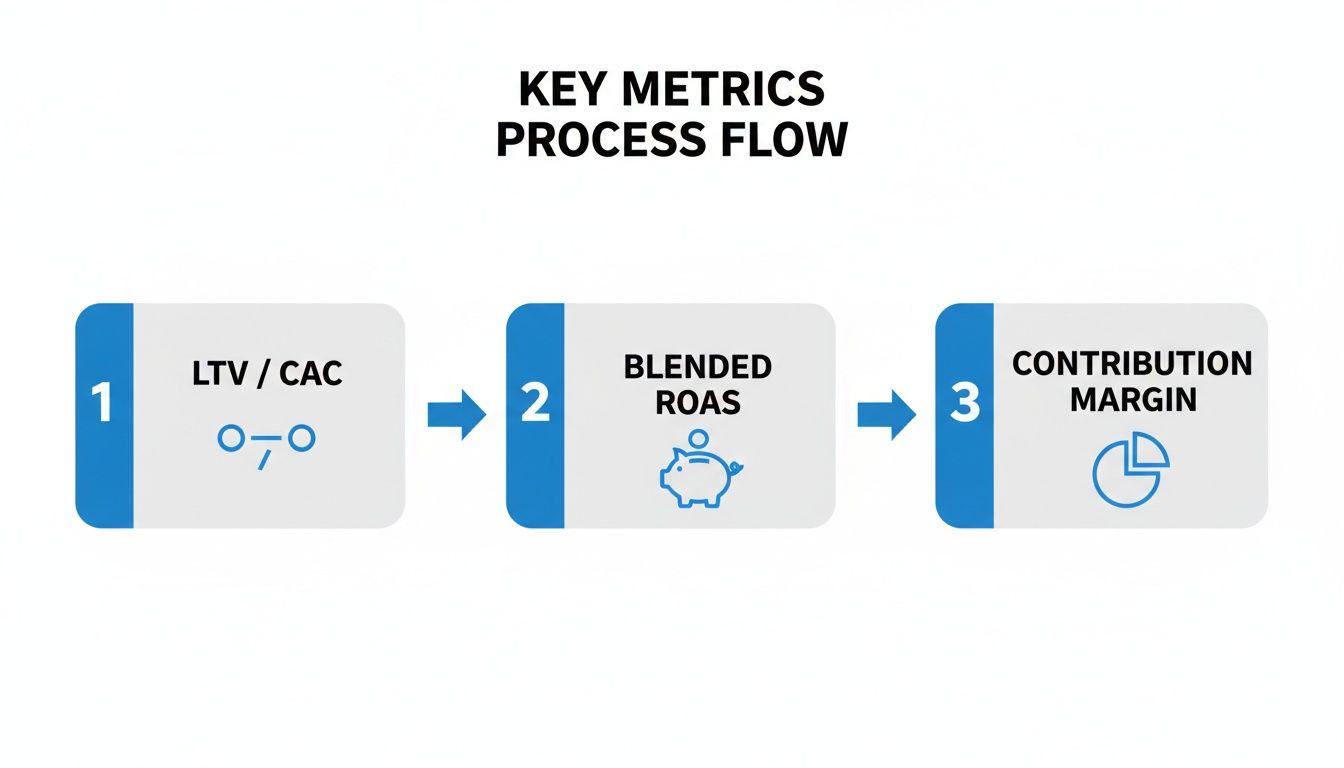
It’s all connected. LTV/CAC tells you about customer value, Blended ROAS shows overall marketing efficiency, and Contribution Margin reveals your per-order profitability. Get these three right, and you’re on your way to building a smarter ecommerce growth strategy.
Here’s a practical breakdown of the metrics you should be looking at when you conduct your own channel audit.
Key Metrics for Your Channel Audit
| Channel Type | Primary Metric | Secondary Metrics | What It Tells You |
|---|---|---|---|
| Acquisition | LTV:CAC Ratio | 60/90-Day LTV, Payback Period, AOV | The long-term profitability and efficiency of a channel. |
| Acquisition | New Customer ROAS | CVR, CPA | The immediate return on ad spend from first-time buyers. |
| Retention | LTV by Flow/Campaign | Open Rate, Click-Through Rate, AOV | How effectively your email/SMS efforts are driving repeat purchases. |
| Retention | Time to Second Purchase | Repeat Purchase Rate | The speed and likelihood of a new customer becoming a loyal one. |
This table isn't exhaustive, but it's a solid starting point for moving beyond surface-level stats and understanding the true performance of your marketing.
Auditing Your Retention Channels
Your audit isn't finished until you’ve scrutinized your retention efforts in email and SMS. It's not enough to just send out campaigns; you need to measure their direct impact on LTV and purchase frequency.
Analyze the performance of different campaigns by segment:
- Does your welcome series actually convert new subscribers? What’s the average LTV of customers who engage with it versus those who don’t?
- Are your abandoned cart flows recovering sales profitably, or are you just torching your margin with steep discounts?
- Do your post-purchase campaigns successfully drive a second purchase within that critical first 30-60 day window?
Answering these questions shows you exactly where the leaks are in your retention funnel. With a tool like MetricMosaic, this becomes much simpler. The platform connects your Klaviyo data directly to your Shopify store data, automatically calculating the LTV of customers who engage with specific email flows.
This turns your retention channels from a cost center into a predictable profit driver, completing your audit and arming you with the insights needed to build a truly effective growth strategy.
Building Your Acquisition and Retention Playbooks
Alright, you've audited your channels and have a solid grasp on your metrics. Now it's time to move from analysis to action. This is where we build the specific, repeatable playbooks that will actually drive your growth.
Think of it as creating a balanced engine. Customer acquisition and retention need to work in perfect harmony, not as competing priorities.
The old way was to stick these teams in separate silos. The acquisition folks chased top-of-funnel leads, while the retention team desperately tried to keep the bucket from leaking. That just doesn’t work anymore. To scale sustainably today, you need a unified approach fueled by real-time profitability data.
Crafting a Smarter Acquisition Strategy
Your acquisition playbook needs to be guided by one core principle: optimize for long-term profit, not just the immediate ROAS you see in your ad dashboards.
Relying on those misleading numbers inside your Meta or Google Ads accounts is a surefire recipe for burning cash on customers who buy once and never come back.
The real game-changer is basing your ad spend decisions on your LTV to CAC ratio. When you know that customers from a specific Google Ads campaign have a 2.5x higher LTV than those from a TikTok campaign, your budget allocation becomes crystal clear. You can scale the winning campaigns with confidence because you're not just guessing—you're making decisions based on actual, predictable profit.
Here’s how you can put that into practice:
- Scale with LTV Data: Double down on the campaigns and channels that consistently bring in high-LTV customer cohorts. A good analytics tool can surface these insights automatically, telling you things like, "Your 'Outdoor Enthusiast' lookalike audience on Meta has a 90-day LTV of $150, well above your Shopify store average."
- Test New Channels Intelligently: When you're ready to explore a new platform, set a data-informed test budget. Don't just pull a number out of thin air. Base it on your target CAC and the average LTV of similar customer profiles you've acquired from other channels.
- Optimize Ad Creative for Value: Look beyond click-through rates. Analyze which ad creatives and messages attract customers with the highest AOV and repeat purchase rates. This gives your creative team direct feedback on what resonates with your best customers.
The goal isn't just to acquire customers; it's to acquire the right customers. A modern acquisition playbook uses profitability data to filter out the one-time buyers and focus every dollar on attracting future brand loyalists.
This approach transforms your ad spend from an expense into a calculated investment in future revenue.
Engineering a Powerful Retention Engine
While acquisition brings new customers in the door, retention is what builds a resilient, profitable DTC brand. It’s always cheaper to get an existing customer to buy again than to acquire a new one.
Your retention playbook should be laser-focused on systematically increasing Average Order Value (AOV) and purchase frequency.
This is where next-generation analytics really shine. Forget the generic "we miss you" email blasts that everyone ignores. Modern tools let you act on predictive insights that were once only available to enterprise giants.
Imagine your analytics platform sending you an alert: "We've identified a cohort of 250 customers who haven't purchased in 60 days but have a high predicted LTV. They are at risk of churning." This isn't just a report; it's a direct command to act. You can immediately export that list and hit them with a personalized re-engagement campaign.
Here are some actionable retention tactics for your playbook:
- Personalized Campaigns: Segment customers based on purchase history and LTV to create hyper-relevant email and SMS flows. Target your high-LTV cohorts with exclusive offers or early access to new products.
- Churn Prevention Alerts: Use predictive insights to spot at-risk customers before they leave for good. A proactive "win-back" offer is far more effective than a desperate plea after they've already gone cold.
- Smart Upsells and Cross-sells: Use market basket analysis to see which products people frequently buy together. This data can directly power your post-purchase email flows and on-site recommendations, giving AOV a nice bump.
- Data-Driven Loyalty Programs: Design your loyalty program to reward the behaviors you actually want to see. If your data shows that customers who make a second purchase within 45 days have a much higher LTV, create a specific reward to incentivize that exact action.
By building these two playbooks—one for profitable acquisition and one for proactive retention—you create a self-reinforcing growth loop. You acquire new, high-value customers efficiently, and your retention efforts turn them into a predictable, growing source of revenue. That balanced approach is the essence of a winning ecommerce growth strategy.
Putting Your Growth Strategy Into Practice

A well-defined strategy is a great start, but its real power comes from execution. For busy Shopify founders and operators, the biggest hurdle is turning that strategy into a daily reality without getting lost in spreadsheets and manual reports.
This is where your growth plan goes from a static document to a living, breathing engine for your business. The goal is to operationalize your insights—to build a system where data doesn't just inform you but actively guides your decisions in real time. It's about closing the gap between knowing what to do and actually doing it.
From Complexity to Clarity with AI
The core problem for most DTC brands isn't a lack of data. It's the overwhelming complexity of trying to connect it all. Manually blending data from Shopify, Google Analytics, Meta Ads, and Klaviyo is a tedious, error-prone task that eats up hours you simply don’t have.
This is exactly the kind of mess that AI was built to solve.
Modern analytics platforms like MetricMosaic act as a central hub for your store. They automatically do the heavy lifting:
- Automated Data Blending: Your key data sources are unified into a single, reliable view of performance. No more conflicting dashboards or CSV exports.
- Real-Time Cohort Analysis: Instantly see the LTV of any customer cohort without spending a day wrestling with pivot tables.
- Accurate Attribution: Get a clear, blended picture of what's truly driving sales, moving beyond the often-misleading data inside the ad platforms themselves.
This kind of automation doesn't just save you time. It gives you the clarity to execute your ecommerce growth strategy with confidence. You stop reacting to last month’s numbers and start proactively shaping next month's outcomes.
The Rise of Conversational and Predictive Analytics
The next big step in operationalizing your strategy is making data more accessible and proactive. Two key trends are leading the way for DTC brands.
First up is conversational analytics. Imagine being able to ask your business a question in plain English and get an immediate, accurate answer. Instead of building a complex report, you can just ask, "What was our new customer ROAS on Meta last month for the spring collection?" This removes the technical barriers, allowing anyone on your team to get the insights they need, instantly.
The second trend is predictive insights. This is where AI moves from just reporting on the past to helping you anticipate the future. An advanced analytics platform won't just tell you that a customer cohort is performing well; it will proactively alert you to an opportunity.
You might get a notification that says, "A specific SKU is trending with your highest-LTV customers. Consider featuring it in your next email campaign to this segment." This is AI acting as a growth co-pilot, surfacing opportunities you might have missed.
Turning Your Data Into a Competitive Edge
Ultimately, putting your ecommerce growth strategy into action means letting technology handle the tedious analysis so you can focus on making high-impact decisions.
When your data is unified, accessible, and proactive, it stops being a burden and becomes your single biggest competitive advantage. AI-powered tools automate the "what," so you can focus on the "why" and "what's next." They turn your store's raw data into a clear narrative that guides your every move—from budget allocation to marketing campaigns. This is how you build a resilient, scalable brand.
Common Questions About Ecommerce Growth
Even the best-laid growth strategy runs into real-world questions. As a Shopify founder, you're constantly in the weeds, troubleshooting and trying to find a clear path forward. Let's dig into some of the most common hurdles that pop up once you get serious about growing with data.
These are the challenges that separate a strategy on paper from one that actually puts money in the bank.
How Do I Actually Calculate Customer Lifetime Value?
This is the big one. Sure, you can find basic formulas online, but a simple calculation like (Average Order Value) x (Purchase Frequency) x (Customer Lifespan) just doesn't cut it for a growing DTC brand. It’s a blunt instrument that completely misses the nuances between different customer groups.
The real answer? Historical cohort analysis. This means you group customers by the month they first bought from you and then track their cumulative spending over time. But let's be honest, trying to do this in a spreadsheet is a total nightmare—it’s clunky, complex, and a single formula error can throw everything off.
This is where AI-powered analytics tools really shine. They plug right into your Shopify data, run the cohort analysis for you automatically, and give you a precise, real-time LTV. This lets you see exactly how the value of your customers changes month over month, giving you a much more reliable number to build your strategy around.
My Facebook Ads ROAS Is Great, But My Business Isn’t Profitable?
I hear this one all the time. It’s one of the most frustrating feelings for a Shopify store owner. You see a 4.5x ROAS in your Meta Ads dashboard and think you're killing it, but when you check your P&L at the end of the month, the story is completely different.
The problem is the attribution gap. The ROAS you see inside an ad platform is a siloed metric. It completely ignores:
- Cost of Goods Sold (COGS): The actual cost of the product you just sold.
- Operating Costs: Shipping, fulfillment, packaging, and transaction fees.
- True Attribution: The platform is designed to take credit for every sale it possibly can, even if it was just one of many touchpoints in the customer journey.
The metric you need to obsess over is blended ROAS (Total Revenue / Total Ad Spend) and, more importantly, your contribution margin per order. This is what tells you the true profitability of your marketing. A real ecommerce growth strategy is built on this complete financial picture, not the vanity metrics from a single ad platform.
Your business doesn't run on platform-reported ROAS; it runs on actual cash flow and net profit. The moment you shift your focus from what Meta says is profitable to what your bottom line confirms, you start building a sustainable business.
What’s the Best First Step to Build a Data-Driven Growth Strategy?
It's so easy to get buried in all the data and advice out there. If you're wondering where to start, the single most impactful first step is to establish a single source of truth.
Before you can build playbooks or optimize channels, you need an honest, unified view of your business's health. That means getting all your critical data—Shopify, Google Analytics, Meta Ads, Klaviyo—into one centralized platform.
Trying to build a strategy by pulling reports from five different dashboards is like navigating with five different maps that all contradict each other. It’s a recipe for confusion, wasted time, and bad decisions.
When you unify your data first, you get a clear, unfiltered view of your core metrics like LTV, CAC, and blended ROAS. This baseline becomes the rock-solid foundation for every strategic decision you make. It replaces guesswork with clarity and gives you the confidence to put your money where it will actually make a difference.
Your data tells a story about where your business has been and where it can go next. The next step is to translate that story into clear, profitable action. Stop wrestling with spreadsheets and start getting the answers you need to scale faster. Begin your free trial with MetricMosaic and see how story-driven analytics can become your biggest competitive advantage.