Customer Churn Analysis for Shopify: Stop Losing Your Best Customers
Unlock the secrets of customer churn analysis. Learn why Shopify customers leave and discover practical, AI-driven strategies to boost retention and LTV.
Customer churn analysis is all about digging into your data to figure out why customers stop buying from your Shopify store. For a DTC founder, it's not about landing on a single, sterile percentage. It’s about finding the hidden patterns across your Shopify, marketing, and customer data that show you who is leaving and what’s pushing them out the door.
Plugging the Leaks in Your Shopify Store
Every DTC founder knows the high of a new sale. But what about the quiet churn of customers who buy once and never come back? This is the classic ‘leaky bucket’ problem, and it quietly sabotages countless Shopify stores. You’re pouring your ad budget into one end, while your hard-won customers are slipping out the other.
You pour time, energy, and a ton of your marketing budget into acquiring new customers. But all the while, a percentage of that hard-won base is slipping through the cracks, draining your profitability and long-term growth.

That slow leak might not feel like a five-alarm fire day-to-day, but its cumulative impact is massive. It traps you in an expensive cycle of constantly acquiring new customers just to tread water, killing your profitability. This is exactly where customer churn analysis becomes your most valuable tool—it’s how you find and plug those leaks to build a more resilient, profitable Shopify brand.
Beyond Spreadsheets and Manual Reports
For too long, really understanding churn felt like a heavy data science project—something reserved for big-box retailers with dedicated analyst teams. The old way meant manually exporting data from Shopify, painfully stitching it together with reports from Klaviyo and your ad platforms, and then spending hours wrestling with unwieldy spreadsheets.
The result? Usually, a confusing and unreliable picture that was already outdated by the time you finished.
That manual grind is no longer the only option. Modern AI-powered analytics platforms like MetricMosaic are built for the specific reality of running a DTC brand. They automatically connect your scattered data sources into a single, cohesive story. This AI-driven approach turns complexity into clarity. It replaces manual data crunching and reveals precisely why customers are leaving by answering the questions that actually matter:
- Do customers acquired from Meta ads churn faster than those from Google?
- Is there a specific product that seems to kill retention and lower LTV?
- At what point in their journey are most people dropping off?
The Staggering Cost of a Bad Experience
One of the biggest—and most invisible—drivers of churn is a poor customer experience. When shipping gets delayed, product quality misses the mark, or customer support is slow, people rarely complain.
They just leave.
This isn't a small problem. Poor customer experience is a massive reason people churn, with businesses losing an estimated $4.7 trillion globally each year because of it. Here in the U.S., a staggering 56% of customers don't bother complaining after a bad experience; they just quietly take their business to a competitor. You can dig deeper into the financial impact of customer experience on Forrester.
When you reframe customer churn analysis from a reactive chore into a proactive growth strategy, you stop guessing why customers are leaving. You start using your own Shopify data to make smarter decisions that improve retention, boost LTV, and build a real, sustainable competitive advantage.
What Churn Analysis Really Tells You About Your Brand
Let's cut through the jargon. "Customer churn analysis" sounds like something you need a data science degree for, but it's really just detective work. You're digging into your store’s data to figure out who is leaving, when they’re leaving, and—most importantly—why.
For a growing Shopify brand, this is way more than just spitting out a single churn percentage for a report. It’s about finding the hidden story behind your numbers. It's the difference between knowing that you lose customers and knowing why a specific group of customers—say, first-time buyers of your best-selling product—almost never come back for a second purchase. This is the insight that directly impacts profitability.
Good analysis answers the tough questions that a simple sales report just can't:
- Are customers who buy our hero product actually less valuable over time?
- Are the customers we're acquiring from that new TikTok campaign churning twice as fast, killing our ROAS?
- Is there a specific drop-off point, like 45 days after the first purchase, where we lose people for good?
Trying to answer these questions by hand means spending days, if not weeks, fighting with CSV exports and pivot tables. Honestly, most Shopify founders are too busy running the business to even attempt it.
From a Pile of Data to a Clear Story
This is where next-gen analytics tools like MetricMosaic completely change the game. Instead of you manually trying to connect the dots between your Shopify data, your ad accounts, and your email platform, the AI does the heavy lifting for you. It finds the patterns automatically.
Think of it like this: your data is a huge box of puzzle pieces. A spreadsheet just dumps the pieces on the table. A true analytics platform assembles the puzzle for you and points out the sections that are on fire. It turns a mess of data into a clear, story-driven insight, giving you answers you can act on without having to become a data expert yourself.
Churn analysis isn't about finding one metric to track. It's about finding the specific friction points in your customer journey—a confusing product, a delayed shipment, a badly timed email—and fixing them to improve LTV and make your Shopify business more profitable.
Your Churn Rate Isn't My Churn Rate
It's also critical to remember that churn is not a one-size-fits-all number. What’s considered "normal" or "good" can swing wildly based on what you sell.
For instance, the general retail industry might see an average churn rate of around 24%. But if you look at media or professional services, they often have retention rates of 84%, which means their churn is only 16%. These benchmarks, which you can dig into deeper over at Exploding Topics, show why you have to look at your store’s performance in the right context.
The Real Point of All This
At the end of the day, the goal isn't just to measure churn; it's to reduce it. Once you understand what’s actually causing customers to leave, you can stop being reactive and start building a proactive strategy.
Instead of just sending a generic "we miss you" email to everyone who hasn't bought in a while, you can build smarter, targeted campaigns. For example, if you discover that customers who buy a specific skincare product churn because they don't see results fast enough, you can create a post-purchase email flow that sends them usage tips and testimonials to keep them engaged and guide them to success.
This is how you turn your Shopify data into a real advantage. You stop guessing and start making informed decisions that directly grow your revenue, building a DTC brand that's built to last.
Unifying the Clues for a Clearer Picture
Good churn analysis is a lot like detective work. To solve the mystery of why your customers are leaving, you have to gather all the clues. But for most DTC founders, those clues are scattered everywhere—across Shopify, your email platform like Klaviyo, ad accounts, and even your support tickets in Gorgias. This fragmented data is a huge roadblock to growth.
Trying to connect those dots manually is an absolute nightmare. It’s a messy world of CSV downloads and VLOOKUPs that’s slow, tedious, and almost guaranteed to be wrong.
The hard truth is you can't find real answers when your data lives in separate buckets. A single data point, like a customer's last purchase date, tells you almost nothing by itself. The real story only comes out when you start connecting it with other clues. Was their last purchase from a campaign that consistently produces fast-churning customers? Did they stop opening your emails two weeks before they lapsed?
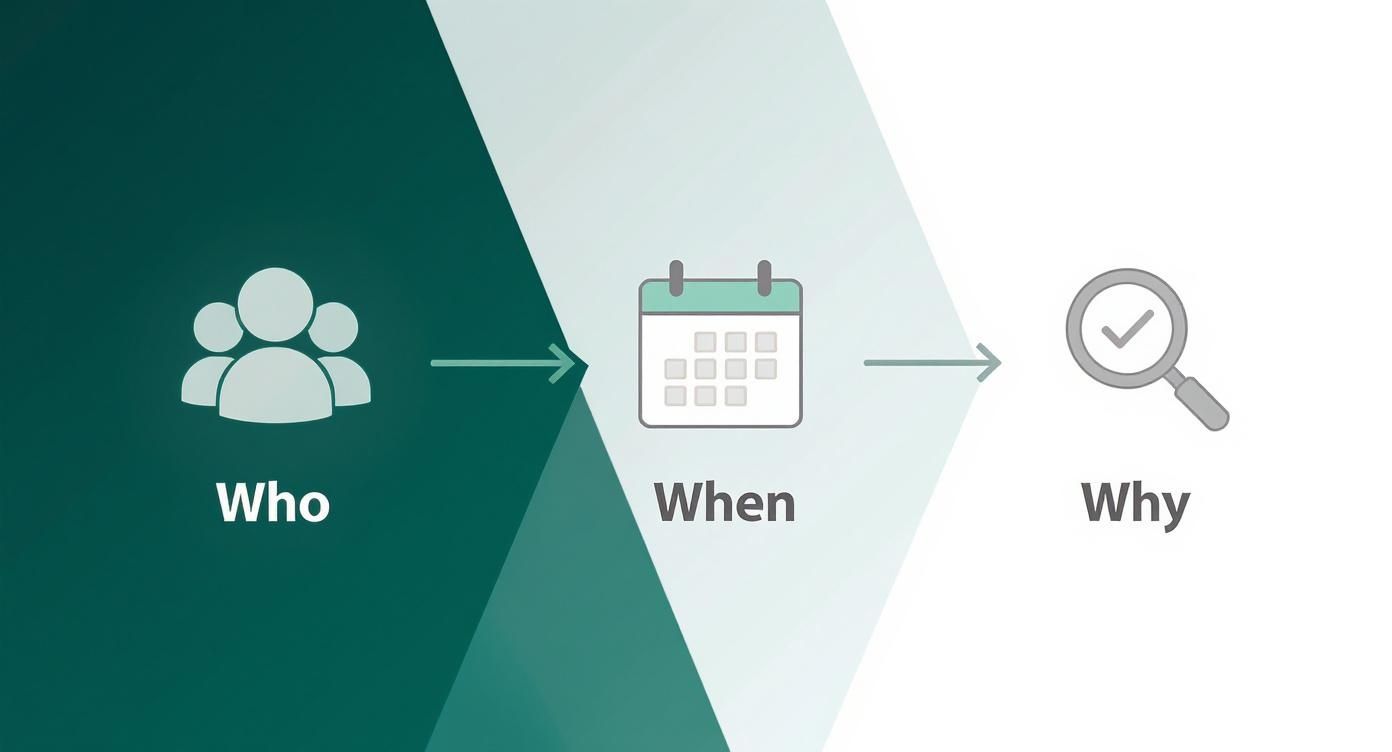
This breaks it down perfectly. You need to know who is leaving, when they’re leaving, and why. Without a unified view that connects these three pieces, you’re just staring at random numbers instead of seeing the actual narrative of your customer's journey.
From Manual Mess to Automated Clarity
This is where a purpose-built, AI-powered analytics platform like MetricMosaic changes the game for Shopify brands. Instead of you spending hours trying to stitch everything together, the system does it for you automatically. It acts as a central hub, pulling data from all your essential tools to build a single, unified profile for every customer.
This 360-degree view is the non-negotiable foundation for any meaningful customer churn analysis. Without it, you’re just guessing. With it, you can stop asking if you have a churn problem and start understanding exactly what's causing it.
This automated unification lets you see the whole journey. You can finally connect the dots between the specific ad a customer clicked, the products they bought, how they engaged with your emails, and their eventual decision to stop buying.
The Essential Data Points to Connect
To build this complete picture, your platform needs to pull in several key types of data. Think of them as different categories of clues that, when pieced together, reveal the full story of your DTC brand's performance.
Here are the must-have data sources to unify:
- Transactional Data (from Shopify): This is the "what" and "when" of their buying behavior. It includes things like Average Order Value (AOV), purchase frequency, time between orders, specific products purchased, and any discount codes used.
- Marketing & Acquisition Data (from Ad Platforms): This tells you where your customers came from and what they cost. You need to connect Customer Acquisition Cost (CAC), the specific campaign or ad that brought them in, and the channel (e.g., Meta, Google, TikTok).
- Behavioral & Engagement Data (from Klaviyo & GA4): This shows how people interact with your brand outside of a purchase. Key signals here are email open/click rates, how often they visit your site, time on site, and which product pages they view.
- Customer Support Data (from Gorgias, Zendesk, etc.): This is where the gold is. This qualitative data gives you crucial context on customer friction. Connecting support ticket history, complaint types, and resolution times can uncover product or shipping issues that lead directly to churn.
By bringing all these sources together, you can finally start asking—and answering—the questions that lead to real growth. You might discover that the customers you acquired from that one Facebook campaign had a great CAC, but they churn out twice as fast as everyone else, making their LTV a disaster. That’s the kind of insight that turns data into profit.
Uncovering the 'Why' Behind Customer Churn
With your Shopify, marketing, and customer data finally talking to each other, you can stop staring at spreadsheets and start figuring out the real story behind your numbers. This isn't about getting a Ph.D. in data science; it's about using practical methods to get actionable answers. For a busy DTC operator, this is where the real detective work begins.
The whole point is to turn that unified data into a clear narrative. Are the customers you picked up during Black Friday truly different from your year-round regulars? Do people who buy Product X tend to vanish much faster than everyone else? These are exactly the kinds of questions that traditional analytics make you spend days manually crunching data to answer.
Using Cohort Analysis to Compare Customer Groups
One of the most powerful tools you have is cohort analysis. Think of it like comparing different "graduating classes" of customers. Instead of lumping your entire customer base into one giant blob, you group them into cohorts based on when they made their first purchase—the January 2024 cohort, the Black Friday 2023 cohort, and so on.
This simple shift immediately exposes trends that would otherwise be completely invisible.
You might find that customers acquired during a big summer sale have a much lower lifetime value (LTV) and churn way faster than those who bought during a quieter month. This insight is pure gold. It tells you that your deep-discount strategy might just be attracting the wrong crowd: one-and-done bargain hunters instead of loyal fans. An AI-driven platform makes this conversational, allowing you to ask questions in plain English and get instant answers.
An AI-driven platform puts this on autopilot, letting you instantly slice and dice your cohorts by:
- Acquisition Channel: Are customers from Meta ads sticking around longer than those from an influencer collab? Now you'll know.
- First Product Purchased: Pinpoint the exact products that act as gateways to creating your most loyal, high-spending customers.
- Discount Used: Find out if that 30% off coupon is actually costing you money by bringing in low-LTV buyers who never return.
From Historical Data to Predictive Insights
Looking at what happened in the past is useful, but the real advantage comes from knowing what's about to happen next. This is where AI-powered analytics platforms like MetricMosaic completely change the game for Shopify stores. They move beyond simple historical reports and into the realm of predictive analytics.
Instead of waiting for a customer to ghost you and then asking "why?", predictive models analyze thousands of behavioral signals in real-time. They can forecast which customers are likely to churn before they actually hit the exit.
Predictive churn models are like an early warning system for your revenue. They analyze subtle changes in customer behavior—like a sudden drop in email engagement or a longer-than-usual gap between purchases—to flag at-risk accounts, giving you a chance to intervene proactively.
This lets you finally switch from a reactive to a proactive retention strategy. You can automatically segment these "at-risk" customers and hit them with targeted win-back campaigns, special offers, or even a personal check-in from your support team.
The Power of AI in Churn Analysis
Let’s be honest, trying to do this kind of analysis manually is a nightmare. It's incredibly time-consuming and just not practical for a lean DTC team. The difference between the old spreadsheet method and a modern AI platform is night and day. AI simplifies analytics and replaces manual data crunching.
The table below breaks down just how much time and complexity you save by leaving the manual grunt work behind.
Manual vs AI-Powered Churn Analysis
| Analysis Step | Manual Spreadsheet Approach | AI-Powered Analytics Platform |
|---|---|---|
| Cohort Creation | Hours of filtering and pivot tables to group customers by month, channel, or first product. | Instant, automated cohort generation with a few clicks. |
| Behavioral Signals | Nearly impossible to track across multiple systems (site visits, email opens, purchase cadence). | Continuously analyzes thousands of cross-platform signals in the background. |
| Churn Prediction | Guesswork based on historical data and gut feelings. | Uses machine learning to calculate a "churn risk score" for every single customer. |
| Finding Insights | Requires deep analytical skills to spot meaningful patterns in a sea of numbers. | Proactively surfaces "stories" and recommendations, telling you what actions to take. |
By automating the heavy lifting, AI turns churn analysis from a dreaded, once-a-year project into an ongoing, accessible system for growth. It effectively puts a data science team in your pocket, freeing you up to focus on strategy and action, not data wrangling.
Turning Churn Insights into Retention Wins
Analysis without action is just trivia. Once you’ve uncovered why customers are leaving your Shopify store, it’s time to move from insight to execution. This is where you translate the "what" and "why" of churn into a practical retention playbook that actually grows your bottom line and improves profitability.
The whole point is to draw a straight line from a specific data finding to a real-world marketing tactic. For a DTC brand, this means turning those patterns into personalized, automated actions that feel intentional and genuinely add value for the customer.

We're not talking about generic "we miss you" emails. This is about precision. If your predictive models flag a high-value customer as ‘at-risk’ because their purchase frequency dropped off a cliff, the move could be a hyper-personalized win-back offer sent via SMS. It might even be a proactive check-in from your customer support team.
Proactive Strategies for First-Time Buyers
Your first-time buyer experience is ground zero for retention. A confusing or underwhelming first purchase is a fast track to churn. Honestly, many Shopify brands lose the retention battle right here before it even begins.
Research from 2025 drives this home, showing that poor onboarding (23%) and weak relationship-building (16%) are two of the top three reasons customers churn. It confirms what we all know intuitively: a bad first impression is incredibly costly. Pendo has more great data on how that initial customer experience impacts retention on Pendo.io.
Use your churn insights to fortify this crucial period:
Finding: Customers who buy your best-selling skincare kit churn quickly.
- Action: Build a targeted post-purchase email and SMS sequence in a tool like Klaviyo that triggers off that specific SKU. Drip out usage tips, video tutorials, and user-generated content over the first 30 days to guide them to success and prove the product's value.
Finding: Customers acquired from a specific TikTok ad have a miserable second-purchase rate and poor LTV.
- Action: Create a unique welcome series just for this segment. Acknowledge where they came from ("Glad you found us on TikTok!") and immediately give them a compelling reason to stick around, like early access to a new drop or a small credit toward their next order.
Rewarding and Retaining Your Best Customers
Not all customers are created equal, so your retention efforts shouldn't be either. Customer churn analysis is how you pinpoint your high-LTV cohorts—the VIPs who drive a massive chunk of your revenue. Your job is to make them feel seen and valued.
Your best customers aren't just transactions; they're assets. Use your data to identify who they are, then build a retention strategy that treats them like the VIPs they are. This deepens loyalty and turns happy customers into powerful brand advocates.
Finding: Customers who make three or more purchases in their first six months have a 90% retention rate over the next year.
- Action: Create an automated segment for these customers and enroll them in an exclusive loyalty program. Offer real perks like free shipping, early access to sales, or a dedicated customer service line. Make their loyalty tangible.
Finding: Your top 5% of customers by LTV consistently buy a mix of products from two specific categories.
- Action: Develop personalized cross-sell campaigns that recommend products from their complementary category. Use your data to say, "Since you love our performance tees, here are the shorts our other top customers pair them with."
Closing the Loop with Product and Experience Feedback
Finally, churn analysis often uncovers problems that marketing alone can't fix. It can shine a light on fundamental issues with your products, your shipping, or the overall customer experience. Acting on this feedback is one of the most powerful retention plays you have.
For example, if you see a spike in churn and returns right after launching a new product, that’s a massive red flag. The data gives you the hard evidence you need to go back to your supplier, rewrite the product description on your Shopify store, or fix your fulfillment process.
By using customer churn analysis to inform your core operations, you don't just reduce churn—you build a stronger, more customer-centric DTC brand from the inside out.
Turning Churn Analysis Into Your Competitive Edge
Let's be real: effective customer churn analysis isn't some project you knock out once a quarter and then forget about. For a modern Shopify brand, it’s an ongoing system. It's the engine you build to create more predictable, resilient growth.
This is about making a fundamental shift. It’s moving away from the frantic, reactive fire-fighting of customer churn and into a more proactive rhythm of growth. It’s about finally turning all that fragmented Shopify, marketing, and customer support data into your most reliable asset.
The old way—wrestling with spreadsheets and just guessing why good customers disappear—is officially broken. In today's DTC world, the brands that win are the ones that can move from a piece of data to a smart action the fastest.
From Complexity to Clarity: Your Next Step
This whole process really boils down to three core ideas we've covered. If you miss these, you're basically flying blind, stuck in that expensive loop of acquiring new customers just to replace the ones quietly slipping out the back door.
- A Unified View of Your Data Isn't Optional: Your customer’s journey is messy. It's scattered across Shopify, your ad platforms, your email tool, maybe even your helpdesk. Stitching that story together is the only way you’ll ever uncover the real "why" behind churn.
- AI Is Your Co-Pilot for Action: The sheer amount of data is just too much for any human to sift through manually. AI-powered analytics platforms like MetricMosaic act as your analyst, automatically connecting the dots and flagging the insights that actually matter.
- Insights Have to Drive Action: Analysis without a clear next step is just trivia. Every discovery you make—whether it's identifying a product that leads to churn or spotting an at-risk customer segment—has to lead directly to a specific retention tactic you can launch.
The ability to truly understand and act on your data is the ultimate unfair advantage. It's the difference between guessing what your customers want and knowing, with real confidence, how to keep them coming back for more.
So, stop guessing why your customers are leaving. Start building a more predictable, more profitable Shopify brand by turning your data into a clear roadmap for growth. AI-driven analytics is the key that unlocks this, transforming overwhelming complexity into your most powerful tool for building a business that lasts.
Common Questions About Churn Analysis
Even with a solid plan, a few questions always pop up when founders start digging into churn. Here are the most common ones we hear from Shopify brands, along with some straight-up, practical answers.
How Often Should I Actually Be Looking at This Stuff?
The old way was to run a big, clunky churn report once a quarter. Honestly, that’s way too slow for a modern DTC brand. Things move too fast.
Today, with AI-powered tools, you can monitor churn signals pretty much in real-time. This flips the script from a reactive, backward-looking report into a proactive system that spots trouble early.
For most operators, a weekly check-in on your retention dashboards is the right cadence. You'll catch negative trends before they snowball, and automated insights can help you tweak your marketing and CX on the fly, without needing to block out a whole day for a massive analysis project.
What’s a "Good" Churn Rate for a Shopify Store?
This is easily the question I get asked the most, and the real answer is: it depends. A lot. For subscription brands, a monthly customer churn rate between 5-7% is a pretty solid benchmark to aim for.
But for non-subscription eCommerce, it’s far more useful to track things like repeat purchase rate and cohort LTV growth. The most important benchmark isn't some generic industry number—it's your own historical performance. The real goal is to consistently beat your own numbers.
Your job isn't to hit an arbitrary industry average. It's to build a system that methodically lowers your store's own churn rate, month after month, turning retention into a growth engine you can count on.
Can AI Really Tell Me Who Is Going to Leave?
Yes. And it’s a game-changer. This is where next-gen analytics platforms leave the old spreadsheets in the dust. Predictive AI models aren't just looking at what happened in the past; they’re analyzing thousands of tiny behavioral signals that happen before a customer churns.
It’s not a crystal ball, but it’s shockingly effective. The AI is constantly learning from patterns across countless data points, like:
- Purchase Cadence: Are the gaps between a customer's orders getting weirdly long?
- Site Engagement: Have they stopped browsing products or visiting your store altogether?
- Email Interaction: Did they go from a loyal opener to completely ignoring your campaigns?
From these signals, the model assigns a 'churn risk score' to every single customer. This lets you get surgical with your retention efforts, focusing your budget and energy on saving high-value customers who are on the verge of walking away.
Ready to stop guessing why customers leave and start getting clear, actionable answers? MetricMosaic unifies your Shopify store data with your marketing and customer platforms, using AI to tell you exactly where your retention leaks are and how to fix them.
Start your free trial today and turn your data into your competitive advantage.