Mastering Contribution Margin in Units for Shopify Profitability
Unlock your Shopify store's true profit potential. Learn how to calculate and use contribution margin in units to make smarter pricing and marketing decisions.

As a Shopify founder, you're drowning in data. Ad spend from Meta, sales data from Shopify, fulfillment costs from your 3PL—it’s a constant battle to connect the dots. You see revenue climbing, but a nagging question remains: are you actually making money on each sale, or just spinning your wheels?
This is where contribution margin in units becomes your single source of truth. It’s the cash left over from selling one product after you’ve covered all its direct, variable costs. This is the money that goes on to pay your fixed costs—like software subscriptions and salaries—and, eventually, becomes your profit.
The Hidden Metric Driving Your Shopify Profits
So many DTC brands get laser-focused on top-line revenue while completely overlooking the per-unit profitability that actually funds their growth. It's a classic trap. You see big sales numbers in your Shopify dashboard and assume you're crushing it, but you could easily be losing money on every single box you ship.
This data chaos leads to expensive mistakes, like scaling ad campaigns for products with paper-thin margins or running promotions that accidentally erase your profits.
The real challenge for any ambitious Shopify brand is moving from unreliable reports to a crystal-clear view of the cash-flow engine of the business. You need to know, on a SKU-by-SKU basis, which products are your profit heroes and which are secretly draining your bank account.

Why Per-Unit Profitability Matters
Think of your business as a ship. Revenue is the wind in your sails, pushing you forward. But contribution margin is the hull—if it isn't solid, you'll take on water and sink, no matter how fast you seem to be going.
Getting a handle on this metric is the foundation for every smart decision you'll make, from pricing to ad spend. It answers the questions that keep you up at night:
- Can this product handle a 20% discount during our next flash sale without killing my profit?
- Is it actually profitable to offer free shipping on this specific item, or is it a loss leader?
- Should I double down on Meta ads for my bestseller, or is another product a much safer bet to scale my CAC?
By focusing on the contribution margin in units, you move from simply growing sales to growing profitable sales. It's the difference between building a business that looks good on paper and one that builds real, sustainable wealth and improves your LTV.
Without this clarity, you're just flying blind. Manually crunching this in spreadsheets is a slow, error-prone nightmare. This is where AI-powered analytics transforms complexity into clarity. Instead of getting buried in VLOOKUPs, AI-driven platforms automatically calculate this for you in real-time.
They plug directly into your Shopify data, ad platforms, and shipping software to give you an instant, accurate picture of per-unit profitability. It’s about turning fragmented data into your biggest competitive advantage.
Calculating Your Contribution Margin Per Unit
Let's break down this formula in plain English and make it something you can actually use for your Shopify store. The idea is simple: for every single item you sell, how much cash is left over after you've paid for the direct costs of making and selling that specific item?
That leftover cash is your contribution margin per unit. Think of it as the fuel for your store's profitability engine.
The formula itself is refreshingly straightforward:
Selling Price Per Unit - Variable Costs Per Unit = Contribution Margin Per Unit
This isn't just some MBA-level homework; it's the financial gut-check for every product you carry. But to get a number you can trust, you first have to nail down your variable costs—those are the expenses that tick up every single time an order comes through.

Identifying Your True Variable Costs
For a DTC brand, these costs are so much more than just what you paid for the product. They are any expense you only pay when you sell an item. It's so important to separate these from your fixed costs, like your Shopify plan, software subscriptions, and employee salaries, which you pay no matter what.
Common variable costs for a Shopify store include:
- Cost of Goods Sold (COGS): This is the direct cost of either manufacturing or purchasing the product from your supplier.
- Transaction Fees: What Shopify Payments, Stripe, or PayPal carves out of every sale (usually around 2.9% + 30¢).
- Shipping & Fulfillment: This could be the fees your 3PL charges per order or your direct costs for postage and packing materials if you ship in-house.
- Warehousing: Costs tied directly to storing products. Getting a handle on your inventory carrying cost is key here, because every dollar you save on storage directly boosts your per-unit contribution margin.
A Practical DTC Example
Let's walk through how this works for a hypothetical DTC product—we'll use a bag of high-end, custom-blended coffee.
Trying to track all these moving parts in a spreadsheet is a recipe for mistakes, especially as your SKU count grows. This is where AI-powered analytics tools can be a game-changer, pulling this data automatically to give you a real-time, accurate view without the manual headache.
Here’s a simple table to show the math in action.
Calculating Contribution Margin Per Unit: A Simple Example
| Metric | Amount | Description |
|---|---|---|
| Selling Price | $25.00 | The price a customer pays on your Shopify store. |
| COGS | -$8.00 | Cost of coffee beans, roasting, and labor. |
| Packaging | -$1.50 | Custom bag, label, and shipping box. |
| Payment Processing | -$1.03 | Shopify Payments fee (2.9% + $0.30). |
| Fulfillment Fee | -$3.00 | Cost per pick-and-pack from your 3PL. |
| Total Variable Costs | -$13.53 | The sum of all direct costs for one sale. |
| Contribution Margin | $11.47 | The cash left over to cover fixed costs and profit. |
So, with a contribution margin of $11.47, you know exactly how much each bag of coffee contributes to paying your rent, salaries, and ultimately, your bottom line.
This single number is your key to making smarter decisions on pricing, marketing spend, and inventory for this specific SKU, directly impacting your ROAS and overall profitability.
Making Smarter Decisions With Your Margin Data
Knowing your contribution margin per unit is one thing. Actually using it to grow your Shopify brand is where the real money is made. This metric isn't just a number to plug into a spreadsheet—it's your strategic guide for making smarter, more profitable decisions across your entire DTC operation.
Once you move past the basic calculation and start putting the metric to work, you gain incredible clarity. You can finally see which levers to pull to improve profitability, whether that means adjusting prices, optimizing your CAC, or deciding where to spend your ad budget.
Optimize Your Pricing Strategy
One of the fastest ways to burn through cash is by underpricing your products. A low price might feel like it's driving sales, but if your margin is razor-thin, you could be losing money on every single order without even realizing it. Contribution margin per unit completely removes the guesswork.
By knowing exactly how much cash each product generates after variable costs, you can set prices that guarantee profitability from day one. If a popular item has a low margin, you now have a clear business case to either raise its price or find ways to knock down its variable costs. This same thinking applies when you want to improve your gross profit margin—it all comes down to smarter pricing and cost control.
Analyze Marketing and Promotions
Flash sales and discount codes can be powerful tools for driving traffic, but they can also be a total disaster for your bottom line if you're not careful. A 20% off coupon might seem harmless, but it cuts directly into your contribution margin.
With SKU-level margin data, you can model the exact financial impact of a promotion before you launch it.
- Scenario A (No Discount): Your product has a healthy $15 contribution margin.
- Scenario B (20% Off): That same product’s margin gets slashed to just $5.
This simple analysis forces you to ask the hard questions: Will the discount generate enough extra sales volume to justify the hit on each unit's profit? Or are you just sacrificing your bottom line for a short-term ROAS spike?
Build Profitable Product Bundles
Bundling is a fantastic way to boost your Average Order Value (AOV), but it only really works if the bundle itself is profitable. The secret is to strategically combine your high-margin items with slower-moving or lower-margin products.
By understanding the contribution margin in units for each product, you can create bundles that feel like a great deal for the customer while protecting—or even enhancing—your overall profit per order. It’s about being intentional, not just throwing products together to clear inventory.
Guide Your Inventory and Ad Spend
Finally, this metric is your best friend when it comes to managing inventory and allocating ad spend. It helps you sort your products based on how they actually perform for your business financially.
- High-Margin Heroes: These are the products you should be obsessed with. Double down on ad spend here, make sure they are always in stock, and feature them prominently across your site. Higher margins give you more room to acquire customers profitably.
- Low-Margin Workhorses: These items might sell a lot, but they don't add much to your profit. Look for ways to increase their margin, or maybe use them as loss leaders to improve customer LTV and retention.
- Zombie SKUs: These are the products with low sales and low margins. It might be time to say goodbye. They're likely tying up cash and warehouse space that could be used for your winners.
Using contribution margin per unit as your guide ensures every dollar you invest in inventory and advertising is working as hard as it possibly can to grow your business profitably.
Finding the Right Data in Your Tech Stack
Knowing the formula for contribution margin in units is the easy part. The real challenge for most founders is hunting down the right numbers, especially when they're scattered across a dozen different apps.
Let’s be honest, manually stitching together spreadsheets isn't just a grind—it's a recipe for costly mistakes.
Your journey starts in Shopify, where you can pull the sales price and Cost of Goods Sold (COGS) for each SKU. But that only gets you part of the way there. To get a truly accurate picture of your profitability, you have to dig up all the other variable costs that often get missed.
Uncovering Hidden Variable Costs
Think about all the little expenses that only pop up when an order is actually placed. These are absolutely critical for an accurate calculation, yet they live in totally different systems:
- Transaction Fees: You'll need to pull these directly from your payment processor, like Shopify Payments or Stripe.
- Shipping & Fulfillment Costs: This data is hiding in your 3PL's dashboard or shipping software like ShipStation.
- Packaging Costs: Don't forget the boxes, mailers, and tape. These costs add up with every single order you ship.
This fragmented data is a major headache. Exporting CSVs and trying to make them all play nice together is a massive time sink. Worse, it increases the risk of basing critical decisions on bad data. This whole mess is why AI-powered analytics tools have become so essential—they integrate with your entire tech stack to automatically calculate your contribution margin in real-time, giving you a single source of truth without the manual number-crunching.
This granular, per-unit focus isn't just for small brands. Even global giants like AB InBev use it to navigate market changes. By subtracting all variable costs from revenue, they calculate an incremental contribution margin per unit that guides their strategy, proving how essential this metric is at any scale. Learn more about how large enterprises apply unit economics for smarter decisions on einvestingforbeginners.com.
This process shows how having accurate, real-time margin data fuels smarter decisions across your entire business.
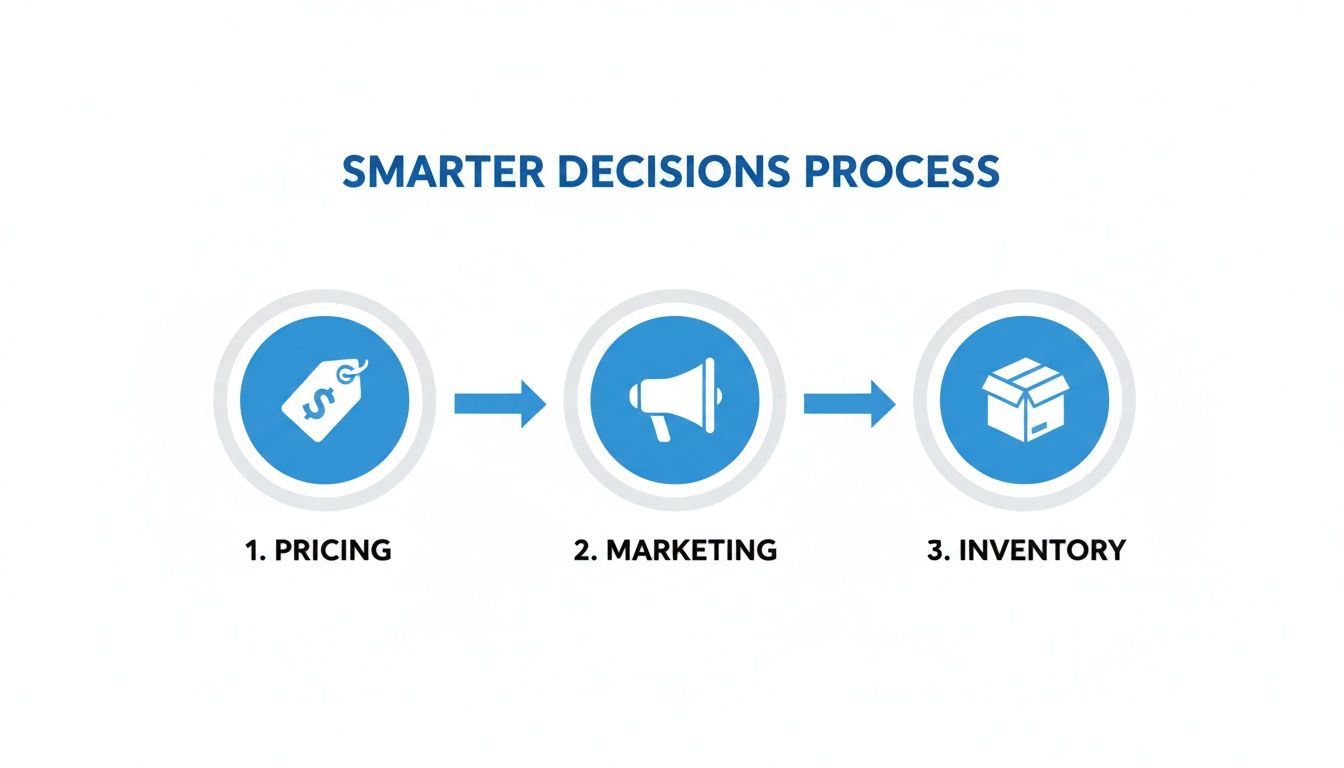
The key takeaway here is that your pricing, marketing, and inventory decisions are all deeply connected. A clear view of your contribution margin in units is the thread that ties them all together, ensuring every move you make actually drives profit.
Common Margin Calculation Mistakes to Avoid
Calculating your contribution margin in units seems simple enough on the surface, but a few common slip-ups can lead to a completely flawed analysis. For a Shopify brand, getting this number right is non-negotiable for sustainable growth, yet I see founders trip over the same hurdles time and time again.
The goal isn't just to land on a number. It's to get a number you can actually trust to guide your pricing, ad spend, and inventory strategy. Let's walk through the most common pitfalls so you can steer clear of them.
Misclassifying Fixed and Variable Costs
The most frequent error, by a long shot, is mixing up fixed and variable costs. It sounds basic, but the nuance is everything. A fixed cost, like your monthly Shopify subscription, gets paid no matter how many units you sell. A variable cost, like payment processing fees, only happens when you actually make a sale. Classifying a variable cost as fixed (or the other way around) will throw off your entire calculation.
Here's a real-world example: Is your warehouse staff's salary a fixed cost? If they're full-time employees on payroll, then yes. But if you pay a 3PL a per-order pick-and-pack fee, that labor is absolutely a variable cost. That single distinction is critical for getting an accurate margin.
Ignoring Hidden Variable Costs
So many direct-to-consumer brands stop at COGS and call it a day. This is a dangerous habit that leads to a massively over-inflated sense of profitability. Your true variable costs go much deeper than just what you paid your supplier for the product.
The real contribution margin in units must account for every single cost incurred to get one specific item out the door. This includes all the 'invisible' expenses that quietly eat away at your profitability on every single order.
These are the costs people almost always forget:
- Payment Processing Fees: That ~2.9% + 30¢ from Shopify Payments or Stripe adds up fast.
- Packaging Materials: The box, the tape, the crinkle paper—it all costs money.
- Sales Commissions: Any performance-based payouts to your sales team are tied directly to a sale.
- Platform Transaction Fees: These are any extra fees charged by marketplaces or other platforms that aren't part of standard payment processing.
When you ignore these, a product that looks profitable on paper can quickly become a money-loser in reality.
Using Averages Instead of SKU-Level Data
Finally, please, stop relying on store-wide averages. An average margin is a recipe for disaster because it masks the truth about individual product performance. It lumps your heroes and your duds together into one misleading number.
Your best-selling t-shirt might have a healthy 60% margin, while a slow-moving accessory is barely scraping by at 15%. Averaging them out gives you a useless metric that hides both your biggest opportunity (the t-shirt) and your biggest problem (the accessory).
Getting granular with SKU-level data is where the magic happens. This used to mean spending hours buried in spreadsheets, but that's no longer the case. Next-gen AI analytics platforms like MetricMosaic make this level of detail effortless. They automatically connect to all your tools to calculate the true contribution margin in units for every single product, giving you the clarity you need to make genuinely smart decisions.
Automating Profitability Analysis With AI
Let's be honest. Manually calculating the contribution margin per unit for every single product in your Shopify store is a nightmare. No founder has time for that kind of spreadsheet drudgery.
As your catalog grows, the task just gets bigger and more complex. The risk of one tiny human error in a formula skyrockets, and before you know it, you're making critical business decisions based on flawed numbers.
This is exactly where AI-powered analytics platforms like MetricMosaic give DTC brands a massive edge. Instead of wrestling with CSV exports and VLOOKUPs, these tools do the heavy lifting for you. They automatically sync with your entire tech stack—Shopify, your 3PL, payment gateways, and ad platforms—to get a complete, real-time picture of your costs.
From Static Spreadsheets to Dynamic Insights
The real magic of AI here isn't just about speed. It’s about turning the contribution margin from a static number you calculate once a quarter into a living, breathing insight you can use every day.
Imagine just asking your data platform, "Which products had the highest contribution margin last month?" and getting an instant, visual answer. No formulas, no spreadsheets. This is the reality of conversational analytics.
These next-gen tools weave complex financial analysis into your daily workflow, making it simple and intuitive. They can even provide predictive insights, showing you how a price change might impact future profitability. They tell the story of your data so you can act on it.
AI-driven analytics frees you to focus on strategy, not spreadsheets. It bridges the gap between raw data and profitable action, ensuring your growth is built on a solid financial foundation.
This automated approach also helps you look into the future. Let’s say a product starts with a $60 margin per unit ($100 price - $40 variable cost). With better supply chain management or bulk discounts, you might trim those variable costs. Financial modeling can show how that margin could grow to $67.50.
That's a 12.5% increase in per-unit contribution that drops straight to your bottom line, a common outcome for brands that optimize their supply chains. You can dig deeper into how contribution margin evolves over time on wallstreetprep.com.
By automating this crucial calculation, you get the clarity needed to confidently set prices, plan promotions, and put your ad spend behind the products that actually make you money.
A Few Common Questions
Your quick-reference guide to the most common questions we hear about using contribution margin per unit to grow a Shopify business.
How Often Should I Calculate My Contribution Margin?
For most stores, a monthly review is a solid baseline. But if your variable costs—things like shipping rates or raw material prices—are all over the place, calculating it weekly is a much smarter move.
The best practice, though, is to use an AI analytics tool that gives you real-time data. This way, your decisions are always based on what's happening right now, not on numbers from last month's spreadsheet.
Can a Product Have a Negative Contribution Margin?
Absolutely, and it’s a massive red flag for any DTC brand. A negative contribution margin means you’re losing money on every single unit you sell, and that's before you even factor in your fixed overhead costs.
We see this happen with aggressive discount strategies, unexpectedly high shipping fees, or a spike in returns. Finding and fixing these "profit-draining" products is one of the most important things you can do for your store's financial health.
A negative contribution margin isn't just a small loss; it's a sign that the more you sell of that specific product, the faster you lose money. It's a hole in your financial boat that needs to be patched immediately.
What Is a Good Contribution Margin Ratio for a DTC Brand?
There's no single magic number here. It really varies by industry and business model. A brand selling unique, high-end jewelry might have an 80% margin ratio, while a competitive CPG brand might be aiming for 35-45%.
Instead of chasing an arbitrary benchmark, focus on tracking your own margin over time and comparing it across your product catalog. Your goal is to pinpoint your most profitable items and figure out how to improve the margin on everything else. An analytics platform can automatically surface these top performers for you, saving you the guesswork.
Ready to stop guessing and start knowing which products truly drive your profit? MetricMosaic unifies your Shopify data to deliver real-time, SKU-level profitability insights without the manual work. Start your free trial today and turn your data into a competitive advantage.