How to Use Contribution Margin Calculation to Plug the Leaks in Your Shopify Store's Profitability
Unlock Shopify growth with our guide to contribution margin calculation. Learn to use this key metric to boost profitability and make smarter decisions.

Ever feel like you're just spinning your wheels on your Shopify store? You’re pushing hard to drive traffic, your ad campaigns are humming, and the order notifications are rolling in. But when you look at your bank balance at the end of the month, you're left wondering, "Where did all the money actually go?"
If that sounds familiar, you're not alone. For countless DTC founders, the problem isn't a lack of sales; it's a slow, silent leak in profitability that flashy metrics like Return on Ad Spend (ROAS) completely miss. You're drowning in fragmented data from Shopify, Google Analytics, and your ad platforms, with no clear picture of what's truly driving your bottom line.
It's so easy to get fixated on top-line revenue, celebrating every new order. But what if some of your best-selling products are actually costing you money?
It’s Not Just About Top-Line Revenue
This is where the contribution margin calculation changes everything. It’s a simple formula: Sales Revenue minus all Variable Costs. It tells you exactly how much cash each sale leaves behind to pay for your fixed costs (like your Shopify subscription and salaries) and, ultimately, put profit in your pocket.

It shifts your entire mindset from just selling more to earning more on every single thing you sell.
This one calculation cuts through the noise of unreliable reports and gives you a clear, actionable roadmap to improve profitability. Suddenly, you have the clarity to make smarter decisions about your entire DTC operation:
- Your Pricing: Are your prices actually high enough to cover all the per-unit costs and still leave a healthy margin? Or are you undercutting yourself?
- Your Marketing: How much can you really afford to spend on CAC (Customer Acquisition Cost) for a specific product and still come out ahead?
- Your Inventory: Which products are your true profit engines, and which ones are just sucking up cash flow and hurting your LTV (Lifetime Value)?
For any growing Shopify brand, contribution margin isn't some boring accounting term. It's your strategic compass. It points you toward sustainable growth by making sure every single sale strengthens your bottom line instead of weakening it.
Without this insight, you’re flying blind. You might be pouring ad spend into a "hero product" that has razor-thin margins, essentially paying to lose money with every order.
This guide will break down the contribution margin calculation in plain English, showing you exactly how to find and plug those profit leaks. And for those who want to skip the manual data crunching in spreadsheets, AI-powered analytics platforms like MetricMosaic can automate this whole process for you. It pulls together complex data from Shopify and your ad platforms to tell a clear, story-driven narrative about your brand's financial health, one product at a time.
The Simple Formula Driving Your Profitability
Let's get right to it. The math behind contribution margin is surprisingly simple, but the clarity it gives your DTC brand is a game-changer. Forget wrestling with complex financial models; it all boils down to two core formulas every Shopify founder needs to have memorized.
These aren't just for your accountant. They are the engine of your brand, showing you exactly how much cash each sale generates to cover your overhead and, eventually, turn a profit that you can reinvest in growth.
Contribution Margin Formulas At a Glance
To make this even easier, here’s a quick-reference table breaking down the two essential formulas. We’ll dive into each one right after.
| Metric | Formula | What It Tells You |
|---|---|---|
| Contribution Margin Per Unit | Sales Price Per Unit - Variable Costs Per Unit | The exact dollar amount each sale contributes to covering fixed costs and improving profitability. |
| Contribution Margin Ratio (%) | (Contribution Margin Per Unit / Sales Price Per Unit) x 100 | The percentage of revenue from each sale that’s available to cover fixed costs. Crucial for optimizing ROAS. |
Think of these as two sides of the same coin. The per-unit formula gives you a hard dollar value, while the ratio puts that value into a percentage context, making it easier to compare the profitability of different products.
Contribution Margin Per Unit
First up is the per-unit calculation. This is the most straightforward look at a product’s profitability, telling you the exact dollar amount you have left after a single sale, once you’ve paid for the direct costs of that specific item.
The formula is just simple subtraction:
Sales Price Per Unit - Variable Costs Per Unit = Contribution Margin Per Unit
So, if you sell a single t-shirt on your Shopify store, this number is what’s left to put towards things like your marketing spend, software subscriptions, and salaries. It's the absolute foundation for understanding if a product is actually making you money.
Contribution Margin Ratio
While the per-unit figure is great for specifics, the contribution margin ratio gives you much-needed context. It turns that raw dollar amount into a percentage of the sale price. This is incredibly powerful for comparing the profitability of different products, especially when they have totally different prices.
Here’s how you calculate it:
(Contribution Margin Per Unit / Sales Price Per Unit) x 100 = Contribution Margin Ratio (%)
A higher ratio means a bigger chunk of every sale is going straight towards covering your fixed costs and boosting your bottom line.
Let's run a quick example. A DTC brand sells a t-shirt for $25.00. The variable costs (the blank shirt, printing, packaging) add up to $10.00. That gives them a contribution margin of $15.00 per shirt.
Their contribution margin ratio would be 60% ($15.00 / $25.00). This means for every dollar in revenue from that t-shirt, $0.60 is available to help pay the bills and generate profit. You can dig into more advanced scenarios and analyses of contribution margin on Wall Street Prep if you want to go deeper.
Here's a hard lesson many Shopify brands learn: A high-volume product with a low contribution margin ratio can easily be less profitable than a slower-selling item with a high ratio. It's a classic blind spot when you're only chasing top-line revenue instead of true profitability.
Getting a handle on both of these formulas is the first real step toward seeing your business with financial clarity. It connects the dots between your sales figures and sustainable growth.
Identifying Your True Variable Costs
The whole game of an accurate contribution margin calculation comes down to one thing: correctly identifying your variable costs. This is exactly where so many Shopify founders stumble, and it’s a mistake that can give you a completely warped view of your profitability.
Is your monthly Klaviyo subscription a variable cost? What about your Facebook ad spend? Get this wrong, and you're making decisions based on bad data. You could end up scaling products that are actually leaking cash with every single sale, torpedoing your CAC and LTV goals.
The rule is actually pretty simple: if a cost goes up because you sold one more unit, it’s a variable cost. If you pay that cost whether you sell one unit or one thousand, it's a fixed cost.
Common Variable Costs for DTC Brands
For most Shopify stores, the list of variable costs looks pretty similar. You have to track down every single expense that scales directly with each order you ship out the door.
These are the non-negotiables:
- Cost of Goods Sold (COGS): This is the big, obvious one. It’s what you paid for the raw materials and the direct labor to create your product.
- Packaging: Don't gloss over this. Every box, mailer, roll of tape, and bit of crinkle paper adds up. These costs are tied to every single shipment.
- Transaction Fees: Every sale has a fee attached. This includes your Shopify Payments fees (like that familiar 2.9% + 30¢) and any fees from gateways like PayPal or Stripe.
- Pick-and-Pack Fees: If you’re using a 3PL (third-party logistics) provider, you’re almost certainly paying a fee for every item they grab off the shelf and place in a box.
- Shipping Costs: This is what you pay carriers like USPS, FedEx, or DHL to get that package from your warehouse to the customer's doorstep.
This infographic breaks down the two main ways you can look at your margin once you’ve tallied up these costs.
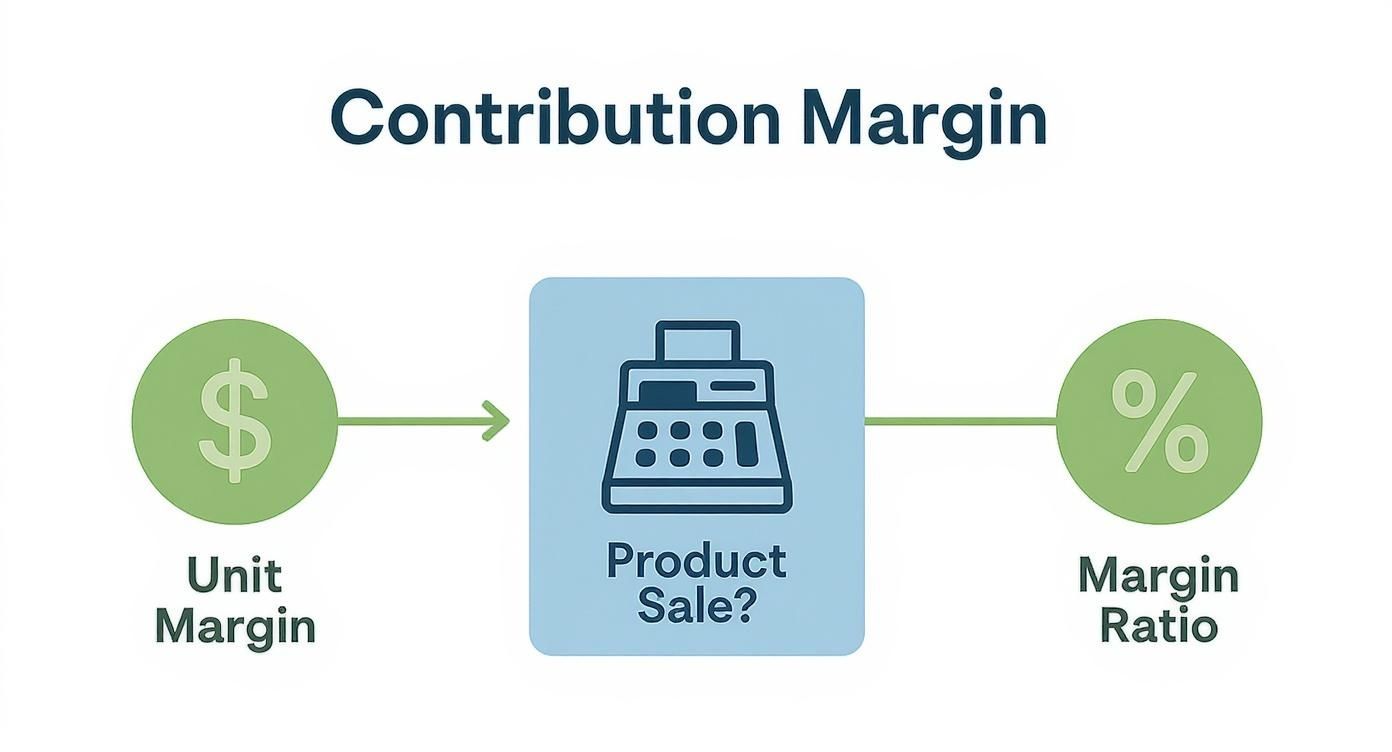
As you can see, after you make a sale, you can analyze its performance either by the raw dollar amount it contributes or by its efficiency as a percentage. Both are incredibly useful for making smarter decisions.
The Gray Area: Marketing Spend
The big debate always comes down to performance marketing spend. Should you roll your Meta or Google ad spend into your variable costs? The honest answer is: it depends on what you're trying to figure out.
For a true, per-unit contribution margin that helps you set prices and plan inventory, I strongly recommend you exclude ad spend. Why? Because ad costs can fluctuate wildly and aren't directly tied to producing one specific unit. Ad spend is the cost of getting a customer (your CAC), not the cost of fulfilling their order.
However, if you're trying to figure out how profitable a specific marketing campaign or channel is, then you absolutely would factor in ad spend. This just gets you to a different, more specific metric—something often called "contribution margin after customer acquisition costs."
The key is to be consistent. For your core, product-level profitability analysis, keep ad spend out of it. Treat it as an operating expense that your total contribution margin needs to be big enough to cover.
Getting this separation right is foundational. An AI-powered analytics platform like MetricMosaic can automate this whole process. It pulls cost data directly from your Shopify store and other sources, ensuring your contribution margin is always based on clean, accurate, and properly sorted data—no more spreadsheet headaches.
How Contribution Margin Shapes Your Growth Strategy
Figuring out your contribution margin is just the first step. The real magic happens when you turn that number into an action plan that actually drives profitable growth for your Shopify store. This isn't just some boring accounting metric; it's the closest thing you have to a strategic compass, pointing you directly toward your biggest opportunities to improve AOV, LTV, and retention.
When you have an accurate, SKU-level contribution margin, you can finally stop guessing. You get the clarity to make confident moves on the things that really matter in your DTC business.
Pinpoint Your True Profit Drivers
One of the biggest and most immediate wins is finally seeing which of your products are financial superstars and which ones are just dead weight. It’s easy to get fooled by a bestseller that’s flying off the shelves. But if its contribution margin is razor-thin, you're just running on a high-volume treadmill that isn't actually building your bottom line.
Once you can analyze the contribution margin for every single SKU, the path forward becomes much clearer:
- Double down on your winners: Funnel your marketing budget toward promoting the high-margin products that are actually making you money and improving your overall CAC.
- Fix or cut the losers: Spot the low-margin items that are bleeding you dry. From there, you can decide if they need a price bump, a cost reduction, or if it's time to cut them loose.
- Optimize your inventory: Stop tying up precious cash in low-margin stock that doesn't generate enough profit to justify the investment.
This is where SKU-level insight is a total game-changer. Instead of getting lost in tedious spreadsheet work, AI-powered tools like MetricMosaic can instantly serve up a ranked list of your products by profitability, telling a clear story about what's really moving the needle.
Refine Your Pricing and Promotion Strategy
Contribution margin is the bedrock of any intelligent pricing strategy. It tells you your absolute price floor—the point below which you’re literally losing money on every single sale. More importantly, it shows you how much wiggle room you have.
A healthy contribution margin gives you the flexibility to run aggressive promotions, create bundles to increase AOV, or absorb rising ad costs without gutting your profitability. A low margin, on the other hand, is a massive warning sign. It’s telling you that you either need to raise your prices or find a way to seriously slash your variable costs.
For example, a shoe company might discover a specific sneaker has a contribution margin ratio of 33.4%. This means about one-third of the retail price is left over to cover fixed costs and contribute to profit. Knowing this lets them accurately model the impact of a flash sale, ensuring they don't accidentally run a promotion that costs them money. You can learn more about how margins differ across various industries in this in-depth career guide on Indeed.com.
Knowing your margin for each product transforms pricing from a "what feels right" exercise into a data-driven decision. You can confidently set prices that support your growth goals instead of quietly undermining them.
Master Your Marketing Efficiency
For DTC brands, maybe the most powerful way to use contribution margin is to connect it directly to your marketing spend. It’s the key that unlocks your true break-even ROAS (Return on Ad Spend).
Your break-even ROAS is simply the minimum return you need from your ads just to cover the cost of the product sold and the ad spend itself. The formula is refreshingly simple: 1 / Contribution Margin Ratio.
Let's say a product has a 40% contribution margin ratio (or 0.4). Your break-even ROAS is 1 / 0.4 = 2.5. This means any ad campaign for that product with a ROAS below 2.5x is actively losing you money. This single calculation brings incredible clarity to your ad accounts, helping you kill underperforming campaigns and scale the winners with confidence.
Look, crunching your contribution margin in a Google Sheet is a solid starting point. We've all been there. But let's be honest—for any Shopify brand that's actually growing, it’s a fragile system just waiting to implode.
The minute you launch a new product, run a flash sale, or your shipping partner adjusts their rates, that once-perfect spreadsheet becomes a minefield of outdated numbers and broken formulas. It’s a time suck, and it’s dangerously error-prone.

This is precisely where next-generation, AI-powered analytics platforms are changing the entire game for DTC founders. They make all that manual data crunching obsolete.
Moving Beyond the Spreadsheet Grind
Modern tools like MetricMosaic are built to connect directly to all the scattered pieces of your business. They pull everything together automatically, unifying data from:
- Your Shopify Store: All your sales data, pricing, discounts, and order info.
- Your Ad Platforms: Real-time spend from Meta, Google, TikTok—you name it.
- Your Cost Data: Your latest COGS, shipping rates, and pesky transaction fees.
Suddenly, you have a single source of truth for your profitability. No more wrestling with VLOOKUPs. You get a live, SKU-level view of your contribution margin that updates itself. This is how you stop reacting to last month's numbers and start making proactive, data-backed decisions that improve ROAS, CAC, and LTV.
The real magic of AI here isn't just about speed; it's the clarity it provides. It takes a chaotic mess of fragmented data and turns it into a clear, actionable story about what’s actually making you money.
Predictive Insights and Conversational Analytics
But it gets even better. The best platforms today do more than just report on what already happened. They use predictive insights to show you what’s likely to happen next. You can model out scenarios on the fly, like "What happens to my total contribution margin if I bump the price of my best-seller by 10%?" and get an instant, data-driven answer.
This is also where we're seeing the rise of conversational analytics. Imagine just asking your data questions in plain English, as if you were talking to a seasoned growth strategist on your team.
Founder: "Show me my top 10 products by contribution margin last month."
AI Co-pilot: "Your top product was the 'Organic Cotton Hoodie,' with a contribution margin of $28.50 per unit. It generated a total contribution of $14,250, accounting for 18% of your total margin for the month."
This is the future of DTC analytics. It’s not about building more dashboards. It’s about getting immediate, story-driven answers to your most important questions so you can stay nimble, pounce on opportunities, and plug profit leaks long before they ever show up on a static end-of-month P&L.
Avoiding Common Pitfalls in Your Analysis
Contribution margin is an incredibly powerful metric, but it’s also one that can be dangerously misleading if you’re not careful. I’ve seen DTC founders fall into a few common traps that give them a completely false sense of their store's financial health, leading to some pretty costly mistakes down the line.
The first and most dangerous pitfall is ignoring your fixed costs entirely. It’s so easy to get pumped about a product with a high contribution margin, but that number only tells you half the story.
That margin is what you have left over to pay for everything else—your Shopify subscription, team salaries, warehouse rent, and all that software you’re paying for. If your total contribution margin isn't big enough to cover those essentials, your business is not profitable. Period.
Don't Let Averages Hide Your Problems
Another classic mistake is using blended or average costs across all your SKUs. This is especially tempting for brands with tons of product variations. I get it, it's easier than digging into the specifics for every single item.
The problem is that this practice completely masks the truth. You might have a "hero" product that sells like crazy, but when you dig into its specific variable costs, you find it has a razor-thin or even negative margin.
Using an average cost makes that hero product look perfectly fine, while it’s actually draining cash from your business with every single sale. Real clarity only comes from a SKU-level contribution margin calculation.
Stale Data Leads to Bad Decisions
Finally, a lot of founders treat their contribution margin calculation as a one-and-done task. They build a spreadsheet, plug in the numbers once, and then forget about it. But your costs are always changing:
- Shipping carriers adjust their rates every year.
- Ad platforms like Meta and Google see fluctuating CPMs.
- Raw material and manufacturing prices for your products go up.
If your calculations aren't based on the most current data, you're flying blind. A product that was profitable three months ago might be a money-loser today.
A great example of this in action is how big companies like Starbucks approach new product launches. When they introduce a seasonal drink, they have to meticulously calculate both the fixed costs of the campaign (marketing, training) and the specific variable costs per cup. If a new latte sells for $6.50 with $2.40 in variable costs, its $4.10 contribution margin has to pay off all those campaign costs before it adds a single dollar to the bottom line. You can explore more of these cost-volume-profit examples on Pressbooks.
Avoiding these common pitfalls isn't about becoming an accounting wizard. It's about being disciplined with your analysis. Your next step is to ensure the numbers you rely on for critical pricing, marketing, and inventory decisions are a true reflection of your business today.
Ready to stop guessing and start knowing your true profitability? MetricMosaic is the AI-powered analytics co-pilot that automates your contribution margin calculation right down to the SKU level. It unifies your Shopify, ad platform, and cost data to give you a real-time, story-driven view of what's actually driving profit in your business. Start your free trial and see your numbers with total clarity.