How to Calculate Customer Lifetime Value (the Smart Way) for Shopify Brands
A founder's guide to calculating customer lifetime value. Stop guessing and turn your Shopify data into actionable insights for profitable growth.
On the surface, calculating customer lifetime value seems simple enough. It’s the total revenue you expect from a customer over their entire relationship with your brand. But if you're like most Shopify founders, you're flying blind, drowning in fragmented data from a dozen different apps, and struggling to land on a number you can actually trust. This isn't just an analytics problem; it leads to flawed ad spend, missed opportunities, and slower growth.
This guide is for Shopify founders and marketers who want to move past unreliable reports. We'll break down how to calculate CLTV in plain English and show you how AI-powered analytics can replace manual data crunching, turning this complex metric into your most powerful tool for profitable growth.
Why Most Shopify Brands Get CLTV Wrong
Let's be honest. As a founder, you're juggling product, marketing, and a dozen other fires. Deep data analysis feels like a luxury you can't afford—a task for the data science team you don't have. This is the day-to-day reality for countless Shopify and DTC brands.
You’re probably relying on surface-level metrics. A quick glance at Shopify sales, a peek at your Meta Ads ROAS, maybe a check on your Klaviyo open rates. Each platform gives you a single piece of the puzzle, but you never see the whole picture. This fragmented view creates an unreliable snapshot of what a customer is truly worth to your business over the long haul.
The Manual Grind of Disconnected Data
The problem isn't a lack of data. It’s the soul-crushing, time-sucking grind of trying to stitch it all together. To get a true handle on CLTV, you’d have to:
- Pull all your order history and AOV from the Shopify admin.
- Dig into Google Analytics 4, Meta, and TikTok to attribute acquisition costs.
- Connect email engagement and repeat purchase rates from Klaviyo.
- Manually dump everything into a massive, error-prone spreadsheet.
This is exactly where the process breaks down. Data gets messy, formulas get complicated, and the final number is more of a wild guess than a strategic metric. This common pain point leads directly to bad marketing investments. You might kill a campaign with a low initial ROAS, never realizing it brings in customers who become your most loyal, high-value shoppers six months down the line.
The Rising Costs of Customer Acquisition
The stakes have never been higher. Customer acquisition costs have inflated by over 222% in recent years, which means focusing on retention isn't just a good idea—it's a financial necessity for every DTC brand.
Yet, there's a huge disconnect. Research shows that while 89% of companies agree CLTV is critical for building brand loyalty, only 42% feel they can actually measure it accurately. If you want to dive deeper, you can explore more of these customer lifetime value statistics and see how you stack up.
For a growing Shopify brand, calculating customer lifetime value isn't an academic exercise. It's the key to unlocking profitable scale. It tells you exactly how much you can afford to spend to acquire a new customer and still make money.
This is the exact problem AI-powered analytics tools like MetricMosaic were built to solve. They automatically pull together data from all your sources, turning that complex, siloed information into a clear, story-driven view of customer value. Instead of wrestling with spreadsheets, you get actionable insights that guide your growth strategy—no in-house analyst required.
Gathering Your Essential Data for CLTV
Any halfway decent CLTV calculation starts with good, clean data. Before you even think about plugging numbers into a formula, you have to get your ingredients in order. For most DTC brands, that means pulling info from the usual suspects that power your business.
Think of it as a quick data audit. The whole point is to stitch together a single story of a customer's journey—from the moment they first clicked a Meta ad all the way to their tenth purchase. Honestly, this manual report-pulling is the exact soul-crushing work that makes most founders throw their hands up and forget CLTV altogether. But just knowing where the data lives is the first step to eventually automating it all.
Your Core Data Sources
To really nail down customer lifetime value, you have to connect the dots between what people are buying, how they found you in the first place, and what marketing they actually respond to. This data isn't hiding in one spot; it's scattered across a few key platforms.
- Shopify: This is your ground truth for everything transactional. You'll need customer order histories, average order value (AOV), how often people come back to buy, and even product-level details to figure out which items create the most loyal customers.
- Google Analytics 4 (GA4): This is where you get the "before" picture. GA4 tracks how shoppers discovered your site, which channels brought them in, and how they clicked around your store before pulling out their wallets.
- Klaviyo (or your ESP): Your email platform is a goldmine for retention insights. It's not just about open and click rates; it's about connecting specific email campaigns and flows directly to repeat purchases.
- Meta & Google Ads: This is where your customer acquisition cost (CAC) lives. To get a true picture, you have to link your ad spend back to specific customer cohorts to see what you’re really paying to bring in different types of buyers.
Trying to connect all this manually is a complete nightmare of CSV exports and VLOOKUPs that will make your eyes bleed. This is where modern analytics tools like MetricMosaic come in. They automatically pipe all these sources into one place, saving you from the spreadsheet grind and ensuring your numbers are always live.
The Challenge of Data Discrepancies
As soon as you start pulling these reports, you'll slam headfirst into a classic DTC headache: the numbers don't match. Shopify might show $1,000 in sales from a campaign, but Meta Ads is patting itself on the back for $1,500. Why? Because every platform has its own way of taking credit for a sale (its attribution model).
This is the "siloed data" problem in a nutshell. When your tools don't talk to each other, you're working with flawed inputs. Your CLTV gets skewed, and you end up making bad calls on where to spend your marketing budget.
An accurate CLTV is flat-out impossible without a unified customer profile. You have to be able to connect the dots between an anonymous visitor in GA4, a new lead in Klaviyo, and a paying customer in Shopify. That unified view is the bedrock of any metric you can actually trust.
This is the problem AI-powered analytics platforms were built to solve. They act as a neutral referee, pulling in data from all your systems and intelligently stitching together each customer's unique journey. This whole process replaces hours of mind-numbing reconciliation with an automated, accurate picture of what's really going on, so you can focus on strategy instead of spreadsheets. Getting this data foundation right is the most important prep work you can do before we jump into the calculations.
Choosing the Right CLTV Calculation Method
Let's be clear: not all CLTV formulas are created equal. The right approach for your Shopify store hinges on your specific goals, how long you’ve been in business, and the quality of the data you have on hand.
I'm going to break down the three primary ways to calculate customer lifetime value. No jargon, just a straightforward look at each one so you can pick the model that makes sense for your brand right now.
Each method tells a different story. Historical CLTV is your rearview mirror, cohort analysis groups customers to spot trends, and predictive CLTV is your crystal ball.
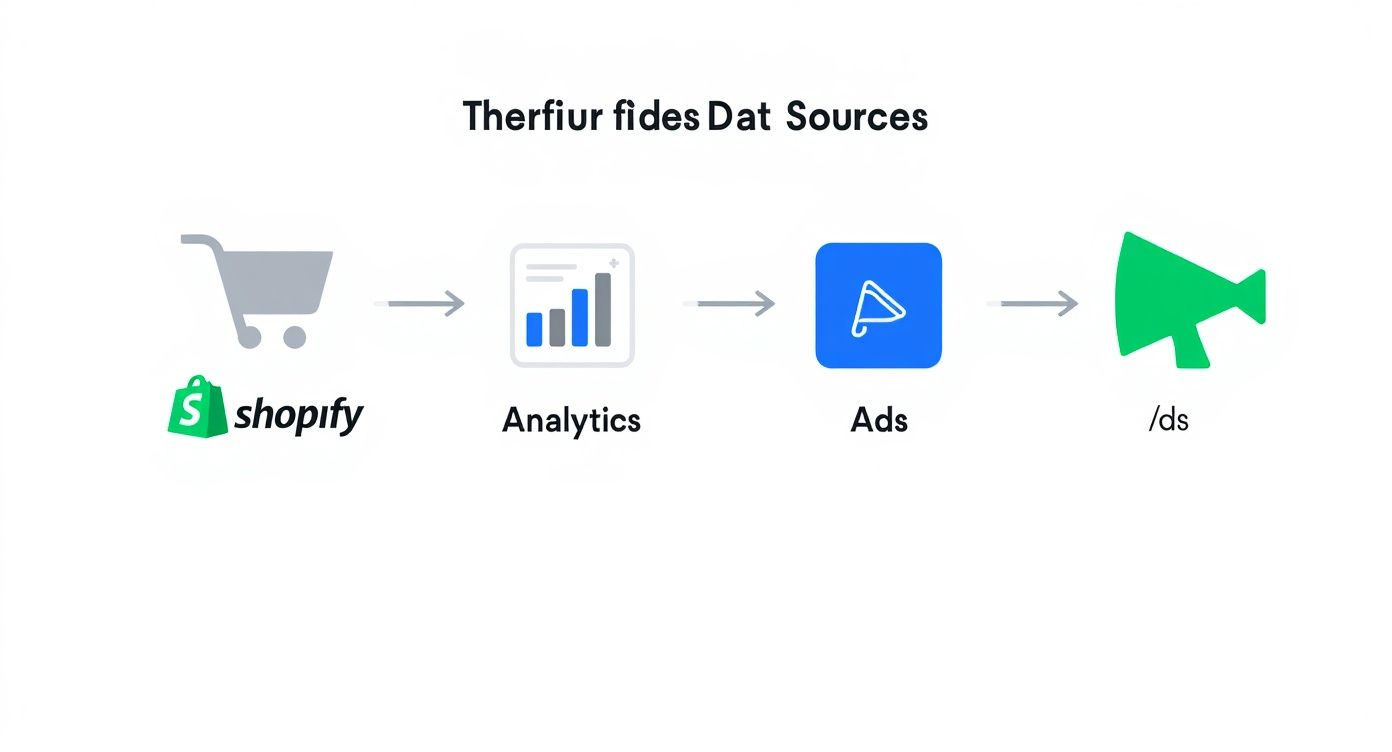
The big takeaway here? A truly accurate CLTV calculation requires pulling data from multiple places—your sales channels, analytics platforms, and ad accounts—to get the full picture of a customer's journey.
To make sense of these options, here's a quick rundown of how they stack up.
CLTV Calculation Methods Compared
| Method | Complexity | Key Benefit | Best For |
|---|---|---|---|
| Historical | Low | Simplicity | Brands new to CLTV looking for a quick baseline. |
| Cohort-Based | Medium | Actionable Insights | Brands wanting to understand acquisition channel quality. |
| Predictive | High | Future-Proofing | Ambitious brands looking to proactively boost retention & ROAS. |
Each method builds on the last, moving from a simple historical view to a powerful, forward-looking strategy.
The Simple Starting Point: Historical CLTV
This is the most straightforward way to get a number on the board. Historical CLTV is a simple, backward-looking calculation that adds up the total profit a customer has already generated.
The formula is pretty basic:
(Average Order Value) x (Purchase Frequency) x (Customer Lifespan)
- Average Order Value (AOV): The typical amount a customer spends in a single transaction.
- Purchase Frequency: How often an average customer buys from you within a specific period (like a year).
- Customer Lifespan: The total time an average customer sticks with your brand.
So, if a customer at your Shopify supplement store spends $75 per order (AOV), buys 4 times a year, and stays loyal for 2 years, your historical CLTV is $600 ($75 x 4 x 2).
Founder-Friendly Tip: This is the perfect entry point. It’s easy to calculate with just your Shopify data. But be warned: its biggest flaw is assuming the future will be a carbon copy of the past, and we all know it rarely is.
A More Nuanced View: Cohort-Based CLTV
This is where things get really interesting—and much more actionable. Instead of lumping all your customers into one big bucket, cohort analysis groups them by when they made their first purchase. Think "January 2024 Cohort" or "Black Friday 2023 Cohort."
By tracking the spending of each cohort over time, you start to see powerful trends emerge. You might find that customers acquired during a summer sale have a 25% higher CLTV than those from your holiday campaigns.
That kind of insight is pure gold. It tells you which acquisition channels and campaigns are delivering your best customers, not just the most customers. This is how you start making smarter decisions on your Meta ad spend. You stop optimizing for a low initial CAC and start optimizing for high long-term value.
The Future-Proof Approach: Predictive CLTV
For any ambitious DTC brand, this is the end game. As the name implies, predictive CLTV uses AI and machine learning models to forecast how much value a customer is likely to generate in the future.
This is a massive leap forward. Predictive models sift through thousands of data points—purchase history, time between orders, product categories, even engagement with your Klaviyo emails—to find the subtle patterns that signal a high-value customer.
This is where the synergy between relationship marketing and CLV really shines. Research is increasingly showing that machine learning vastly improves forecasting over traditional methods. By predicting behavior, you can personalize interactions and build trust, which in turn maximizes customer value. If you're curious, you can find tons of new research about the synergy between relationship marketing and CLV online.
For a Shopify founder, this means you can suddenly:
- Spot VIPs early: Identify customers showing signs of becoming top spenders and roll out the red carpet.
- Stop churn before it starts: See which customers are at risk of leaving and re-engage them with targeted campaigns.
- Set smarter ad budgets: Accurately forecast the future value of new customers to justify higher—but still profitable—CAC targets.
Building these models from scratch is a heavy lift, usually requiring a dedicated data science team. But this is exactly where AI-powered analytics platforms like MetricMosaic come in. They handle all the complexity for you, putting predictive insights right at your fingertips without you ever touching a line of code. It turns a complicated metric into a clear, actionable growth strategy.
Putting Your CLTV Insights into Action
Calculating customer lifetime value is only half the battle. A number sitting in a spreadsheet doesn't do anything for your bottom line. The real magic happens when you start using that insight to make smarter, more profitable decisions across your entire business. This is where AI-driven analytics turn complexity into clear, actionable improvements on your ROAS, CAC, and retention.
This is where we move from theory to action.
Think of your CLTV as a strategic compass. It guides your marketing spend, shapes your customer experience, and ultimately dictates how you invest your resources for sustainable growth. Without it, you're just guessing.
Redefining Your Ad Spend and ROAS Targets
For most DTC brands, the default success metric for ad campaigns is immediate Return on Ad Spend (ROAS). It's simple, sure, but this short-term view can be dangerously misleading. A campaign might have a low day-one ROAS but acquire customers who become incredibly valuable over the next 12 months.
Knowing your CLTV by acquisition channel changes the entire game.
Let's say your Meta ads bring in customers with an average CLTV of $450, while your TikTok ads attract customers with a CLTV of $250. Suddenly, you have a much clearer picture of what you can truly afford to spend to acquire a customer from each channel.
This allows you to set far more intelligent ROAS and Customer Acquisition Cost (CAC) targets. You might be perfectly happy to accept a lower initial ROAS from Meta because you know the long-term payoff is significantly higher. You're no longer chasing cheap clicks; you're investing in high-value relationships.
This isn't just theory; it's a proven growth lever. Market leaders like Amazon and Netflix have built empires by focusing on long-term value. They know that acquiring new customers can cost 5 to 25 times more than retaining existing ones, making CLTV the core of their financial strategy. Check out more on how these market leaders maximize customer value.
Powering Hyper-Personalized Marketing with CLTV Segmentation
Once you have a reliable CLTV number, the next step is to segment your customer base into value tiers. This is where real personalization kicks in, especially inside a tool like Klaviyo.
Instead of blasting your entire list with the same generic offer, you can tailor your communication based on what each customer is actually worth to your business.
Here’s a simple way to think about it:
- VIP High-Value Customers: These are your top-tier buyers. Treat them like gold. Give them early access to new products, exclusive discounts, and personalized notes. The goal is retention and turning them into evangelists for your brand.
- Mid-Tier Customers: This group has serious potential. Nudge them toward higher value with targeted cross-sells, product bundles, and loyalty program incentives. You're trying to increase their purchase frequency and AOV.
- Low-Tier & At-Risk Customers: These customers might have made a single, small purchase. The mission is to re-engage them with compelling offers or educational content that proves your brand's value and secures that crucial second purchase.
This approach turns your marketing from a megaphone into a one-on-one conversation, which dramatically improves engagement and drives repeat purchases.
A Real-World Shopify Scenario
Imagine a Shopify brand selling premium coffee beans. For a long time, they optimized all their ad campaigns for a low cost-per-purchase, focusing only on the first sale's AOV. Their growth was slow and expensive.
After calculating their CLTV, they made a game-changing discovery.
Customers who first bought their "Espresso Starter Kit" had a CLTV 3x higher than customers who just bought a single bag of coffee. The problem? The starter kit had a lower margin and a higher CAC, so they had previously throttled its ad budget.
Armed with this insight, they completely shifted their marketing strategy:
- Increased Ad Spend: They doubled down on campaigns promoting the Espresso Starter Kit, willingly paying a higher CAC because they knew the long-term payoff was massive.
- Personalized Klaviyo Flows: New starter kit buyers were immediately dropped into a unique email flow with brewing tips, exclusive espresso blend offers, and replenishment reminders.
- Refined Retention Efforts: They launched a subscription program specifically for their espresso customers, locking in that high-value relationship for the long haul.
The result? Within six months, they doubled their overall marketing efficiency and saw a 40% increase in their 12-month CLTV. They stopped acquiring cheap customers and started investing in profitable, long-term relationships.
This is the power of operationalizing CLTV—it transforms your data from a historical report into a forward-looking growth strategy. AI-driven platforms like MetricMosaic automate this entire process, surfacing these kinds of high-impact insights without all the manual analysis.
The Future of CLTV Is AI-Powered and Predictive
Let's be honest. Spreadsheets and manual calculations can only get your Shopify brand so far. The backward-looking reports you spend hours building are practically obsolete by the time you finish them.
The future of eCommerce analytics is automated, intelligent, and—most importantly—predictive. And this is where the next wave of tools is completely changing the game for founders who are serious about growth.
You don't have time for a week-long data science project just to understand your customers. You need answers now. AI is driving a massive shift, turning analytics from a reactive chore into a proactive growth engine.

From Manual Reports to Conversational Analytics
Imagine asking your business data complex questions in plain English and getting back instant, accurate answers. That’s the entire idea behind conversational analytics, a trend that's quickly making clunky, old-school dashboards feel ancient.
Instead of wrestling with filters to figure out why your repeat purchase rate dipped last month, you could just ask an AI co-pilot:
"What was our 60-day repeat purchase rate for customers who first bought the 'Espresso Starter Kit' via Meta ads in Q2, and how does that compare to Q1?"
This isn't sci-fi anymore. Platforms like MetricMosaic use this exact technology to let you literally chat with your data. It frees you from the soul-crushing grind of data crunching, letting you follow your curiosity and find insights that would’ve been buried in a spreadsheet. It turns every founder into their own data analyst.
Unlocking Proactive Growth with Predictive Insights
The real magic of AI in eCommerce analytics is its ability to look forward, not just back. Predictive insights use machine learning to scan your historical Shopify and marketing data, spotting patterns that can forecast what customers will do next. This lets you get ahead of the curve instead of constantly reacting to last month's numbers.
Here’s how this actually changes your day-to-day strategy:
- Churn Prediction: AI can flag customers who are showing early warning signs of churning—maybe their purchase frequency has dropped, or they've stopped opening your Klaviyo emails. You can then hit this "at-risk" segment with a specific re-engagement campaign before they're gone for good.
- VIP Identification: The models can also pinpoint new customers who share the behavioral DNA of your best, most loyal VIPs. This is your cue to roll out the red carpet and nurture them into high-value customers from day one.
- Smarter Inventory & Merchandising: By predicting which products are often bought together, you can create way more effective bundles, cross-sells, and personalized recommendations that directly boost your AOV.
For a growing Shopify brand, this is the ultimate competitive advantage. While your competitors are busy figuring out what happened last quarter, you're already acting on what's going to happen next quarter.
This jump from historical reporting to predictive action is what AI-powered analytics is all about. It takes the guesswork out of customer lifetime value and turns it into a living, forward-looking strategy. The goal is no longer just to understand your data; it's to use it to shape your brand's future. That frees you up to focus on what you actually love doing—building amazing products and connecting with your customers.
Your Top CLTV Questions, Answered
Once you get past the formulas and the data wrangling, a handful of practical questions always come up. This is where theory meets reality for busy Shopify founders. Let's get right into the ones I hear most often.
How Often Should I Recalculate CLTV?
For any fast-growing DTC brand, CLTV is definitely not a "set it and forget it" number. Your marketing channels, customer habits, and even your products are always in motion.
I've found that refreshing your CLTV calculations on a quarterly basis is the sweet spot. It’s frequent enough to spot important trends without bogging you down in analysis. Think about it: a big product drop or a major shift in your Meta ad strategy can totally change your customer value, and a quarterly check-in is perfect for catching that.
What’s a Good LTV to CAC Ratio?
This is the big one. Every operator wants to know the magic number. While it’s going to shift based on your industry and margins, a healthy benchmark for a growing Shopify brand is a 3:1 LTV to CAC ratio.
Here’s a quick way to think about it:
- A 1:1 ratio is a red flag. After you pay for the products and keep the lights on, you're actually losing money on every new customer.
- A 3:1 ratio is where you want to be. It signals a strong, profitable business model with enough cash left over to reinvest in real growth.
- A 5:1 ratio or higher might sound great, but it can actually mean you’re leaving money on the table. You could probably be investing more aggressively in marketing to grow faster.
This ratio is one of the truest indicators of your brand's long-term health. It tells the simple story of whether or not you're acquiring customers in a way that can last.
How Can I Actually Improve My CLTV?
Boosting CLTV isn't just about throwing more money at ads. The real wins come from getting more value from the customers you already have. The best strategies are all about improving retention and pushing up that Average Order Value (AOV).
A few tactics that consistently move the needle:
- Launch a Loyalty Program: Give your repeat buyers a reason to come back again and again.
- Implement Smart Cross-Sells: Use post-purchase surveys and past order data to offer up products people will actually find useful.
- Master Your Email & SMS: Dig into your Klaviyo data. Build personalized flows that bring specific customer segments back to buy again.
- Offer Subscriptions: If you sell anything consumable, a subscription model is the single most powerful tool for locking in predictable, long-term revenue.
Can I Calculate CLTV If My Brand Is New?
You can, but you have to be realistic. A brand that’s been around for less than a year just doesn’t have the history to calculate a true, long-term historical CLTV.
For new brands, the best approach is a short-term predictive model. Start by tracking the 60 or 90-day value of your customer cohorts. No, it’s not a full "lifetime" value, but it gives you a critical early read on which channels are delivering higher-quality customers. As more time passes and you collect more data, your CLTV models will get sharper and far more powerful.
Calculating customer lifetime value is the difference between guessing and growing. Stop wrestling with spreadsheets and start making smarter decisions. MetricMosaic connects all your Shopify data to give you a clear, predictive view of your CLTV in real-time, turning your data into your biggest competitive advantage. Start your free trial today.